

Thomax Technology is an Australian warehouse management system provider whose .wms platform is growing in the UK. The system is cloud-based, ISO27001 certified according to Thomax, and built around API-first integration and no-code configuration. For UK businesses comparing WMS options, Thomax sits in an interesting position: technically capable in several areas, but with a small UK reference base and no published pricing. This guide looks at where Thomax performs well, where its limitations show, and which alternatives suit UK 3PLs and mid-market warehouse operations.
What is Thomax .wms and who is it designed for?
Thomax .wms is a cloud-hosted SaaS warehouse management system from Thomax Technology, a logistics software company that is Australian owned and headquartered, with regional businesses in the UK, New Zealand, Canada, Singapore and the USA. The platform is built around API-first connectivity, no-code system configuration and rapid deployment. That positions it for eCommerce, distribution and fulfilment businesses that need to go live quickly without heavy IT involvement.
Core capabilities include multi-warehouse and multi-tenant architecture, automated workflows, guided task management, 100+ dispatch methods, real-time customer tracking and business intelligence data feeds. Named customers include Knobby and Kitchen Warehouse, mostly in Australia. In the UK, the most prominent reference is Miniclipper Logistics, which chose Thomax in March 2025 for a rollout running from 2025 to 2027. By October 2026, four of Miniclipper’s six UK sites were live on the platform.
Even so, Thomax .wms is still a relatively new name in the UK market. Pricing isn’t published. Independent reviews are scarce. And for UK 3PLs that need local support, established billing models and proven multi-client deployments, there are open questions about how well the platform covers UK-specific operational requirements.
Why do warehouses look for a Thomax alternative?
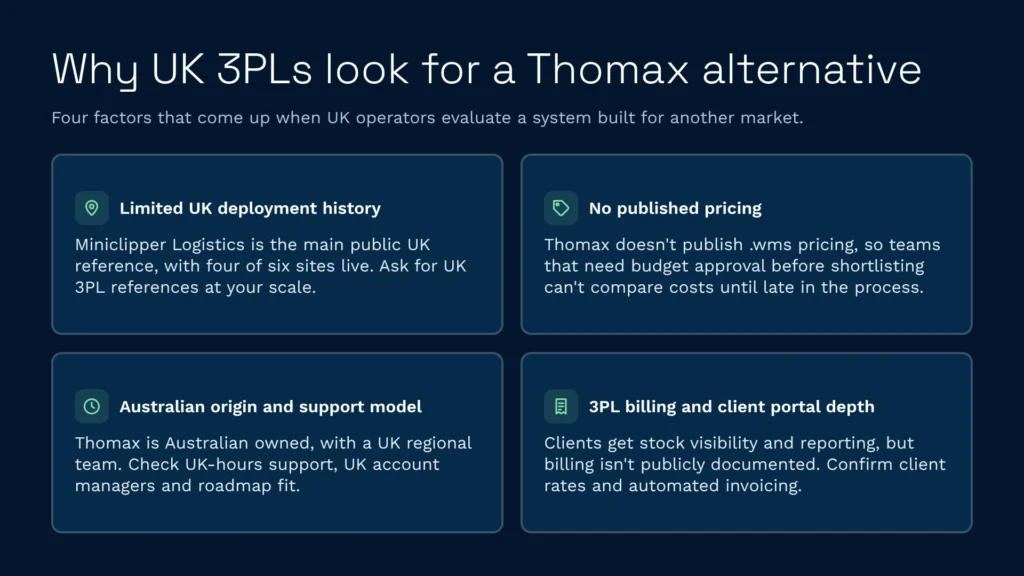
Businesses that consider Thomax .wms and then look elsewhere tend to cite four factors. Each one reflects the gap between a system built in one market and the operators evaluating it in another.
Limited UK deployment history
Miniclipper Logistics is the most prominent publicly referenced UK deployment, and that rollout is still in progress, with two sites left to move over. For UK 3PLs weighing a WMS decision, asking for UK references at comparable scale and complexity is standard due diligence. It’s an area where Thomax currently has limited public evidence to offer.
No published pricing
Thomax doesn’t publish pricing for .wms. For businesses running structured WMS evaluations, particularly those that need budget approval before shortlisting vendors, this creates friction early in the process. Without a published model, you can’t make a direct cost comparison until late in the sales cycle.
Australian origin and support model
Thomax is Australian owned and headquartered. It has a UK regional business and a commercial lead for the UK and Europe, but its development history has been shaped mainly by the Australian market. Operators who need UK-hours support, UK-based account managers and a roadmap shaped by British logistics requirements should check these in detail before committing.
3PL billing and client portal depth
Thomax .wms is strong on API connectivity, carrier integration and multi-warehouse architecture. What’s less clear, based on Thomax’s own product information, is the depth of its 3PL-specific billing. UK 3PLs need configurable rates per client, automated invoices that capture pick fees, storage charges, returns handling and goods-in, plus client-level portals with real-time stock visibility. These aren’t standard across all WMS platforms. Miniclipper has said the system gives its customers stock visibility and self-service reporting, so some client-facing access is there, but Thomax’s public documentation doesn’t detail billing.
What should you look for in a Thomax wms alternative?
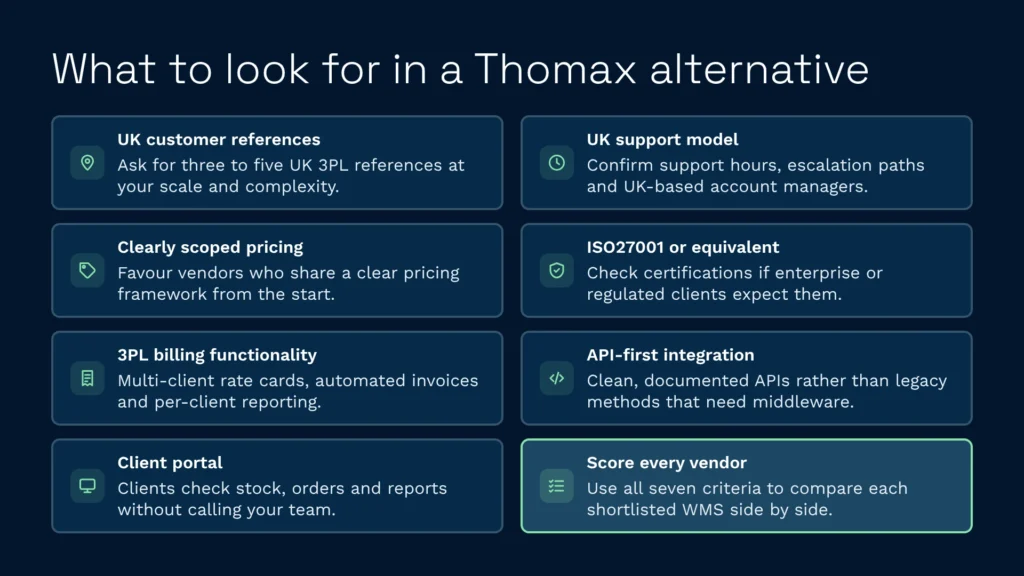
A Thomax alternative should match its technical strengths while closing the UK-specific gaps. Use these criteria to guide your evaluation.
- UK customer references: Ask for three to five UK 3PL references at your operational scale. References from other markets aren’t a substitute for proven UK deployments.
- Published or clearly scoped pricing: Prioritise vendors who share a clear pricing framework early, rather than requiring full sales engagement before any numbers come up.
- 3PL billing functionality: Multi-client rate cards, automated invoice generation and per-client reporting are table stakes for third-party logistics providers, not optional extras.
- Kundportalen: Clients need self-service access to their stock positions, order history and reports, without involving your warehouse team in every query.
- UK support model: Confirm support hours, escalation paths and whether account managers are UK-based. Support run from another time zone may not line up with UK warehouse shift patterns.
- ISO27001 or equivalent: If security certification matters to your clients, particularly for enterprise or regulated-industry work, check that the alternative holds equivalent certifications.
- API-first integration: Thomax’s API-first model is a real strength. Any alternative should have clean, documented APIs rather than legacy integration methods that rely on middleware.
Which Thomax .wms alternatives are worth considering?
The WMS market is growing fast. Grand View Research values the global warehouse management system market at around USD 3.4 billion in 2025 and expects it to reach about USD 16 billion by 2033, a compound annual growth rate of 21.9%. UK operators have strong domestic options to consider.
Clarus WMS
Clarus WMS is a UK-built warehouse management system designed for third-party logistics providers and complex mid-market warehouse operations. Thomax .wms competes on technical breadth and API connectivity. Clarus competes on operational depth for 3PLs: multi-client billing with configurable tariffs, a native customer self-service portal, and tailored views that let each client check their own stock and order progress.
Clarus is based in Manchester and built around how 3PL contracts are actually structured. Tariffs can be set by customer, SKU, project, service bundle or SLA, with flat fees, tiered bands, minimums, surcharges and seasonal rates. It connects through a documented API and ready-made integrationer with platforms including Shopify, Brightpearl och Qargo TMS. For operators moving from Thomax .wms, or evaluating it on a shortlist, Clarus is a direct UK-built comparison.
Mintsoft
Mintsoft is a UK cloud WMS backed by The Access Group, with strong eCommerce and multichannel fulfilment credentials. It publishes its pricing, includes 3PL client billing at per-client rates and has a built-in client portal. It’s a credible option for operations where eCommerce carrier connectivity and order management are the main requirements.
SnapFulfil
SnapFulfil is a cloud WMS from Synergy Logistics, which operates in the UK and North America. It targets 3PL and warehousing operations in the mid-market, with multi-owner functionality, enhanced 3PL billing with tiered rates, and a customer portal that lets each client see its own stock and shipments. It’s more directly comparable to Thomax .wms in terms of operational complexity.
Peoplevox
Peoplevox, now part of Descartes, is built for direct-to-consumer brands and eCommerce retailers. It suits own-account warehouses and single-client fulfilment operations. It’s less suited to complex multi-client 3PL environments with detailed billing requirements.
| Plattform | Origin | 3PL billing | Kundportal | Published pricing |
|---|---|---|---|---|
| Clarus WMS | UK | Yes, configurable tariffs per client | Yes, native | Yes, starting prices |
| Thomax .wms | Australia | Not publicly documented | Customer stock visibility and reporting | Nej |
| Mintsoft | UK | Yes, per-client rates | Ja | Ja |
| SnapFulfil | UK and North America | Ja | Ja | Not confirmed |
| Peoplevox | UK (now part of Descartes) | Not its focus | Not confirmed | Not confirmed |
How does Clarus WMS compare to Thomax .wms for UK 3PLs?
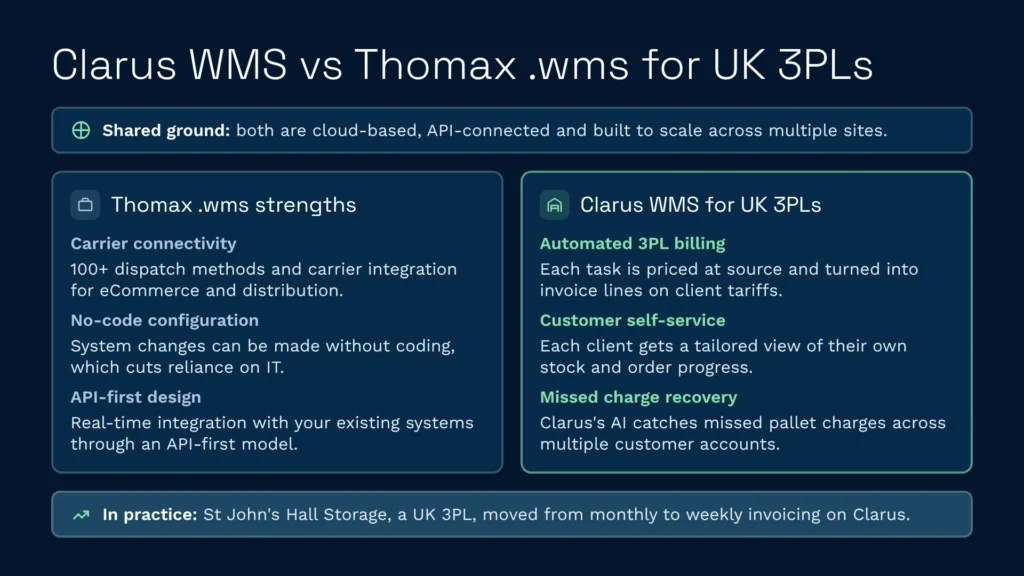
Thomax .wms and Clarus WMS share some architecture: both are cloud-based, API-connected and built to scale across multiple warehouse sites. Where they differ is market focus and operational depth for UK 3PL work.
Thomax .wms brings strong carrier connectivity and a no-code configuration model that cuts reliance on IT for system changes. Those are real operational advantages. But its UK presence is still early, pricing isn’t published, and the depth of its 3PL billing isn’t documented publicly.
Clarus WMS was built in the UK for 3PLs. The billing module records each task at source, prices it automatically and turns it into invoice lines. That covers storage, picks, putaway, kitting, relabelling and returns processing, all against client-specific tariffs. Accrual dashboards show unbilled activity, and any disputed line can be traced back to the event that created it. Clarus’s AI also catches missed pallet charges across multiple customer accounts. Förvaring i St John’s Hall, a UK 3PL, moved from monthly to weekly invoicing on Clarus and no longer spends around four days a month checking invoices.
Den customer self-service portal gives each 3PL client a tailored view of their stock and order progress. They can answer their own availability questions without raising a ticket with your warehouse team.
The UK 3PL market was worth USD 29.10 billion in 2025 and is forecast to reach USD 36.54 billion by 2031, according to Mordor Intelligence. Value-added warehousing and distribution is the fastest-growing service segment, at a 4.79% CAGR. To capture that growth, operators need a WMS that can handle increasingly complex client requirements, backed by proven UK references.
Ready to compare WMS options with a 3PL specialist?
If you’re evaluating Thomax .wms alongside UK-built alternatives, we can give you a direct comparison based on your operation. Clarus WMS is built for 3PLs and complex warehouse operations, around how logistics contracts are actually structured and priced.
Our team can talk through your billing models, client structures and warehouse workflows, and show you how Clarus handles them before you commit. Starting prices are on our prissättningssida, and if you’d like a feel for the system first, you can watch the quick demo.
Kom i kontakt med vårt team att diskutera dina krav.