

Finding the right inventory management tools can make the difference between a thriving warehouse operation and one plagued by stockouts, overstocking, and manual data entry. Whether you’re a 3PL provider managing multiple clients’ stock or a retailer running operations across several locations, the tools you choose directly impact your bottom line.
Inventory management tools help you track stock levels in real time, automate reorder points, manage multiple locations, and integrate with your accounting systems. The best inventory management solution goes beyond basic stock counting. It synchronises data across sales channels, reduces human error, and gives you the visibility you need to make faster decisions.
In this guide, we’ll explore what inventory management tools do, the different types available, and how to choose the right solution for your business. We’ll also look at why many UK 3PLs and retailers are moving towards purpose-built warehouse management systems for greater control and efficiency.
What Are Inventory Management Tools?
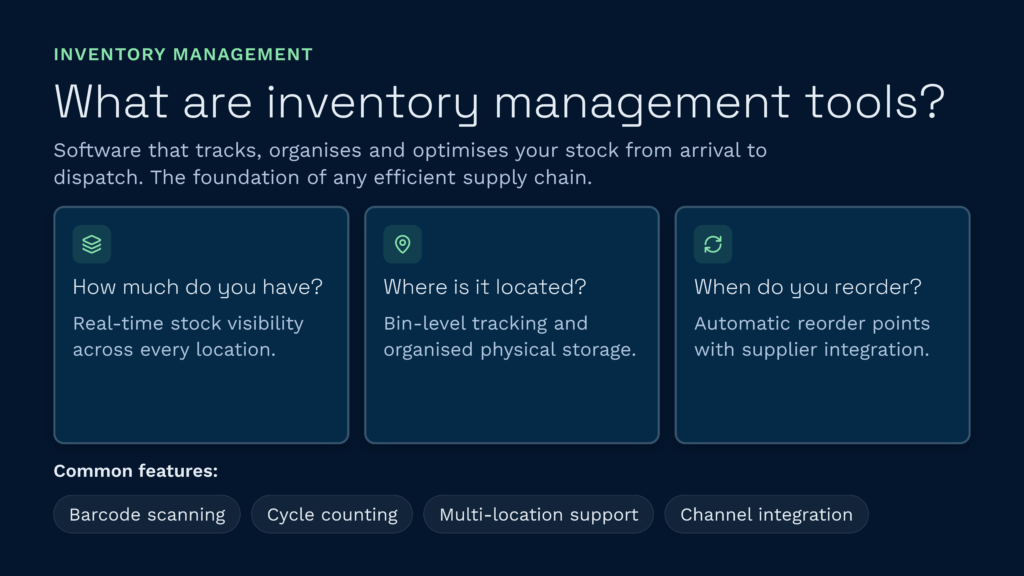
Inventory management tools are software systems designed to track, organise, and optimise your stock from the moment goods arrive at your warehouse until they leave your dock. They sit at the heart of any efficient supply chain, handling everything from barcode scanning and stock counting to demand forecasting and automated reorder points.
At their core, these tools answer three key questions:
- How much stock do you have? Real-time stock level visibility across all locations.
- Where is it located? Bin location tracking and physical storage organisation.
- When do you need to reorder? Automatic reorder points and supplier integration.
Modern inventory management tools often include features like barcode and QR code scanning, cycle counting, multi-location support, channel integration (Amazon, eBay, Shopify), and reporting dashboards. Some advanced platforms offer demand forecasting, supplier management, and enterprise resource planning integration for end-to-end supply chain visibility.
The 4 Types of Inventory Management
Understanding the different types of inventory management approaches helps you choose the right strategy and tools for your business model.
1. Perpetual Inventory System
This system updates your stock levels in real time, every time you receive, move, or ship goods. Most modern digital inventory management solutions use this approach because it provides constant visibility. Your stock counts are always accurate (in theory), and you can spot discrepancies immediately through cycle counting.
Best for: Multi-channel retailers, 3PLs, and businesses where accuracy and speed are critical.
2. Periodic Inventory System
With periodic inventory, you count physical stock at set intervals (usually monthly or quarterly) and reconcile against your records. This approach requires less technology and is cheaper to operate but leaves you blind to stock movements between counts.
Best for: Small retailers with limited SKU counts and predictable demand.
3. Just-in-Time (JIT) Inventory
JIT minimises stock levels by ordering goods only as you need them. This reduces holding costs and warehouse space but requires reliable suppliers and accurate demand forecasting. It’s popular in manufacturing and high-volume retail but risky if supply chains are disrupted.
Best for: High-volume operations with predictable demand and dependable suppliers.
4. Two-Bin System
A simple manual method where two bins hold the same item. When the first bin empties, you use the second and automatically reorder. It’s low-tech but effective for small operations with consistent usage patterns and high-demand items.
Best for: Small businesses with simple inventory needs and strong supplier relationships.
Most UK businesses now blend these approaches. Retailers use perpetual systems for fast-moving goods and periodic counts for slow-moving SKUs. A purpose-built inventory management solution lets you mix strategies across different product categories.
What Tools Are Used in Inventory Management?
Modern inventory management solutions combine hardware, software, and integration capabilities. Here’s what you’ll typically find in a comprehensive toolkit:
Barcode and RFID Technology
Barcode scanners and handheld devices let warehouse staff record stock movements instantly. RFID tags provide even faster identification without line-of-sight requirements, though they cost more. Both eliminate manual data entry and reduce picking errors.
Stock Management Apps
Mobile apps let your team access inventory data on the warehouse floor in real time. A good stock management app displays bin locations, shows available stock before picking, alerts staff to low levels, and captures receipts on mobile devices. It transforms paper-based processes into instant digital records.
Integration with Point of Sale (POS) Systems
Your inventory tool must sync with your sales channels. Whether customers buy from your physical shop, website, or marketplace, stock levels update automatically across all channels. This prevents overselling and keeps your data clean.
Reporting and Analytics
Dashboards showing stock turnover, slow movers, stockout risks, and inventory value help you make data-driven decisions. Advanced reports reveal seasonal trends, supplier performance, and storage cost allocation by product.
Enterprise Resource Planning Integration
Connecting inventory management tools to your accounting software (QuickBooks, Xero, Sage) creates a seamless data flow. Purchase orders automatically update inventory, sales automatically update financial records, and stock valuation methods like average cost accounting happen in real time.
For 3PLs managing multiple clients’ stock, this integration is critical because you need to track costs and profitability by client account.
Multi-Channel Inventory Management and Stock Rotation
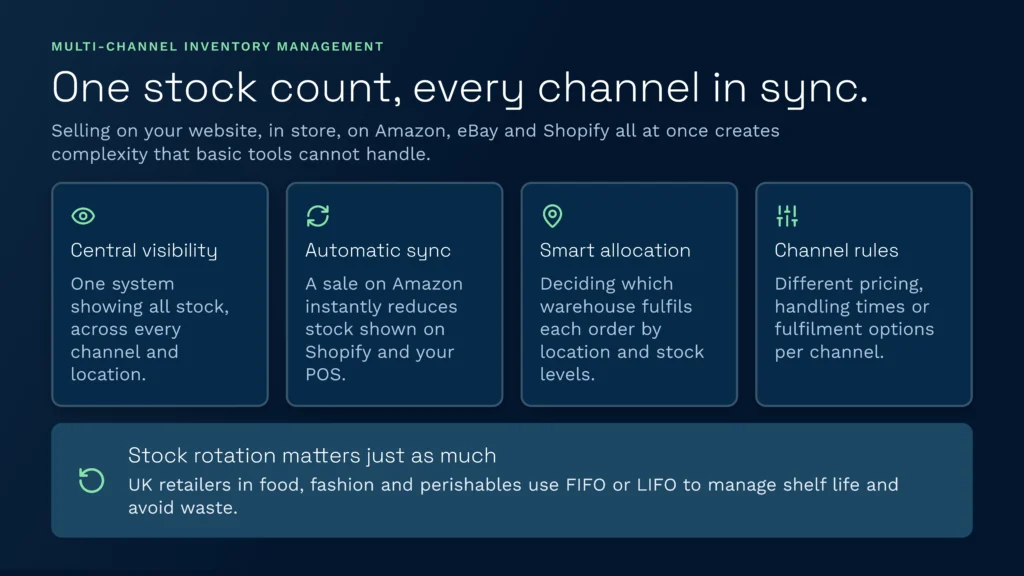
Running an inventory management operation across multiple sales channels introduces complexity that basic tools struggle to handle. You need your stock levels in sync whether customers buy through your website, physical storefront, Amazon, eBay, or Shopify.
Multi-channel inventory management means:
- Central visibility: One system showing all stock across all channels and locations.
- Automatic synchronisation: A sale on Amazon automatically reduces stock shown on Shopify and your POS system.
- Intelligent allocation: Deciding which warehouse fulfils which order based on location and stock availability.
- Channel-specific rules: Setting different pricing, handling times, or fulfilment options per channel.
Equally important is stock rotation. Many UK retailers, particularly in food, fashion, and perishables, follow FIFO (First In, First Out) or LIFO (Last In, First Out) principles to manage shelf life and avoid waste. Learn more about implementing effective stock rotation practices and how to choose the best warehouse management system for your operation.
Inventory management tools with strong stock rotation features use bin location data and expiry date tracking to guide pickers towards the oldest stock first, protecting margins and meeting customer expectations for freshness.
The 80/20 Rule in Inventory Management
The Pareto principle, or 80/20 rule, states that roughly 80% of your revenue typically comes from 20% of your products. In inventory management, this insight is transformative because it changes how you prioritise your resources and effort.
Most inventory management tools classify stock using ABC analysis:
- A-items (top 20%): Your highest-value products. These need careful control, frequent cycle counts, and premium bin locations. Any error here directly impacts profit.
- B-items (middle 30%): Medium-value products. Standard inventory procedures apply.
- C-items (bottom 50%): Low-value, often slow-moving SKUs. You can use simpler counting methods and less premium space.
Applying the 80/20 principle means investing your best tools, staff, and warehouse space in A-items. Use automated systems to manage B and C items efficiently without tying up expensive resources.
Many 3PLs use this to improve profitability. By concentrating warehouse management system benefits on high-value client accounts and streamlining standard operations for others, they can offer competitive pricing without sacrificing accuracy on what matters most.
Choosing the Right Inventory Management Solution
Not all inventory management solutions work for every business. Your choice depends on your complexity, scale, and growth plans. Here’s what to evaluate:
Scalability
Can the system grow with you? A solution perfect for 50 SKUs may crumble under 5,000. Look for platforms that handle multi-location operations, support hundreds of users, and can manage millions of transactions without slowdown.
Integration Capabilities
Does it connect to your accounting software, ecommerce platforms, and shipping tools? Integration gaps mean manual data re-entry, which kills efficiency and introduces errors. Check compatibility with your current tech stack.
Mobile and Warehouse Functionality
Can your team use it on the warehouse floor? A stock management app that works offline, syncs when connected, and displays key information instantly will drive adoption and reduce errors. Compare this carefully between options.
Cost Model
Some platforms charge per user, others per transaction or SKU count. For growing businesses, understand whether costs scale linearly or offer volume discounts. Hidden costs for support, training, or advanced features often surprise buyers later.
Implementation and Support
How long does setup take? Will the vendor help with data migration, staff training, and go-live support? A poorly executed implementation can cost months of lost efficiency and frustrated staff.
For 3PLs managing multiple clients, look specifically for solutions designed for multi-tenancy and billing automation. Many standard retail inventory management tools struggle with the complexity of 3PL operations, which is why many leading 3PLs now choose purpose-built 3PL management systems over generic solutions.
Top Inventory Management Solutions for UK Businesses
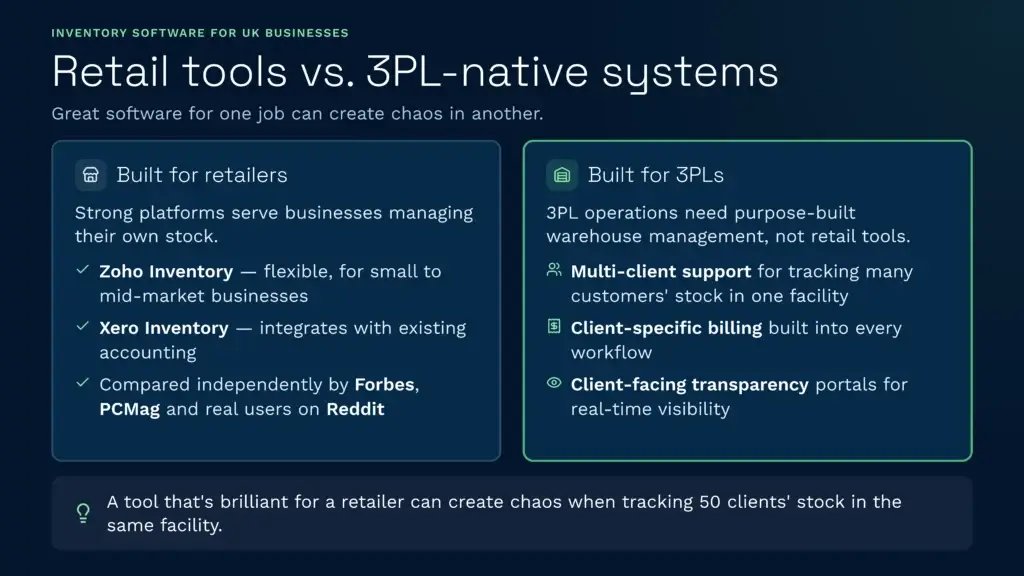
Several strong inventory management platforms serve the UK market, each with different strengths. According to recent reviews, options like Zoho Inventory Management Software offer flexible features for small to mid-market businesses. Xero Inventory Management integrates well with existing accounting workflows for users already on that platform.
For comprehensive independent reviews, Forbes Best Inventory Management Software compares solutions across multiple dimensions, and PCMag Best Inventory Management Software provides technical evaluation. For peer recommendations, Reddit Inventory Management Recommendations offers real user experiences.
However, if you’re a 3PL provider, these solutions often don’t fit because they’re built for retailers managing their own stock. True 3PL operations need multi-client support, client-specific billing, and client-facing transparency portals. This is where 3PL management systems and purpose-built warehouse management systems excel.
Understanding the difference between retail inventory management tools and 3PL-native solutions is crucial. A solution that works brilliantly for an e-commerce retailer may create chaos when you’re tracking 50 different clients’ stock in the same facility.
Retail Stock Management Software and Growing Your Operation
Retail stock management software has evolved significantly. Modern retail stock management software includes real-time stock visibility, automatic reorder triggers, and omnichannel integration. But the complexity doesn’t stop there.
As you grow from a single location to multiple stores, a basic retail stock management tool can become a bottleneck. You’ll need:
- Multi-location inventory tracking and transfer management.
- Central purchasing with automatic allocation across locations.
- Store-level reporting and performance analytics.
- Warehouse management system benefits for physical operations.
- Advanced costing methods like average cost accounting for accurate profitability tracking.
Many growing UK retailers find that what served them at 3 stores no longer works at 10, and they need to move to a more sophisticated platform or risk losing visibility and control.
Ready to Transform Your Warehouse Operations?
Navigating the complexities of multi-channel syncing, strict stock rotation, and 3PL multi-tenancy doesn’t have to be a solo mission. As your operation scales, relying on generic retail software, outdated periodic counts, or manual spreadsheets will inevitably hold your business back. To truly optimise your supply chain, you need a purpose-built solution designed to handle the fast-paced realities of modern fulfilment.
At Clarus, we deeply understand the unique challenges facing growing UK retailers and ambitious 3PL providers. Our comprehensive warehouse management systems are engineered specifically to provide the real-time visibility, seamless integrations, and absolute accuracy required to protect your margins and scale without friction.
Whether you are struggling to manage complex multi-client billing, looking to upgrade from basic stock apps, or simply need expert guidance on applying the 80/20 rule to your specific facility, our team is ready to help. Get in touch with us at Clarus today to discuss your operational challenges, request a tailored demonstration, and discover how we can help you turn your inventory management into your biggest competitive advantage.