

Manhattan Associates is a true tier-1 enterprise warehouse management system and an 18-time Gartner Magic Quadrant leader. But it’s built for very large distribution centres running 50,000+ orders daily with in-house IT teams and budgets measured in millions. If your 3PL or wholesale operation needs to be live in months rather than years, needs automated 3PL billing built in, and doesn’t have an enterprise IT department on staff, Manhattan’s enterprise complexity becomes a liability rather than a strength. This guide compares Manhattan to the alternatives that actually fit mid-sized and growing warehouses.
Quick Comparison: Manhattan vs Alternatives at a Glance
| WMS | Best For | 3PL Multi-Client | Billing Automation | Time to Live | Pricing Model |
|---|---|---|---|---|---|
| Clarus | UK 3PLs, wholesalers, rapid deployment | Purpose-built, fully isolated per client | Yes, captures all billable events | Around 12 weeks | From £1,000/month, monthly rolling |
| Manhattan Associates | Large multi-site DCs, 50,000+ daily orders | Supported via complex configuration | Generic, requires custom setup | Vendor quoted, a multi-month implementation programme | Custom quote, annual licence plus implementation, no public price list |
| Mintsoft | Growing 3PLs, omnichannel order management | Yes, designed for multi-client | Yes, per-client pricing rules | Vendor quoted, ask for a written go-live date | Custom quote plus usage fees |
| Snapfulfil | E-commerce fulfilment, high-volume picking | Limited, single-client optimised | Limited billing automation | Vendor quoted, ask for a written go-live date | Custom quote, module-based, varies by configuration |
| Körber Warehouse Management | Large distributors, complex automation | Yes, but enterprise-scale configuration | Generic, requires integration | Vendor quoted, a multi-month implementation programme | Custom quote, enterprise pricing |
| Extensiv 3PL Warehouse Manager | Mid-sized 3PLs, USA-focused market | Yes, dedicated 3PL platform | Yes, activity-based billing | Vendor quoted, ask for a written go-live date | Custom quote, per-warehouse subscription model |
Why alternatives to Manhattan make sense for most UK operations
Manhattan is positioned as the gold standard for enterprise warehouse management, and for the right use case, it delivers real value. However, Manhattan’s architecture and feature depth come with costs that make it impractical for many organisations.
What is Manhattan WMS?
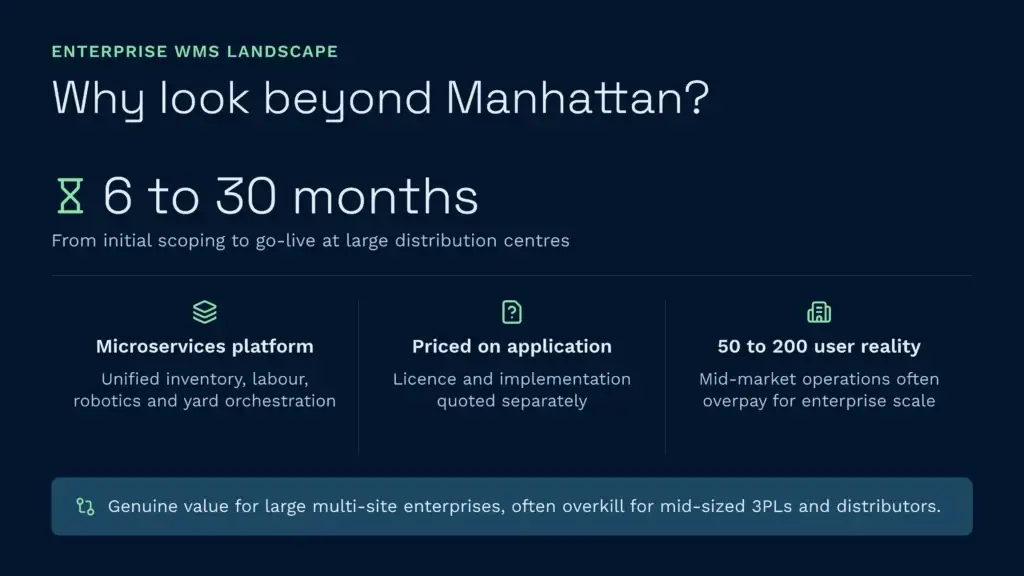
Manhattan Active Warehouse Management is a cloud-native, microservices-based WMS from Manhattan Associates that provides unified inventory, labour, automation, and yard orchestration. It integrates a native Warehouse Execution System (WES) for robotics orchestration and includes embedded AI agents for labour optimisation and wave coordination.
The Manhattan implementation reality
Manhattan’s documentation advises implementations typically take six to nine months to prepare for go-live, though timelines commonly stretch to 18 to 30 months at large distribution centres. The organisation must complete detailed process design, engineered standards development, and automation interface scoping. Implementation is quoted per programme rather than published, and what you pay depends on complexity, number of sites, integration scope, and customisation.
Annual subscription pricing is available on application only, and is set by transaction volumes, user counts, and module selection. Additional costs for change management, training, and operational transition support stack on top.
Is Manhattan WMS worth it for a mid-sized warehouse?
Not typically. Manhattan’s enterprise scope, long implementation timeline, and high licence costs assume a large multi-site operation with dedicated IT resources and a multi-year budget. A mid-sized 3PL or wholesale distributor with 50 to 200 users, operating from one or two locations, will overpay for features it doesn’t need and endure implementation timelines that delay operational benefit.
The alternative: purpose-built WMS for 3PLs
The gap Manhattan leaves is precisely where purpose-built 3PL systems thrive. Clarus WMS, for example, is cloud-native like Manhattan but designed from the ground up for multi-client stock segregation, automated billing based on actual warehouse activity, and rapid deployment. A UK 3PL with Clarus goes live in around 12 weeks for a standard implementation, on monthly rolling contracts starting at £1,000 per month, with multi-client billing automation running from day one.
Clarus already operates with companies like JODA Freight, which brought stock accuracy from the low 90s to 99.8% after switching from legacy systems. St John’s Hall Storage cut invoicing time from four hours a day to twenty minutes. Neither of these outcomes required enterprise-scale implementation or IT resources beyond a warehouse operations team that knows their own process.
The billing automation advantage is the sharpest differentiator. A purpose-built 3PL WMS like Clarus captures every billable event in real time: receiving, storage, picking, packing, despatch, returns, value-added services like kitting or relabelling. Generic platforms like Manhattan or Körber require custom integration and manual configuration per client, a cost and ongoing maintenance burden that purpose-built systems eliminate.
Comparing the realistic alternatives to Manhattan
Mintsoft: UK-built multi-client WMS
Mintsoft is a cloud-based order management and warehouse management platform with particular strength in omnichannel order coordination. It combines order management, warehouse operations, and shipping in one interface, and is especially strong for growing direct-to-consumer brands and 3PLs managing orders across Shopify, Amazon, and wholesale channels simultaneously.
Strengths: UK company with strong omnichannel positioning, flexible pricing (quoted per operation, plus usage fees), faster implementation than Manhattan although you should ask for a written go-live date, and solid multi-client support for 3PLs.
Limitations: smaller feature set compared to Manhattan around advanced robotics orchestration and AI labour optimisation. Best suited for omnichannel and DTC rather than traditional wholesale or bulk distribution.
Best for: growing 3PLs managing omnichannel orders, DTC brands with multiple sales channels.
Snapfulfil: ecommerce fulfilment specialist
Snapfulfil is a specialist fulfilment WMS built around high-volume parcel picking and ecommerce operations. It excels in single-site, single-client scenarios where picking speed and accuracy are paramount.
Strengths: excellent wave picking optimisation, strong parcel and carton picking performance, rapid deployment although the timeline is vendor quoted, module-based pricing flexibility.
Limitations: limited 3PL multi-client functionality, not designed for activity-based billing across clients, and not optimised for wholesale or traditional distribution. Retrofitting multi-client scenarios adds complexity without native support.
Best for: single-site, single-client ecommerce fulfilment operations, high-volume parcel picking.
Körber warehouse management: enterprise scale
Körber is a direct competitor to Manhattan in the enterprise space: a comprehensive WMS platform with sophisticated robotics orchestration, advanced labour analytics, and deep customisation capabilities. It’s a legitimate Gartner contender and serves large complex distributors and manufacturers worldwide.
Strengths: comparable to Manhattan on advanced automation features, strong integration capabilities, and sophisticated reporting for large operations. Proven track record in complex multi-site environments.
Limitations: similar multi-month implementation timelines, enterprise-scale pricing quoted per operation with no public price list, requires dedicated IT resources. Like Manhattan, not specifically designed for 3PL multi-client billing simplicity.
Best for: large distributors with complex automation requirements, multi-site operations with IT resources to match.
Extensiv 3PL Warehouse Manager: 3PL-first design
Extensiv (formerly part of the 3PL Central family) is purpose-built for third-party logistics with dedicated multi-client stock segregation, activity-based billing, and a strong focus on the 3PL operational workflow. It’s particularly strong in North America and growing in Europe.
Strengths: dedicated 3PL billing automation, per-client reporting and visibility, client portal functionality, faster implementation than Manhattan, though you should ask the vendor for a written go-live date.
Limitations: less established in the UK market compared to Snapfulfil or Mintsoft, pricing model can be high for smaller 3PLs, and feature depth around robotics orchestration trails Manhattan and Körber.
Best for: mid-sized 3PLs prioritising dedicated multi-client billing and rapid deployment.
What are the alternatives to Manhattan Associates WMS?
The realistic alternative categories are:
- Purpose-built 3PL systems: Clarus, Mintsoft, Extensiv. These prioritise multi-client billing automation and rapid deployment, trading some advanced robotics features for operational simplicity and faster time to value.
- Ecommerce specialists: Snapfulfil, Helm WMS. These excel in high-volume picking and parcel operations but offer limited 3PL multi-client support.
- ERP-integrated systems: Delta WMS, Sage 200 integrated modules. These are lean and fast for single-company operations tightly coupled to ERP systems like Sage.
- Enterprise alternatives: Körber, Infor WMS, Oracle WMS. These compete with Manhattan on scale and complexity but come with similar implementation timelines and IT resource demands.
For a UK-based 3PL or wholesale operation, the best alternatives typically sit in the first category: purpose-built 3PL systems that prioritise the specific pain of multi-client billing and rapid deployment over the broad feature depth of enterprise platforms.
How to choose: Manhattan vs purpose-built alternatives
Ask yourself these questions.
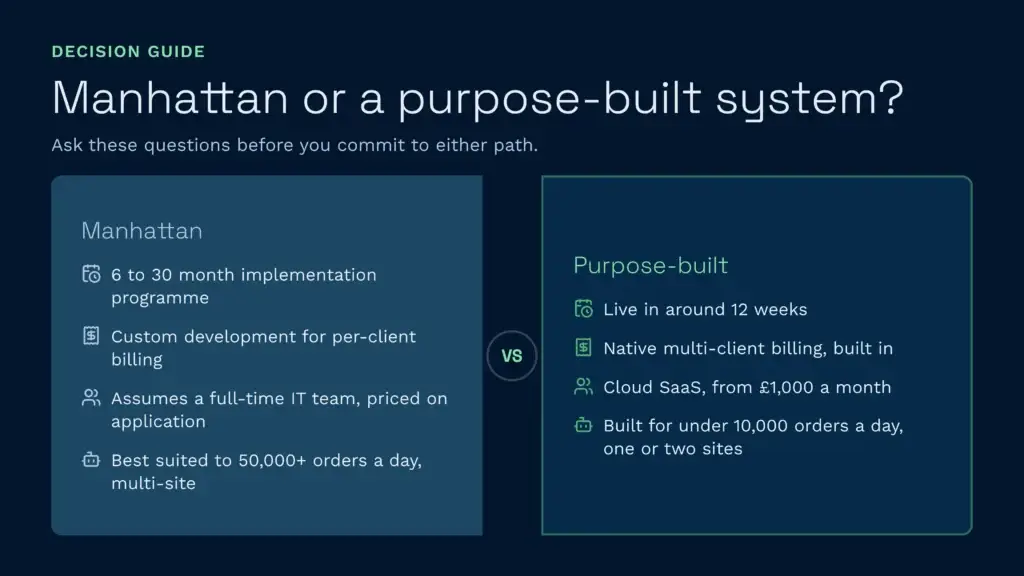
- When do you need to be live? Manhattan quotes a multi-month implementation programme. A standard Clarus implementation runs to around 12 weeks, with the time going on data, configuration and training. Ask both for a dated plan with milestones, not just a headline figure.
- How complex is your client billing? If each client has unique pricing rules, activity-based charges, and tiered fees, a purpose-built 3PL system like Clarus automates this natively. Manhattan or Körber require custom development.
- Do you have dedicated IT resources? Manhattan and Körber assume you have a full-time IT team for configuration, integration, and ongoing support. If not, a cloud-native SaaS model like Clarus removes that burden entirely.
- What’s your annual volume? Manhattan assumes 50,000+ orders daily across multiple sites. If you’re below 10,000 orders daily in one or two locations, you’re paying for unused scale.
- Do you need bespoke robotics integration? Manhattan and Körber have native WES (Warehouse Execution System) orchestration for complex automation. If your operation is manual or uses standard conveyors and pick-to-light systems, purpose-built platforms often integrate the same tools with faster deployment.
- What’s your budget timeline? Manhattan is priced on application, with a separate implementation quote on top of the annual licence, so get both in writing. Purpose-built 3PL: from £1,000 per month rolling contract, no long-term lock-in.
For most UK 3PLs and mid-sized distributors, the honest answer is that Manhattan’s enterprise breadth is overkill. The best alternatives deliver most of the functionality in a fraction of the implementation time, and for a fraction of the cost. The right system is the one that fits your actual operational scale, not your aspirational maximum scale.
Speak to a warehouse expert
If you’re evaluating your options and want to see how a purpose-built WMS works in practice, Clarus is worth a conversation. We work with 3PLs and distributors across the UK to implement warehouse management software that fits the way you operate, not the other way around. Unlike enterprise platforms built for the top 5% of operations, Clarus is designed for the businesses that actually power UK logistics and fulfilment today.
Get in touch with our team to talk through your requirements.