

If you’re running a warehouse, 3PL operation, or multi-channel distribution business, you’ve likely considered Cin7 as an inventory management solution. Cin7 Core and Cin7 Omni handle multi-channel order management and basic inventory control, but they’re not built from the ground up for the operational reality of third-party logistics, complex multi-client billing, or fast-moving stock rotation. Many businesses outgrow Cin7 because of pricing complexity, limited 3PL-specific features, or support responsiveness. This guide explores the best Cin7 alternatives for 2026 and helps you evaluate the right fit for your operation.
Quick comparison of top Cin7 alternatives
| Platform | Best for | Multi-client / 3PL | Billing automation | Deployment |
|---|---|---|---|---|
| Clarus WMS | 3PLs, food & beverage, multi-client operations | Purpose-built multi-client isolation | Real-time event-based billing engine | Cloud-native, around 12 weeks |
| Mintsoft | Growing 3PLs, omnichannel brands | Configurable multi-client workflows | Manual + some automation | Cloud SaaS, 6–8 weeks |
| Snapfulfil | High-volume picking optimisation | Limited, retrofit approach | Limited, event logs only | Cloud, 45 days |
| Deposco | Inventory forecasting, demand planning | Multi-tenant architecture | Basic activity tracking | Cloud, 6–8 weeks |
| Körber | Enterprise logistics, automation-ready | Modular, complex setup | Module-based, requires integration | On-premise or cloud, 6+ months |
| Helm WMS (formerly Despatch Cloud) | UK 3PLs, rapid deployment | Multi-location support | Event-based logging | Cloud, 4–6 weeks |
Clarus WMS: purpose-built for 3PL and multi-client operations
Clarus is a cloud-native WMS designed from the ground up for 3PL, wholesale distribution, and food & beverage operations. Unlike Cin7, which treats inventory as a single bucket that can be segmented by tags or filters, Clarus segregates each client’s stock, reporting, and billing in isolated views within a single warehouse system.
Key features
- Automated 3PL billing engine: every billable event, receiving, storage, pick, pack, despatch, returns, value-added services, is captured in real time without manual counting. St John’s Hall Storage, a 3PL, cut invoicing from four hours to twenty minutes using Clarus’s billing automation.
- Multi-client stock segregation: each client sees their own inventory, their own reports, their own portal. No cross-contamination, no billing disputes caused by shared data.
- Client self-service portal: clients view real-time stock levels, shipment tracking, billing summaries, and order status without emailing you. White-labelable with your branding.
- Smart wave picking: orders batch automatically and picking routes optimise walking paths, claimed to reduce travel time by up to 50%.
- Real-time scan verification: 99.9% pick accuracy through barcode verification at the point of contact.
- FEFO/FIFO/LIFO control: rotation logic, expiry date management, and batch/lot tracking for full recall readiness.
- 70+ carrier integrations: DHL, UPS, FedEx, Royal Mail, DPD, Evri, with full API access for custom workflows.
- Accounting integrations: Sage 200, Xero, QuickBooks, Dynamics, your billing data syncs automatically.
Clarus vs Cin7: where Clarus wins
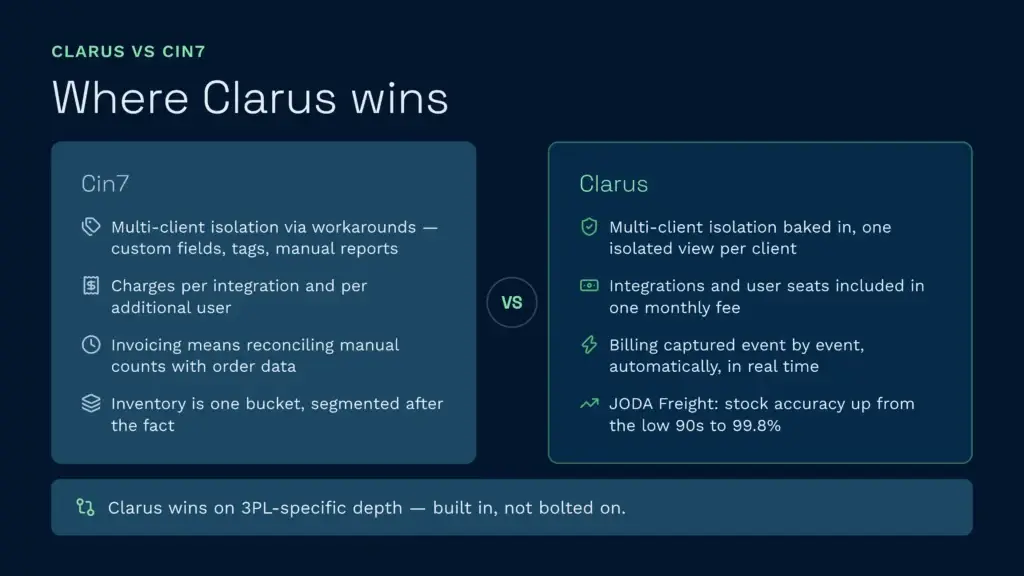
Clarus wins decisively on 3PL-specific depth. Cin7 requires you to build multi-client isolation using workarounds (custom fields, tags, manual reports). Clarus has it baked in. Where Cin7 charges per integration and per additional user, Clarus includes integrations and user seats in one monthly fee. Invoicing that takes hours in Cin7 (reconciling manual counts with order data) happens in real time in Clarus, event by event, automatically. JODA Freight brought stock accuracy from the low 90s to 99.8% after switching.
Where Clarus is not a fit
Clarus is built for 10+ warehouse users and businesses with multi-client complexity or 3PL operations. If you’re a tiny single-client webshop shipping from one corner, Cin7 may still be more economical. Clarus also doesn’t include point-of-sale or retail operations management; Cin7 does.
Pricing
From £1,000 per month on a monthly rolling contract. No lock-in, no per-user overage charges, no hidden integration fees. What you see is what you pay. Sub-2-minute support response time included.
Customer proof point
St John’s Hall Storage reduced invoicing time from four hours to twenty minutes and eliminated manual reconciliation entirely. See more Clarus customer stories.
Mintsoft: flexible omnichannel platform for growing 3PLs
Mintsoft is a cloud-based WMS and order management platform popular with mid-market 3PLs and omnichannel brands. It’s been operating for over a decade with a strong UK following, particularly in fashion, furniture, and fast-moving consumer goods.
Key strengths
- Flexible workflow builder: you can tailor processes to match how your operation actually works.
- Extensive integrations: a better range than Cin7 for less common marketplaces and logistics platforms.
- Real-time inventory visibility across multiple warehouse locations.
- Barcode scanning and RFID support.
- Advanced reporting engine: custom reports for clients and management.
Limitations vs Clarus
- Multi-client billing is a manual or semi-automated process, you’ll still spend time reconciling client-specific charges.
- Implementation is quoted in weeks rather than committed in writing, so ask for the figure in your contract. For reference, a standard Clarus implementation runs to around 12 weeks.
- Pricing is custom-quoted and typically positioned above budget options for small-to-medium operations.
- Support is email-based; response times are longer than Clarus’s sub-2-minute SLA.
Who Mintsoft is best for
Growing 3PLs with established operational processes who want flexibility to tailor workflows, and omnichannel brands managing their own warehouse alongside external fulfilment.
Pricing
Custom-quoted, depending on volume and features, with long-term contracts common.
Snapfulfil: specialist in high-volume picking optimisation
Snapfulfil is a cloud-native warehouse execution system (WES) designed to optimise the picking process for maximum throughput. It’s popular with large distributors and high-volume ecommerce fulfilment centres.
Key strengths
- Picking path optimisation: algorithms reduce travel time and increase picks per hour, critical for volume operations.
- Robotics integration: works with automated systems (AMRs, sortation, etc.).
- Wave and batch management: a highly configurable rules engine.
- Cloud-native architecture, positioned for a fast go-live, though ask for the exact figure in writing before you sign.
Limitations
- WES only: it’s focused on warehouse execution, not multi-client billing or client portals. You’ll need a separate order management and billing system.
- 3PL support is limited; it treats all clients the same, which doesn’t work if you need per-client SLAs or charge-back models.
- Limited accounting integrations compared to Clarus or Mintsoft.
- Custom-quoted pricing, positioned toward the higher end for high-volume, automation-ready deployments, and longer setup for non-standard configurations.
Who Snapfulfil is best for
High-volume distribution centres and parcel fulfilment operations where picking optimisation is the critical bottleneck, and where clients don’t need their own portal or detailed activity-based billing.
Pricing
Custom-quoted, and generally among the pricier options here once volume and integration complexity are factored in.
Deposco: inventory forecasting and demand planning at scale
Deposco is a cloud-native 3PL platform that combines warehouse management, inventory forecasting, and distributed order management in one multi-tenant system.
Key strengths
- Integrated demand forecasting: machine learning predicts demand patterns and reduces out-of-stock rates (Deposco claims a 30% reduction).
- Multi-tenant architecture: built for 3PLs from day one.
- Real-time labour allocation: AI-driven task assignment to optimise utilisation.
- Integrated with distributed order management (DOM) for multi-location routing.
- API-first, modern tech stack.
Limitations
- Billing automation is basic: event logs exist but require custom integration to turn into client invoices.
- Smaller user base than Mintsoft or Clarus; fewer public reviews and case studies.
- Implementation is quoted in weeks; ask for the figure in writing before you sign.
- Support responsiveness not clearly communicated.
Who Deposco is best for
3PLs and distributors with complex demand planning requirements where forecasting accuracy and inventory optimisation are competitive differentiators, and where you have the technical depth to integrate billing systems.
Pricing
Custom quote. No public pricing; typically enterprise-level discussions.
Körber: enterprise-class logistics suite, with automation integration
Körber (formerly known as Körber Supply Chain) is a global logistics software company offering modular warehouse management, transport management, and supply chain planning solutions used by large distributors and 3PLs.
Key strengths
- Modular architecture: you pick the modules you need (WM, TM, planning, etc.) and integrate them.
- Automation-ready: designed to work with AMRs, automated sortation, and robotics.
- Enterprise-scale support: dedicated implementation teams and SLAs.
- Global compliance and multi-currency support.
Limitations
- On-premise or complex cloud deployment, not simple SaaS. Infrastructure costs and version management are your responsibility.
- Implementation timelines: six to 12-plus months for complex configurations.
- Licensing model is expensive and tied to throughput or seats; total cost of ownership is substantial.
- Overkill for small-to-medium operations; the complexity and cost aren’t justified unless you’re processing millions of orders annually.
- Support is based on contracted SLA tiers; response times aren’t guaranteed.
Who Körber is best for
Large multinational 3PLs and distributors with complex automation requirements, existing on-premise infrastructure, and budgets to match enterprise deployment costs.
Pricing
Custom enterprise pricing, with no transparent public price list. Expect a significant total cost of ownership for mid-sized deployments.
Helm WMS: UK-focused rapid deployment for 3PLs
Helm WMS, formerly Despatch Cloud, is a UK-based cloud WMS popular with smaller-to-mid-market 3PLs. It was purpose-built for rapid deployment and multi-location support.
Key strengths
- UK-based support, no time zone delays.
- Rapid deployment relative to enterprise platforms.
- Multi-location support and client portals.
- Event-based logging for billing audit trails.
- Integration with common UK carriers and accounting platforms.
Limitations
- Automated billing is limited compared to Clarus, you’ll still need to process event logs into invoices manually or with basic rules.
- Smaller ecosystem than Mintsoft or Clarus; fewer integration partners and fewer case studies in newer verticals.
- Customisation is possible but can add to implementation time.
Who Helm WMS is best for
UK-based 3PLs and distributors seeking rapid cloud deployment with UK support, where you have basic-to-intermediate billing requirements and want to avoid long implementation cycles.
Pricing
Custom-quoted, generally positioned as a more affordable option than the larger enterprise platforms in this list.
How to choose the best Cin7 alternative
How many clients do you manage?
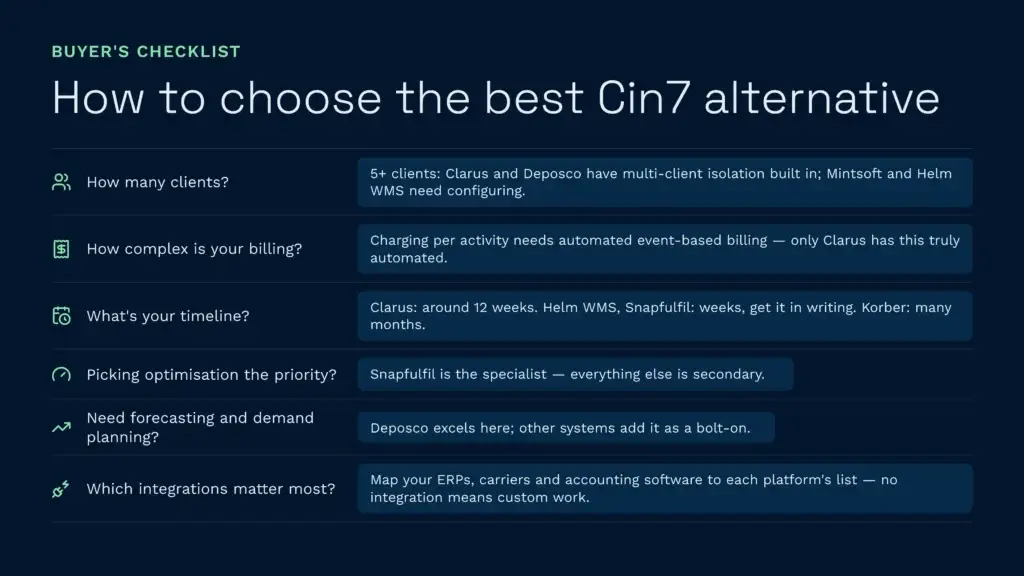
If you’re a 3PL with 5+ clients, multi-client isolation is non-negotiable. Clarus and Deposco have it built in; Mintsoft and Helm WMS require configuration.
How complex is your billing?
If you charge per activity (receives, picks, storage days), you need automated event-based billing. Only Clarus has this truly automated.
What’s your implementation timeline?
A standard Clarus implementation takes around 12 weeks, which leaves time to train people properly. Mid-market cloud platforms like Helm WMS and Snapfulfil quote in weeks, so ask for the figure in writing. Enterprise systems like Körber commonly run for many months.
What’s your budget?
From a published £1,000-a-month starting rate (Clarus) up to significant enterprise-level annual contracts (Körber). Work out your ceiling and work backwards from there.
Do you need picking opti misation above all else?
Snapfulfil is your specialist. Everything else is a secondary concern.
Do you need forecasting and demand planning?
Deposco excels here; other systems add it as a bolt-on.
What integrations matter most?
Map your current tech stack (ERPs, carriers, accounting software) to the platform’s integration list. No integration means custom work, which means cost and time.
Migration from Cin7 to another system: what to expect
Migrating from Cin7 is generally straightforward because Cin7 data is well-structured (inventory, orders, and products are all in clean tables). Here’s what to plan for.
Data export
Cin7 allows CSV export of inventory, orders, customers, and products. Most alternative systems accept CSV bulk import or have API ingestion tools. Expect one to two weeks for data cleansing and validation.
Integration mapping
You’ll likely keep some of your Cin7 integrations (e.g. Shopify, Xero) and connect them to the new system instead. Each platform has a different integration architecture. Plan two to four weeks to remap and test.
Testing and cutover
Run both systems in parallel for one to two weeks to validate that data flows correctly. Then pick a cutover date (typically a quiet period) and switch over. Plan for one to two days of operational disruption.
Support and training
Most platforms provide implementation support; Clarus includes a sub-2-minute response SLA. Budget two to four weeks for training your team on new workflows.
Total migration timeline: around 12 weeks for a standard project, longer for a complex multi-location setup.
Cin7 Core vs Cin7 Omni: should you upgrade first?
Before you switch platforms, understand what you’d get by upgrading within Cin7.
Cin7 Core is designed for smaller ecommerce and made-to-order businesses. It has basic inventory control, a limited integration library, and no advanced warehouse management. Cin7 Omni is aimed at larger enterprises, adding a much broader integration library, advanced warehouse management, multichannel selling, B2B portals, EDI, and production planning.
If you’re running a 3PL or multi-client operation, neither Cin7 Core nor Omni were designed for you. Both treat inventory as a single bucket. Upgrading from Core to Omni gives you more integrations and features, but not the multi-client separation or billing automation you actually need. That’s where purpose-built 3PL systems like Clarus come in.
Why businesses search for a Cin7 alternative
Cost and pricing complexity
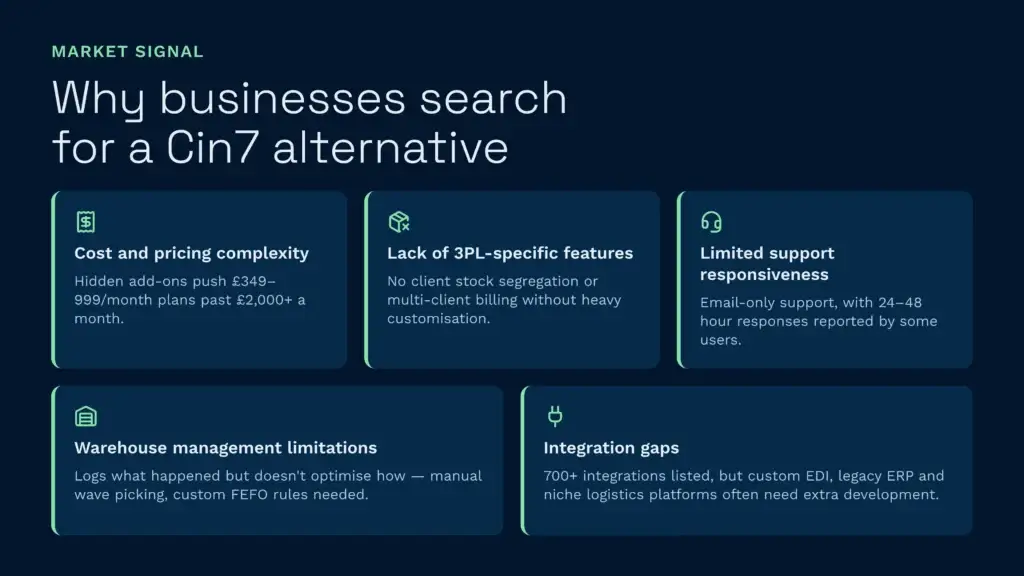
Cin7’s advertised pricing looks straightforward, but independent buyer comparisons frequently note hidden costs from integration add-ons, additional users beyond plan limits, automations, and custom development work. A flat-rate alternative like Clarus, at £1,000 a month for unlimited users and integrations, removes that unpredictability.
Lack of 3PL-specific features
Cin7 is built for brands managing their own inventory. It doesn’t segregate client stock, automate multi-client billing, or provide per-client portals without heavy customisation. 3PLs quickly hit the limits of what’s possible within Cin7’s architecture.
Limited customer support responsiveness
Cin7’s support is email-based, and some reviewers report slow turnaround on tickets. For warehouse operations where issues cost money by the hour, that lag matters. Clarus and Helm WMS offer faster support SLAs.
Warehouse management limitations
Cin7’s WMS features are basic: it logs what happened but doesn’t optimise how it happens. Picking routes aren’t optimised, wave picking is manual, and FEFO rotation requires custom rules. Snapfulfil and Clarus offer more sophisticated execution logic.
Integration gaps
While Cin7 lists a large number of integrations, integration quality varies. Custom EDI, legacy ERP connectors, and niche logistics platforms often require additional development work. Alternatives like Mintsoft and Clarus have deeper integrations with UK logistics providers and accounting software.
Cin7 limitations that alternatives solve
Multi-client complexity
Cin7’s problem: you manage client A, B, and C in the same warehouse. All their inventory sits in one system. Cin7 uses “customer codes” or “warehouse locations” to separate them, but it’s a workaround, not a native feature. Reports are messy; billing is error-prone.
Clarus’s solution: each client’s stock, reporting, and billing is isolated at the database level. No cross-contamination. Invoicing is automatic.
Billing automation
Cin7’s problem: you charge per receive, per pick, per storage day. At month-end, you manually count events from logs and reconcile against invoices. A 3PL with 10 clients can spend four to eight hours a month on this.
Clarus’s solution: every event (receive, pick, pack, despatch, storage, return) is captured in real time and tallied automatically. St John’s Hall Storage went from four hours to twenty minutes.
Picking inefficiency
Cin7’s problem: pickers get printed lists or scan items in the order they appear. There’s no route optimisation; travel time is wasted.
Clarus’s solution: smart wave picking batches orders and optimises walking paths, with a 50% travel time reduction claimed.
Client visibility
Cin7’s problem: clients email asking “how much stock do I have?” You log in, find their code, run a report, email back. All day, every day.
Clarus’s solution: the client portal shows real-time stock, orders, shipments, and billing. White-labelable. Clients serve themselves.
Accuracy and recalls
Cin7’s problem: a product recall comes in. You search manually through orders and stock, hoping you catch everything. Takes hours.
Clarus’s solution: a full audit trail by batch and lot number means recalls are completed in minutes. Campeys of Selby, a food distributor, achieved sub-5-minute recall tests and BRC Double-A accreditation after switching to Clarus.
Speak to a warehouse expert
If you’re evaluating your options and want to see how a purpose-built WMS works in practice, Clarus is worth a conversation. We work with 3PLs and distributors across the UK to implement warehouse management software that fits the way you operate, not the other way around.
Get in touch with our team to talk through your requirements.