

Haulage software is the transport management system (TMS) that plans loads, schedules drivers and vehicles, and records each delivery. If your haulage business also runs a warehouse, you need a second system alongside it: a warehouse management system (WMS) to control stock, picking and despatch inside the building. The two only work well together when the data passing between them is clean and agreed on both sides.
What haulage software does
Haulage software runs the transport side of the business. Most packages cover some or all of these jobs:
- Load planning: grouping orders into trips and sequencing the drops.
- Vehicle and driver allocation: matching trailers and drivers to each job.
- Delivery records: recording when and where a load was delivered, and sending updates to customers.
- Job costing: working out what each trip cost to run and what to charge for it.
Driver hours and tachograph data are a separate compliance area. Some hauliers keep them inside the transport system, others use dedicated tools. Either way the rules are set by government. The Driver and Vehicle Standards Agency (DVSA) enforces them, and you can read the basics in the guidance on drivers’ hours and the tachograph guidance. Trade bodies such as the Road Haulage Association and Logistics UK also represent hauliers on these issues.
Haulage software manages the fleet. On its own, it does not know what is on a pallet in your warehouse, where that pallet sits on the rack, or whether it is ready to load.
Why a haulier with a warehouse needs a WMS as well
A transport system knows that a trailer is due at 4pm. It rarely knows which pallets are on it, whether they have arrived yet, which batch should go first, or which bay a picker should walk to. A WMS fills that gap. It records what comes in, where each pallet is stored, how stock is picked, and what leaves on each despatch. Pallets can carry a standard identifier, such as the SSCC pallet number defined by GS1 UK, so the receiving site can identify a pallet with one scan.
The gap causes real problems on the warehouse floor. Mat Buttar, Head of Solutions at Clarus, uses a simple example. Without priority information, a warehouse picks 100 orders in whatever order they come up. The first 20 picked may be the last 20 that need to leave, so they end up in the bays nearest the dock while the orders due out first are still on the racks. Mat describes the fix this way: the transport system sends back load references and priority numbers, and the warehouse releases orders so the first 20 to leave are the first 20 picked.
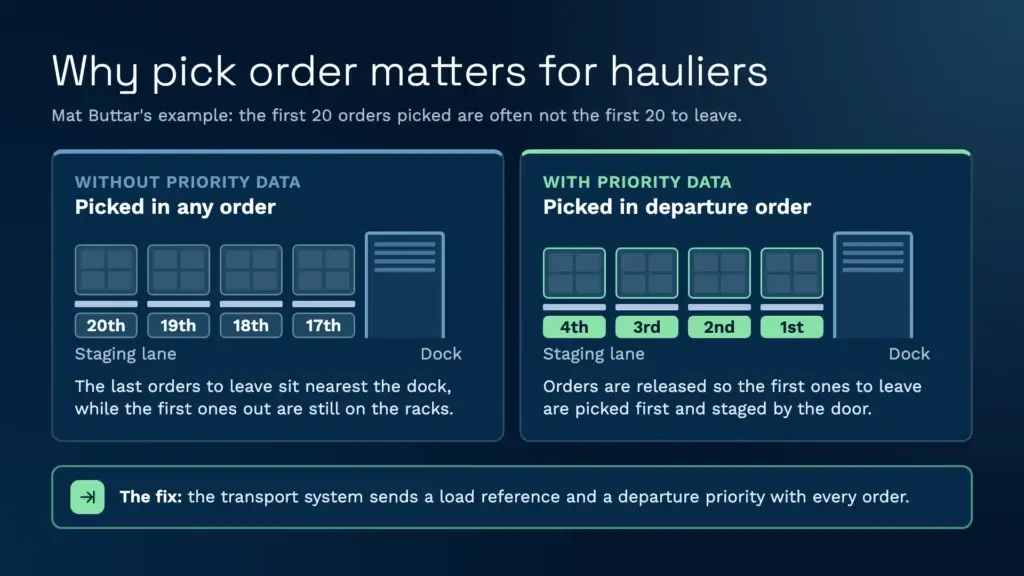
That is the point where the two systems have to talk. The transport system decides what should leave and when. The WMS decides how the work gets done inside the building.
TMS vs WMS: who does what
A TMS manages the journey and the vehicle. A WMS manages the stock and the work inside the warehouse. A haulier with warehouses needs both, and the table below shows where the line usually falls.
| Job | Usually handled by | Why it matters for a haulier with a warehouse |
|---|---|---|
| Vehicle, driver and load planning | Transport management system | Decides which trailer leaves, when, and with what capacity. |
| Drivers’ hours and tachograph records | Transport system or a dedicated compliance tool | Governed by DVSA rules, and separate from warehouse stock. |
| Goods in, put away and stock location | Warehouse management system | Shows what is in the building and exactly where it sits. |
| Pick order and despatch sequence | WMS, using priority data from the TMS | Gets the orders that leave first picked and staged first. |
| Pallet and case labelling | WMS, to GS1 standards | Gives each pallet an identifier the receiving site can scan. |
| Client billing for warehouse activity | WMS billing | Captures handling and storage events so they can be invoiced. |
Clarus is a WMS. It does not plan routes, schedule drivers or keep tachograph records, and it does not replace your transport system. It sits alongside one. Clarus has integrations with Qargo TMS and Maxoptra, so load and order information can pass between the two systems.
How the two systems connect
Most integrations follow the same pattern. The transport system creates the load and sends the orders to the warehouse. The WMS allocates stock, picks and despatches, then sends confirmation back so the transport system knows what has left. Clarus is built API first, so the link can be shaped around whatever your transport software offers.
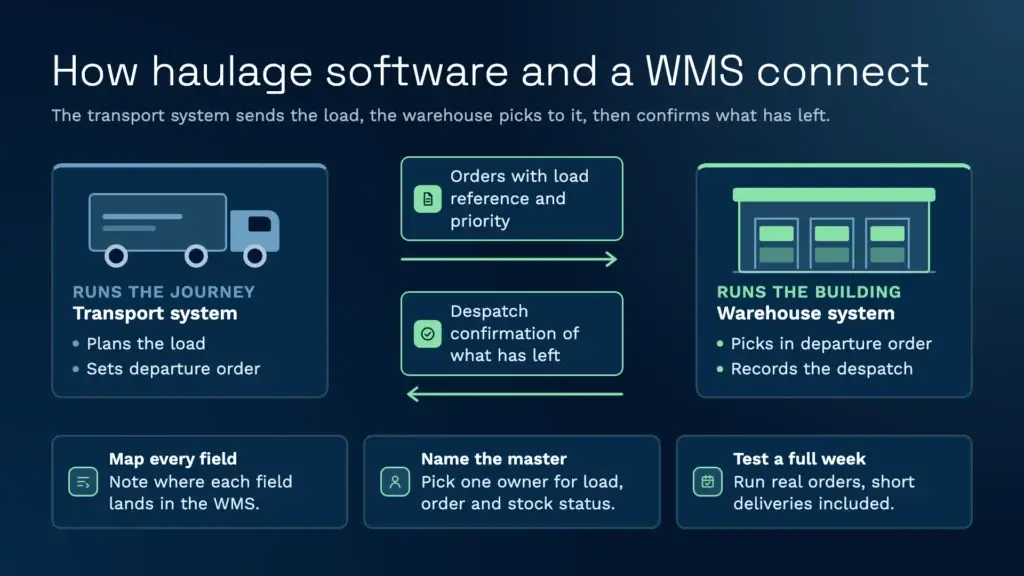
Before you connect them, agree which system owns each piece of information. Load status is usually the transport system’s job. Stock location and pick status belong to the WMS. Trouble starts when both systems try to own the same field.
Where the transport system offers an API, data moves almost as it happens. Where it only produces files, the warehouse maps those files into its own format and sends a confirmation file back. That mapping is where most of the effort goes, so budget time for it rather than assuming it is a quick feed.
- Map every field. List each field the transport system sends and note where it lands in the warehouse system.
- Name the master. Decide which system is the source of truth for load status, order status and stock.
- Ask for priority data. Check whether the transport system can send a load reference and a departure priority for each order.
- Agree the timing. Confirm whether the link runs in real time over an API or as a scheduled file.
- Test a full week. Run real orders through before go-live, including short deliveries and damaged pallets.
If you also send parcels, Clarus’s carrier integrations connect it to the parcel carriers you already use. The shipping management software page covers that side of the job in more detail.
Where the dock becomes the pinch point
The loading dock is where the transport plan and the warehouse plan collide. Mat has seen the same pattern across many sites: stock arrives that nobody planned for, because a customer who hears “yes, we’ll store it” may send whatever they like, whenever they like. Yesterday’s goods are still in the receiving bay while today’s trucks wait outside, so the pickers who should be clearing orders are unloading instead.
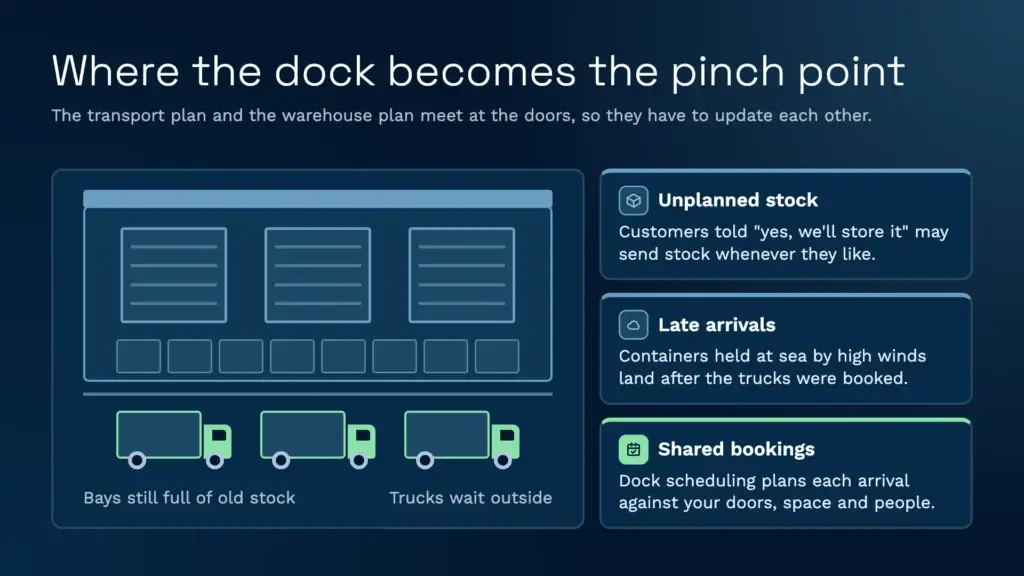
Weather makes it worse. Mat’s own examples include containers held at sea by high winds, which arrive a day late, after the haulier has already booked the trucks to collect them. Plans on both sides have to update each other, or the warehouse receives freight it has no space or people for.
Dock scheduling helps. The Clarus dock scheduling feature gives everyone the same view of bay bookings, so arrivals can be planned against the doors, space and people you actually have. Pair it with a confirmed departure list from the transport system, so the dock plan reflects what is really due.
What a haulier should look for in a WMS
If you are choosing warehouse software to sit beside your transport system, test it on the jobs that matter at the dock. Take this short list into every demo:
- GS1 barcodes as standard. Clarus reads GS1 barcodes by default. GS1 application identifiers let one scan fill in the product, batch, date and quantity, instead of someone typing each field by hand.
- A reference on every pallet. Each pallet in the building needs its own identifier. Mat recommends an 18-digit reference in line with GS1, so a pallet can be found, moved and loaded with one scan.
- Data sent ahead of delivery. When a supplier sends pallet data before the truck arrives, receiving becomes a quick check rather than a data entry job. Mat’s example is a truck of 26 pallets booked in with 26 single scans.
- Stock kept apart by customer. If you store goods for several customers, each customer’s stock, rules and charges should stay separate inside one warehouse.
- Pick order that follows the load. Ask the supplier to show orders released in departure order, using the load reference and priority your transport system sends.
- A realistic go-live plan. A standard Clarus implementation goes live in around 12 weeks when both sides give the project the right support. Complex projects with many integrations take longer.
Run each check with your own data: a real supplier label, a real load and a real customer. That shows you how the system copes with your work, not just a tidy demo.
Is there a best transport management software in the UK?
No single transport management software is the best choice for every UK haulier, and any ranking that claims otherwise deserves a close look. The right system depends on fleet size, how much work you subcontract, how many depots you run, and which systems the software must connect to.
A practical approach is to shortlist three or four options, run each one against a month of your real job sheets, and check how it connects to your warehouse software. Ask each supplier for the integration method and the data it sends in both directions, not just a list of features.
Common mistakes when buying haulage software for a combined business
- Buying a transport system to fix a warehouse problem. Planning tools cannot show you which bay a pallet is in, and a WMS cannot plan a route.
- Expecting software to fix poor data. A WMS amplifies the process you already run. If labels are inconsistent or stock records are wrong today, the system will show those faults faster, not remove them.
- Leaving the integration until the end. Mapping fields and agreeing ownership is usually the slowest part of the project, so start it early.
- Assuming one product covers everything. Driver compliance records and warehouse stock have different owners, and they need different tools.
Clarus is not the right fit if you only need transport planning and have no warehouse operation. It is built for 3PL and warehouse operations, and it earns its place where stock, picking and despatch need the same care as the trucks.
Haulage businesses using Clarus
Clarus has haulage customers as well as 3PLs. Matthews Haulage and Sovereign Transport both have customer stories on our site. Welch Group, a transport and 3PL business, runs Clarus alongside Qargo TMS. Its case study records 100% admin time saved by removing duplicate data entry between the two systems. Edge Transport, a food and 3PL business, reached over 99% stock accuracy.
Speak to a warehouse expert
If you’re evaluating your options and want to see how a purpose-built WMS works alongside your transport system, Clarus is worth a conversation. We work with 3PLs and distributors across the UK to implement warehouse management software that fits the way you operate, not the other way around.
Get in touch with our team to talk through your requirements.