

If you’re evaluating Brightpearl, you’re probably facing one of its core limitations: it’s a retail operating system built around order and inventory management, not warehouse operations. That works for ecommerce-first teams with small fulfilment operations, but for 3PLs, wholesalers, and distributors who manage multiple clients, complex billing, and high-volume picking, Brightpearl creates more problems than it solves. This guide compares the best alternatives to Brightpearl in 2026: cloud-based platforms that deliver built-in warehouse functionality, faster implementation, and better control over your operations.
Kurzer Vergleich von Brightpearl-Alternativen
| Lösung | Am besten für | Unterstützung mehrerer Mandanten | Integriertes WMS | Automatisierte Rechnungsstellung | Bereitstellung |
|---|---|---|---|---|---|
| Clarus WMS | 3PL-Anbieter, Distributoren, Multichannel-Fulfillment | Ja – getrennte Verwahrung von Wertpapieren für mehrere Kunden | Ja – speziell dafür entwickelt | Ja – Erfassung von Ereignissen in Echtzeit | Cloud, around 12 weeks typical |
| NetSuite | Großunternehmen, komplexe Betriebsabläufe | Ja (mit Konfiguration) | Nein (Zusatzlizenzen) | Ja | Cloud, 3–6 Monate |
| Cin7 | Kleine und mittlere Einzelhändler, Multichannel-Händler | Begrenzt | Basic (Cin7 Omni) | Grundlegend | Cloud, Wochen |
| Odoo ERP | Kostenbewusste Unternehmen, die auf Open Source setzen | Ja (mit Modulen) | Grundmodul für die Lagerverwaltung verfügbar | Ja | Cloud oder selbst gehostet, Wochen bis Monate |
| Fischglas | Fertigung, komplexe Lagerhaltung | Nein | Ja – starker Fokus auf die Fertigung | Begrenzt | Cloud oder vor Ort, 2–4 Monate |
| Zoho Inventory | Start-ups, kostenbewusste kleine und mittlere Unternehmen | Begrenzt (1 Lager pro Konto) | Grundlegend | Begrenzt | Cloud, sofort |
Warum Unternehmen nach einer Alternative zu Brightpearl suchen
Brightpearl’s core strength, unifying order, inventory, and accounting, becomes a weakness when your operation grows beyond a single warehouse or when you operate a 3PL model. Here’s why businesses move on.
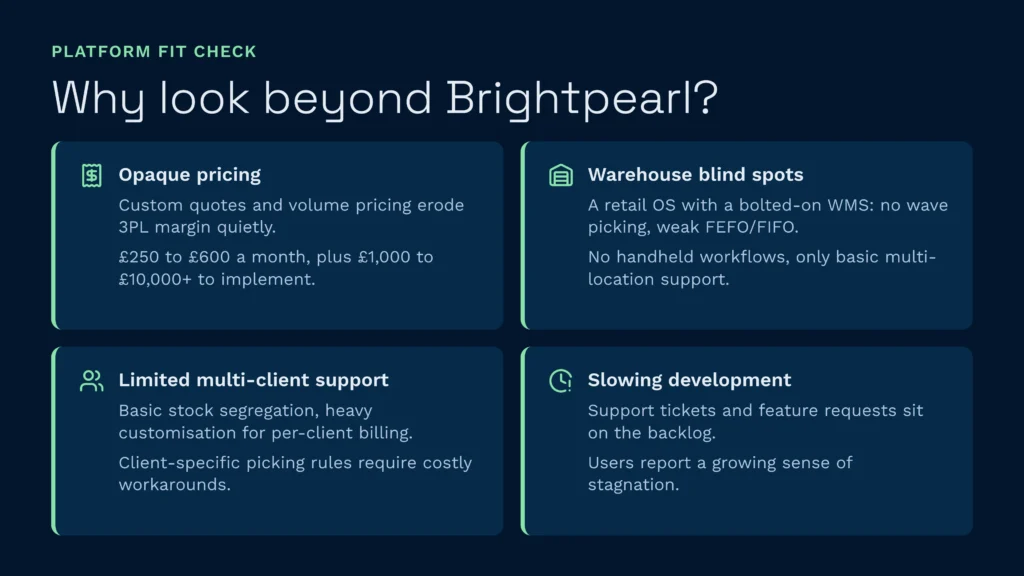
Der Fokus auf Retail-OS führt zu blinden Flecken im Lager
Brightpearl is a retail operating system, not a warehouse management system. Its WMS module, powered by Warewolf, carries significant gaps: no wave picking, limited FEFO/FIFO rotation, no handheld device workflows, and basic multi-location support. If your core business is moving goods through a warehouse accurately and fast, you’re fighting the platform, not working with it.
Eingeschränkte Multi-Client-Funktionen
Für 3PL-Anbieter und Distributoren, die mehrere Kunden mit unterschiedlichen Preis-, Berichts- und Abrechnungsregeln verwalten, behandelt Brightpearl alle Kunden gleich. Die Bestandstrennung ist sehr einfach gehalten, und die Erstellung kundenspezifischer Kommissionierregeln oder Abrechnungslogik erfordert umfangreiche Anpassungen. Kunden weisen darauf hin, dass die Ersteinrichtung und die Einarbeitungszeit einen erheblichen Zeitaufwand erfordern, und laufende Anpassungen sind kostspielig.
Fehlende aktive Weiterentwicklung
Einige Nutzer berichten, dass es in den letzten Jahren bei Brightpearl selbst nur minimale Weiterentwicklungen gegeben habe, even though support tickets are generally answered quickly. The frustration is more that feature requests raised through support often sit on the backlog rather than shipping. For a platform managing your core operations, that lack of product momentum is a risk.
Aufschlüsselung nach Anbietern: Die besten Brightpearl-Alternativen
Clarus WMS: best for 3PLs and multichannel distributors
Clarus ist ein cloud-natives WMS, das von Grund auf für 3PL-Anbieter, Großhändler und Distributoren entwickelt wurde.. Unlike Brightpearl, it doesn’t try to do everything: it focuses on what warehouse operations need, multi-client stock segregation, fast picking, inventory accuracy, and real-time billing.
Warum Sie sich für Clarus entscheiden sollten:
- Multi-client out of the box: each client’s inventory, picking rules, and billing are isolated within a single warehouse. No retrofitting required.
- Automated 3PL billing engine: captures every billable event in real time, receiving, storage, picking, packing, despatch, returns, without manual counting. St John’s Hall Storage reduziert die Rechnungsstellung von vier Stunden auf zwanzig Minuten.
- Purpose-built WMS: smart wave picking optimises walking paths (50% travel time reduction claimed), real-time scan verification targets 99.9% accuracy, and FIFO/LIFO/FEFO logic is configurable per client or product.
- Kundenportal: white-labelable self-service portal. Your clients see real-time stock, order status, and billing summaries without pestering you.
- No infrastructure to build: cloud-native architecture means no server setup. A standard implementation goes live in around 12 weeks; warehouse management systems built for your specific operational model scale faster.
- Monthly rolling contracts: no long-term lock-in. From £1,000/month; see Preise für Clarus WMS für Ihren konkreten Anwendungsfall.
- Strong integrations: 200+ out-of-the-box connections including Shopify, Amazon, WooCommerce, 70+ shipping carriers, and accounting software like Sage 200 and QuickBooks.
Where Clarus isn’t the fit: if your business is pure accounting and order management with minimal warehousing, Brightpearl’s integrated approach may still work. Clarus is a warehouse specialist, not an ERP.
Kundenbewertung: JODA Freight steigerte die Bestandsgenauigkeit von knapp über 90 % auf 99,81 TP3T und verkürzte die Dauer der Inventuren von Wochen auf Tage.. MSD / Mitchell Storage & Distribution cut admin workload by 60% and unlocked new revenue opportunities.
NetSuite: best for large enterprises with complex finance needs
NetSuite (im Besitz von Oracle) ist eine umfassende Cloud-ERP-Lösung. Sie deckt die Bereiche Auftragsabwicklung, Bestandsverwaltung, Buchhaltung, CRM und Lieferkettenplanung ab und bietet dabei Berichtsfunktionen sowie Anpassungsmöglichkeiten auf Unternehmensniveau.
Strengths: deep financial reporting, multi-subsidiary support, global scalability, strong audit trails for regulated industries, and a robust API for custom integrations.
Limitations: no built-in WMS, you’ll need a separate system or to licence the WMS module at extra cost. Implementation takes three to six months and requires deep technical expertise. Pricing is enterprise-level and custom-quoted, and tends to grow with add-ons and customisation. Not designed for 3PLs; multi-client billing requires configuration work.
Who it’s for: large enterprises (£50M+ revenue) with complex financial, compliance, or multi-entity requirements. Not a good fit for mid-market 3PLs or distributors seeking a faster, leaner alternative to Brightpearl.
Cin7: best for budget-conscious SMB retailers
Cin7 (auch unter dem Namen Cin7 Omni vertrieben) ist eine cloudbasierte Plattform für Bestands- und Auftragsmanagement, die sich an E-Commerce-Anbieter und kleine sowie mittelständische Einzelhändler richtet.
Strengths: affordable entry-level pricing, fast cloud deployment, multichannel order management (Shopify, eBay, Amazon, etc.), barcode scanning, and decent reporting. Cin7 Omni adds basic warehouse module features.
Limitations: limited multi-client support; designed for single-location retailers, not 3PLs. WMS features are basic (no wave picking, no advanced FEFO logic). Billing automation is straightforward but not built for complex 3PL rate structures. Limited reporting depth compared to Brightpearl.
Who it’s for: startups and small ecommerce sellers managing one warehouse, selling across multiple channels, on a tight budget. If you’re a 3PL or high-volume distributor, you’ll quickly outgrow it.
Odoo ERP: best for cost-conscious businesses wanting flexibility
Odoo ist ein modulares Open-Source-ERP-System mit Modulen für Bestandsverwaltung, Auftragsabwicklung, Lagerverwaltung, Buchhaltung und CRM. Sie können es in der Cloud (über Odoo.sh) oder auf einem eigenen Server bereitstellen.
Strengths: highly customisable, you pay for what you use. Basic WMS module available. Strong community and third-party app ecosystem. Self-hosting means no ongoing licence fee if you have in-house technical resources.
Limitations: open-source means a steeper implementation and customisation curve; you’ll need developer resources. Multi-client support requires module configuration and often custom code. Warehouse features are basic compared to dedicated WMS platforms. Support is community-driven unless you pay for commercial support.
Who it’s for: small-to-mid-sized businesses with development resources in-house or access to Odoo-certified implementation partners. If you want the lowest total cost of ownership and have time to invest in setup.
Fishbowl: best for manufacturing and complex inventory
Fishbowl ist ein spezielles System für die Bestandsverwaltung und die Fertigungssteuerung mit umfangreichen Funktionen für die Chargenverfolgung, Seriennummern und Produktionsabläufe. Es ist sowohl als Cloud-Lösung als auch als Vor-Ort-Lösung verfügbar.
Strengths: purpose-built for manufacturing; strong multi-location and lot-control features. Real-time inventory visibility. Good for bill of materials (BOM), production scheduling, and component traceability. Integrates with QuickBooks and other accounting software.
Limitations: not designed for 3PLs or multichannel ecommerce. Multi-client billing is not a core strength. Implementation can take two to four months. Handheld scanning requires add-on licensing.
Who it’s for: manufacturing businesses needing strong lot control, production planning, and component traceability. Not a Brightpearl alternative for distributors or 3PLs.
Zoho Inventory: best for startups and budget beginners
Zoho Inventory is a lightweight, affordable cloud inventory management tool from the Zoho suite. A free tier is available, and it integrates with Zoho’s accounting, CRM, and other apps.
Strengths: very affordable, quick to set up, multichannel selling (Amazon, Etsy, Shopify, eBay, Walmart), barcode scanning, and a mobile app. Good reporting for the price.
Limitations: one warehouse per account; no multi-client support. No real WMS features (no wave picking, no directed putaway, no advanced routing). Billing automation is basic. Limited customisation. Zoho is significantly cheaper than Brightpearl for SMB use cases, aber dafür musst du bei den Funktionen Abstriche machen.
Who it’s for: micro-businesses and solopreneurs selling online with minimal warehouse operations. If you need grown-up warehouse management or multi-client billing, this won’t scale.
So wählen Sie die beste Alternative zu Brightpearl aus
Start with three questions.
What is your core operation?
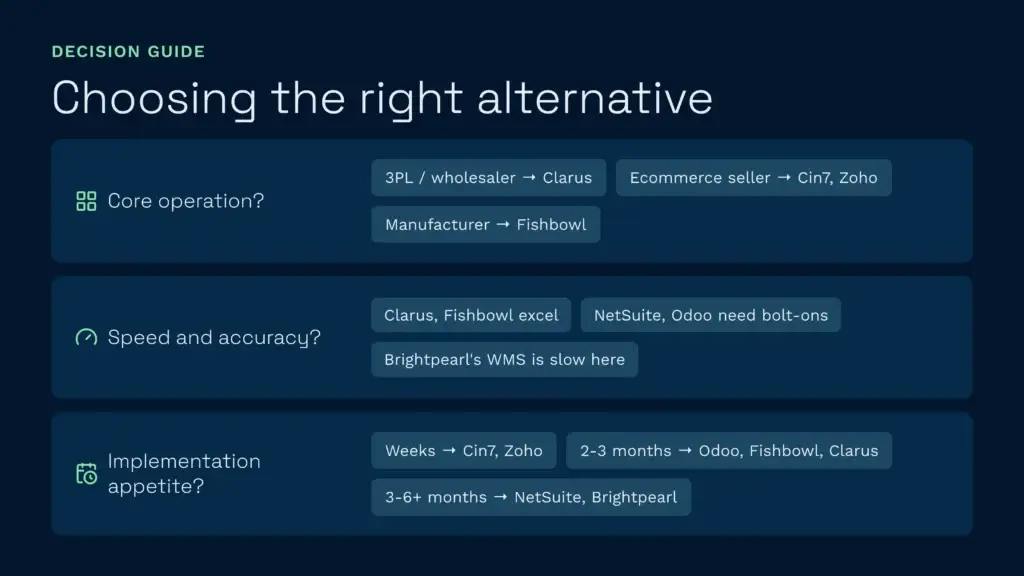
If you’re a 3PL or wholesaler managing multiple clients: you need multi-client stock segregation and automated billing at the core, not bolted on. The best warehouse management system software for 2026 is purpose-built for your model. Clarus, Odoo (with configuration), and NetSuite (with WMS licensing) support this. Everything else will require heavy customisation.
If you’re a single-location ecommerce seller: you don’t need multi-client complexity. Cin7, Odoo, or even Zoho Inventory will serve you faster and cheaper than Brightpearl. The money you save can go toward growing the business.
If you’re a manufacturer: Fishbowl is the obvious choice. Brightpearl’s accounting is stronger than Fishbowl’s, but if you need lot control and production scheduling, Fishbowl wins.
How important is warehouse speed and accuracy?
Ein Überblick über die Lagerkosten in Großbritannien shows that labour is your biggest variable cost. A warehouse system that reduces picking time, eliminates misplaced stock, and speeds up receiving directly reduces your per-unit cost. Brightpearl’s WMS is slow here: wave picking, directed putaway, and real-time scan verification are missing or weak. Clarus and Fishbowl excel; NetSuite and Odoo require bolt-ons.
What’s your implementation appetite?
Fast (weeks): Cin7, Zoho Inventory. Cloud-native architectures skip server setup and heavy customisation.
Medium (two to three months): Odoo (with partner help), Fishbowl, and Clarus at around 12 weeks for a standard implementation.
Slow (three to six months or more): NetSuite, large Brightpearl deployments. Enterprise scope, lots of configuration, deep integration work.
Whatever the answer, get the timeline in writing with the milestones behind it. A standard project needs time for data work, configuration and training, and a date with no plan attached to it tends to slip.
Integriertes WMS vs. nachträglich integrierte Lagerfunktionen
This is the core reason many businesses abandon Brightpearl. Here’s the truth: a warehouse system grafted onto an order or accounting platform will always be second-class.
Integriertes WMS (speziell entwickelt)
When the warehouse is the product, the system is optimised for it. Clarus, for instance, was built from day one to handle multi-client stock, complex picking workflows, billing events, and real-time accuracy. Every interface, every decision rule, every automation assumes the warehouse is the centre of gravity. Wave picking, scan verification, directed putaway, and FEFO rotation are native, not retrofitted. Handheld device workflows run on purpose-built logic, not generic order-taking tools. Implementation is faster because everything aligns, with no architectural compromises.
Bolt-on WMS (added to an ERP or order management core)
When WMS is added to an order or accounting system, it sits on top of a different architecture. Brightpearl’s WMS works, but it’s not integrated into the core data model the way a purpose-built system would be. You get basic pick lists, barcode scanning, and location tracking, but wave picking is either missing or weak, advanced rotation logic is limited, and multi-client workflows require heavy customisation. You’re using a forklift to do a scalpel’s job: it works, but inefficiently.
The cost difference: a purpose-built WMS typically costs the same or less than bolting WMS onto an ERP, but you get:
- Schnellere Kommissionierung (Reduzierung der Bearbeitungszeit um 50% im Vergleich zu manuellen Kommissionierlisten)
- Higher accuracy (99.9% with scan verification vs 97 to 98% with manual lists)
- Shorter implementation (around 12 weeks vs three to six months)
- Geringerer betrieblicher Aufwand (kein Kampf mit der Plattform bei Änderungen im täglichen Arbeitsablauf)
Wenn in Ihrem Lager täglich mehr als 1.000 Artikel umgeschlagen werden oder Sie mehrere Kunden betreuen, macht sich der integrierte Vorteil bereits im ersten Jahr bezahlt.
Unterstützung für Multichannel- und Einzelhandelsaktivitäten
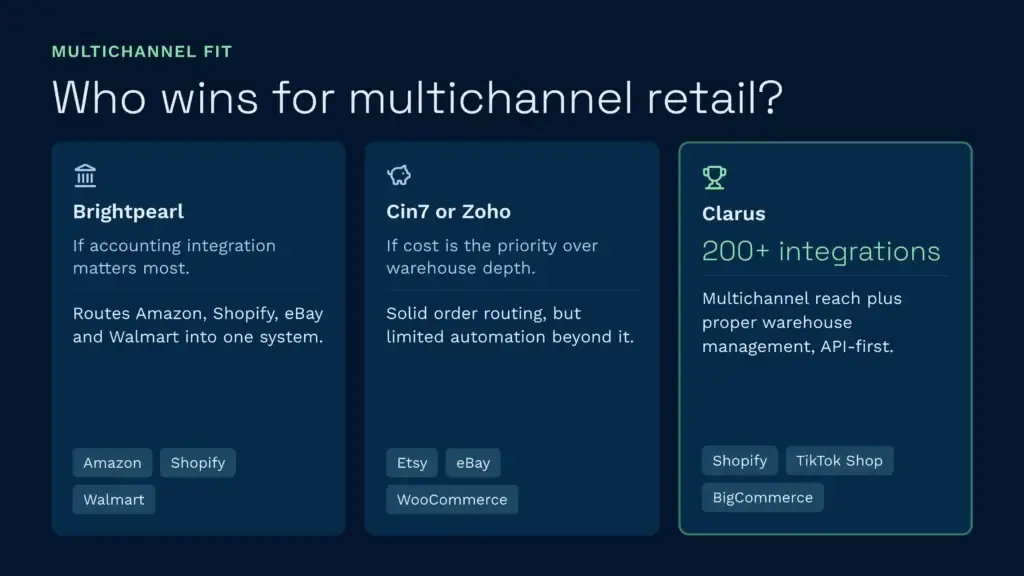
Brightpearl excels at multichannel order routing: Amazon, Shopify, eBay, Walmart all feed into one system. If that’s your focus, you’ll miss it in some alternatives.
Klar
200+ integrations including all major ecommerce platforms (Shopify, WooCommerce, Amazon, eBay, Etsy, TikTok Shop, BigCommerce, Magento, Wix, Squarespace, OnBuy). API-first architecture means custom integrations are straightforward. The focus is order-to-warehouse, not order-to-accounting, so multichannel routing is clean and fast.
NetSuite
Leistungsstarkes Multichannel-Auftragsmanagement; die Integrationen sind umfassend und tiefgreifend. Allerdings zahlen Sie dafür Preise auf Enterprise-Niveau, und das WMS ist nach wie vor separat erhältlich oder ein teures Zusatzmodul.
Cin7
Gute Multichannel-Auftragsweiterleitung (Amazon, Etsy, Shopify, eBay, Walmart, WooCommerce). Speziell für E-Commerce-Händler entwickelt; dies ist eine der größten Stärken von Cin7. Die Automatisierungsmöglichkeiten gehen jedoch über die Auftragsweiterleitung hinaus nur begrenzt.
Odoo ERP
Multichannel über Apps und Integrationen, erfordert jedoch eine Konfiguration. Community-basiert; die Ergebnisse können variieren.
Fischglas
Der Schwerpunkt liegt auf der Fertigung; der Multichannel-Einzelhandel gehört nicht zu den Kernkompetenzen. Sie benötigen eine separate Ebene für die Auftragsabwicklung.
Zoho Inventory
Gute Integration von Bestellungen aus verschiedenen Kanälen (Amazon, Etsy, Shopify, eBay, Walmart, WooCommerce). Speziell für den E-Commerce entwickelt; bietet eine solide Auftragsweiterleitung, jedoch keine Lagerverwaltung.
Winner for multichannel retail: Brightpearl if accounting integration matters; Cin7 or Zoho Inventory if cost is the priority; Clarus if you need multichannel plus proper warehouse management.
Integrationen: Buchhaltung, Marktplätze und Versand
Integrationen im Bereich Rechnungswesen
Brightpearl: an integrated accounting module; no separate accounting system needed. QuickBooks, Xero, and Sage 200 all connect.
Klar: integrates with Sage 200, Microsoft Dynamics, SAP, QuickBooks, Zoho Inventory and Unleashed Software. You pick your accounting system; Clarus feeds billing and inventory data in real time.
Cin7: QuickBooks, Xero, Sage, Freshbooks.
Odoo: an integrated accounting module; also connects to external systems.
NetSuite: integrated accounting; industry-leading financial reporting.
Fischglas: QuickBooks, Xero; limited other accounting integrations.
Zoho Inventar: Zoho Books (Zoho’s accounting app), QuickBooks, Xero.
Marktplatz-Integrationen
Brightpearl: Amazon, eBay, Shopify, Magento, BigCommerce, WooCommerce, Walmart, and others, 41+.
Klar: Shopify, WooCommerce, Amazon, eBay, Etsy, TikTok Shop, BigCommerce, Magento, Wix, Squarespace, OnBuy, and 190+ others.
Cin7: Amazon, eBay, Shopify, Etsy, WooCommerce, Walmart, and more.
Odoo: via apps and custom integrations; community-driven.
NetSuite: broad integrations; custom work required for some.
Fischglas: limited natively; custom integrations common.
Zoho Inventar: Amazon, eBay, Shopify, Etsy, Walmart, WooCommerce, and others.
Versand-Integrationen
Brightpearl: limited shipping software natively; relies on integrations with third-party carriers.
Klar: 70+ shipping providers including DHL, UPS, FedEx, Royal Mail, Parcelforce, DPD, Evri, TNT, and pallet networks (Palletways, Pallex, The Pallet Network, Palletforce).
Cin7: major carriers (UPS, FedEx, DHL, Royal Mail, Hermes, DPD, TNT).
Odoo: via integrations and custom code.
NetSuite: via integrations and a TMS (Transportation Management System) module.
Fischglas: basic carrier integrations; TMS is separate.
Zoho Inventar: major carriers (UPS, FedEx, DHL, Shippo).
Versand winner: Clarus if you need 70+ carriers and pallet network integration; Cin7 or Zoho Inventory if basic parcel carrier routing is enough.
Sprechen Sie mit einem Lagerfachmann
Wenn Sie gerade Ihre Optionen abwägen und sehen möchten, wie ein speziell entwickeltes WMS in der Praxis funktioniert, lohnt es sich, mit Clarus ins Gespräch zu kommen. Wir arbeiten mit 3PL-Anbietern und Distributoren in ganz Großbritannien zusammen, um Lagerverwaltungssoftware zu implementieren, die sich Ihren Arbeitsabläufen anpasst – und nicht umgekehrt.
Kontaktieren Sie unser Team um Ihre Anforderungen zu besprechen.