

In March 2026, IFS completed its acquisition of Softeon, folding the US-headquartered warehouse management specialist into a much larger enterprise resource planning platform. For UK 3PLs and mid-market warehouse operators weighing up their options, that acquisition raises three immediate questions: what happens next to Softeon customers, how long does an implementation really take, and what are the realistic alternatives if you need a system built for multi-client billing and fast deployment?
This guide compares Softeon to the realistic alternatives, including Clarus WMS, Körber (now Infios), Mintsoft and NetSuite. We’ll walk through what each is good at, where they fall short, and who they’re actually built for.
Comparaison rapide
| Plateforme | Meilleur pour | 3PL multi-clients | Facturation automatisée | Vitesse de mise en service | Modèle de prix |
|---|---|---|---|---|---|
| Clarus WMS | Prestataires logistiques tiers (3PL) au Royaume-Uni, services multi-clients, déploiement rapide | Oui, spécialement conçu à cet effet | Oui, tous les événements ont été enregistrés | Semaines (12 semaines en général) | À partir de 1 000 £ par mois, renouvellement mensuel |
| Softeon (IFS) | Entreprise de niveau 1, opérations multisites | Oui, pris en charge | Partiel (TMS requis pour l'optimisation) | Mois (devis sur mesure) | Devis personnalisé, non publié |
| Körber | Grands groupes d'entreposage, à l'échelle mondiale | Oui, pris en charge | Module complémentaire | De quelques mois à plusieurs années | Devis personnalisé, non publié |
| Mintsoft | Segment intermédiaire, fortement axé sur le commerce électronique | Oui, mais les coûts ne cessent d'augmenter | Frais par commande, frais liés au volume | De quelques semaines à plusieurs mois | Volumétrique : par intégration, commande, expédition, étiquette |
| NetSuite WMS | Entreprises déjà utilisatrices de NetSuite | Oui, via le module | Via le module de comptabilité | Non publié | Non publié, inclus dans l'abonnement NetSuite |
Clarus WMS : spécialement conçu pour les opérations 3PL
Clarus is a UK-based cloud WMS designed from the ground up for prestataires logistiques tiers (3PL) and multi-client distributors. Here’s what that means in practice.
Where Clarus excels. The platform treats each of your clients as a separate business within a single warehouse. Stock is segregated by client, each client sees only their own data in a branded client portal, and billable activity is captured automatically. When a pallet is put away, stored, picked and packed, the system logs each step against the right client account. At invoicing time, there are no manual counts, no spreadsheets and no disputes over whether something happened or not. Garde-meubles de St John's Hall, a UK third-party warehousing provider, cut its invoicing time by 90%. Its managing director had been spending around four days at the end of each month checking invoices. Once the data proved reliable, he stopped checking by hand and moved invoicing from monthly to weekly. JODA Fret, which stocks and distributes refrigeration units for retail, saw stock accuracy climb into the 90% to 97% range in year one and reach 99% by year two. Clarus goes live in around 12 weeks on a standard project. Most alternatives we’ve looked at don’t come close to that speed.
Les cas où Clarus n'est pas la solution la plus adaptée. It’s not an enterprise resource planning system. If you need purchasing, manufacturing scheduling or accounting coverage beyond stock transactions, you’ll connect Clarus to a separate ERP. It doesn’t have a dedicated returns module, yard management, or advanced labour management with engineered labour standards. It has what a UK mid-market warehouse operation actually needs, and nothing it doesn’t.
Main features: multi-client segregation with individual portals, automated 3PL billing (putaway, storage, picking, packing, returns and value-added services all captured), cueillette by wave, batch, zone or tote, lecture de codes-barres, FIFO/FEFO/LIFO rotation, série et batch tracking, planification des quais, cross-docking, kitting (assembly) workflows, multi-warehouse management, handheld scanning with customisable workflows, automations for replenishment and hold logic, and a full transactional audit trail. The system runs in the cloud, so there are no servers to maintain.
Tarifs : Plans start from £1,000 per month on a monthly rolling contract. Orders and shipments are unlimited and Clarus doesn’t bill on throughput, so there are no per-order fees or volumetric charges. Your quote adds tiered user licensing and a one-off implementation fee. You can see Combien coûte un système de gestion d'entrepôt (WMS) ? in more detail in our pricing guide.
Mise en œuvre : 12 weeks is the standard for a correctly resourced project on both sides. That includes master data clean-up, user training, interface testing, and a phased go-live by client account rather than a big-bang cutover.
Softeon (désormais IFS Softeon) : une entreprise de premier plan sous une nouvelle direction
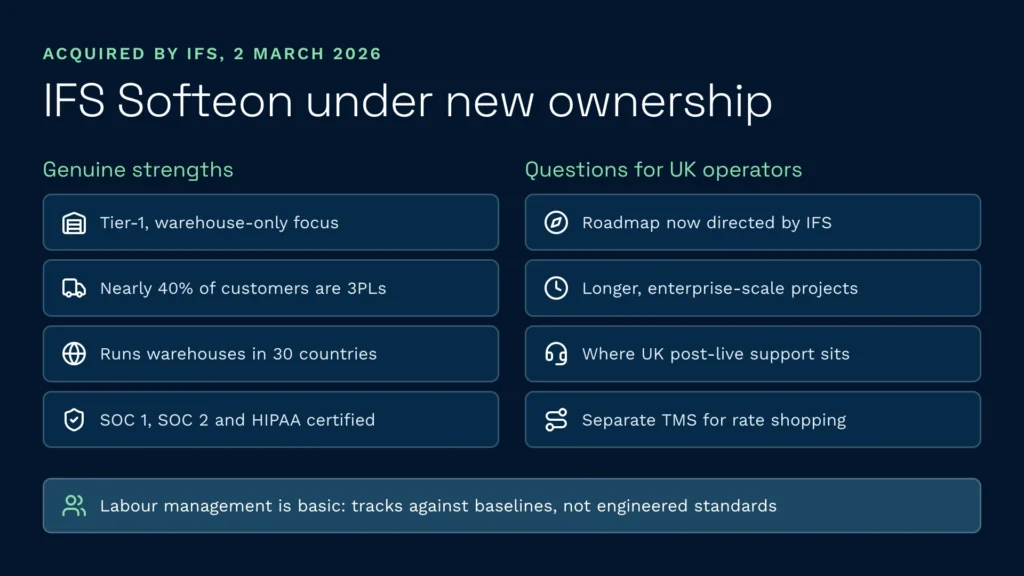
What happens to Softeon customers now that IFS has acquired it? IFS completed the acquisition on 2 March 2026, having announced it on 17 December 2025. The product continues as IFS Softeon, a cloud WMS for warehouse and distributed order management.
What Softeon is strong at. It’s a Tier-1 vendor focused on warehouse operations, not a bolt-on module to an ERP. Softeon markets a “micro-tuning” approach, which means configuration flexibility for custom operational patterns rather than forcing you into a standard template. According to Softeon’s own WMS FAQ, nearly 40% of its customers operate in 3PL, which shows real strength in that segment. The combined business manages warehouse operations across 30 countries, and customers named by IFS include Brooks, Casey’s, Denso, Sears Home Services, Sony and UPS. Security is solid: role-based access control, AES 256 encryption at rest, TLS 1.2 in transit, SSO and MFA, plus SOC 1, SOC 2 and HIPAA compliance.
La question de la nouvelle structure de propriété pour les opérateurs britanniques. Being folded into a large ERP vendor raises specific concerns for UK 3PLs and mid-market operators. First, roadmap direction: IFS now directs Softeon’s future development. Second, implementation weight: enterprise ERP vendors typically deploy with significant professional services hours and longer project timelines. Third, UK-specific support: IFS was founded in Sweden and delivers globally, while Softeon is headquartered in Reston, Virginia. Where UK post-live support sits in that structure isn’t yet clear. Fourth, carrier costs: Softeon’s parcel engine connects to carriers in the US, Canada, the UK and Europe, but Softeon says advanced rate shopping and cost optimisation are typically handled through a separate Transportation Management System. For 3PLs, that can mean a second system to buy and maintain.
Avertissement concernant la gestion du personnel. Softeon describes its labour capabilities as basic: the system tracks performance against baseline standards but doesn’t support engineered labour standards, so you’d need a dedicated labour management system for that. That’s a fair statement of what it does rather than a weakness, but it matters to your staffing cost model if that’s a priority.
Tarifs : Non publié. Devis sur mesure.
Retour sur investissement et calendrier de mise en œuvre : Softeon doesn’t publish an ROI timeframe or typical implementation duration. It says ROI varies with the complexity of the implementation and directs enquiries to the vendor.
Körber (now Infios): global scale, enterprise complexity
Körber’s supply chain software business, a joint venture between Körber AG and KKR, rebranded as Infios in March 2025. Many UK operators still know it as Körber. It covers warehouse management, order management and transport management. For organisations running global, multi-site operations with substantial capital available, it can handle vast scale and integration depth.
Pourquoi Körber est le bon choix. Large warehouse groups, global supply chains, operations that need tight ERP and manufacturing integration, and scenarios where customisation to match complex existing processes is expected and budgeted. If you’re managing hundreds of sites and need unified visibility, Körber can do it. We cover the trade-offs in more depth on our Körber WMS alternative page.
Les domaines dans lesquels Körber n'est pas adapté. UK mid-market operators with five to ten sites, 3PLs evaluating a system change, and anyone with a modest implementation budget. Körber doesn’t publish pricing or implementation timelines, so both arrive as a custom enterprise quote rather than a figure you can plan against. It’s built for large organisations with the resources to manage a large implementation.
Mintsoft : destiné au marché intermédiaire, mais les tarifs augmentent en fonction du volume
Mintsoft, owned by The Access Group, is one of the UK’s most established mid-market WMS providers, particularly strong with multi-brand ecommerce fulfilment and 3PL operations.
Les domaines dans lesquels Mintsoft donne de bons résultats. Ecommerce-heavy businesses and organisations already embedded in its ecosystem. Each core plan includes 131 standard integrations, and the system is familiar to large parts of the UK logistics market. For ecommerce pure-plays and smaller 3PLs, deployment is reasonable.
Pricing concern: tiers that climb with volume. Mintsoft’s 3PL pricing is tiered by monthly order volume and number of 3PL clients, with the highest volumes priced on application. Optional modules sit on top, including white labelling, and unsupported or modified integrations can carry a setup cost. For a growing 3PL, that means costs step up as order volumes and client numbers rise, whereas a model that doesn’t bill on throughput stays flat. We go into more detail on our Mintsoft alternative page.
Atouts opérationnels. Mintsoft handles multi-client and multi-warehouse scenarios, and its integrations cover the main UK carriers and ecommerce channels. For operations with relatively stable volumes and lower per-order complexity, the system is reliable and well supported.
NetSuite WMS : destiné aux entreprises qui utilisent déjà NetSuite
NetSuite is Oracle’s cloud ERP platform, headquartered in Austin, Texas. Its WMS is an add-on to NetSuite’s inventory management rather than a standalone product, and it needs the Advanced Inventory Management feature.
Quand le WMS de NetSuite est la solution idéale. You’re already running NetSuite as your ERP, you need warehouse management capability, and you have the budget for enterprise ERP software. Oracle doesn’t publish NetSuite WMS pricing, so the only way to know what it costs you is a quote. Because the module runs inside NetSuite, warehouse transactions update NetSuite inventory in real time with no data mapping between systems. If you’re weighing a single suite against a specialist system, it’s worth reading Comparaison entre les systèmes ERP et WMS Tout d'abord.
Les lacunes pour les prestataires logistiques tiers (3PL). The WMS module isn’t purpose-built for 3PL operations. Oracle’s NetSuite WMS documentation covers inbound, inventory and outbound processing, but doesn’t mention 3PL client billing or a client portal, so expect custom development or extra apps if you need them. Pricing is bundled into the NetSuite subscription, so it’s not clear how much of your spend is actually WMS. For a 3PL evaluating the system, the question becomes: are we paying for this because we need the ERP, or because we need warehouse management? If it’s the latter, a purpose-built WMS that connects via API is faster and cheaper to go live. See our NetSuite WMS alternatives guide for the options.
How to choose: questions to ask yourself
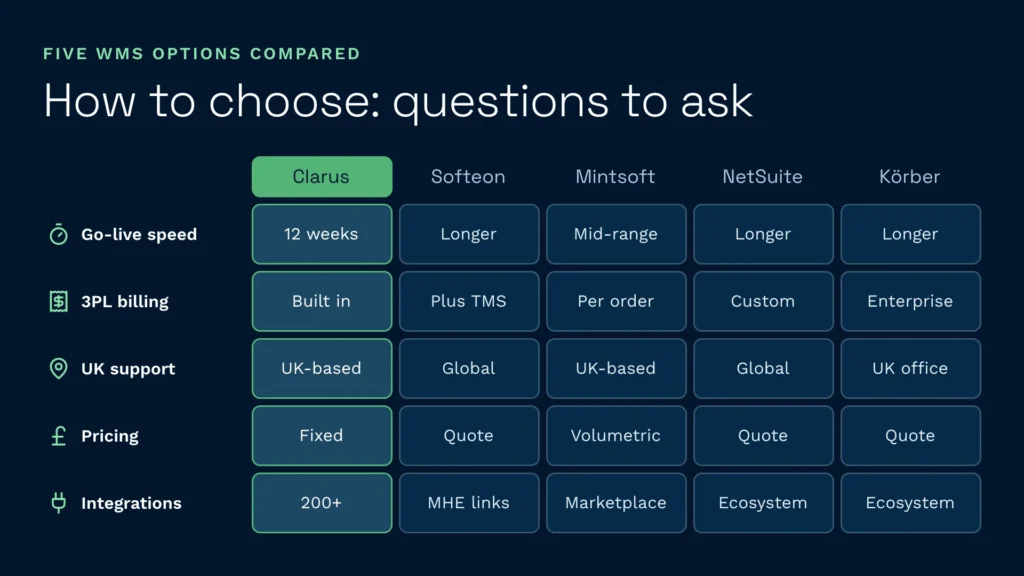
Rapidité de mise en service. Do you need to go live in weeks or months? Clarus runs 12-week implementations. Softeon, Körber and NetSuite don’t publish timelines, and enterprise projects typically run longer. Mintsoft sits in between. If you’re replacing a failing legacy system or at risk of losing a customer contract, speed matters.
Facturation 3PL multi-clients. Are you invoicing multiple clients for storage, picks, packing, despatch and returns from a single warehouse? Clarus was built for this. Softeon supports it but relies on a separate TMS for advanced rate shopping. Mintsoft includes client billing, with pricing tiers that step up as order volumes and client numbers grow. NetSuite’s WMS documentation doesn’t cover 3PL billing. Körber handles it, but at enterprise cost and timeline.
Assistance et mise en œuvre au Royaume-Uni. Do you need support after go-live from someone who understands UK warehouse operations and UK carrier quirks? Clarus is UK-based. Mintsoft is UK-based. Körber (Infios) is a global vendor. NetSuite is headquartered in Austin, Texas, with global delivery. Softeon is now part of IFS, an ERP vendor founded in Sweden.
Si vous souhaitez avoir une vue d'ensemble plus large plutôt que de vous limiter à ces cinq éléments, nous tenons à jour une vue d'ensemble de la Meilleur système de gestion d'entrepôt (WMS) pour les entrepôts britanniques and a fuller buyer’s guide to the best WMS.
Transparence des prix. Does your business work best with predictable monthly costs, or are you comfortable with enterprise custom quotes? Clarus publishes its pricing. Mintsoft publishes its standard tiers, which scale with volume. The others don’t publish pricing.
Complexité de l'intégration. How many external systems need to connect? Clarus connects to hundreds of tools through ready-made connectors or its API. Softeon uses its Elastic Communicator for vendor-agnostic robotics and materials handling equipment. Mintsoft includes 131 standard integrations. NetSuite and Körber integrate deeply with their own ecosystems.
Discutez avec un expert en entreposage
If you’re evaluating your options and want to see how a purpose-built WMS works in practice, Clarus is worth a conversation. We work with 3PLs and distributors across the UK to implement warehouse management software that fits the way you operate, not the other way around.
Contactez notre équipe pour discuter de vos besoins.