

The best warehouse management system software balances operational depth with ease of deployment, connecting inventory control, order fulfilment and labour management in one platform. Grand View Research valued the global WMS market at USD 3.38 billion in 2025, with growth forecast at 21.9% a year to 2033, so there are more platforms to choose from than ever. This guide breaks down the main options by operation type (enterprise, 3PL and SME) so you can focus your evaluation on platforms that match your scale.
Vilken är den bästa programvaran för lagerhanteringssystem år 2026?
The best WMS depends on your operation type. Manhattan Active Warehouse Management leads for large enterprise, Clarus WMS and Extensiv are built for 3PL operations, and platforms like Mintsoft and Zoho Inventory suit smaller warehouses. No single platform wins every category.
Hur skiljer sig de ledande WMS-plattformarna åt beroende på driftstyp?
| Plattform | Typ av insats | Driftsättning | What sets it apart |
|---|---|---|---|
| Manhattan Active Warehouse Management | Stort företag | Molnbaserad | Named a Leader in the Gartner Magic Quadrant for WMS 18 times in a row |
| SAP Extended Warehouse Management | Enterprise (SAP-ekosystemet) | With SAP S/4HANA or stand-alone | Deep ERP integration for complex supply chains |
| Oracle NetSuite WMS | Mellanstora företag till stora företag | Moln | Warehouse management inside the NetSuite ERP |
| Clarus WMS | 3PLs and multi-client warehouses | Moln | Automated billing per client, client self-service portal |
| Lagerchef för omfattande 3PL-verksamhet | 3PL-leverantörer | Moln | Hantering av flera kunder, integration med operatörer |
| Deposco | Mid-market 3PL, ecommerce | Moln | New 3PL clients onboarded in a week or less |
| Mintsoft (Access Group) | SME, ecommerce fulfilment, 3PLs | Moln | UK-built, carrier integrations |
| Zoho Inventory | Småföretag | Moln | Low cost, multichannel selling |
Pricing models vary as much as the platforms do. Enterprise vendors such as Manhattan and SAP quote on request, while most cloud platforms charge a monthly subscription. Clarus publishes its base plans on its prissättningssida, so you can see where you’d start before speaking to anyone.
För verifierade användarrecensioner och jämförelser av funktioner kan man vända sig till kataloger som Gartner Peer Insights och Capterra Storbritannien carry detailed ratings from warehouse professionals.
Vilka funktioner bör det bästa WMS-systemet ha?
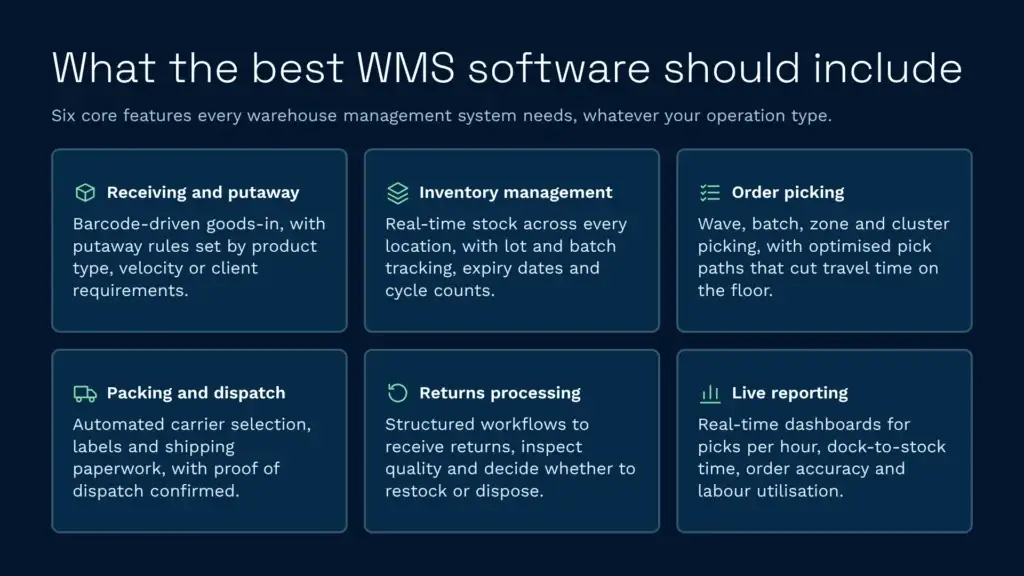
A warehouse management system earns a “best” rating when it handles core warehouse operations reliably and still has the flexibility to fit your specific workflows. Feature checklists matter less than how well the system copes with your day-to-day reality.
Viktiga funktioner i alla WMS-kategorier
- Mottagning och inlagring: barcode-driven inleveranshantering with configurable putaway rules based on product type, velocity or client requirements
- Inventory management: real-time stock visibility across locations, lot and batch tracking, expiry date management and cycle counting
- Orderplockning: support for wave, batch, zone and cluster picking, with optimised pick paths to cut travel time
- Packing and dispatch: automated carrier selection, label generation and shipping documentation with proof-of-dispatch confirmation
- Returns processing: structured workflows for receiving returns, quality inspection, and restocking or disposal decisions
- Rapportering och analys: real-time dashboards covering picks per hour, dock-to-stock time, order accuracy and labour utilisation
Vad skiljer WMS-system för stora företag från plattformar för medelstora företag?
| Förmåga | Företags WMS | Mid-market WMS |
|---|---|---|
| Hantering av flera webbplatser | Ett globalt lagernätverk med centraliserad styrning | Typically 1 to 5 sites |
| Automationsintegration | Native AMR, AS/RS and conveyor integration | API-baserad eller begränsad |
| Arbetskraftshantering | Standarder för konstruktion, incitamentsuppföljning | Grundläggande produktivitetsrapportering |
| Konfigurationsdjup | Mycket anpassningsbara arbetsflöden för varje anläggning | Mallbaserat med viss anpassning |
| Implementeringstid | 6 to 18 months | 4 to 12 weeks |
Vilket WMS-system passar bäst för 3PL-lagerverksamhet?
Third-party logistics providers need a WMS that handles multi-client complexity natively, not as an afterthought bolted onto a single-client system.
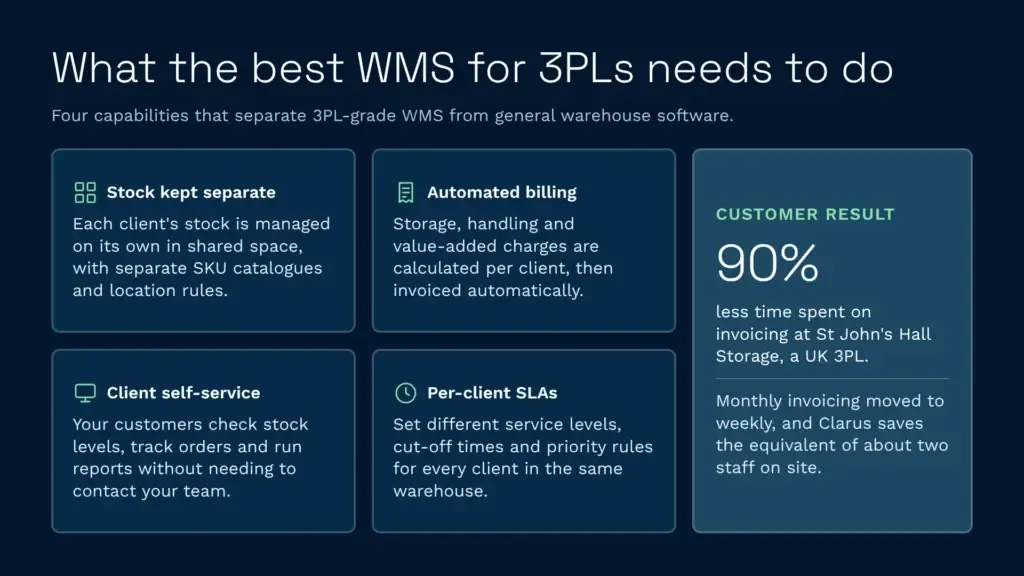
The capabilities that separate 3PL-grade WMS from general warehouse software include:
- Multi-client inventory segregation: each client’s stock managed independently within shared warehouse space, with separate SKU catalogues and location rules
- Automated client billing: billing engines that calculate storage charges, handling fees and value-added services per client, and generate invoices automatically
- Client self-service portals: secure dashboards for your customers to check stock levels, track orders and run reports without contacting your team
- Flexible SLA management: different service levels, cut-off times and priority rules for each client
Clarus WMS is built for 3PL operations. Each client’s stock is kept separate with its own rules and audit trail, and storage, handling and value-added charges are captured automatically against each client’s tariffs and sent straight into your accounts. Förvaring i St John’s Hall, a UK 3PL, used to spend around four days at the end of every month checking invoices. With Clarus, Förvaring i St John’s Hall cut its invoicing time by 90%, moved from monthly to weekly invoicing, and now saves the equivalent of about two staff on site.
For a deeper look at multi-client requirements, see our guide to the Det bästa WMS-systemet för 3PL-företag.
Hur utvärderar man WMS-programvara innan man köper den?
Test the system against your actual operations, not theoretical scenarios. Choosing on a feature checklist rather than operational fit is one of the easiest ways for a WMS project to go wrong.
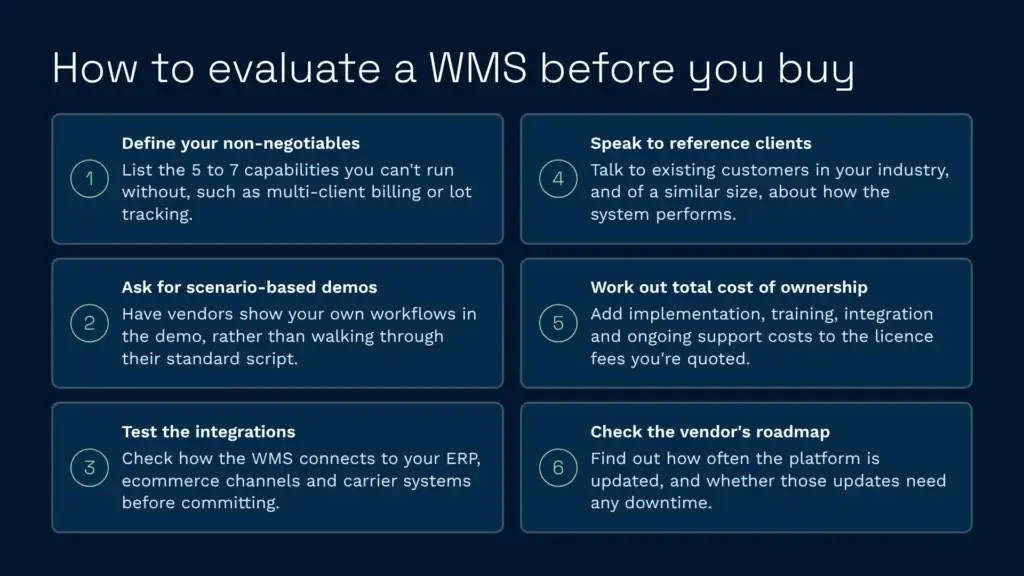
Ett praktiskt utvärderingsramverk för WMS
- Define your non-negotiables: list the 5 to 7 capabilities you can’t operate without (for example multi-client billing, carrier API integration, lot tracking)
- Request scenario-based demos: ask vendors to demonstrate your specific workflows, not their standard demo script
- Test integration capabilities: check how the WMS connects with your ERP, ecommerce channels and carrier systems before committing. Our ERP vs WMS guide covers where each system’s job starts and stops, and you can browse Clarus’s integrationer to see what connects out of the box
- Check reference clients: speak with existing customers in your industry and of a similar size
- Evaluate total cost of ownership: include implementation, training, integration and ongoing support costs alongside licence fees. An ROI calculator helps put numbers against the decision
- Assess the vendor’s roadmap: find out how often the platform is updated and whether updates need downtime
Recensioner om Gartner Peer Insights are particularly useful during evaluation because they include implementation feedback alongside feature ratings, which gives you a realistic picture of what to expect during deployment. If you’re not sure your operation is ready to switch, a WMS readiness assessment will show you the gaps first.
Vad innebär en WMS-implementering vanligtvis?
Implementation timelines and complexity vary a lot between cloud-native and on-premise platforms. Deposco says its 3PL customers can onboard new clients in a week or less, while full enterprise deployments can take 12 to 18 months.
En typisk implementering av ett molnbaserat WMS-system följer följande steg:
- Discovery and scoping (1 to 2 weeks): mapping your current workflows, integration requirements and data migration needs
- System configuration (2 to 4 weeks): setting up warehouses, locations, products, users and workflow rules
- Integration build (2 to 6 weeks): connecting the WMS to your ERP, ecommerce platforms and carrier systems via APIs
- User acceptance testing (1 to 2 weeks): your team checks the system against real scenarios
- Go-live and support (1 week): supervised launch with vendor support on-site or remote
At Clarus, introduktion starts with a site visit to map your real processes, then the system is configured around them. Familjen Campeys från Selby got in touch in early December and was fully operational by the end of January, with core setup done in a single day.
Smaller UK operations have plenty of cloud options too. Mintsoft, part of the UK-headquartered Access Group since 2020, is aimed at 3PLs and ecommerce brands.
Är du redo att hitta det bästa WMS-systemet för ditt lager?
The best warehouse management system is the one that fits your operation today and scales with your growth. If you run a 3PL or manage multiple clients from shared warehouse space, a platform built for multi-client work saves you the workarounds a generic system needs.
Clarus WMS gives 3PLs and multi-client warehouses client-level stock control, automated billing and a self-service portal for their customers. Boka ett samtal with the team to talk through your workflows, or watch the demo först.