

Blue Yonder WMS är en etablerad plattform för företagsförsörjningskedjor. Den betjänar över 3 000 stora kunder inom detaljhandel, fordonsbranschen och logistik, och fungerar väl när skala och komplexitet är prioriterat. Men Blue Yonder är inte bara ett alternativ till Blue Yonder för de flesta organisationer som utvärderar ett WMS. Det är själva alternativet. Frågan är om dess kostnad, implementeringstid och bredd på funktioner passar just din verksamhet.
Den här guiden ger en genomgång av det verkliga alternativet till Blue Yonder. Specialutvecklat lagerhanteringssystem erbjuda snabbare implementering, transparent prissättning och en uppsättning funktioner som är anpassad till 3PL-företag, grossister och distributörer i stället för multinationella företag.
| Plattform | Bäst för | 3PL med flera kunder | Implementering | AI:s tillämpningsområde |
|---|---|---|---|---|
| Clarus WMS | 3PL-företag, distributörer, livsmedel och drycker, tillverkningsindustrin | Segregering av inbyggda klienter | ~12 veckor | Golv och kommersiellt skikt |
| Blue Yonder WMS | Stora företag, hög automatiseringsgrad, globala nätverk | Eftermonterat stöd | Ej publicerad (tillhandahålls via professionella tjänster) | Verksamhet på golvet (uppgiftskoordinering, arbetskraft) |
| Körber WMS | Tier 1-tillverkare, stora 3PL-företag, företag i stor skala | Stöd för flera lager | Ej publicerad | Fokus på inbyggd automatisering, begränsad autonom körning |
| Snapfulfil | E-handel, detaljhandel, mindre 3PL-företag (äldre) | Delvis stöd | Ej publicerad | Ingen aktiv AI; endast analys och rapportering |
Clarus WMS: specialutvecklat för 3PL- och distributörsverksamhet
Clarus är ett molnbaserat WMS som från grunden har utformats för verksamheter där kunden inte själv driver lagret. Verksamheten sköts istället av en tredjepartslogistikleverantör (3PL), en distributör eller tillverkaren.
Vad den gör. Clarus-handtag separering av aktier mellan flera kunder, automatiserad fakturering som registrerar alla lagerhändelser i realtid (mottagning, lagring, plockning, packning, leverans, returer, mervärdestjänster), arbetsflöden för handhållen skanning, FIFO/FEFO/LIFO-rotation, hantering av utgångsdatum, återkallelser, dockning, cross-docking samt integrationer med över 70 transportörer, över 200 e-handelsplattformar och ERP-system, däribland Sage 200, Dynamik, och QuickBooks. Systemet är API-baserat och körs från en enda miljö över flera lageranläggningar.
Där det passar perfekt. Alla 3PL-företag eller distributörer med minst 10 lageranvändare, en omsättning på 5 miljoner till 500 miljoner pund och kunder som skiljer sig åt vad gäller SLA, prisstruktur eller integrationskrav. Företag inom livsmedels- och dryckesbranschen som hanterar FEFO och kontroll av bäst före-datum. Grossistverksamheter som hanterar lager på flera platser och kundportaler. Tillverkare med behov av spårning av satser/partier.
När det inte passar så bra. Renodlad B2C-pakethantering för enskilda kunder (för höga omkostnader). Mycket små verksamheter med färre än 10 användare. Automatiserade megalager med stora volymer där robotkoordination är den primära funktionen. Verksamheter som redan har ett fungerande WMS och endast behöver en returmodul eller ett gårdsledningssystem. Clarus har inte dessa moduler och kommer inte att utveckla dem på beställning.
Viktiga funktioner. Självbetjäningsportal för kunder (kan anpassas efter kundens varumärke). Smart Wave-plockning (uppgiven minskning av transporttiden med 50%). Verifiering av skanning i realtid (påstådd noggrannhet på 99,9%). Riktad inlagring och påfyllning. Planering av lastbryggor. Tullager- och farligt gods. Arbetsflöden för kit-sammanställning. HHD (handhållen enhet) för att skapa arbetsflöden. Automatiseringar och utlösare för flaskhalsar. AI-lagerassistent som läser av driftsdata och ger insikter. Fullständig revisionsspår.
Belägg. Förråd i St John’s Hall, ett 3PL-företag, har minskat sin faktureringstid med 90%. Det manuella inmatningsarbetet i slutet av månaden, som tidigare tog fyra dagar, har nu eliminerats. JODA Frakt, ett 3PL-företag inom livsmedelslogistik, uppnådde en lagerprecision på 99%, vilket minskade tiden för inventering från flera veckor till en enda dag. KATEM Logistik De ökade sina månatliga plockvolymer tiofaldigt efter bytet. Familjen Campeys från Selby, en leverantör av livsmedel och drycker, lyckades genomföra produktåterkallelser på under fem minuter och säkerställde BRC Double-A-ackreditering. Det här är riktiga kunder med verifierade resultat, inte påhittade fallstudier.
Priser. Priserna börjar på 1 000 £ per månad för Core-paketet, 1 500 £ för Scale och 2 000 £ för Enterprise. De slutliga offerterna inkluderar användarlicenser enligt en stegvis prissättning samt en engångsavgift för implementering som anpassas efter er verksamhet, och startpriserna anges på prissättningssida snarare än under ett samtal.
Blue Yonder WMS: samordning av företagets leveranskedja
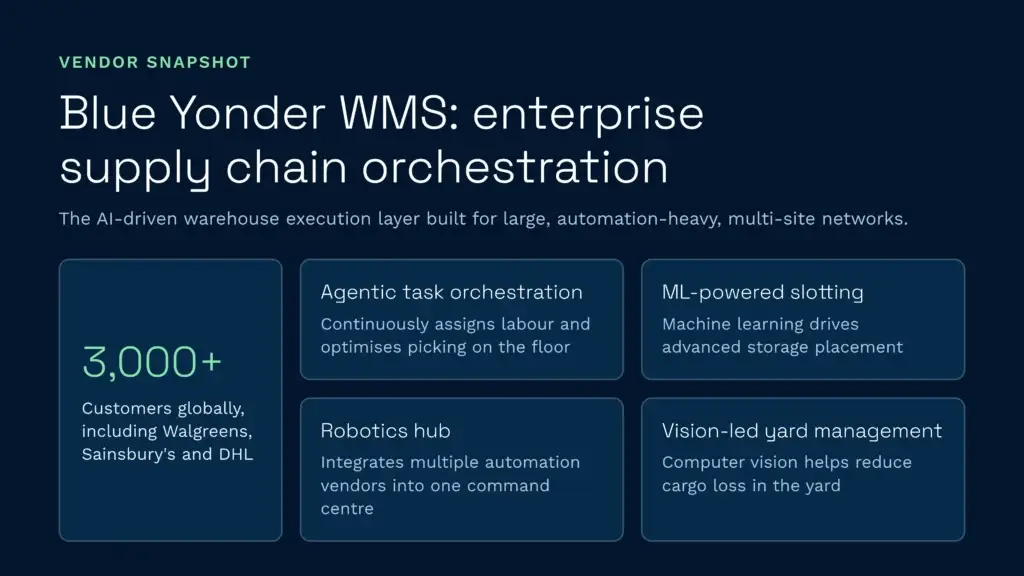
Blue Yonder positionerar sig som “AI-företaget för leveranskedjan”. Plattformen är verkligen effektiv i sin verksamhet: den samordnar arbetskraften, automatiserar uppgifter, hanterar returer, styr lagerområden och integrerar flera automatiseringsleverantörer (robotar, transportband, sorteringsmaskiner) i en enda kontrollcentral.
Vad den gör. Blue Yonder WMS utgör lagerhanteringslagret i en betydligt större programvarusvit som omfattar planering av leveranskedjan, detaljhandelsplanering, orderhantering och transportledning. Själva WMS-systemet omfattar driftshantering, personalanalyser, resursprognoser, AI-driven uppgiftsutförande, robotintegration, lagerplatshantering, returhantering och avancerad slotting. Företaget uppger att man har över 3 000 kunder världen över, däribland Walgreens, Sainsbury’s och DHL.
Där det passar perfekt. Stora företag med dussintals distributionscenter i flera länder, där inköpsstyrkan sänker mjukvarukostnaderna som andel av de totala investeringarna. Verksamheter där robotteknik är central för affärsmodellen och där en djupgående integration av maskinvision (särskilt inom lagerhantering och platsallokering) är värd den komplexitet som implementeringen medför. Globala leveranskedjor där det krävs enhetlig rapportering och planering över hela nätverket.
Där det sannolikt inte passar så bra. 3PL-företag med 1 till 5 lageranläggningar och en varierad kundbas. Regionala grossister eller distributörer. Företag där den främsta prioriteringen är att identifiera ofakturerat arbete på den kommersiella sidan (uteblivna avgifter, samlingsorder, fakturakonflikter). Organisationer som utvärderar WMS-system med en implementeringstid på 12 veckor. Inköpare som jämför priser utifrån offentliggjorda prislistor; Blue Yonders priser är inte offentliggjorda, och processen för att få en offert kan ta flera veckor.
Viktiga funktioner. Blue Yonder WMS använder agentbaserad AI för att kontinuerligt fördela resurser och optimera samordningen av arbetsuppgifterna på lagergolvet. Systemet har avancerad slotting som bygger på maskininlärning. Robotikhubben integrerar flera automatiseringsleverantörer. Returhanteringen omfattar arbetsflöden för inkommande varor och avyttring. Uppställningsplatshanteringen använder datorseende och maskininlärning för att minska förluster av gods. Arbetsstyrningen mäter prestanda och engagemang. Systemet hanterar verksamhet på flera anläggningar och erbjuder djup integration med transportband, RFID-system, TMS-plattformar och ERP-system via det som Blue Yonder kallar Luminate Data Management Services.
En viktig aspekt: AI:s tillämpningsområde. Blue Yonders AI hanteras direkt på lagergolvet. Den fördelar arbetsuppgifter, optimerar plockvägar och tillämpar logik för varuplacering. Den hanteras inte på den affärsmässiga nivån. Uteblivna avgifter, fakturatvister, aktivitetsbaserad fakturering och hantering av samlingsorder sköts fortfarande manuellt eller kräver anpassad integration. För många 3PL-företag är det just på den andra nivån, den kommersiella verksamheten, som marginalförlusterna faktiskt uppstår.
Priser. Ingen offentlig information. Priset fastställs vanligtvis individuellt per installation utifrån antalet anläggningar, automatiseringsnivå, integrationsomfattning och årlig transaktionsvolym. Blue Yonder offentliggör inte heller några tidsplaner för implementeringen, och implementeringen sköts av företagets team för professionella tjänster eller en certifierad partner. Begär därför skriftliga offerter på både licenskostnaden och tjänstekostnaden innan du gör en jämförelse.
Infios WMS (tidigare Körber): tillverkning och logistik för stora företag
Infios, tidigare känt som Körber Supply Chain Software fram till företagets varumärkesförnyelse 2025, är en etablerad Tier-1-aktör med lång erfarenhet inom fordonsindustrin, tillverkningsindustrin och stora 3PL-försörjningskedjor. Plattformen är utformad för verksamheter där lagerautomatisering (transportband, sorteringsanläggningar, ”goods-to-person”-system) är integrerad i själva anläggningen.
Där det passar bra. Tier 1-leverantörer inom fordonsindustrin som hanterar JIT-verksamhet (just-in-time). Stora tillverkare med komplexa behov av batchkontroll och spårbarhet. Företag inom EU med starka relationer till etablerade systemintegratörer. Organisationer som redan bedriver verksamhet lokalt och är vana vid kapitalintensiva infrastrukturmodeller.
När det inte passar så bra. Företag som prioriterar molnlösningar. Mindre 3PL-företag där flexibilitet och smidighet är viktigare än bredd. Verksamheter som utvärderar WMS som en molnbaserad SaaS-tjänst snarare än ett lokalt installerat system. Kunder där snabb implementering är ett affärskrav.
Snapfulfil: traditionell e-handel och orderhantering inom detaljhandeln
Snapfulfil var det dominerande molnbaserade WMS-systemet för e-handel och mindre 3PL-företag innan konsolideringen ledde till att fokus flyttades mot den högre prisklassen. Systemet används fortfarande av hundratals mindre aktörer.
Där det passar bra. E-handelsföretag som sköter sin egen orderhantering. Små till medelstora 3PL-företag med fokus på en eller två kunder. Organisationer som är nöjda med Snapfulfils nuvarande funktionsutbud och utvecklingsplan.
När det inte passar så bra. 3PL-leverantörer med flera kunder och komplex fakturering. Verksamheter där det krävs aktiv utveckling och innovation i snabb takt. Inköpare som utvärderar modern, serverlös molnarkitektur.
Så här väljer du ett WMS när du utvärderar Blue Yonder
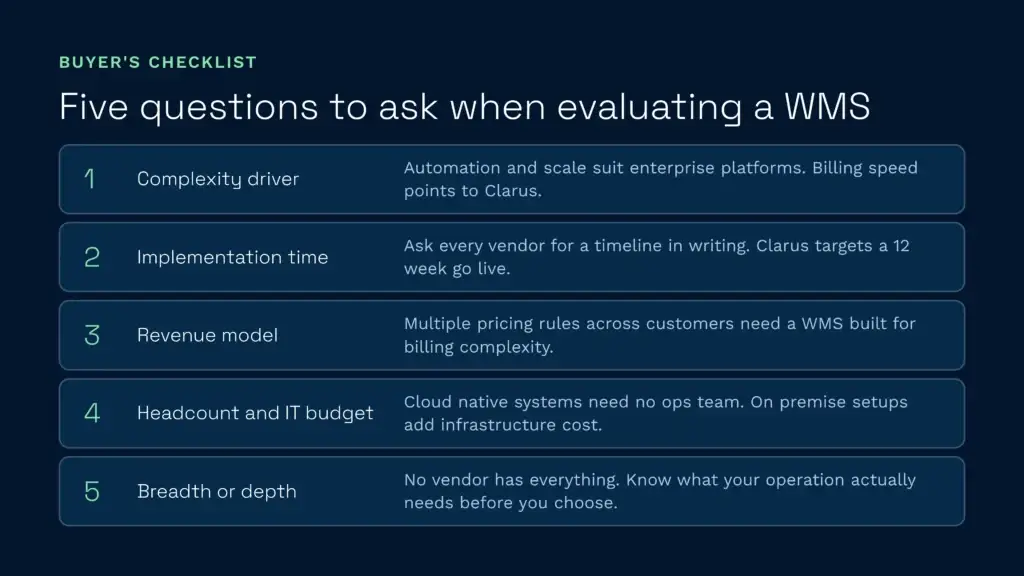
Fråga 1: Vad är det som driver komplexiteten?
Om det handlar om automatisering, skalbarhet och samordning mellan flera anläggningar är Blue Yonder eller Infios rimliga alternativ. Om det gäller faktureringsnoggrannhet och snabb avkastning är Clarus det rätta valet.
Fråga 2: Hur mycket tid kan du ägna åt implementeringen?
Varken Blue Yonder eller Infios offentliggör någon tidsplan för implementeringen, så be varje leverantör om en skriftlig tidsplan samt två referenser från företag av samma storlek som ert. Clarus siktar på att driftsätta ett standardprojekt inom 12 veckor. Om ni behöver driftsätta systemet snabbare är detta en viktig konkurrensfördel.
Fråga 3: Hur ser er intäktsmodell ut?
Om ni debiterar kunderna per pall, per plockning, per kilo, per dag eller per SKU, och ni har mellan 3 och 20 olika prissättningsregler för er kundbas, måste WMS-systemet vara utformat för att hantera komplexa faktureringsprocesser. Clarus är det. Blue Yonder är det inte.
Fråga 4: Hur många anställda har ni och hur stor är er IT-budget?
Molnbaserade, serverlösa system (Clarus) kräver inget driftsteam. Lokalt installerade eller hybridsystem (Infios, delar av Blue Yonder) kräver infrastruktur, säkerhetsuppdateringar och uppgraderingshantering. Räkna med den kostnaden.
Fråga 5: Behöver du ett så brett utbud av funktioner som möjligt eller en så djup specialisering som möjligt?
Blue Yonder har fler moduler (returer, lagerhantering, temperaturkontroll). Clarus är mer specialiserat på fakturering för flera kunder, snabb implementering och automatisering på affärsnivå. Inget av dem har allt. Ta reda på vad du faktiskt behöver, inte vad som skulle vara trevligt att ha senare.
Tala med en lagerarbetare
Om du håller på att utvärdera dina alternativ och vill se hur ett specialutvecklat lagerhanteringssystem (WMS) fungerar i praktiken, är Clarus värt att ta en pratstund med. Vi samarbetar med 3PL-företag och distributörer över hela Storbritannien för att implementera lagerhanteringsprogramvara som anpassas efter just er verksamhet – inte tvärtom.
Kom i kontakt med vårt team att diskutera dina krav.