

If you’re running a wholesale operation, managing inventory across multiple locations, fulfilling orders for hundreds of customers, and keeping costs under control is no small task. That’s where wholesale management software comes in. Rather than juggling spreadsheets and manual processes, the right system automates stock control, streamlines order management, and gives you real-time visibility across your entire distribution network.
This guide explores what wholesale management software actually does, why it matters for 3PLs and ecommerce businesses, and how to choose a solution that scales with your operation.
What Is Wholesale Management Software?
Wholesale management software is a platform designed to manage the unique demands of bulk distribution and B2B fulfilment. Unlike retail-focused systems, these tools handle high-volume orders, complex pricing structures, inventory management for wholesalers, and integration with multiple customer channels.
At its core, wholesale management software tracks stock levels across warehouses, automates order processing, manages customer accounts with tiered pricing, and generates insights into what’s moving and what’s sitting idle. Many systems also integrate with accounting software, shipping carriers, and ecommerce platforms to create a connected supply chain.
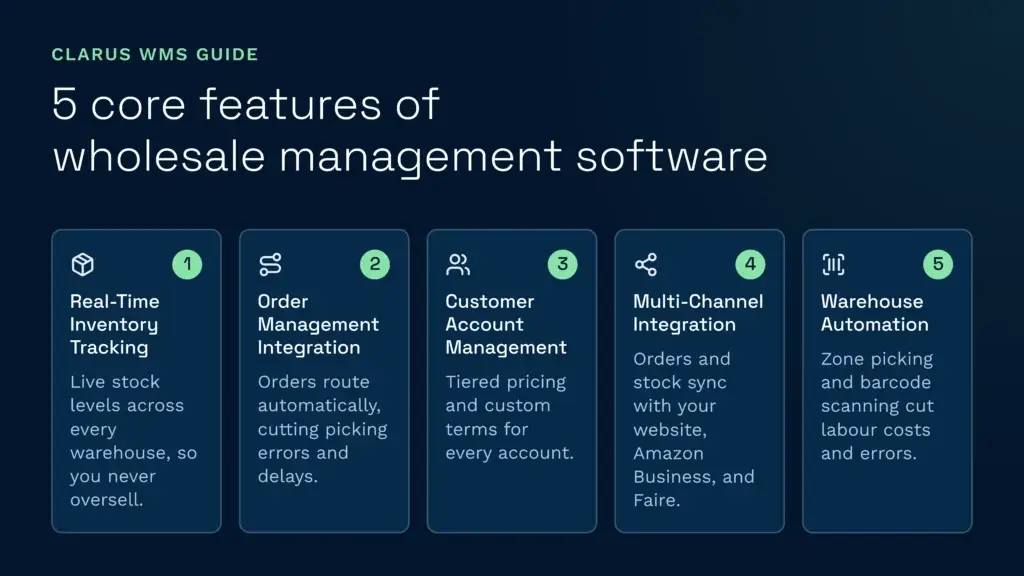
Core Features of Wholesale Management Software
Real-Time Inventory Tracking
Stock control software that’s truly real-time tells you exactly what you have on hand, where it is, and when you’ll run out. This prevents overselling, reduces safety stock waste, and ensures you can always fulfil orders on time. The best systems sync across multiple warehouses simultaneously, so your team sees the same numbers everywhere.
Order Management System Integration
A modern order management system sits at the heart of wholesale operations. It captures orders from your website, EDI feeds, or manual entry, then routes them to the right warehouse, prints labels, and tracks shipments. This automation cuts picking errors and speeds up fulfilment by days.
Customer Account Management
Wholesale businesses rarely charge the same price to every buyer. Your software should support tiered pricing, volume discounts, custom payment terms, and customer-specific catalogues. This makes invoicing faster and keeps high-value accounts happy with tailored pricing.
Multi-Channel Integration
B2B ecommerce integration is critical. Your software should sync automatically with your website, Amazon Business, Faire, or other platforms, pulling orders and pushing inventory levels in real time. This stops the nightmare of selling stock you don’t have.
Warehouse Automation
As you grow, you’ll want features like zone picking, wave optimisation, and barcode scanning. These reduce labour costs and picking errors, which directly improves your margins and customer satisfaction.
Why Wholesale Businesses Need Dedicated Software
You might be tempted to use a standard warehouse management system or a basic ecommerce platform, but wholesale distribution has specific needs. Generic systems often struggle with high-volume orders, complex pricing, EDI compliance, and the level of automation required to stay competitive.
Dedicated wholesale management software is built from the ground up to handle bulk orders, manage inventory for wholesalers across multiple locations, and connect to the B2B channels your customers use. This specialisation saves time, reduces errors, and lets your team focus on growth rather than fighting the software.
Wholesale Distribution Software vs. Standard WMS
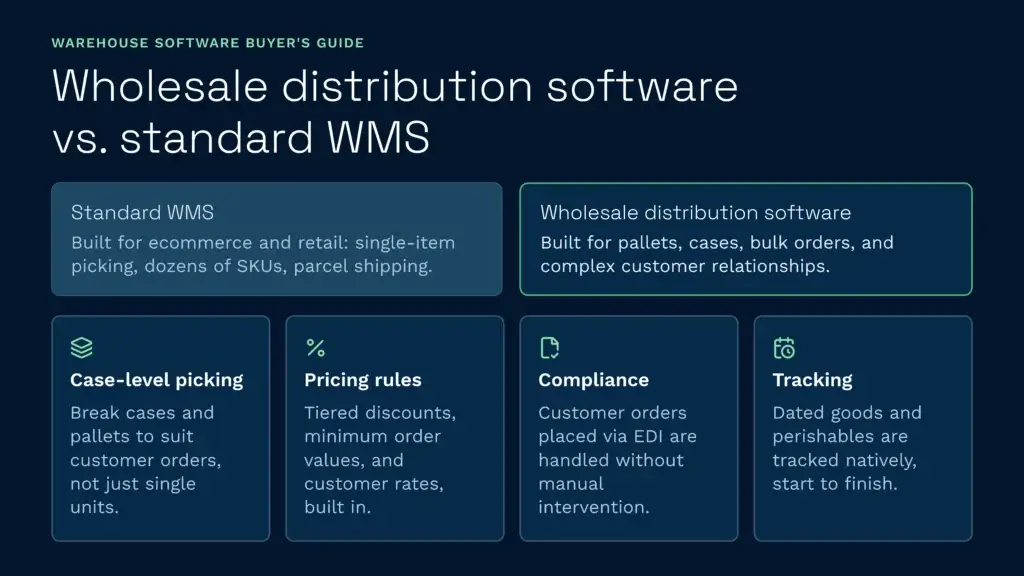
A standard warehouse management system is often designed for ecommerce or retail, picking single items, managing SKUs by dozens, handling parcel shipping. Wholesale distribution software, by contrast, is built for pallets, cases, bulk orders, and complex customer relationships.
The differences matter. A true warehouse management system for wholesalers will include:
- Case-level picking: You’re not picking individual units; you’re breaking cases and pallets to suit customer orders.
- Pricing rules: Tiered discounts, minimum order values, weight-based pricing, and customer-specific rates are built-in, not bolted on.
- Compliance and EDI: If your customers submit orders via EDI, the software handles it without manual intervention.
- Batch and expiry tracking: If you deal with dated goods or perishables, the software tracks them natively.
When you’re choosing between a general WMS and wholesale distribution software, ask yourself: does this platform understand my business model, or am I forcing my workflow into something designed for someone else?
How Wholesale Management Software Improves Profitability
The business case for wholesale management software comes down to three things: speed, accuracy, and insight.
Speed
Manual processes waste time. Automating order entry, picking, and invoice generation cuts fulfilment time by 40–60%. Faster fulfilment means happier customers and the ability to take on more volume without hiring more staff.
Accuracy
Hand-picking from a printout introduces errors. Barcode scanning, automated picking routes, and real-time inventory sync reduce picking errors to near zero. Fewer errors mean fewer refunds, fewer customer complaints, and lower operational friction.
Insight
You can’t optimise what you can’t see. Good wholesale management software shows you which products move fastest, which customers are most profitable, where inventory is slow, and where you’re losing money. That data drives smarter buying, better pricing, and lower waste.
If you’d like to understand the broader context, explore how a 3PL management system handles these challenges at scale, or dive into the cost of warehousing to see where your biggest levers are.
Key Considerations When Choosing Wholesale Management Software
Not all wholesale management software is created equal. Before committing, check these boxes:
Scalability
Your business will grow. Can the software handle 10x the current order volume, more SKUs, and additional warehouses without breaking? Cloud-based platforms usually scale better than on-premise systems.
Integration Capability
Your software stack includes accounting, shipping, ecommerce, and maybe EDI. Will your new system play nicely with the tools you already use? Check API documentation and integration partnerships before signing on.
Ease of Use
Complex software requires extensive training and often slows adoption. Look for platforms with clean interfaces, good training resources, and responsive support. Your warehouse staff will thank you.
Implementation Time
Some systems take months to deploy; others go live in weeks. If you need fast results, prioritise solutions that offer quick implementation, templated workflows, and hands-on onboarding support.
Cost Structure
Understand the full cost: per-transaction fees, per-user fees, setup costs, training, and support. Some vendors hide costs; others are transparent. Get everything in writing.
For guidance on evaluating all your options systematically, see our guide to how to choose a WMS.
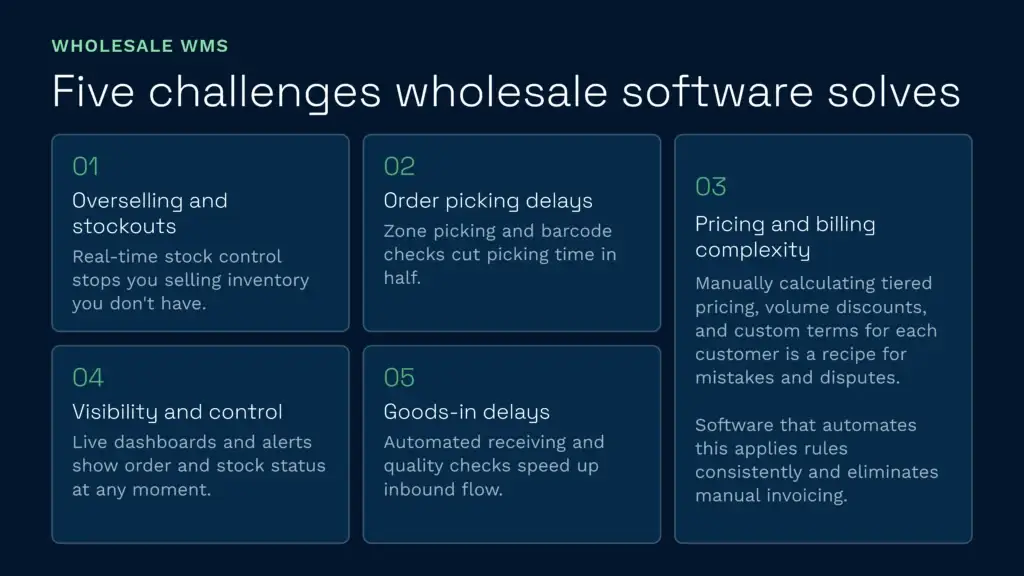
Common Challenges Wholesale Management Software Solves
Overselling and Stockouts
When inventory updates are slow or manual, you accidentally sell stock that isn’t there. Customers get angry, you lose credibility, and fulfilment gets chaotic. Real-time stock control software prevents this entirely.
Order Picking Delays
Manual picking, searching shelves with a paper list, is slow and error-prone. Automated picking routes, zone picking, and barcode verification cut picking time in half and nearly eliminate errors.
Pricing and Billing Complexity
Manually calculating tiered pricing, volume discounts, and custom terms for each customer is a recipe for mistakes and disputes. Software that automates this applies rules consistently and eliminates manual invoicing.
Visibility and Control
If you can’t see real-time order status, inventory levels, or shipment tracking, you’re flying blind. Good wholesale management software gives you dashboards, reporting, and alerts so you know what’s happening at any moment.
Goods-In Delays
Receiving and putting away stock slowly clogs your operation. Automated goods-in processes, barcode scanning, and quality checks speed up inbound flow. For more on this, explore our breakdown of the goods-in process and its impact on warehouse efficiency.
Wholesale Management Software for Growing 3PLs
For 3PLs managing inventory on behalf of multiple clients, wholesale management software is especially critical. You need to handle diverse SKUs, customer-specific rules, separate billing, and audit trails that prove you’re meeting service levels.
The best solutions for 3PLs include:
- Multi-client support: Separate inventory, pricing rules, and billing per customer without separate licenses.
- White-label capability: Your customers can access a portal that shows their inventory and order history.
- Billing automation: Charge for storage, handling, or transactions automatically based on activity, with detailed invoicing.
- Compliance and auditability: Complete audit trails, batch tracking, and reports to satisfy customer and regulatory requirements.
Many generic WMS platforms weren’t designed with 3PLs in mind and force you into workarounds. Purpose-built solutions are worth the extra investment because they handle your actual workflow.
Ready to Optimise Your Warehouse?
If you are looking for practical ways to streamline your operations or simply want to explore how a tailored warehouse management system could work for your business, we are here to help. The team at Clarus are always happy to chat through your specific challenges, answer your questions, or arrange a personalised demo whenever you are ready.
Get in touch with us today to see how we can support your long-term fulfilment goals.