

Cycle counting is a way of checking stock on a rolling schedule, so a slice of your warehouse is counted every week instead of shutting down to count everything once a year. Each count is compared with the system record, every gap is investigated, and the stock is corrected while the evidence is still fresh. Done properly, cycle counting gives you a stock accuracy figure you can trust all year, plus the records you need for year-end accounts.
The accounts side matters too. HM Revenue and Customs (HMRC) takes its stock valuation rules from the Business Income Manual, and an auditor who never saw the year-end count has to rebuild the evidence another way. ICAEW explains in its guidance on remote inventory audit testing why a count taken on a different date needs extra procedures.
What is cycle counting, and how is it different from a stocktake?
A cycle count is a planned count of part of your stock, rotated so that every location or product is checked at least once in a set period. A full stocktake counts everything in one go, usually with operations paused. The two methods answer different questions. A stocktake gives you one snapshot of the warehouse, while cycle counting tells you how accurate the system is between snapshots.
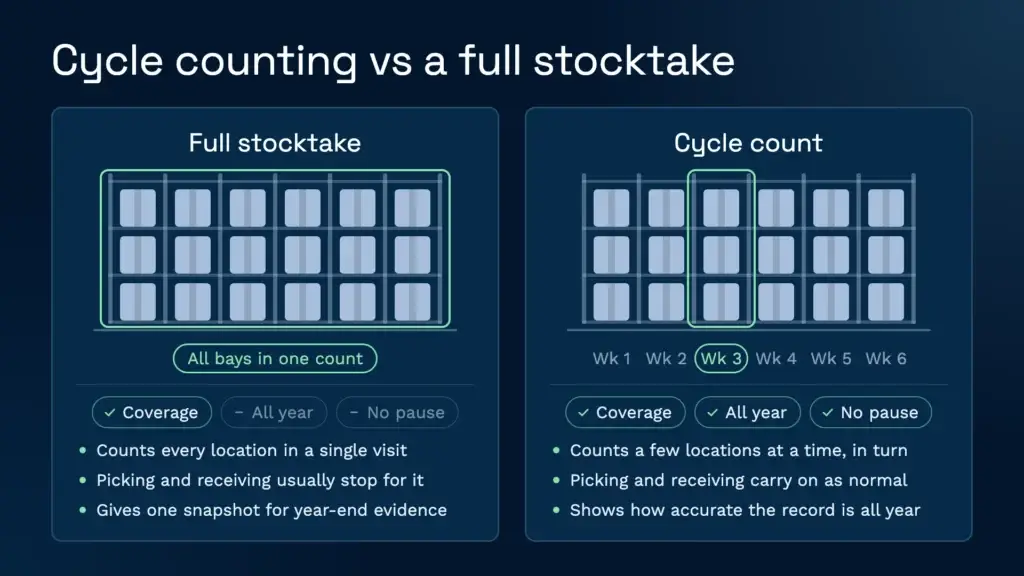
The difference shows up in the operation. A stocktake stops picking and receiving for a day or more. A cycle count runs alongside normal work, a few locations at a time, so the warehouse keeps moving.
| Method | When it runs | Impact on operations | Best used for |
|---|---|---|---|
| Full stocktake | Once a year, or at a fixed date | High, operations usually paused or moved to nights | Year-end evidence and a clean baseline |
| ABC cycle count | Rolling, with high-value stock counted most often | Low, a few locations at a time | Keeping valuable and fast-moving stock accurate |
| Location-based check | Rolling by aisle, bay or zone | Low to medium, depending on zone size | Finding where errors cluster on the floor |
| Spot check | Ad hoc, after a query or a failed pick | Very low | Checking one product quickly |
Treat the table as a starting point rather than a rulebook. Most sites use two or three of these methods together. For the software that runs a full count, see stock taking software, which covers the stocktake side rather than the method. The structured stock check feature in Clarus supports the same four check types: full warehouse count, cycle count, location-based check and spot check.
ABC and location-based counting schedules
An ABC schedule ranks stock by value or movement. A items are high value or fast moving, so they are counted most often. B items are counted less often, and C items least often. You set the frequencies against your own risk, because the cost of a wrong count varies from one business to the next. The point of the system is that the stock most likely to cost you money gets the most attention.
Location-based counting works from the floor instead. You count a whole aisle, bay or zone in one visit. This suits sites where the problem is physical, such as stock in the wrong place or racking that does not match the system, and it keeps counters in one area rather than chasing products across the building.
Counting in racking usually means working at height, so plan count routes that keep people off ladders and away from moving equipment. The Health and Safety Executive sets out the work at height rules that apply to that work.
Clarus schedules stock checks against locations from the desktop, or creates them in bulk from a CSV file. If you plan counts by value or movement, ask any vendor to show you how that drives the count schedule.
Blind counts: why the counter should not see the expected quantity
A blind count is a stock count where the person counting records the quantity before they see what the system expects, so the count tests the record instead of confirming it. Once a counter sees “expected: 40”, there is a strong pull to find 40, even when the rack holds 36. Hiding the expected figure removes that pull, and the result is an honest measure of accuracy.
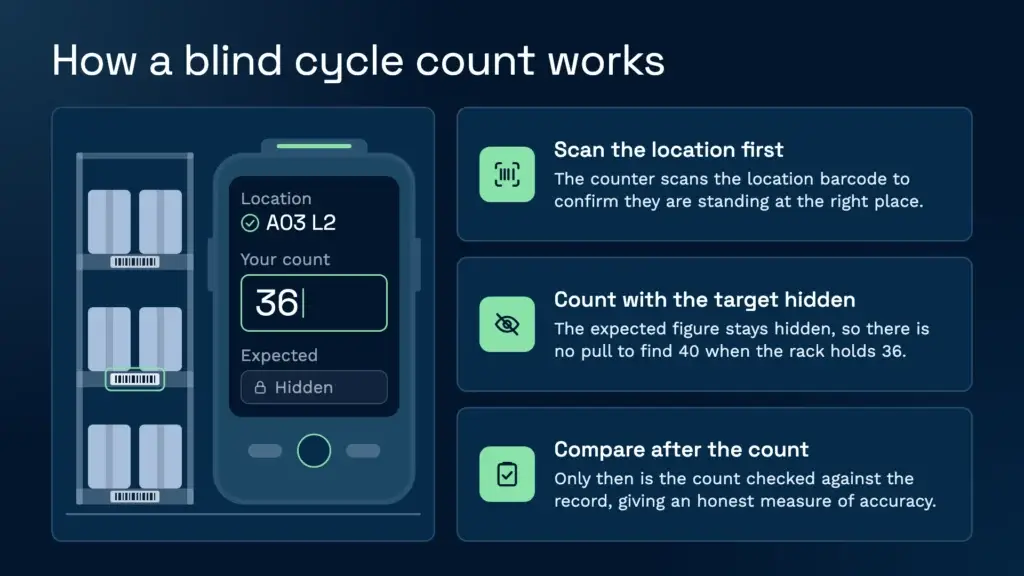
Clarus uses a guided blind count flow on handheld devices. Operators scan the location barcode first to confirm where they are, then enter their count. Several operators can work the same check at once, and a location is only locked for counting while an active task is in progress there.
Tolerance and recount rules
A tolerance is the variance you accept without investigation. A recount rule decides when a count must be repeated before the stock record is changed. Both are policy decisions, and they are the part of the process most often left vague.
Set tolerances by product class, not as one number for the whole site. A tolerance that suits bulk fixings will hide a real problem on high-value electronics. Write the rules down so that the person counting and the person approving the adjustment work to the same standard. A common approach is to send any variance outside tolerance for a second count by a different person, and to adjust only when both counts agree.
Clarus records a pass or fail status for each location as it is counted, so supervisors can act before the check finishes. Whichever system you use, check how it handles tolerance thresholds and recounts before you rely on them.
Variance reason codes: why the reason matters as much as the number
A variance reason code is a short, fixed label, such as pick error, damaged stock, receiving error or system issue, recorded against each stock difference. Without codes, a variance is just a number. With them, you can see which cause is growing and fix the process behind it.
Keep the list short so counters choose quickly, and review it each quarter so the codes match the errors you actually find. Track the result as stock accuracy against your warehouse KPIs, so the trend is visible to the people who can act on it.
In Clarus, a supervisor assigns a reason code to each failed location, such as pick error, damaged stock or system issue. Failed locations show the counted and expected quantities side by side, and every check is closed with a reason code before it is exported.
How the sampling method keeps accuracy visible all year
Mathew Buttar, Head of Solutions at Clarus, describes the logic behind sample counting. Count a fixed number of pallets each week, measure the error rate in that sample, and apply the same rate to the rest of the stock. His example is counting 500 pallets a week. The figure you get is only as good as the sample, so rotate the sample across locations rather than counting the same racks every time.
He is blunt about the alternative. A full count means stopping operations, paying overtime or counting on night shift. A sample keeps the warehouse running and still gives you a number you can track.
How cycle counting supports year-end accounts
Cycle counting supports year-end accounts by keeping the stock record accurate all year, so the year-end count becomes a confirmation rather than a rescue. Stock is valued at the lower of cost and net realisable value, under the rule set out in HMRC’s stock valuation guidance on cost and net realisable value. HMRC’s wider approach starts from generally accepted accounting practice, so the physical count has to match the books.
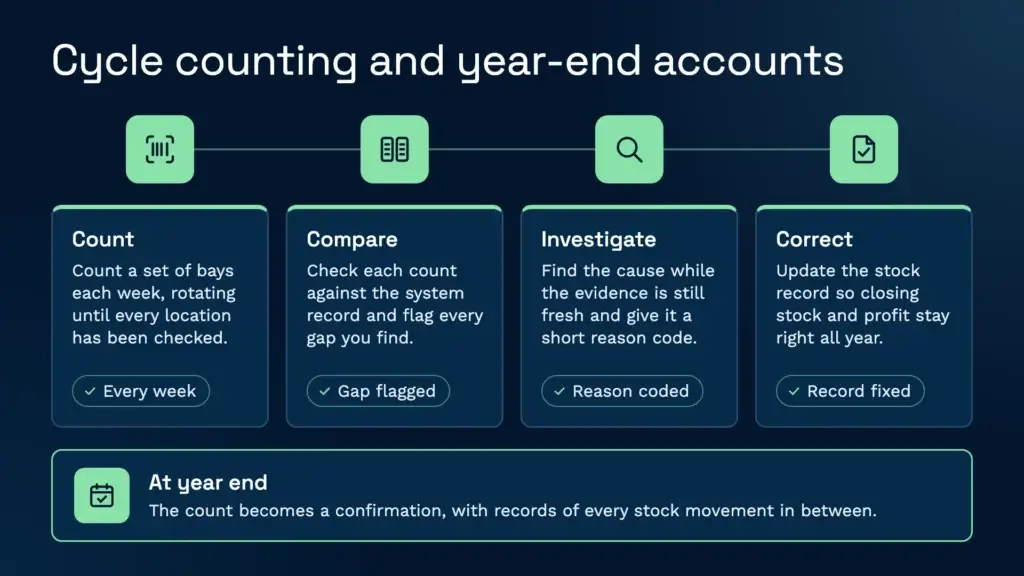
Quantity matters as much as price here. If the count is wrong, the closing stock figure is wrong, and profit is wrong with it. ICAEW’s guidance makes the same point from the audit side. A count at a different date needs records of stock movements in between that can be relied on, and the longer the gap, the harder that reconciliation becomes. A cycle count programme builds those records as you go.
JODA Freight is a Clarus customer that moved through this shift. JODA reached 99% stock accuracy, and stock takes went from weeks to one day.
How a WMS schedules and records counts
Paper and spreadsheet counts have a record-keeping problem. Sheets get lost, figures get rewritten, and nobody can say who counted what. A warehouse management system removes that by putting the count on the system from the start. Clarus checks run alongside picks, replenishments and putaways rather than stopping them, so the schedule fits around the day’s work.
Every check is timestamped, attributed to a named operator and closed with a reason code. Results can be exported for customers or auditors. These records support compliance requirements, including Cyber Essentials Plus and food safety standards. The wider stock control side sits in the Clarus inventory management feature.
Three rules to start with
- Pick the method per product class. Count high-value and fast-moving stock most often, and use location checks to find where errors cluster.
- Write the tolerance and recount rules down. Agree them before the first count, not after the first argument.
- Code every variance. A reason code turns a gap into a process fix.
Our verdict: run cycle counts all year as your main accuracy control, and keep a full count only where your auditor or accounts need one at year end.
Speak to a warehouse expert
If you’re evaluating your options and want to see how stock checks run in practice, Clarus is worth a conversation. We work with 3PLs and distributors to implement warehouse management software that fits the way you operate, not the other way around.
Get in touch with our team to talk through your requirements.
Related reading: how to improve inventory accuracy.