

If you’re a UK 3PL evaluating Boltrics, you’re probably weighing a proven but ERP-heavy Dynamics 365 platform against a growing pool of purpose-built, cloud-native warehouse management systems. Boltrics’ 3PL Dynamics is built on Microsoft Dynamics 365 Business Central and covers warehouse management, transport management and freight forwarding. That breadth is useful, but it also brings the structure, licensing and change management of an ERP platform. For many UK operators, a more specialised 3PL WMS is worth a serious look.
This guide walks through five Boltrics alternatives for 3PLs in 2026, with a comparison table, a look at why teams switch, and practical guidance on how to choose.
Quick comparison: Boltrics alternatives at a glance
| Solution | Cloud-native | Multi-client / 3PL billing | Typical go-live | Best for |
|---|---|---|---|---|
| Clarus WMS | Yes (serverless) | Native — automated billing engine | Around 12 weeks | UK 3PLs, multi-client operations, fast deployment |
| Boltrics | No — Dynamics 365 BC | Native (3PL Dynamics) | 6-12 weeks (claimed: 3 months) | Logistics groups wanting integrated ERP + WMS + TMS |
| Deposco | Yes | Native multi-tenant | 6-12 weeks | High-growth 3PLs needing scale and speed |
| Mintsoft | Yes | Native — per-client tenancy | 4-8 weeks | Multi-site 3PLs, UK and Europe |
| Snapfulfil | Yes | Native (Multi-owner) | 6-10 weeks | High-volume fulfilment, e-commerce heavy |
| Delta WMS | Yes | Native multi-client | 4-6 weeks | Speed-focused, UK food and beverage, wholesale |
Why teams leave Boltrics for cloud-native alternatives
Boltrics is built on Dynamics 365 Business Central, which brings both strengths and constraints.
Implementation speed and cost
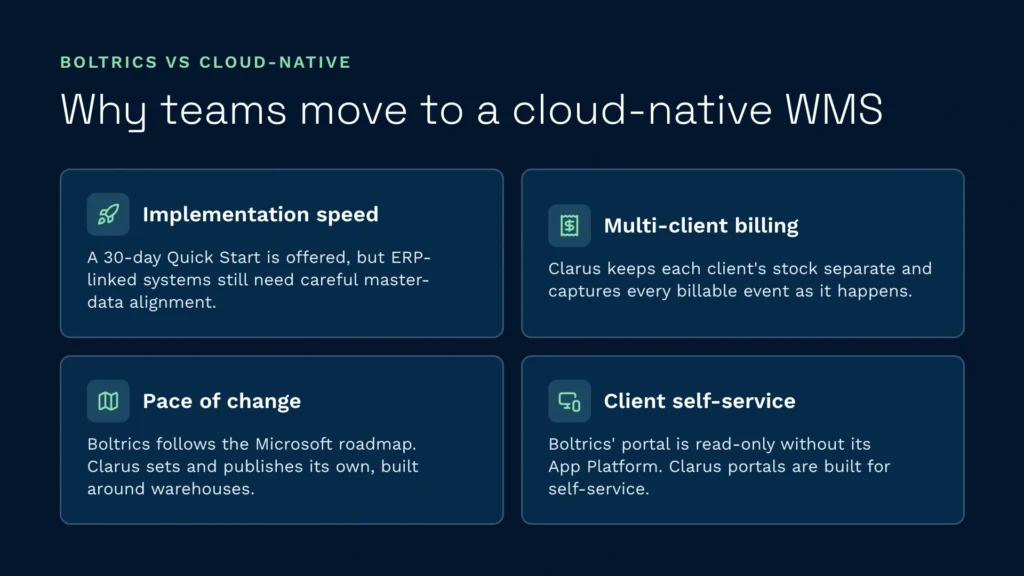
Boltrics offers a Quick Start package designed for a 30 business-day go-live, and it promises a fixed time and fixed price for a three-month implementation. But a system tied to a broader ERP architecture still needs careful master-data alignment and change management across your tech stack. If you’re unsure whether you need an ERP at all, our guide to ERP vs WMS sets out when a dedicated WMS makes more sense.
Multi-client billing and separation
Boltrics handles multi-client logistics natively through 3PL Dynamics, including contract-based billing. But some warehouse teams find the wider Dynamics 365 interface heavy for day-to-day floor work. Purpose-built 3PL systems like Clarus focus entirely on the warehouse user. Each client’s inventory, orders and activity are kept separate within a single warehouse, and every billable event (receiving, storage, pick, pack, despatch) is captured as it happens. Our guide to multi-client WMS goes into more detail.
Pace of change
Boltrics is subscription-based and kept up to date, but you’re still working within the wider Microsoft ecosystem and its roadmap. A specialist WMS vendor sets its roadmap around warehouse operations alone. Clarus, for example, publishes its public roadmap so you can see what’s coming.
Client visibility and self-service
Boltrics includes a web-based Customer Portal where clients can see inventory, shipments, receipts and invoices. On its own, the portal is read-only, and clients can only take action when it’s combined with Boltrics’ App Platform. Some 3PLs prefer a portal built around self-service from the start. Clarus, Deposco, Mintsoft and Snapfulfil all offer client portals, which cut your support workload and give your customers a more professional experience.
Clarus WMS: the purpose-built alternative
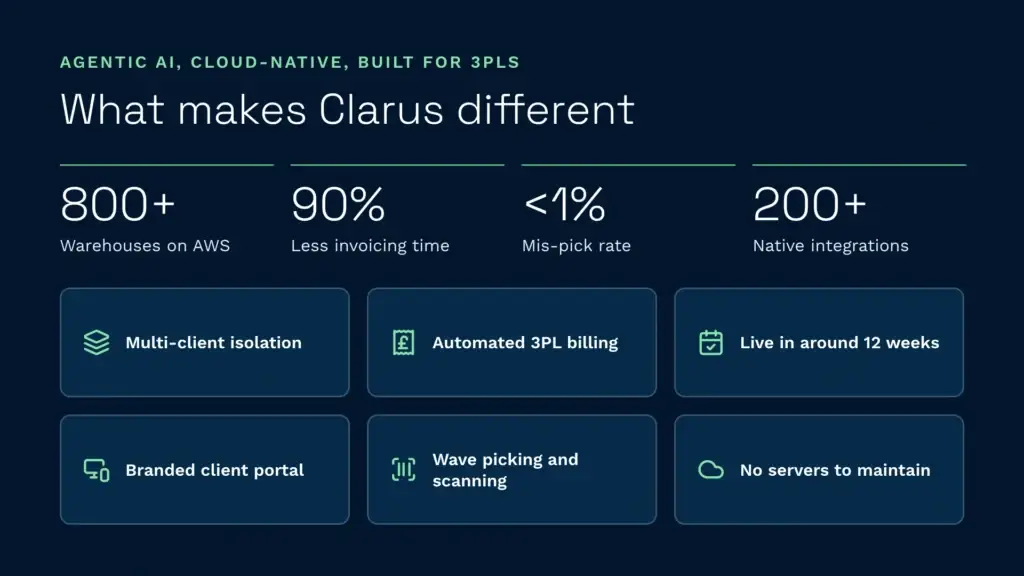
Clarus is an agentic AI-driven, cloud-native WMS built for 3PLs and multi-client warehouses. It runs on AWS, with more than 800 warehouses using it across Europe, North America, the Middle East and Asia-Pacific.
What makes Clarus different
- True multi-client isolation: Each client’s stock, billing and reporting is kept separate within one shared system, with no manual segregation workarounds.
- Automated 3PL billing: With 3PL billing, you set rates once, charges are captured as the work happens, and invoices build automatically. St John’s Hall Storage, a UK third-party warehousing provider, cut its invoicing time by 90% and saves the equivalent of about two staff members’ workload. Clarus’s AI assistant also catches missed pallet charges across customer accounts. Pricing is published, paid monthly, with no long-term tie-in.
- Deployment without the ERP overhead: A standard Clarus implementation goes live in around 12 weeks, and there’s no ERP architecture to untangle on the way. You’re not migrating years of ERP master data. You’re onboarding your operation into a system built for the work you do, with templates and guidance from Clarus Onboarding.
- Client self-service portal: With Customer Self-Service, clients log in to a portal carrying your brand and see live stock, order milestones, shipment tracking and charging data. That’s one less phone call about “where’s my stock?”
- Wave picking and scan verification: Smart Wave Picking batches orders and optimises walking paths, and barcode scanning stops a packer putting the wrong item in the wrong box. Clarus customers cut mis-picks to under 1%. JODA Freight, a refrigerated logistics provider, moved off an Excel database and reached 99% stock accuracy, with stock takes cut from weeks to a single day.
- Native integrations: Clarus connects to over 200 systems, including Shopify, Amazon Shipping, and carriers such as DHL, UPS, Royal Mail and Evri. If you’re keeping Business Central for finance, there’s a Clarus and Business Central integration through Patchworks. The Core plan includes unlimited courier integrations and unlimited ecommerce and marketplace connectors. See the full list on the integrations page.
- No servers to maintain: Clarus is cloud-native, so there’s no on-site server or infrastructure for your team to look after.
Where Clarus is a poor fit
Clarus isn’t right for pure B2C parcel fulfilment at massive single-client volume (millions of picks a month for one customer). Nor is it right for businesses that need warehouse management, accounting, GL and AP/AR in one system. If that’s you, Dynamics or another enterprise ERP may be the right call. But for most 3PLs that are multi-client, mid-scale and need billing automation, Clarus is a strong fit.
Proof point: MSD (Mitchell Storage & Distribution)
MSD replaced a bespoke, in-house warehouse system and a layer of spreadsheets with Clarus and cut warehouse admin by 60%. Customer emails and calls about stock levels and costs fell by about 60%. MSD now records bespoke work such as kitting, re-boxing and cross-docking as chargeable tasks, and has added cross-docking for the Palletforce network as a revenue stream. Read more in the Clarus customer stories library.
Other strong alternatives to Boltrics
Deposco
Deposco is a cloud platform that combines warehouse management, order management and a 3PL client portal. It competes hard on integration breadth, with 150+ pre-built connectors to carriers, shopping carts and ERPs, and says customers can reach operational efficiency in 90 days or less. Its Bright Portal, launched in 2026, gives clients real-time access to inventory, order status, SLA performance and billing. Pricing is custom and SaaS-based.
Weaknesses vs Clarus: Deposco is a US company with a UK office in London, so check what level of UK support and local carrier coverage you’d get. Ask to see your own rate cards configured in a demo before you compare billing.
Mintsoft
Mintsoft is a cloud-based WMS for 3PLs and ecommerce fulfilment, with native multi-client support and a client portal where each client gets their own login. It cites over 150 integrations. Note that Mintsoft has been owned by The Access Group since 2020 and is sold as Access Mintsoft.
Weaknesses vs Clarus: Mintsoft lets you build client invoices from storage, handling and shipping charges, but it doesn’t capture every billable event as it happens the way Clarus does. For complex billing rules, expect some manual work. Compare the two in our guide to Mintsoft alternatives.
Snapfulfil
Snapfulfil, from Synergy Logistics, is a specialist fulfilment WMS that’s especially strong in ecommerce and high-volume parcel picking. It handles multiple clients through multi-owner functionality, includes 3PL charging options such as storage, pick surcharging and VAS charging, and gives clients their own access portal.
Weaknesses vs Clarus: Snapfulfil is built around ecommerce fulfilment first. If your operation mixes pallet storage, cross-docking and bespoke client workflows, check how well it handles complex multi-activity pricing. See our Mintsoft vs Snapfulfil comparison for more.
Access Delta
Access Delta is one of the two products in Access WMS from The Access Group, alongside Access Mintsoft. It’s a mature, widely installed UK system that can be deployed on-premise or in the cloud. It includes a 24-hour client portal where clients can view stock, track orders and see invoices, and Access cites 150+ pre-built integrations across the product family.
Weaknesses vs Clarus: Access describes storage billing rules on location types but no dedicated activity-based 3PL billing engine. Pricing is per feature, so you’ll need a formal quote. And if you’re comparing Delta with Mintsoft, you’re comparing two products from the same vendor.
Comparison: Boltrics vs the alternatives
Architecture and deployment
Boltrics: Runs on Dynamics 365 Business Central and can be deployed in the cloud or on-premise. Boltrics offers a 30 business-day Quick Start and a fixed-price, three-month implementation, but plan for post-go-live tuning and change management across your ERP.
Clarus, Deposco, Mintsoft, Snapfulfil: All cloud-based and purpose-built, with no ERP architecture to work around. A standard Clarus implementation runs to around 12 weeks. The others quote in weeks, so ask each one for the figure in writing.
Multi-client billing
Boltrics: Contract-based billing is part of 3PL Dynamics, but it sits inside a wider ERP structure. Check how much configuration your rate cards need.
Clarus: Every billable event (receiving, storage, picking, packing, despatch, returns, value-added services) is captured as the work happens. Client A’s activity never crosses into Client B’s charges, and invoices build automatically. Our guide on how to automate 3PL billing explains the approach.
Deposco, Mintsoft, Snapfulfil: All support multiple clients. Ask each to demo your most complex rate card before you compare.
Client visibility and portal
Boltrics: Web-based Customer Portal showing inventory, shipments, receipts and invoices. It’s read-only unless combined with the App Platform.
Clarus: Branded self-service portal with live stock, order milestones, tracking and charges, with access set per role.
Deposco, Mintsoft, Snapfulfil, Access Delta: All offer client portals. Compare what clients can actually do in them, not just what they can see.
Integration breadth
Boltrics: Strong if your tech stack is already Dynamics. It includes EDI and ERP integration options, but check pre-built coverage for the ecommerce platforms and carriers you use.
Clarus: Connects to over 200 systems, including Shopify, Amazon Shipping and carriers such as DHL, UPS, Royal Mail and Evri. If a system isn’t listed, there’s an open API.
Deposco, Mintsoft, Access WMS: Each cites 150+ pre-built integrations.
How to choose: Boltrics vs the alternatives
Ask yourself these questions.
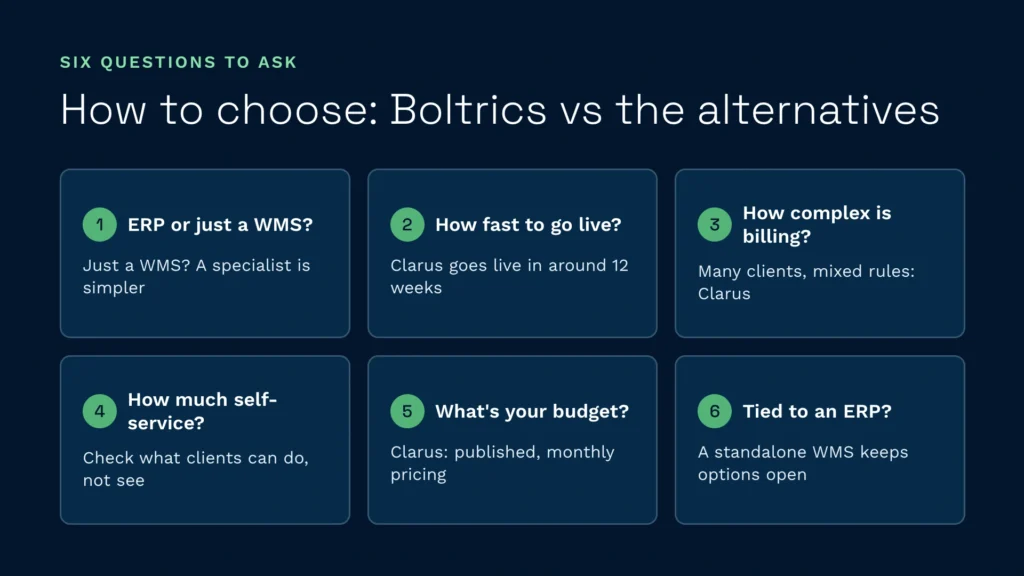
1. Do you need an integrated ERP or just a WMS?
If you need accounts, GL, AP/AR and multi-currency handling in one system, and you’re already on Dynamics, Boltrics keeps you in the Microsoft ecosystem. If you just need a WMS that connects to your existing accounting software, a specialist WMS is simpler. Our ERP and WMS guide explains the difference.
2. How fast do you need to go live?
If you’re comfortable with an ERP-style implementation and the change management that comes with it, Boltrics is manageable. If you want a warehouse system live within a quarter without touching your ERP, a standard Clarus implementation runs to around 12 weeks. Get Deposco and Mintsoft to quote alongside it.
3. How many clients do you serve, and how complex is their billing?
- Single client, high-volume ecommerce: Snapfulfil.
- Multiple clients with mixed SLAs and billing rules: Clarus or Mintsoft.
- Large client base at high scale: Deposco or Clarus.
4. How important is client self-service?
If your clients expect a portal to check stock and shipments, every option here has one. The difference is how much clients can do in it. Boltrics’ portal is read-only unless you add its App Platform.
5. What’s your budget?
Boltrics is priced per user on top of the Dynamics platform. Clarus publishes its pricing, is paid monthly and has no long-term tie-in, which makes it easier to budget for and justify to your finance team.
6. Do you want to be tied to an ERP platform, or keep your options open?
Boltrics is built on Dynamics 365 Business Central, so your WMS and ERP move together. Changing either later means reworking integrations and migrating data. With a standalone WMS like Clarus, your warehouse system can change independently of your accounting software, which lowers your strategic risk.
Migration path from Boltrics to a cloud-native alternative
If you’re running Boltrics now and evaluating a move, here’s what to expect.
Data preparation
You’ll export client master data, product catalogues, SKU attributes and any active stock from Boltrics. Most alternatives have data-import templates, and Clarus provides templates and guidance for this step. Allow time to clean and map the data properly, as this is where most migrations slip.
Integration re-mapping
Your EDI, carrier feeds and ecommerce connections will need pointing at the new system. If the new platform has pre-built connectors for them, this is quick. If you’ve built bespoke Dynamics integrations, allow extra time to rebuild them or find a pre-built equivalent.
Testing and checks
Before cutover, run checks to confirm that picking, packing and invoicing are correct in the new WMS. Keep this period tight, since running two systems side by side for too long is one of the most common reasons a switch stalls.
Cutover
On the chosen date, you move clients over, run a final data sync and go live, with support standing by. Clarus’s onboarding team keeps your operation running during the move.
Total migration timeline: around 12 weeks from decision to live. That’s far less disruption than an ERP-to-ERP swap, and the billing gains start the month you go live. For more on implementation, see our guide to WMS for 3PL.
Speak to a warehouse expert
If you’re weighing up your options and want to see how a purpose-built WMS works in practice, Clarus is worth a conversation. We work with 3PLs and distributors across the UK and Europe to implement warehouse management software that fits the way you operate, not the other way around.
Get in touch with our team to talk through your requirements.