

Oracle WMS Cloud is a powerful enterprise warehouse management system, but it comes with a hefty price tag, long implementation timelines and limited flexibility for 3PL operations. If you’re evaluating Oracle or looking to switch, this guide compares the leading alternatives and shows why a purpose-built, cloud-native WMS might be a better fit, especially if you run a 3PL, wholesale distributor or smaller multi-site operation.
We’ve researched the market, reviewed G2 ratings, and compared pricing models, implementation speed and features. Here’s what you need to know.
Schnellvergleich: Oracle WMS im Vergleich zu den besten Alternativen
| System | Am besten für | 3PL-Abrechnung für mehrere Kunden | Implementierungszeit | Preismodell | Cloud-nativen |
|---|---|---|---|---|---|
| Clarus WMS | 3PL-Anbieter, britische Distributoren, speziell dafür errichtete | Integrierte, automatisierte Abrechnung pro Kunde | Wochen, nicht Quartale | Veröffentlicht: Tarife ab 1.000 £/Monat (Grundpreis) | Ja, Serverless |
| Oracle WMS Cloud | Lager von Großunternehmen | Eingeschränkt, erfordert Anpassung | Mehrmonatiges Unternehmensprogramm | Nicht veröffentlicht; wird je nach Geschäft angegeben | Ja (SaaS) |
| Blue Yonder WMS | Hochautomatisierte Anlagen, Großunternehmen | Leistungsfähig, aber komplexe Einrichtung | Mehrmonatiges Unternehmensprogramm | Nicht veröffentlicht; wird je nach Geschäft angegeben | Ja (Cloud) |
| Infor WMS | Große Vertriebszentren, Infor-Ökosystem-Shops | Konfigurierbar, erfordert jedoch viel manuelle Arbeit | Mehrmonatiges Unternehmensprogramm | Nicht veröffentlicht; wird je nach Geschäft angegeben | Vor Ort oder in der Cloud |
| Manhattan Associates | Große Unternehmen mit hohem Automatisierungsgrad | Fortgeschritten, erfordert jedoch einen hohen Implementierungsaufwand | Mehrmonatiges Unternehmensprogramm | Nicht veröffentlicht; wird je nach Geschäft angegeben | Ja (Cloud-nativ, Microservices) |
| Snapfulfil | 3PL-Anbieter im Mittelstand, Schwerpunkt Großbritannien | Umfassende Unterstützung für mehrere Mandanten | Wochen, konfigurationsgesteuert | Nicht veröffentlicht; wird je nach Geschäft angegeben | Hybrid (Cloud + lokal) |
Clarus WMS – speziell für 3PL-Anbieter und britische Distributoren entwickelt
Who it’s best for: single-site and multi-site 3PLs, wholesale distributors, Speisen und Getränke, ecommerce fulfilment and manufacturing. If you run a multi-client warehouse or have fast-changing client contracts, Clarus is built for that.
Was macht den Unterschied aus?
Clarus is a cloud-native, agentic AI-driven WMS. Unlike enterprise platforms that retrofit multi-client billing after the fact, Clarus was built for 3PL operations from the start: each client’s stock, billing and reporting are kept separate, yet managed from one interface.
Stärken
- Automatisierte 3PL-Abrechnung Every putaway, pick, pack, cycle count, value-added service and storage day is recorded at source, and client-specific tariffs turn completed work into itemised invoice lines through automated charging and invoicing. St John's Hall Lagerung, a UK 3PL, cut invoicing time by 90% and no longer re-keys invoice data into its accounts package. No more spreadsheet disputes at month-end.
- Schnelle Bereitstellung: Live in weeks, not quarters. You go live on real data quickly because the system doesn’t need a long migration or enterprise-scale configuration first.
- Einfache Verwaltung mehrerer Kunden: Picking, putaway, shelf-life and FIFO rotation und billing rules are set per client. You’re not retrofitting client separation into a single-client design; it’s native.
- Cloud-native Architektur No servers to patch, no version upgrades, no infrastructure overhead. It runs on ISO-certified AWS infrastructure and you’re always on the latest release.
- Kundenportal: Through Kunden-Self-Service, clients see live stock levels, order status, despatch tracking and charges in a branded portal, with access set by role. It ends the daily “how much stock have I got?” phone calls.
- Über 200 Integrationen: Clarus connects to over 200 systems, including carriers such as Königliche Post, DHL und Versand durch Amazon, ecommerce platforms such as Shopify, WooCommerce and eBay, and accounting packages such as Sage. Browse the full list on the integrations page.
- Actionable AI: Clarus’s KI-Assistent reads operational data and takes action within set permissions, such as recovering missed billing charges or quarantining expired stock, rather than just reporting on a dashboard.
Einschränkungen
Clarus isn’t a fit if you’re running a single, massive automated distribution centre with 500+ users and complex SAP integration at enterprise scale. It’s built for 3PLs and distributors, not Fortune 500 mega-facilities. It’s also not the choice if you need on-premise infrastructure for regulatory reasons.
Preise
Die Tarife beginnen bei einem Grundpreis von 1.000 £ pro Monat, und die Preisstufen werden veröffentlicht, anstatt sie für ein Verkaufsgespräch zurückzuhalten. Ein vollständiges Angebot umfasst gestaffelte Benutzerlizenzen, bei denen die Kosten pro Benutzer mit steigender Nutzerzahl sinken, sowie eine einmalige Einrichtungsgebühr. Ihr Preis richtet sich nach der Anzahl der Standorte und Benutzer, nicht nach dem Durchsatz. Daher bleiben Bestellungen, Sendungen, SKUs, Spediteure und Integrationen unbegrenzt, egal wie hoch die Spitzenauslastung auch sein mag.
The contrast with Oracle isn’t really about the number, it’s about whether there is a number at all before you enter a sales cycle. Preise für Clarus WMS anzeigen und Sie können die Stufen sowie einen Richtwert auf einen Blick erkennen.
Kundenreferenzen
JODA Fracht, a UK refrigerated logistics provider, moved off an Excel database, reached 99% stock accuracy and cut stock takes from weeks to a single day. MSD (Mitchell Storage & Distribution) saw customer emails and calls about stock levels drop by around 60% once clients could check for themselves, and turned its cross-docking operation for the Palletforce network into a reliable revenue stream. KATEM Logistik went from around 1,000 picks a month on a largely paper-based system to between 10,000 and 12,000, with order accuracy up from an estimated 80% to between 98% and 99%.
These aren’t Fortune 500 facilities. They’re the kind of operators that make up the backbone of UK warehousing. Read more in our Kundenberichte.
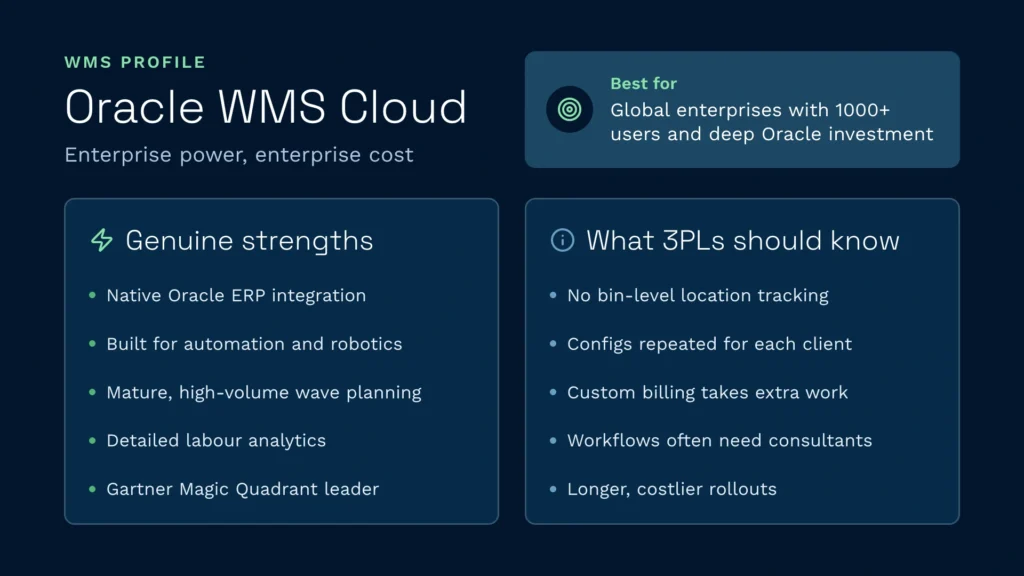
Oracle WMS Cloud: Leistungsfähigkeit auf Unternehmensniveau, Kosten auf Unternehmensniveau
Who it’s best for: Very large enterprises (1,000+ users across multiple continents) with deep Oracle investments and budgets that can absorb long implementation timelines and enterprise-level annual costs.
Was das ist
Oracle WMS Cloud started life as LogFire, a cloud-based WMS that Oracle acquired in 2016 and now sells as part of its supply chain management suite. It has advanced features like wave planning, directed putaway, labour tracking and deep supply chain integration, if you have the time and money to make the most of them.
Stärken
- Umfassende ERP-Integration: If your business runs on Oracle ERP, warehouse activity flows into the wider Oracle suite without third-party middleware.
- Erweiterte Automatisierungsunterstützung: Integrates with autonomous mobile robots, AGVs, conveyors, sortation systems and carousels. Built for enterprise-scale sort and pack automation.
- Planung für fortgeschrittene Surfer: Hochgradig anpassbare Wellenvorlagen für komplexe Kommissionierszenarien. Wenn Ihr Betrieb täglich Hunderte von Wellen abwickelt, ist Oracle für dieses Volumen gerüstet.
- Erfassung und Optimierung des Arbeitsaufwands: Detaillierte, aufgabenbezogene Personalkostenkalkulation und Produktivitätsanalysen, die sich besonders in sehr großen Betrieben mit enormen Personalkosten bewähren.
- Gartners Glaubwürdigkeit: Named a Leader in the Gartner Magic Quadrant for WMS for the 11th consecutive year in 2026. That matters if your procurement process demands it.
Where 3PLs tend to struggle
Oracle does support multi-client operations, but the platform is designed for enterprise-scale programmes, and that shows up in the places 3PLs care about most:
- Billing for contract variations: Per-client tariffs, value-added services and contract-specific charges usually need configuration work, and often partner or consultant time, before invoices come out the way your contracts are written.
- Customisation runs through consultants: If the standard picking reports, replenishment rules or client-specific workflows don’t match your operation, changing them is typically a consulting engagement. That’s cost and delay on top of licensing.
- Client onboarding: Ask how long it takes to set up a new client end to end, including billing rules and portal access, and who does the work. If the answer is a project rather than a configuration task, that limits how fast you can grow.
Realität der Umsetzung
Oracle doesn’t publish a standard implementation timeline. Enterprise WMS programmes of this kind commonly run to several months for a single site, and considerably longer for multi-site or heavily customised rollouts, followed by a stabilisation period before the operation is running smoothly on it.
In that window, your team is in implementation mode. They’re not improving operations, they’re answering questions about your business processes and approving customisations.
Preise
Oracle doesn’t publish base pricing, so any figure you see quoted online is someone’s guess rather than a rate card. What you can plan for is the shape of the cost rather than its size: a subscription that scales with users, warehouses and transaction volume, an implementation consulting engagement, data migration, training, and custom development where the standard product doesn’t fit. Get every one of those as a separate line in writing, and ask specifically what happens to the subscription when your volumes grow, because that’s the line that tends to move.
Wo Oracle punktet
If you’re a large enterprise with existing Oracle infrastructure, legacy systems to replace, automated high-speed warehouses, and a team of 20+ people who can absorb a year-long implementation, Oracle WMS has some of the deepest ERP integration and automation support in the market. For that segment, it’s the right tool.
For everyone else, 3PLs, distributors, food and beverage, UK operations, the cost, complexity and timeline are overbuilt.
Blue Yonder WMS: AI-powered automation at scale
Who it’s best for: High-automation facilities (conveyor-heavy, robotics-driven), global enterprises and demand forecasting-intensive operations.
Übersicht
Blue Yonder (formerly JDA Software, now owned by Panasonic) is a long-standing name in warehouse automation and demand planning, and was named a Leader in the 2026 Gartner Magic Quadrant for WMS for the 18th consecutive time. It’s rated 4.2 out of 5 on G2, from a small number of reviews. It’s strongest where robotic systems, automated conveyors and machine-learning-driven wave optimisation are in play.
Stärken
- AI for demand forecasting and labour planning, predicting staffing needs from order patterns
- Enge Integration mit robotergestützten Kommissionier- und Sortiersystemen
- Real-time orchestration across people and automation
- Global support and multi-language capability
Einschränkungen
- Preis: Enterprise-Segment, Preise werden pro Geschäft vereinbart und nicht veröffentlicht. Liegt deutlich über dem Preisniveau, zu dem die meisten kleinen bis mittelgroßen 3PL-Anbieter einkaufen.
- Umsetzung: Ein von Beratern geleitetes Programm und nicht etwa eine reine Konfigurationsmaßnahme.
- Komplexität im 3PL-Bereich: Multi-client billing exists but needs significant configuration. It’s not native like Clarus.
- Für viele ist das übertrieben: If you’re not running robots and automated sorting, you’re paying for features you won’t use.
Für wen ist es geeignet?
If you run a high-automation facility (an Amazon-style fulfilment centre or a large pallet network hub) and you have the budget and implementation bandwidth, Blue Yonder is among the strongest options for AI-driven optimisation.
Infor WMS: mature, complex, Infor-centric
Who it’s best for: Large enterprises running Infor ERP, facilities with highly standardised processes and long-term implementation budgets.
Übersicht
Infor WMS was named a Leader in the 2026 Gartner Magic Quadrant for WMS for the eighth consecutive time. It’s mature, widely used and tightly connected to Infor’s wider supply chain tools.
Stärken
- Proven at scale, with a large global install base
- Erweiterte Logik für die gezielte Einlagerung und Wellenplanung
- Integration in das Deep Infor-Ökosystem (Lieferkettenplanung, Fertigung)
- Cloud-based today, with many customers migrating from older on-premise installs
Einschränkungen
- Komplexität der Benutzeroberfläche: Routine tasks can take a lot of clicks and data-entry steps per operation.
- Aufwand für die Anpassung: Changing standard reports and workflows usually involves Infor or partner consultants, which ties you to that professional services ecosystem.
- Umsetzungszeit: Eher ein mehrmonatiges Programm als eine reine Konfigurationsmaßnahme. Langwierig und mit hohem Berateraufwand verbunden.
- 3PL-Eignung: Configurable multi-client support, but manual-heavy. It isn’t built natively for it like Clarus.
Für wen ist es geeignet?
If you’re already deep in the Infor ecosystem and have a large, standardised operation with a long implementation runway, Infor WMS is a proven choice. For smaller 3PLs, or those not committed to Infor, it’s overengineered and slow to deploy.
Manhattan Associates WMS: cloud-native, microservices-based
Who it’s best for: Large global enterprises, automation-first operations and organisations with significant IT investment.
Übersicht
Manhattan Associates was named a Leader in the 2026 Gartner Magic Quadrant for WMS for the 18th time in a row. Its Manhattan Active Warehouse Management platform is built entirely on microservices.
Stärken
- Cloud-native, microservices-based design, scalable and modular
- Umfassende Automatisierungsintegration (Robotik, Fördersysteme)
- Fortgeschrittene Analysen zu Arbeitskräften und Produktivität
- Global scale, handling high-volume operations across multiple regions
Einschränkungen
- Preis: Top-tier and enterprise-only, quoted per deal rather than published.
- Umsetzung: A long, consultant-led programme. You’ll need a dedicated implementation team.
- Komplexität: Advanced features need technical expertise to configure and maintain.
- Einrichtung eines 3PL-Dienstleisters: Multi-client billing is advanced, but implementation-heavy. Better than Oracle’s, but not as native as Clarus.
Für wen ist es geeignet?
If you’re a large parcel or logistics provider with significant IT resources and a multi-year roadmap, Manhattan Associates has world-class automation and analytics. For UK 3PLs and distributors, it’s overscaled and overpriced.
Snapfulfil: UK-focused 3PL alternative
Who it’s best for: 3PLs, mid-market distributors and UK-centric operations looking for a quicker alternative to Oracle.
Übersicht
Snapfulfil is a UK-born, SaaS cloud WMS with dedicated 3PL functionality, popular with mid-market UK operators. See how it compares in our Snapfulfil alternative guide.
Stärken
- Strong multi-client support with additional 3PL functionality
- Configuration-led implementation, with a 45-day implementation claimed on its own site
- Unterstützung in Großbritannien und auf Großbritannien ausgerichtete Entwicklung
- Cloud-hosted, so no on-site servers to maintain
Einschränkungen
- Kleineres Ökosystem: Good ecommerce connectors, but more limited ERP and TMS connectors, and custom integrations may need third-party middleware.
- Preise: No standard rate is published, so you’ll need a quote.
- Real-world timelines: The headline implementation figure is a best case. Multi-client requirements can stretch it, so get the go-live date in the contract.
Für wen ist es geeignet?
Snapfulfil is a solid alternative if you want a UK-friendly 3PL platform without Oracle’s overhead. It’s a middle ground: not as feature-rich as the enterprise platforms, but faster to deploy and lower cost.
Vergleichstabelle: Wichtige Entscheidungsfaktoren
| Faktor | Klar | Oracle | Blue Yonder | Infor | Manhattan | Snapfulfil |
|---|---|---|---|---|---|---|
| Go-Live-Konfiguration | Wochen, konfigurationsgesteuert | Von Beratern geleitetes Programm | Von Beratern geleitetes Programm | Von Beratern geleitetes Programm | Von Beratern geleitetes Programm | Wochen, konfigurationsgesteuert |
| 3PL-Abrechnung (nativ) | Ja, automatisiert | Eingeschränkt, erfordert Anpassung | Ja, aber kompliziert | Ja, aber sehr manuell | Ja, Fortgeschrittene | Ja, stark |
| Preistransparenz | Veröffentlicht, ab 1.000 £/Monat (Grundpreis) | Nicht veröffentlicht | Nicht veröffentlicht | Nicht veröffentlicht | Nicht veröffentlicht | Nicht veröffentlicht |
| Cloud-nativen | Ja, Serverless | Ja (SaaS) | Ja (Cloud) | Hybrid | Ja, Microservices | Hybrid |
| Integrationen | 200+ | Das Deep-Oracle-Ökosystem | 100+ | Infor-Ökosystem | 50+ | 30 bis 50 |
| Am besten für | 3PL-Anbieter, Distributoren | Großunternehmen | Hoher Automatisierungsgrad | Infor-Shops | Weltweite Ebene | 3PL-Anbieter in Großbritannien |
| Reaktionszeit des Supports | Unter 2 Minuten | Gestaffelt, in der Regel nach Stunden | Gestaffelt, in der Regel nach Stunden | Gestaffelt, in der Regel 4 bis 24 Stunden | Gestaffelt, in der Regel 4 bis 24 Stunden | Gestaffelt, in der Regel 2 bis 4 Stunden |
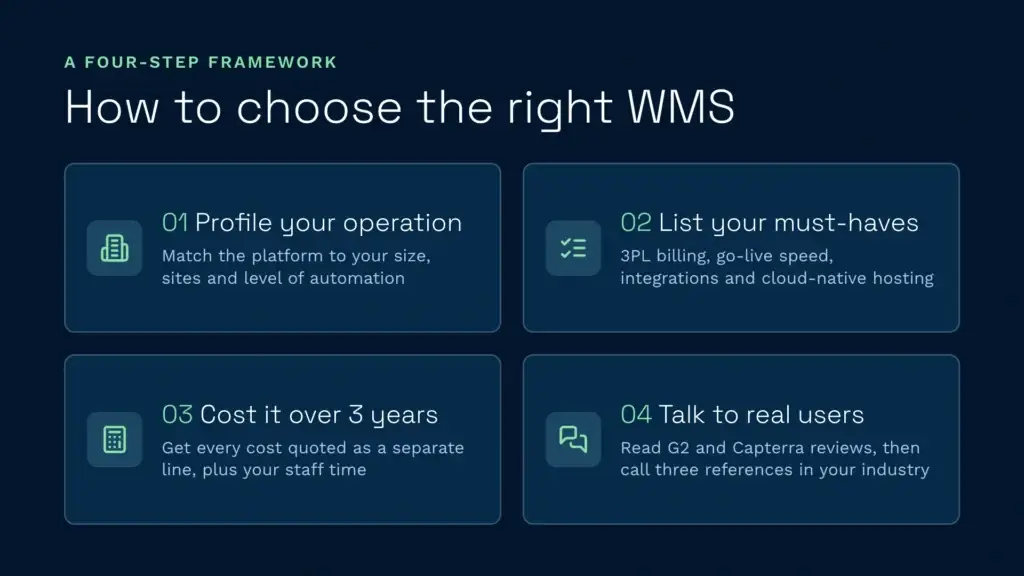
So wählen Sie das richtige WMS für Ihr Unternehmen aus
Choosing a WMS is one of the biggest operational investments you’ll make. Here’s a framework.
1. Start with your operation’s size and profile
- Ein Standort, 50 bis 200 Benutzer: Clarus or Snapfulfil are good fits, with fast deployment and lower cost.
- 3PL-Anbieter mit mehreren Standorten (5 bis 50 Standorte): Clarus is purpose-built for this. Snapfulfil is also strong.
- Automatisiertes Distributionszentrum, über 200 Benutzer: Blue Yonder, Manhattan or Infor. You need advanced automation integration and labour optimisation that smaller platforms don’t focus on.
- Globales Unternehmen, über 500 Benutzer, umfassendes Oracle-Ökosystem: Oracle WMS ist eine sinnvolle Wahl, wenn Sie über das nötige Budget und den erforderlichen Zeitrahmen verfügen. Andernfalls empfehlen wir Manhattan oder Infor.
2. Überlegen Sie sich, was für Sie unverzichtbar ist
3PL-Abrechnung für mehrere Kunden: Clarus (native), Snapfulfil (native), Manhattan (advanced), Infor (configurable), Oracle (configuration-heavy). If this is critical, Clarus or Snapfulfil are the fastest to value. See how automated 3PL billing works in practice.
Schnelle Bereitstellung: Clarus und Snapfulfil sind konfigurationsgesteuert und lassen sich in Wochen bemessen. Unternehmensplattformen sind mehrmonatige Projekte. Bitten Sie jeden Anbieter, seinen Termin im Vertrag festzuhalten.
Spezifische Integrationen: Check that your ERP, shipping carrier and ecommerce platform are supported, and ask whether each connector is native or needs middleware. Clarus connects to 200+ systems.
Cloud-nativ, keine Infrastruktur: Clarus, Manhattan, Blue Yonder, Infor and Oracle are all available as cloud services, but how much of the hosting, upgrades and patching you still handle varies. If you want zero infrastructure headaches, ask each vendor exactly what’s included.
3. Berechnen Sie die Gesamtbetriebskosten über einen Zeitraum von 3 Jahren.
Don’t just compare monthly fees. Include:
- Beratung bei der Implementierung und Unterstützung beim Go-Live
- Data migration and clean-up
- Schulung und Veränderungsmanagement
- Maßgeschneiderte Entwicklungs- und Integrationsarbeiten
- Jährliche Wartungs- und Support-Upgrades
- Infrastruktur und Hosting (sofern nicht cloud-nativ)
- Arbeitszeit der Mitarbeiter während der Umsetzung (Ihre Lohnkosten)
Only one of these vendors publishes a starting price, so a like-for-like table isn’t something anyone can honestly build from public data. Build your own instead: get each shortlisted vendor to quote subscription, implementation, migration, training and custom development as separate lines over three years, then add your own staff time. The gaps between the quotes are usually much larger than the gaps between the subscription rates.
4. Sprechen Sie mit aktuellen Nutzern
Überprüfen G2-Bewertungen for your shortlist. Pay attention to implementation time, support quality, and whether reviewers mention your specific pain points (3PL billing, food traceability, ecommerce volume).
Better yet, ask the vendor for three customer references in your industry and call them directly. You can start with our Kundenberichte.
Oracle WMS vs. Clarus: Ein direkter Vergleich
If you’re specifically comparing Oracle to Clarus, here’s the honest breakdown.
| Dimension | Oracle WMS Cloud | Clarus WMS |
|---|---|---|
| Für 3PL-Anbieter entwickelt? | Nachgerüstet. Die Unterstützung mehrerer Kunden ist vorhanden, erfordert jedoch umfangreiche Anpassungen und die Unterstützung durch Berater. Die Abrechnungslogik ist sehr arbeitsintensiv. | Native. Die Bestandsverwaltung, Abrechnung und Berichterstellung jedes Kunden sind von Grund auf voneinander getrennt. Die automatisierte Abrechnungs-Engine erfasst jedes abrechnungsrelevante Ereignis in Echtzeit. |
| Implementierungszeit | Ein von Beratern geleitetes Programm. Datenmigration, Anpassung an die individuellen Anforderungen und ein komplettes internes Projektteam. | Wochen statt Quartale. Minimaler Aufwand bei der Datenzuordnung, vorgefertigte Multi-Client-Workflows, keine Einrichtung der Infrastruktur. |
| Preise | Nicht veröffentlicht. Abonnement sowie Implementierung, Beratung, Anpassung und Schulung sind erst am Ende eines Verkaufszyklus ersichtlich. | Veröffentlichte Preisstufen ab 1.000 £/Monat (Grundpreis), zuzüglich gestaffelter Benutzerlizenzen und einer einmaligen Einrichtungsgebühr. Keine durch den Durchsatz bedingten Kosten. |
| Was bestimmt den Gesamtwert? | Implementierung und Beratung, deren Kosten bei Unternehmensprogrammen in der Regel höher sind als die Lizenzkosten selbst. | Die Abonnementstufe und die Anzahl Ihrer Nutzer, dargestellt als eine einzige Zeile. |
| Verfolgung auf Locator-Ebene | Nein. Oracle Inventory erfasst keine Daten auf Lagerplatz-/Lokator-Ebene, wodurch die Detailgenauigkeit der Transparenz eingeschränkt ist. | Ja. Jedes Produkt wird bis auf Lagerplatzebene nachverfolgt, was eine Standortmeldung in Echtzeit und Zykluszählungen ermöglicht. |
| Kundenportal | Erfordert eine separate Anpassung. Standardmäßig eingeschränkte Sichtbarkeit. | Integrierte, individuell anpassbare Echtzeit-Bestandsdaten, Auftragsverfolgung und Rechnungsübersichten. |
| KI und Automatisierung | Funktionen für maschinelles Lernen sind in Blue Yonder (einer Tochtergesellschaft von Oracle) vorhanden, nicht jedoch im Kern-WMS. | Der KI-Lagerassistent wertet Betriebsdaten aus, um Aufgaben auszuführen und Erkenntnisse zu gewinnen. „Smart Wave Picking“ optimiert die Laufwege (angeblich: Reduzierung um 50%). |
| SLA-Support | Gestaffelt. Enterprise-Support: Reaktionszeit in der Regel innerhalb von 4 Stunden. Standard-Support: 24 bis 48 Stunden. | Reaktionszeit unter 2 Minuten, rund um die Uhr, keine Abstufung je nach Vertragsstufe. |
| Integrationen | Umfassende Integration in das Oracle-Ökosystem (ERP, Lieferkettenplanung). Beschränkt auf ca. 50 Integrationen von Drittanbietern. | Über 200 Integrationen: über 70 Versanddienstleister, führende ERP-Systeme, E-Commerce-Plattformen, Palettennetzwerke, TMS-Systeme. |
| Vertragsbindung | Vertriebszyklen im Unternehmensbereich mit mehrjährigen Laufzeiten. Ein Ausstieg ist kostspielig. | Laufzeit von Monat zu Monat. Sie können jederzeit kündigen. Das verringert das Risiko. |
If you’re a 3PL, the choice is clear: Clarus solves the problem Oracle wasn’t designed for. If you’re a Fortune 500 enterprise with Oracle infrastructure, Oracle WMS makes sense.
Die Nachteile von Oracle WMS für 3PLs – eine ehrliche Einschätzung
We’ve mentioned this, but it’s worth spelling out for 3PL readers specifically:
- Komplexität der Rechnungsstellung: Multi-client, per-activity billing takes configuration and often consultant time to match your contracts. Without it, you end up relying on spreadsheets or external billing systems to reconcile what the WMS captured.
- Lange Zeit bis zur Wertschöpfung: Ein Unternehmensprogramm umfasst einen längeren Zeitraum, in dem Berater vor Ort tätig sind, maßgeschneiderte Entwicklungen stattfinden und interne Besprechungen abgehalten werden. Während dieser Zeit beantwortet Ihr Team Fragen zu Ihren Prozessen, anstatt diese zu optimieren. Planen Sie neben der Entwicklungsphase auch eine Stabilisierungsphase nach der Inbetriebnahme ein.
- Versteckte Kosten: Whatever subscription you’re quoted covers licensing only. Implementation consulting, data migration, training and custom development are separate, and on this class of platform they’re not a rounding error. Insist on seeing them itemised.
- Aufwand für die Anpassung: Changes to standard workflows and reports usually go through consultants, so you’re often choosing between the standard offering and a consulting queue.
- Client onboarding effort: Each new client needs its own billing rules, workflows and portal set-up. Find out how long that takes on Oracle before you sign, because it governs how quickly you can win and start new contracts.
For UK 3PLs and distributors, these downsides often outweigh the benefits of Oracle’s scale and deep ERP integration.
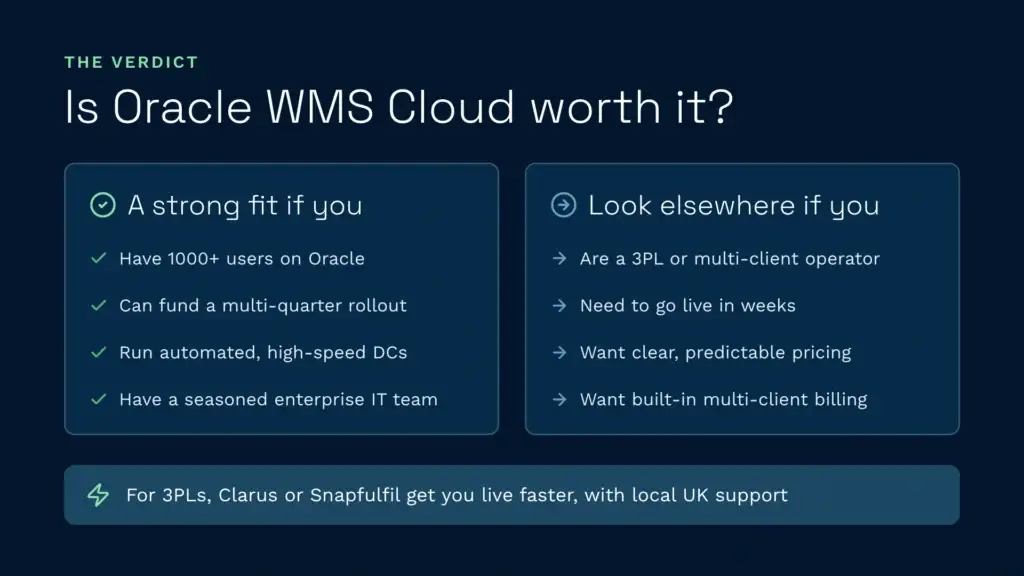
Lohnt sich Oracle WMS Cloud?
Oracle WMS Cloud lohnt sich, wenn:
- You’re a very large enterprise (1,000+ users) with existing Oracle investments
- Sie verfügen über den nötigen Spielraum für ein mehrquartalsübergreifendes Implementierungsprogramm und ein entsprechendes Unternehmensbudget.
- You run automated, high-speed distribution centres with complex labour tracking needs
- Ihr Team verfügt über umfassende Erfahrung im Bereich Unternehmenssoftware und ist in der Lage, langwierige Implementierungen zu bewältigen.
Oracle WMS Cloud isn’t worth it if:
- You’re a 3PL or multi-client distributor. Clarus or Snapfulfil will serve you better and faster
- Sie müssen schnell an den Start gehen (innerhalb von Wochen, nicht Monaten)
- Sie wünschen sich eine transparente, vorhersehbare Preisgestaltung ohne unerwartete Kosten bei der Beratung
- You need strong multi-client billing automation built in
- Die Gesamtkosten müssen von Anfang an ersichtlich sein und nicht erst am Ende des Verkaufsprozesses.
- Sie sind in Großbritannien tätig und wünschen sich lokalen, reaktionsschnellen Support
Sprechen Sie mit einem Lagerfachmann
If you’re evaluating your options and want to see how a purpose-built WMS works in practice, Clarus is worth a conversation. We work with 3PLs and distributors across the UK to implement warehouse management software that fits the way you operate, not the other way around.
Kontaktieren Sie unser Team um Ihre Anforderungen zu besprechen.