

Oracle WMS Cloud is a powerful enterprise warehouse management system, but it comes with a hefty price tag, long implementation timelines and limited flexibility for 3PL operations. If you’re evaluating Oracle or looking to switch, this guide compares the leading alternatives and shows why a purpose-built, cloud-native WMS might be a better fit, especially if you run a 3PL, wholesale distributor or smaller multi-site operation.
We’ve researched the market, reviewed G2 ratings, and compared pricing models, implementation speed and features. Here’s what you need to know.
Quick comparison: Oracle WMS vs the best alternatives
| System | Beste voor | 3PL multi-client billing | Implementatietijd | Prijsmodel | Cloud-native |
|---|---|---|---|---|---|
| Clarus WMS | 3PLs, UK distributors, purpose-built | Native, automated per-client billing | Weeks, not quarters | Gepubliceerd: abonnementen vanaf £ 1.000 per maand (basis) | Ja, serverloos |
| Oracle WMS Cloud | Large enterprise warehouses | Limited, requires customisation | Multi-month enterprise programme | Niet gepubliceerd; wordt per transactie vastgesteld | Yes (SaaS) |
| Blue Yonder WMS | High-automation facilities, large enterprises | Capable but complex setup | Multi-month enterprise programme | Niet gepubliceerd; wordt per transactie vastgesteld | Yes (cloud) |
| Infor WMS | Large distribution centres, Infor ecosystem shops | Configurable but manual-heavy | Multi-month enterprise programme | Niet gepubliceerd; wordt per transactie vastgesteld | Op locatie of in de cloud |
| Manhattan Associates | Large enterprises, automation-heavy | Advanced, but implementation-heavy | Multi-month enterprise programme | Niet gepubliceerd; wordt per transactie vastgesteld | Yes (cloud-native, microservices) |
| Snapfulfil | Mid-market 3PLs, UK focus | Uitgebreide ondersteuning voor meerdere klanten | Weeks, configuration-led | Niet gepubliceerd; wordt per transactie vastgesteld | Hybrid (cloud + on-premise) |
Clarus WMS, purpose-built for 3PLs and UK distributors
Who it’s best for: single-site and multi-site 3PLs, wholesale distributors, eten en drinken, ecommerce fulfilment and manufacturing. If you run a multi-client warehouse or have fast-changing client contracts, Clarus is built for that.
What makes it different
Clarus is a cloud-native, agentic AI-driven WMS. Unlike enterprise platforms that retrofit multi-client billing after the fact, Clarus was built for 3PL operations from the start: each client’s stock, billing and reporting are kept separate, yet managed from one interface.
Sterke punten
- Geautomatiseerde 3PL-facturering: Every putaway, pick, pack, cycle count, value-added service and storage day is recorded at source, and client-specific tariffs turn completed work into itemised invoice lines through automated charging and invoicing. St John's Hall Opslag, a UK 3PL, cut invoicing time by 90% and no longer re-keys invoice data into its accounts package. No more spreadsheet disputes at month-end.
- Fast deployment: Live in weeks, not quarters. You go live on real data quickly because the system doesn’t need a long migration or enterprise-scale configuration first.
- Multi-client simplicity: Picking, putaway, shelf-life and FIFO rotation en billing rules are set per client. You’re not retrofitting client separation into a single-client design; it’s native.
- Cloud-native architecture: No servers to patch, no version upgrades, no infrastructure overhead. It runs on ISO-certified AWS infrastructure and you’re always on the latest release.
- Klantenportaal: Through Klantzelfservice, clients see live stock levels, order status, despatch tracking and charges in a branded portal, with access set by role. It ends the daily “how much stock have I got?” phone calls.
- Meer dan 200 integraties: Clarus connects to over 200 systems, including carriers such as Koninklijke Post, DHL en Verzending via Amazon, ecommerce platforms such as Shopify, WooCommerce and eBay, and accounting packages such as Sage. Browse the full list on the pagina ‘Integraties’.
- Actionable AI: Clarus’s AI-assistent reads operational data and takes action within set permissions, such as recovering missed billing charges or quarantining expired stock, rather than just reporting on a dashboard.
Beperkingen
Clarus isn’t a fit if you’re running a single, massive automated distribution centre with 500+ users and complex SAP integration at enterprise scale. It’s built for 3PLs and distributors, not Fortune 500 mega-facilities. It’s also not the choice if you need on-premise infrastructure for regulatory reasons.
Prijzen
Plans start from £1,000 per month base, and the tiers are published rather than held back for a sales call. A full quote adds tiered user licensing, where the per-user cost falls as you scale, plus a one-off implementation fee. Your price moves with sites and users, not with throughput, so orders, shipments, SKUs, carriers and integrations stay unlimited however heavy the peak gets.
The contrast with Oracle isn’t really about the number, it’s about whether there is a number at all before you enter a sales cycle. View Clarus WMS pricing and you can see the tiers and an indicative figure in one step.
Customer proof points
JODA Freight, a UK refrigerated logistics provider, moved off an Excel database, reached 99% stock accuracy and cut stock takes from weeks to a single day. MSD (Mitchell Storage & Distribution) saw customer emails and calls about stock levels drop by around 60% once clients could check for themselves, and turned its cross-docking operation for the Palletforce network into a reliable revenue stream. KATEM Logistiek went from around 1,000 picks a month on a largely paper-based system to between 10,000 and 12,000, with order accuracy up from an estimated 80% to between 98% and 99%.
These aren’t Fortune 500 facilities. They’re the kind of operators that make up the backbone of UK warehousing. Read more in our klantverhalen.
Oracle WMS Cloud, enterprise power, enterprise cost
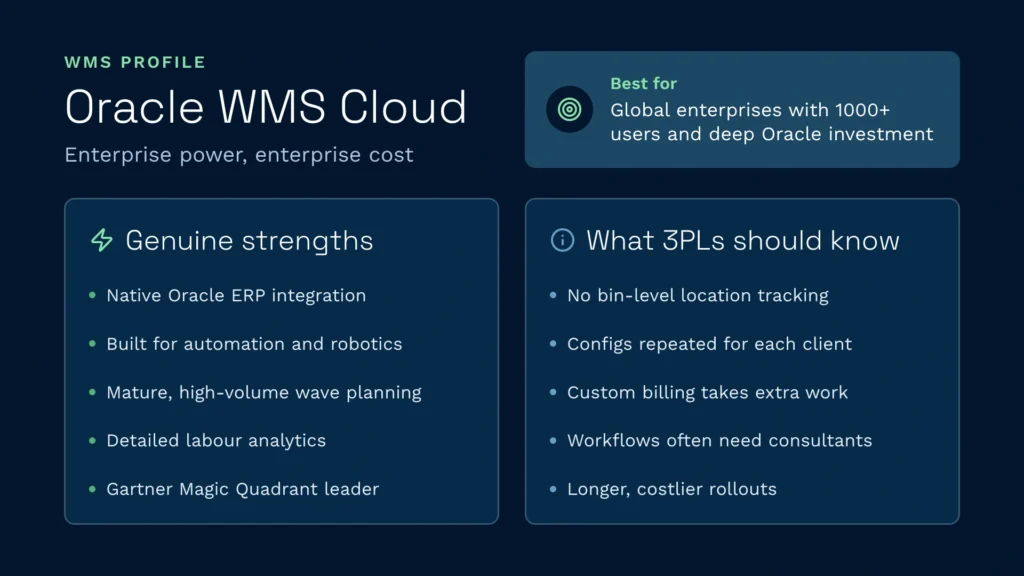
Who it’s best for: Very large enterprises (1,000+ users across multiple continents) with deep Oracle investments and budgets that can absorb long implementation timelines and enterprise-level annual costs.
What it is
Oracle WMS Cloud started life as LogFire, a cloud-based WMS that Oracle acquired in 2016 and now sells as part of its supply chain management suite. It has advanced features like wave planning, directed putaway, labour tracking and deep supply chain integration, if you have the time and money to make the most of them.
Sterke punten
- Deep ERP integration: If your business runs on Oracle ERP, warehouse activity flows into the wider Oracle suite without third-party middleware.
- Advanced automation support: Integrates with autonomous mobile robots, AGVs, conveyors, sortation systems and carousels. Built for enterprise-scale sort and pack automation.
- Mature wave planning: Highly configurable wave templates for complex picking scenarios. If your facility runs hundreds of waves a day, Oracle can handle the volume.
- Labour tracking and optimisation: Detailed task-based labour costing and productivity analytics, useful in very large facilities where labour spend is massive.
- Gartner credibility: Named a Leader in the Gartner Magic Quadrant for WMS for the 11th consecutive year in 2026. That matters if your procurement process demands it.
Where 3PLs tend to struggle
Oracle does support multi-client operations, but the platform is designed for enterprise-scale programmes, and that shows up in the places 3PLs care about most:
- Billing for contract variations: Per-client tariffs, value-added services and contract-specific charges usually need configuration work, and often partner or consultant time, before invoices come out the way your contracts are written.
- Customisation runs through consultants: If the standard picking reports, replenishment rules or client-specific workflows don’t match your operation, changing them is typically a consulting engagement. That’s cost and delay on top of licensing.
- Client onboarding: Ask how long it takes to set up a new client end to end, including billing rules and portal access, and who does the work. If the answer is a project rather than a configuration task, that limits how fast you can grow.
Implementation reality
Oracle doesn’t publish a standard implementation timeline. Enterprise WMS programmes of this kind commonly run to several months for a single site, and considerably longer for multi-site or heavily customised rollouts, followed by a stabilisation period before the operation is running smoothly on it.
In that window, your team is in implementation mode. They’re not improving operations, they’re answering questions about your business processes and approving customisations.
Prijzen
Oracle doesn’t publish base pricing, so any figure you see quoted online is someone’s guess rather than a rate card. What you can plan for is the shape of the cost rather than its size: a subscription that scales with users, warehouses and transaction volume, an implementation consulting engagement, data migration, training, and custom development where the standard product doesn’t fit. Get every one of those as a separate line in writing, and ask specifically what happens to the subscription when your volumes grow, because that’s the line that tends to move.
Where Oracle wins
If you’re a large enterprise with existing Oracle infrastructure, legacy systems to replace, automated high-speed warehouses, and a team of 20+ people who can absorb a year-long implementation, Oracle WMS has some of the deepest ERP integration and automation support in the market. For that segment, it’s the right tool.
For everyone else, 3PLs, distributors, food and beverage, UK operations, the cost, complexity and timeline are overbuilt.
Blue Yonder WMS: AI-powered automation at scale
Who it’s best for: High-automation facilities (conveyor-heavy, robotics-driven), global enterprises and demand forecasting-intensive operations.
Overview
Blue Yonder (formerly JDA Software, now owned by Panasonic) is a long-standing name in warehouse automation and demand planning, and was named a Leader in the 2026 Gartner Magic Quadrant for WMS for the 18th consecutive time. It’s rated 4.2 out of 5 on G2, from a small number of reviews. It’s strongest where robotic systems, automated conveyors and machine-learning-driven wave optimisation are in play.
Sterke punten
- AI for demand forecasting and labour planning, predicting staffing needs from order patterns
- Deep integration with robotic picking and sorting systems
- Real-time orchestration across people and automation
- Global support and multi-language capability
Beperkingen
- Price: Enterprise-tier, quoted per deal and not published. Positioned well above where most small-to-mid 3PLs are buying.
- Uitvoering: A consultant-led programme rather than a configuration exercise.
- 3PL complexity: Multi-client billing exists but needs significant configuration. It’s not native like Clarus.
- Overkill for many: If you’re not running robots and automated sorting, you’re paying for features you won’t use.
Who should consider it
If you run a high-automation facility (an Amazon-style fulfilment centre or a large pallet network hub) and you have the budget and implementation bandwidth, Blue Yonder is among the strongest options for AI-driven optimisation.
Infor WMS: mature, complex, Infor-centric
Who it’s best for: Large enterprises running Infor ERP, facilities with highly standardised processes and long-term implementation budgets.
Overview
Infor WMS was named a Leader in the 2026 Gartner Magic Quadrant for WMS for the eighth consecutive time. It’s mature, widely used and tightly connected to Infor’s wider supply chain tools.
Sterke punten
- Proven at scale, with a large global install base
- Advanced directed putaway and wave-planning logic
- Deep Infor ecosystem integration (supply chain planning, manufacturing)
- Cloud-based today, with many customers migrating from older on-premise installs
Beperkingen
- UI complexity: Routine tasks can take a lot of clicks and data-entry steps per operation.
- Customisation burden: Changing standard reports and workflows usually involves Infor or partner consultants, which ties you to that professional services ecosystem.
- Uitvoeringstijd: A multi-month programme rather than a configuration exercise. Long and consultant-heavy.
- 3PL fit: Configurable multi-client support, but manual-heavy. It isn’t built natively for it like Clarus.
Who should consider it
If you’re already deep in the Infor ecosystem and have a large, standardised operation with a long implementation runway, Infor WMS is a proven choice. For smaller 3PLs, or those not committed to Infor, it’s overengineered and slow to deploy.
Manhattan Associates WMS: cloud-native, microservices-based
Who it’s best for: Large global enterprises, automation-first operations and organisations with significant IT investment.
Overview
Manhattan Associates was named a Leader in the 2026 Gartner Magic Quadrant for WMS for the 18th time in a row. Its Manhattan Active Warehouse Management platform is built entirely on microservices.
Sterke punten
- Cloud-native, microservices-based design, scalable and modular
- Strong automation integration (robotics, conveyor systems)
- Advanced labour and productivity analytics
- Global scale, handling high-volume operations across multiple regions
Beperkingen
- Price: Top-tier and enterprise-only, quoted per deal rather than published.
- Uitvoering: A long, consultant-led programme. You’ll need a dedicated implementation team.
- Complexity: Advanced features need technical expertise to configure and maintain.
- 3PL setup: Multi-client billing is advanced, but implementation-heavy. Better than Oracle’s, but not as native as Clarus.
Who should consider it
If you’re a large parcel or logistics provider with significant IT resources and a multi-year roadmap, Manhattan Associates has world-class automation and analytics. For UK 3PLs and distributors, it’s overscaled and overpriced.
Snapfulfil: UK-focused 3PL alternative
Who it’s best for: 3PLs, mid-market distributors and UK-centric operations looking for a quicker alternative to Oracle.
Overview
Snapfulfil is a UK-born, SaaS cloud WMS with dedicated 3PL functionality, popular with mid-market UK operators. See how it compares in our Snapfulfil alternative guide.
Sterke punten
- Strong multi-client support with additional 3PL functionality
- Configuration-led implementation, with a 45-day implementation claimed on its own site
- UK support and UK-centric development
- Cloud-hosted, so no on-site servers to maintain
Beperkingen
- Smaller ecosystem: Good ecommerce connectors, but more limited ERP and TMS connectors, and custom integrations may need third-party middleware.
- Prijzen: No standard rate is published, so you’ll need a quote.
- Real-world timelines: The headline implementation figure is a best case. Multi-client requirements can stretch it, so get the go-live date in the contract.
Who should consider it
Snapfulfil is a solid alternative if you want a UK-friendly 3PL platform without Oracle’s overhead. It’s a middle ground: not as feature-rich as the enterprise platforms, but faster to deploy and lower cost.
Comparison table: key decision factors
| Factor | Clarus | Oracle | Blue Yonder | Infor | Manhattan | Snapfulfil |
|---|---|---|---|---|---|---|
| Go-live shape | Weeks, configuration-led | Consultant-led programme | Consultant-led programme | Consultant-led programme | Consultant-led programme | Weeks, configuration-led |
| 3PL billing (native) | Yes, automated | Limited, requires customisation | Yes, but complex | Yes, but manual-heavy | Ja, gevorderd | Yes, strong |
| Transparantie in de prijsstelling | Published, from £1,000/mo base | Niet gepubliceerd | Niet gepubliceerd | Niet gepubliceerd | Niet gepubliceerd | Niet gepubliceerd |
| Cloud-native | Ja, serverloos | Yes (SaaS) | Yes (cloud) | Hybrid | Yes, microservices | Hybrid |
| Integraties | 200+ | Deep Oracle ecosystem | 100+ | Infor ecosystem | 50+ | 30 to 50 |
| Beste voor | 3PLs, distributors | Large enterprises | High automation | Infor shops | Global scale | UK 3PLs |
| Reactietijd van de ondersteuning | Sub-2 minutes | Tiered, typically hours | Tiered, typically hours | Tiered, typically 4 to 24 hours | Tiered, typically 4 to 24 hours | Tiered, typically 2 to 4 hours |
How to choose the right WMS for your business
Choosing a WMS is one of the biggest operational investments you’ll make. Here’s a framework.
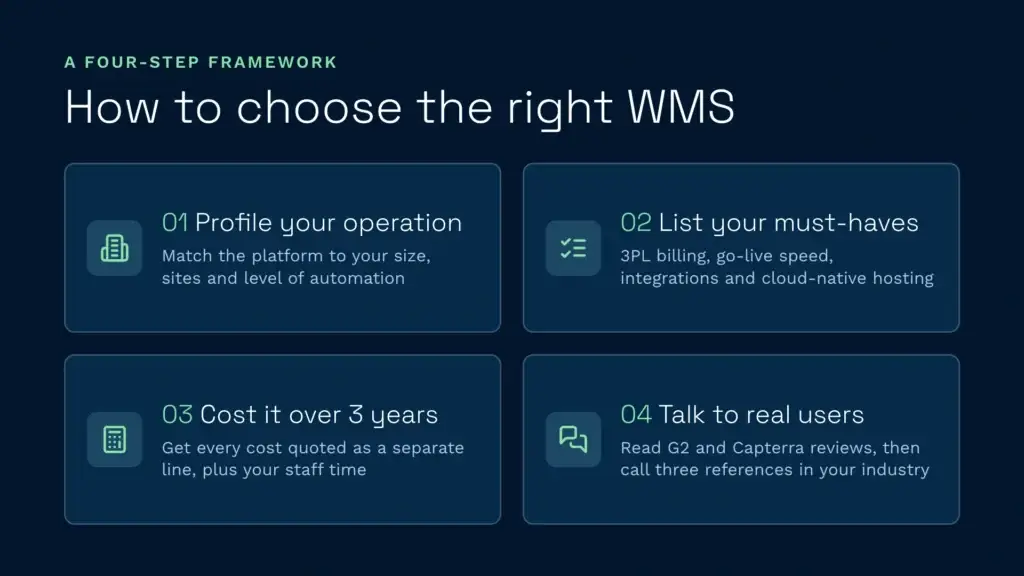
1. Start with your operation’s size and profile
- Single-site, 50 to 200 users: Clarus or Snapfulfil are good fits, with fast deployment and lower cost.
- Multi-site 3PL with 5 to 50 sites: Clarus is purpose-built for this. Snapfulfil is also strong.
- Automated distribution centre, 200+ users: Blue Yonder, Manhattan or Infor. You need advanced automation integration and labour optimisation that smaller platforms don’t focus on.
- Global enterprise, 500+ users, deep Oracle ecosystem: Oracle WMS makes sense if you have the budget and timeline. Otherwise, Manhattan or Infor.
2. Assess your must-haves
3PL multi-client billing: Clarus (native), Snapfulfil (native), Manhattan (advanced), Infor (configurable), Oracle (configuration-heavy). If this is critical, Clarus or Snapfulfil are the fastest to value. See how automated 3PL billing works in practice.
Fast deployment: Clarus and Snapfulfil are configuration-led and measured in weeks. Enterprise platforms are multi-month programmes. Ask any vendor to put its date in the contract.
Specific integrations: Check that your ERP, shipping carrier and ecommerce platform are supported, and ask whether each connector is native or needs middleware. Clarus connects to 200+ systems.
Cloud-native, no infrastructure: Clarus, Manhattan, Blue Yonder, Infor and Oracle are all available as cloud services, but how much of the hosting, upgrades and patching you still handle varies. If you want zero infrastructure headaches, ask each vendor exactly what’s included.
3. Calculate total cost of ownership over 3 years
Don’t just compare monthly fees. Include:
- Implementation consulting and go-live support
- Data migration and clean-up
- Training and change management
- Custom development and integration work
- Annual maintenance and support upgrades
- Infrastructure and hosting (if not cloud-native)
- Staff time during implementation (your salary cost)
Only one of these vendors publishes a starting price, so a like-for-like table isn’t something anyone can honestly build from public data. Build your own instead: get each shortlisted vendor to quote subscription, implementation, migration, training and custom development as separate lines over three years, then add your own staff time. The gaps between the quotes are usually much larger than the gaps between the subscription rates.
4. Talk to current users
Check G2 reviews for your shortlist. Pay attention to implementation time, support quality, and whether reviewers mention your specific pain points (3PL billing, food traceability, ecommerce volume).
Better yet, ask the vendor for three customer references in your industry and call them directly. You can start with our klantverhalen.
Oracle WMS vs Clarus: a direct comparison
If you’re specifically comparing Oracle to Clarus, here’s the honest breakdown.
| Afmeting | Oracle WMS Cloud | Clarus WMS |
|---|---|---|
| Built for 3PLs? | Retrofitted. Multi-client support exists but requires heavy customisation and consultant support. Billing logic is manual-intensive. | Native. Each client’s inventory, billing, and reporting are isolated by design. Automated billing engine captures every billable event in real time. |
| Implementatietijd | A consultant-led programme. Data migration, customisation and a full internal project team. | Weeks, not quarters. Minimal data mapping, pre-built multi-client workflows, no infrastructure setup. |
| Prijzen | Not published. Subscription plus implementation, consulting, customisation and training, visible only at the end of a sales cycle. | Published tiers from £1,000/mo base, plus tiered user licensing and a one-off implementation fee. No charge tied to throughput. |
| What drives the total | Implementation and consulting, which on enterprise programmes commonly outweigh the licence itself. | The subscription tier and your user count, with implementation as a single one-off line. |
| Locator-level tracking | No. Oracle Inventory doesn’t track bin/locator level, limiting granular visibility. | Yes. Every product tracked to bin level, enabling real-time locator reporting and cycle counting. |
| Klantenportaal | Requires separate customisation. Limited visibility by default. | Native, white-labelable, real-time stock levels, order tracking, billing summaries. |
| AI and automation | Machine-learning features exist in Blue Yonder (Oracle subsidiary), not in core WMS. | AI warehouse assistant reads operational data to execute tasks and surface insights. Smart Wave Picking optimises walking paths (claimed: 50% reduction). |
| Support SLA | Tiered. Enterprise support typically 4-hour response. Standard support 24 to 48 hours. | Sub-2-minute response time, 24/7, no tiering based on contract level. |
| Integraties | Deep into Oracle ecosystem (ERP, supply chain planning). Limited to ~50 third-party integrations. | 200+ integrations: 70+ shipping providers, major ERPs, e-commerce platforms, pallet networks, TMS systems. |
| Contract lock-in | Enterprise sales cycles with multi-year terms. Expensive to exit. | Month-to-month rolling. You can leave anytime. Reduces risk. |
If you’re a 3PL, the choice is clear: Clarus solves the problem Oracle wasn’t designed for. If you’re a Fortune 500 enterprise with Oracle infrastructure, Oracle WMS makes sense.
The downsides of Oracle WMS for 3PLs, an honest assessment
We’ve mentioned this, but it’s worth spelling out for 3PL readers specifically:
- Complexiteit van de facturering: Multi-client, per-activity billing takes configuration and often consultant time to match your contracts. Without it, you end up relying on spreadsheets or external billing systems to reconcile what the WMS captured.
- Long time-to-value: An enterprise programme means a sustained period of consultants on site, custom development and internal meetings, during which your team is answering questions about your processes rather than improving them. Budget for a stabilisation period after go-live as well as the build.
- Hidden costs: Whatever subscription you’re quoted covers licensing only. Implementation consulting, data migration, training and custom development are separate, and on this class of platform they’re not a rounding error. Insist on seeing them itemised.
- Customisation burden: Changes to standard workflows and reports usually go through consultants, so you’re often choosing between the standard offering and a consulting queue.
- Client onboarding effort: Each new client needs its own billing rules, workflows and portal set-up. Find out how long that takes on Oracle before you sign, because it governs how quickly you can win and start new contracts.
For UK 3PLs and distributors, these downsides often outweigh the benefits of Oracle’s scale and deep ERP integration.
Is Oracle WMS Cloud worth it?
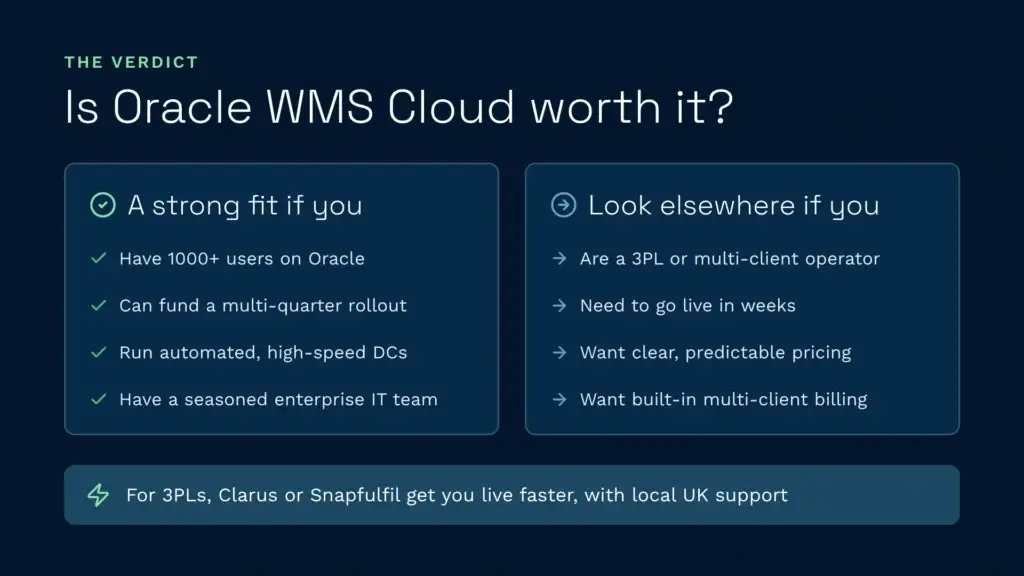
Oracle WMS Cloud is worth it if:
- You’re a very large enterprise (1,000+ users) with existing Oracle investments
- You have the runway for a multi-quarter implementation programme and an enterprise budget to match
- You run automated, high-speed distribution centres with complex labour tracking needs
- Your team has deep enterprise software experience and can manage long implementations
Oracle WMS Cloud isn’t worth it if:
- You’re a 3PL or multi-client distributor. Clarus or Snapfulfil will serve you better and faster
- You need to go live quickly (in weeks, not months)
- You want transparent, predictable pricing without consulting surprises
- You need strong multi-client billing automation built in
- You need the total cost visible up front rather than at the end of a sales cycle
- You operate in the UK and want local, responsive support
Neem contact op met een magazijnexpert
If you’re evaluating your options and want to see how a purpose-built WMS works in practice, Clarus is worth a conversation. We work with 3PLs and distributors across the UK to implement warehouse management software that fits the way you operate, not the other way around.
Neem contact op met ons team om uw wensen te bespreken.