

Körber WMS (formerly HighJump; sold as Körber One) is an enterprise-grade, highly configurable warehouse management system designed for large distribution centres and complex automation. But for mid-market 3PLs and UK distributors, the cost of implementation, length of deployment, and complexity of licensing can make it prohibitive. This guide compares Körber WMS with six faster-to-deploy, cloud-native alternatives that deliver purpose-built 3PL features without the enterprise overhead.
Quick comparison: Körber vs. the alternatives
| Solution | Best for | Multi-client billing | Cloud-native | Typical deployment |
|---|---|---|---|---|
| Clarus WMS | 3PLs, small-to-mid distributors, food & beverage | Native, automated | Yes, serverless | Around 12 weeks |
| Körber WMS | Large DCs, complex automation | Retrofit, costly | On-premise or private cloud | 9–18 months |
| Snapfulfil | eCommerce, small-to-mid 3PLs | Available, additional cost | Yes, SaaS | 8–12 weeks |
| Mintsoft | 3PLs, eCommerce, wholesale | Native, built-in | Yes, cloud-based | 6–10 weeks |
| Delta WMS | Enterprise, multi-warehouse | Available | On-premise or cloud | 7 weeks |
| Deposco | Shopify, multi-channel eCommerce | Available | Yes, SaaS | 2–4 weeks |
| Canary7 | Small warehouses, simple operations | Limited | Yes, cloud | 4–6 weeks |
What is Körber WMS?
Körber WMS is an enterprise warehouse management system sold by the German logistics software company Körber Supply Chain. It was built on the HighJump codebase: HighJump Warehouse Advantage was acquired by Körber in 2015 and is now marketed as Körber One, Körber’s entry into the mid-market.
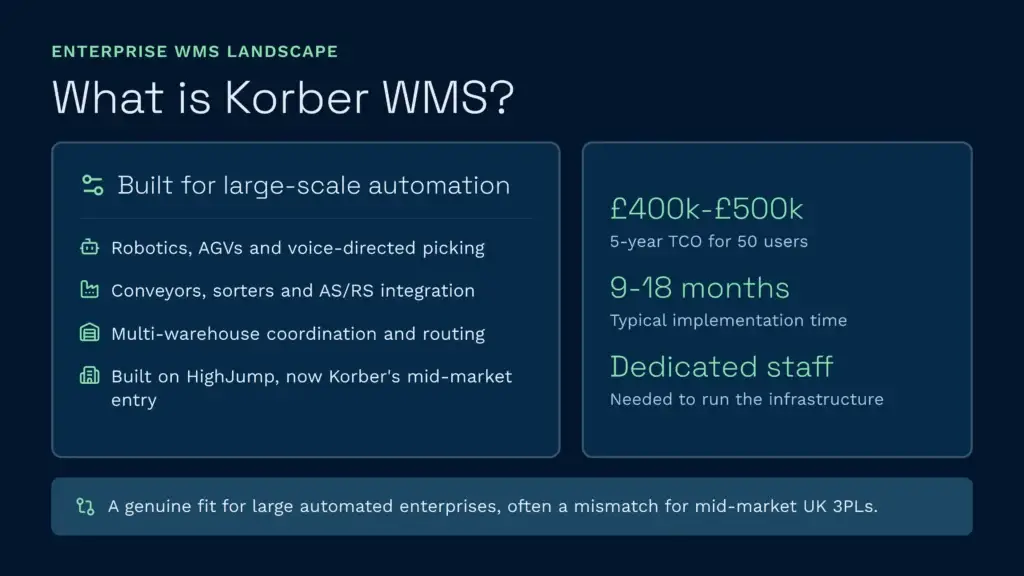
The system is designed to handle complex, high-volume operations: large distribution centres with multiple automation partners (AGVs, robotics, voice-directed picking), multi-warehouse coordination, and sophisticated routing logic. Körber excels at integrating with physical automation, including conveyor systems, sorters, and automated storage-and-retrieval systems (AS/RS).
For enterprises with physical automation at scale, Körber is a strong fit. For mid-market 3PLs and distributors in the UK, it often creates problems: the total cost of ownership (TCO) for a 50-user operation can run well into six figures over five years, implementation typically runs nine to eighteen months, and the system requires dedicated technical staff to maintain on-premise infrastructure or negotiate private cloud arrangements.
Why teams look elsewhere
Three factors drive mid-market operations away from Körber WMS.
Implementation time
Körber implementations are long. A typical project runs 12 to 18 months from contract to live operation, with extended discovery and system design phases. Organisations moving to Körber typically plan for six to nine months of internal resource commitment just for data migration and workflow mapping. This means delayed revenue, extended deployment cost, and operational interruption.
Cloud-native 3PL WMS platforms like Clarus are purpose-built for speed: configuration over customisation, pre-built workflows for 3PL billing and multi-client segregation, and cloud deployment that eliminates infrastructure setup. Typical deployment is around 12 weeks from contract signature to go-live.
Multi-client complexity
Körber WMS was not born as a multi-client system. It was retrofitted to support 3PL operations years after launch. This shows: adding a new client in Körber requires data setup, custom reporting, and often development time. Billing automation, capturing and charging for storage, picking, packing, and returns, requires manual configuration per client.
Clarus was purpose-built for 3PLs. Every client you onboard uses the same system but has completely isolated stock, billing rules, SLAs, and client portal access. St John’s Hall Storage cut invoicing from four hours to twenty minutes using Clarus’s automated billing engine, which captures every billable event in real time. Körber requires manual reconciliation or custom middleware to achieve the same.
Clarus WMS: the purpose-built 3PL alternative
Clarus WMS is a cloud-native warehouse management system purpose-built for 3PLs, wholesale distributors, and food & beverage operations. It runs on serverless cloud infrastructure: no servers to maintain, no version upgrades to schedule, always on the latest release.
What Clarus does better than Körber
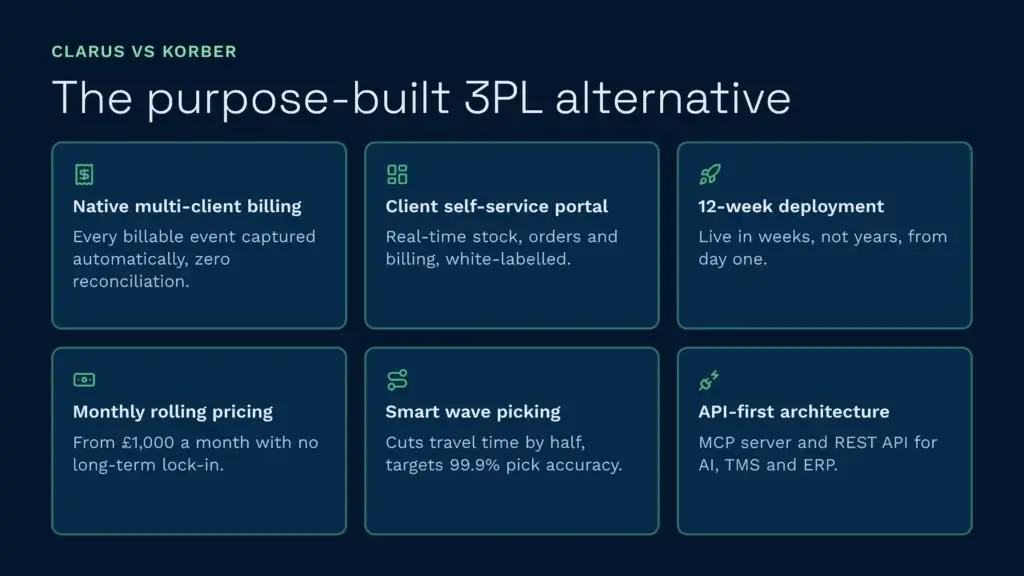
- Native multi-client billing: every billable event (receiving, storage, pick, pack, despatch, returns, value-added services) is captured automatically. JODA Freight brought stock accuracy from the low 90s to 99.8% and eliminated stocktake delays entirely. You charge per client, per activity, per period, with full audit trails and zero manual reconciliation.
- Client self-service portal: clients log in and see real-time stock levels, order status, shipment tracking, and billing summaries. No more fielding “where’s my stock?” calls. The portal is white-labelable with your branding.
- Around 12-week deployment: a standard implementation is measured in weeks, not years. You start capturing real-time data, automating billing, and optimising picking from go-live.
- Monthly rolling pricing: from £1,000 a month with no lock-in. Add users, add sites, grow with zero long-term contract risk.
- Smart wave picking: batches orders automatically and optimises walking paths, claiming a 50% travel time reduction. Real-time scan verification, where the barcode must match the order or the system stops the packer, targets 99.9% pick accuracy.
- Purpose-built for your industry: food & beverage? Clarus handles FEFO/FIFO rotation, best-before-date control, and recall-in-minutes workflows. Campeys of Selby achieved sub-5-minute recalls and an AA BRCGS grade. Manufacturing? Component traceability, serial number capture, and quarantine management are built in. eCommerce 3PL? 70+ carrier integrations, Shopify, WooCommerce, Amazon, and eBay out of the box.
- API-first architecture: Clarus exposes an MCP server and REST API, so AI tools, your TMS, your ERP, and custom scripts can query and update warehouse data in real time.
Clarus limitations
Clarus is not the right fit for:
- Pure B2C parcel-only fulfilment houses (under 10 users, high volume, low complexity): consider Deposco or Snapfulfil instead.
- Large automated distribution centres with conveyor, sorter, and AS/RS integration: Körber, Blue Yonder, or Manhattan Associates remain better choices for that scale.
- Legacy single-warehouse operations that plan to stay on-premise indefinitely.
Snapfulfil: eCommerce-first, quick to deploy
Snapfulfil is a cloud-based WMS built by Synergy Logistics, focused on small-to-mid eCommerce and 3PL operations. It offers inventory tracking, order management, pick optimisation, and returns management in a user-friendly SaaS interface.
Strengths
- Strong eCommerce integration: Shopify, WooCommerce, Magento, BigCommerce, and Amazon built in.
- Quick deployment, typically 8 to 12 weeks from contract to go-live.
- Multi-location support and basic 3PL client features (available at extra cost).
- Reasonable value for small-to-mid eCommerce 3PLs.
Limitations
- Multi-client billing is an add-on, not native, which adds cost and complexity.
- Per-user pricing scales poorly for teams over 20 to 30 headcount.
- Limited automation and warehouse intelligence compared to Körber or Clarus.
- Not industry-specific: food, manufacturing, and healthcare sectors require workarounds.
Mintsoft: cloud-native 3PL focus
Mintsoft is a UK-based cloud WMS designed specifically for 3PLs, eCommerce, and wholesale distributors. Multi-client billing is native, and the product includes a client portal and automated invoicing out of the box.
Strengths
- Purpose-built for 3PLs: multi-client segregation and billing are core, not retrofitted.
- Strong UK and Ireland presence with local support.
- Tiered pricing with predictable scaling.
- Good eCommerce and carrier integrations (70+ carriers).
- Client portal included in all tiers.
Limitations
- Slightly less modern UI compared to newer cloud-native entrants.
- Warehouse intelligence and AI features more limited than Clarus.
- Implementation speed varies; quoted timelines are often shorter than what data migration in practice requires.
Delta WMS: modular enterprise option
Delta WMS (Access Delta WMS) is a modular, scalable WMS for enterprise and mid-market warehouses, from the Access Group. It can be deployed on-premise or in the cloud, and supports 3PL operations with activity-based billing.
Strengths
- Modular architecture: start with core functionality and add advanced features as needed.
- Real-time inventory tracking and cross-docking workflows.
- Support for multiple locations and 3PL facilities.
- Flexible deployment, on-premise or cloud.
- Relatively fast implementation, with go-lives as short as seven weeks reported.
Limitations
- Enterprise-grade licensing that tends to position it above Körber for mid-market budgets, not below.
- 3PL billing requires configuration and is not as automated as native 3PL systems.
- Cloud deployment may still carry ongoing infrastructure costs.
- No transparent per-month pricing published.
Deposco: fast eCommerce fulfilment
Deposco is a cloud WMS optimised for Shopify, multi-channel eCommerce, and high-volume parcel operations. Deployment is fast, typically two to four weeks from signup to go-live.
Strengths
- Fast time-to-value: weeks, not months.
- Deep Shopify and multi-channel eCommerce integration.
- Activity-based pricing: pay for what you pick, pack, or ship.
- Clean user interface and mobile app.
Limitations
- Designed for eCommerce only, not suited to general 3PL or industrial distribution.
- No traditional multi-client or 3PL billing module.
- Limited warehouse intelligence compared to Clarus or Körber.
- Best fit for high-volume, low-complexity operations (over 500 picks a day).
Canary7: budget cloud WMS for small teams
Canary7 is a lightweight, cloud-based WMS for small warehouses and simple operations. It offers basic inventory, order, and picking management at an entry-level price point.
Strengths
- Comparatively affordable for small teams.
- Quick setup, typically four to six weeks.
- Suitable for single-client, simple operations (under 5 users).
- Basic mobile app and API integration.
Limitations
- No native multi-client billing, so not suitable for 3PLs.
- Limited reporting and warehouse intelligence.
- Minimal integration ecosystem, with no out-of-the-box carrier or eCommerce connectors.
- Poor fit for scaling; quickly outgrown beyond 5 to 10 users.
Feature-by-feature: Clarus vs. Körber
| Feature | Clarus WMS | Körber WMS |
|---|---|---|
| Multi-client segregation | Native, built from day one. Every client isolated by stock, billing, reporting, and portal access. | Retrofit capability. Requires custom configuration and often development. Data integration expensive. |
| Automated 3PL billing | Native. Captures receipt, storage, pick, pack, despatch, and returns events automatically per client. St John’s Hall: 4 hours to 20 minutes invoicing. | Manual configuration per client. Requires reconciliation and custom reporting. Prone to leakage. |
| Cloud-native architecture | Serverless, no infrastructure to maintain. Always latest release. | On-premise or private cloud. Requires IT overhead. Version upgrades needed. |
| Deployment speed | Around 12 weeks, configuration-based, pre-built 3PL workflows. | 9–18 months, discovery and design heavy, custom development typical. |
| Pricing transparency | From £1,000/month, monthly rolling, no lock-in. Fixed feature set per tier. | Bespoke enterprise licensing. No published pricing. Long-term contracts typical. |
| Pick accuracy | Smart Wave Picking with 99.9% accuracy via scan verification. 50% travel time reduction claimed. | Excellent for large-volume automation; less optimised for manual picking. |
| Food & beverage | FEFO/FIFO rotation, best-before-date control, batch/lot tracking, sub-5-minute recalls, BRC-ready. | Capable but requires custom configuration. Costs extra. |
| Integrations | 200+ out-of-the-box: Shopify, WooCommerce, Amazon, eBay, 70+ carriers, Sage 200, Dynamics, QuickBooks, TMS, pallet networks. | Broad enterprise integration capability but requires custom connectors for most. |
| Client portal | Self-service included, real-time stock/order/billing visibility, white-labelable, zero additional cost. | Available but typically requires custom development or integration with third-party portal. |
| Support response time | Sub-2-minute response, ISO 27001 certified. | Enterprise support available; response time varies by contract tier. |
| Best for | 3PLs (£5M–£500M revenue), food & beverage, wholesale distribution, mid-market e-commerce. | Large DCs with physical automation, enterprise manufacturing, complex multi-facility operations. |
How to choose: Körber WMS or an alternative?
Ask yourself three questions:
1. Do you need physical automation integration?
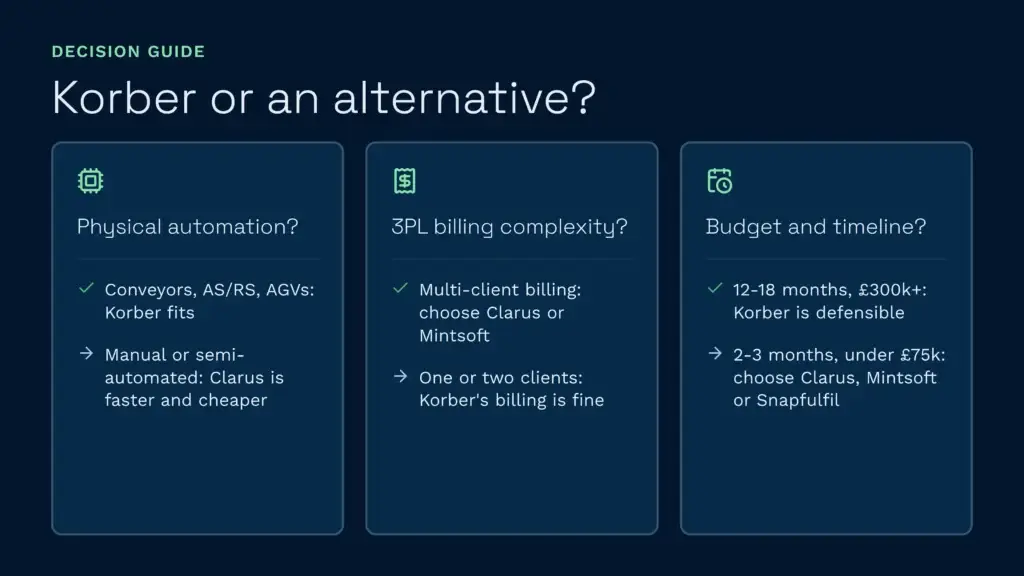
If your warehouse runs conveyors, sorters, AS/RS, or AGVs, and you plan to optimise material flow through sophisticated automation logic, Körber is a better fit than any cloud-native WMS. Its core strength is orchestrating physical systems. Clarus and its competitors are designed for manual and semi-automated operations.
If you run forklifts, scanners, and shelving, or you’re considering automation in two to three years, a cloud-native system like Clarus is a better fit: faster to deploy, cheaper to scale, and easier to adapt as your operation grows.
2. What is your 3PL billing complexity?
If you invoice multiple clients for storage, picking, packing, and value-added services, and you need zero billing leakage, choose a system built natively for 3PL: Clarus or Mintsoft. Retrofitting Körber to handle 3PL billing is possible but expensive and error-prone.
If you have one or two primary customers and billing is simple (a fixed monthly fee), Körber’s generalised billing engine is fine.
3. What is your deployment budget and timeline?
If you have 12 to 18 months and an enterprise-level budget for implementation and licensing, Körber is defensible for large, complex operations.
If you need to go live in under three months and you’re working with a lean budget, choose Deposco or Canary7.
If you have two to three months and a moderate implementation budget, choose Clarus, Mintsoft, or Snapfulfil.
Migration from Körber to a cloud-native WMS
If you’re already on Körber and considering a switch, migration is feasible but requires planning.
- Data export: Körber exports to CSV or flat files. Current inventory, master data, open orders, and customer records can be extracted and reformatted for your new system.
- Cutover approach: plan for a hard cutover (a weekend or overnight) or a phased approach (migrate one product line at a time). Clarus and Mintsoft both support phased cutover.
- Timeline: two to four weeks of preparation, one to two weeks of actual data migration and testing, and one week of go-live support.
- Staff retraining: Clarus and other cloud-native systems are significantly simpler than Körber, so your team will typically need one to two weeks of training, not six to eight.
- Integrations: your ERP, TMS, and eCommerce connections will need to be re-mapped to the new system’s APIs. This is usually the longest part of migration, typically two to four weeks.
Speak to a warehouse expert
If you’re evaluating your options and want to see how a purpose-built WMS works in practice, Clarus is worth a conversation. We work with 3PLs and distributors across the UK to implement warehouse management software that fits the way you operate, not the other way around.
Get in touch with our team to talk through your requirements.