

Körber WMS (ehemals HighJump; vertrieben als Körber One) ist ein hochgradig konfigurierbares Lagerverwaltungssystem der Enterprise-Klasse, das für große Distributionszentren und komplexe Automatisierungslösungen konzipiert ist. Für mittelständische Unternehmen jedoch 3PL-Anbieter Für britische Distributoren können die Implementierungskosten, die Dauer der Einführung und die Komplexität der Lizenzierung jedoch ein Hindernis darstellen. Dieser Leitfaden vergleicht das Körber WMS mit sechs schneller zu implementierenden, cloud-nativen Alternativen, die speziell auf 3PL zugeschnittene Funktionen bieten, ohne den damit verbundenen Aufwand für Großunternehmen.
Schnellvergleich: Körber im Vergleich zu den Alternativen
| Lösung | Am besten für | Mandantenfähigkeit | Cloud-nativen | Typischer Einsatzfall |
|---|---|---|---|---|
| Clarus WMS | 3PL-Anbieter, kleine bis mittelgroße Distributoren, Lebensmittel und Getränke | Nativ, automatisiert | Ja, Serverless | Etwa 12 Wochen |
| Körber WMS | Große Distributionszentren, komplexe Automatisierung | Nachrüstung, kostspielig | Vor Ort oder in einer privaten Cloud | 9–18 Monate |
| Snapfulfil | E-Commerce, kleine bis mittelgroße 3PL-Anbieter | Verfügbar, gegen Aufpreis | Ja, SaaS | 8–12 Wochen |
| Mintsoft | 3PL-Anbieter, E-Commerce, Großhandel | Nativ, integriert | Ja, Cloud-basiert | 6–10 Wochen |
| Delta WMS | Unternehmen, mehrere Lager | Verfügbar | Vor Ort oder in der Cloud | 7 Wochen |
| Deposco | Shopify, Multi-Channel-E-Commerce | Verfügbar | Ja, SaaS | 2–4 Wochen |
| Kanarienvogel7 | Kleine Lager, einfache Abläufe | Begrenzt | Ja, Cloud | 4–6 Wochen |
Was ist Körber WMS?
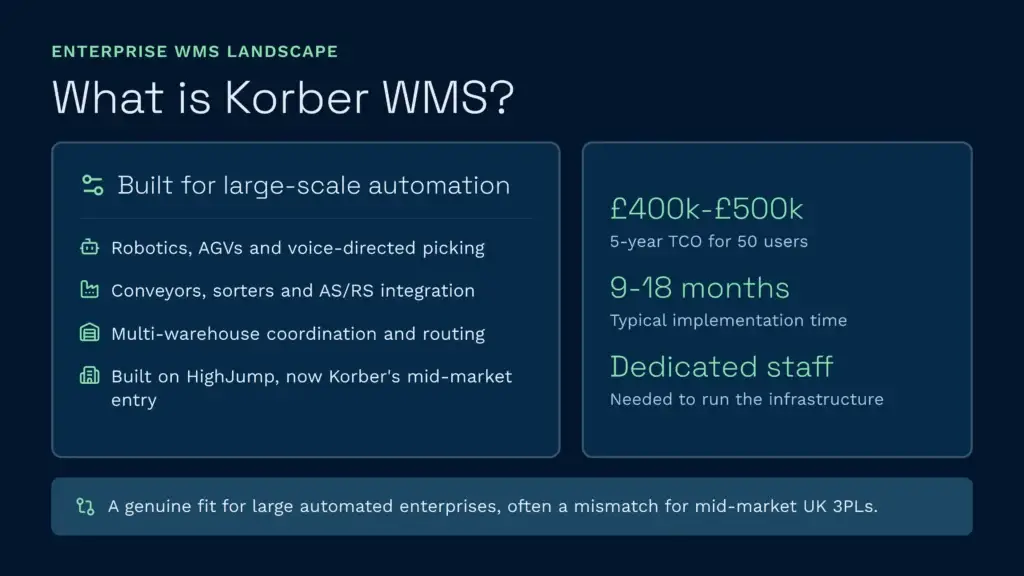
Körber WMS ist ein Lagerverwaltungssystem für Unternehmen, das von dem deutschen Logistik-Softwareunternehmen vertrieben wird Körber Supply Chain. Es wurde auf der HighJump-Codebasis entwickelt: HighJump Warehouse Advantage wurde 2015 von Körber übernommen und wird nun unter dem Namen „Körber One“ vermarktet – Körbers Einstieg in den Mittelstandsmarkt.
Das System ist für komplexe Abläufe mit hohem Durchsatz ausgelegt: große Distributionszentren mit mehreren Automatisierungspartnern (AGVs, Robotik, sprachgesteuerte Kommissionierung), die Koordination mehrerer Lager sowie eine ausgefeilte Routing-Logik. Körber zeichnet sich durch die Integration in die physische Automatisierung aus, darunter Fördersysteme, Sortieranlagen und automatische Lager- und Entnahmesysteme (AS/RS).
Für Unternehmen mit umfangreicher physischer Automatisierung ist Körber eine ideale Lösung. Für mittelständische 3PL-Anbieter und Distributoren in Großbritannien führt dies jedoch häufig zu Problemen: Die Gesamtbetriebskosten (TCO) für einen Betrieb mit 50 Nutzern können über einen Zeitraum von fünf Jahren leicht sechsstellige Beträge erreichen, die Implementierung dauert in der Regel neun bis achtzehn Monate, und das System erfordert spezialisiertes technisches Personal, um die Infrastruktur vor Ort zu warten oder Vereinbarungen für eine Private Cloud auszuhandeln.
Warum Teams sich anderweitig umsehen
Drei Faktoren führen dazu, dass mittelständische Unternehmen vom Körber-WMS abwandern.
Implementierungszeit
Die Implementierung von Körber-Lösungen ist zeitaufwendig. Ein typisches Projekt dauert vom Vertragsabschluss bis zur Inbetriebnahme 12 bis 18 Monate, wobei die Phasen der Anforderungserfassung und des Systemdesigns besonders viel Zeit in Anspruch nehmen. Unternehmen, die auf Körber umsteigen, planen in der Regel sechs bis neun Monate für den Einsatz interner Ressourcen allein für die Datenmigration und die Abbildung der Arbeitsabläufe ein. Dies führt zu Umsatzverzögerungen, erhöhten Implementierungskosten und Betriebsunterbrechungen.
Cloud-native 3PL-WMS-Plattformen wie Clarus sind speziell auf Geschwindigkeit ausgelegt: Konfiguration statt individueller Anpassung, vorgefertigte Workflows für die 3PL-Abrechnung und die Trennung verschiedener Kunden sowie eine Cloud-Bereitstellung, die den Aufbau einer Infrastruktur überflüssig macht. Die typische Bereitstellungsdauer beträgt etwa 12 Wochen von der Vertragsunterzeichnung bis zur Inbetriebnahme.
Komplexität bei mehreren Mandanten
Körber WMS wurde ursprünglich nicht als Multi-Client-System konzipiert. Erst Jahre nach der Markteinführung wurde es nachgerüstet, um 3PL-Betriebe zu unterstützen. Dies zeigt: Das Hinzufügen eines neuen Kunden in Körber erfordert Dateneinrichtungen, maßgeschneiderte Berichte und oft auch Entwicklungszeit. Die Automatisierung der Abrechnung sowie die Erfassung und Abrechnung von Lagerung, Kommissionierung, Verpackung und Retouren erfordern eine manuelle Konfiguration für jeden einzelnen Kunden.
Clarus wurde speziell für 3PL-Anbieter entwickelt. Jeder Kunde, den Sie neu aufnehmen, nutzt dasselbe System, verfügt jedoch über vollständig voneinander getrennte Bestände, Abrechnungsregeln, SLAs und Zugänge zum Kundenportal. St John’s Hall Storage konnte die Rechnungsstellung mithilfe der automatisierten Abrechnungs-Engine von Clarus, die jedes abrechnungsrelevante Ereignis in Echtzeit erfasst, von vier Stunden auf zwanzig Minuten verkürzen. Körber benötigt dafür eine manuelle Abstimmung oder spezielle Middleware.
Clarus WMS: die maßgeschneiderte 3PL-Alternative
Clarus WMS ist ein cloud-natives Lagerverwaltungssystem, das speziell für 3PL-Anbieter, Großhändler und Unternehmen der Lebensmittel- und Getränkebranche entwickelt wurde. Es läuft auf einer serverlosen Cloud-Infrastruktur: Es müssen keine Server gewartet und keine Versions-Upgrades geplant werden – das System ist stets auf dem neuesten Stand.
Was Clarus besser macht als Körber
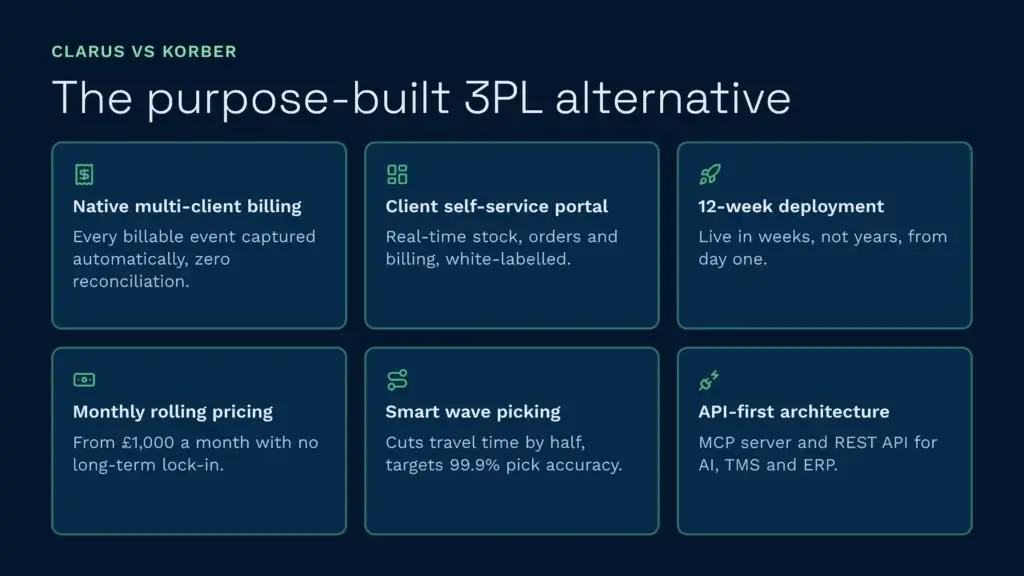
- Native Multi-Client-Abrechnung: Jeder abrechnungsrelevante Vorgang (Wareneingang, Lagerung, Kommissionierung, Verpackung, Versand, Retouren, Mehrwertdienste) wird automatisch erfasst. JODA Fracht Die Bestandsgenauigkeit wurde von Werten im unteren 90er-Bereich auf 99,81 TP3T gesteigert, und Verzögerungen bei der Bestandsaufnahme wurden vollständig beseitigt. Die Abrechnung erfolgt pro Kunde, pro Aktivität und pro Zeitraum, mit lückenlosen Prüfpfaden und ohne manuellen Abgleich.
- Kunden-Self-Service-Portal: Kunden melden sich an und sehen in Echtzeit Lagerbestände, Bestellstatus, Sendungsverfolgung und Rechnungsübersichten. Keine Anrufe mehr mit der Frage “Wo ist meine Ware?”. Das Portal lässt sich mit Ihrem Branding als White-Label-Lösung gestalten.
- Implementierungsdauer von etwa 12 Wochen: Eine Standardimplementierung wird in Wochen und nicht in Jahren gemessen. Sie können bereits ab dem Go-Live mit der Erfassung von Echtzeitdaten, der Automatisierung der Rechnungsstellung und der Optimierung der Kommissionierung beginnen.
- Monatliche, flexible Preisgestaltung: ab 1.000 £ pro Monat ohne Mindestvertragslaufzeit. Fügen Sie Nutzer und Standorte hinzu und wachsen Sie ohne das Risiko langfristiger Verträge.
- Intelligente Kommissionierung: Ordnet Bestellungen automatisch in Chargen zu und optimiert die Laufwege, wodurch eine Reduzierung der Wegzeit um 50% erreicht wird. Durch die Überprüfung per Scan in Echtzeit – bei der der Barcode mit der Bestellung übereinstimmen muss, andernfalls stoppt das System den Kommissionierer – wird eine Kommissioniergenauigkeit von 99,9% angestrebt.
- Speziell für Ihre Branche entwickelt: Lebensmittel und Getränke? Clarus übernimmt die FEFO-/FIFO-Rotation, die Kontrolle des Mindesthaltbarkeitsdatums und Workflows für Rückrufe innerhalb von Minuten. Campeys of Selby erreichte Rückrufe in weniger als 5 Minuten und eine AA-Bewertung nach BRCGS. Fertigung? Rückverfolgbarkeit von Komponenten, Erfassung von Seriennummern und Quarantänemanagement sind integriert. E-Commerce-3PL? Über 70 Spediteur-Integrationen, Shopify, WooCommerce, Amazon und eBay sind standardmäßig verfügbar.
- API-First-Architektur: Clarus stellt eine MCP-Server und REST-API, sodass KI-Tools, Ihr TMS, Ihr ERP und benutzerdefinierte Skripte Lagerdaten in Echtzeit abfragen und aktualisieren können.
Einschränkungen von Clarus
Clarus ist nicht das Richtige für:
- Reine B2C-Fulfillment-Anbieter, die ausschließlich Pakete abwickeln (weniger als 10 Nutzer, hohes Volumen, geringe Komplexität): Ziehen Sie stattdessen Deposco oder Snapfulfil in Betracht.
- Große automatisierte Distributionszentren mit integrierten Förderbändern, Sortieranlagen und automatischen Lager- und Retrieval-Systemen (AS/RS): Körber, Blue Yonder, oder Manhattan Associates sind für diesen Umfang nach wie vor die bessere Wahl.
- Ältere Betriebe mit einem einzigen Lager, die auf unbestimmte Zeit auf eine lokale Lösung setzen wollen.
Snapfulfil: E-Commerce-orientiert, schnell einsetzbar
Snapfulfil ist ein von Synergy Logistics entwickeltes, cloudbasiertes WMS, das speziell auf kleine bis mittelgroße E-Commerce- und 3PL-Betriebe ausgerichtet ist. Es bietet Bestandsverfolgung, Auftragsverwaltung, Kommissionieroptimierung und Retourenmanagement in einer benutzerfreundlichen SaaS-Oberfläche.
Stärken
- Umfassende E-Commerce-Integration: Shopify, WooCommerce, Magento, BigCommerce und Amazon sind bereits integriert.
- Schnelle Umsetzung, in der Regel 8 bis 12 Wochen vom Vertragsabschluss bis zur Inbetriebnahme.
- Unterstützung mehrerer Standorte und grundlegende 3PL-Kundenfunktionen (gegen Aufpreis verfügbar).
- Ein angemessenes Preis-Leistungs-Verhältnis für kleine bis mittelgroße E-Commerce-3PL-Anbieter.
Einschränkungen
- Die Abrechnung für mehrere Kunden ist eine Zusatzfunktion, die nicht standardmäßig integriert ist und somit zusätzliche Kosten und Komplexität mit sich bringt.
- Die Preisgestaltung pro Nutzer ist für Teams mit mehr als 20 bis 30 Mitarbeitern nicht besonders skalierbar.
- Im Vergleich zu Körber oder Clarus sind die Automatisierung und die Lagerintelligenz begrenzt.
- Nicht branchenspezifisch: In den Bereichen Lebensmittel, Fertigung und Gesundheitswesen sind Umgehungslösungen erforderlich.
Mintsoft: Fokus auf Cloud-native 3PL-Lösungen
Mintsoft ist ein in Großbritannien ansässiges Cloud-WMS, das speziell für 3PL-Anbieter, E-Commerce-Unternehmen und Großhändler entwickelt wurde. Die Abrechnung für mehrere Kunden ist nativ integriert, und das Produkt umfasst standardmäßig ein Kundenportal sowie eine automatisierte Rechnungsstellung.
Stärken
- Speziell für 3PL-Anbieter entwickelt: Die Trennung der Kundenkonten und die Abrechnung sind zentrale Funktionen und keine nachträglich integrierten Lösungen.
- Starke Präsenz in Großbritannien und Irland mit vor Ortem Support.
- Gestaffelte Preisgestaltung mit vorhersehbarer Skalierung.
- Gute E-Commerce- und Versanddienstleister-Integrationen (über 70 Versanddienstleister).
- Das Kundenportal ist in allen Tarifen enthalten.
Einschränkungen
- Im Vergleich zu neueren, cloud-nativen Anbietern etwas weniger moderne Benutzeroberfläche.
- Die Funktionen für Lagerverwaltung und KI sind eingeschränkter als bei Clarus.
- Die Implementierungsdauer variiert; die angegebenen Zeitrahmen sind oft kürzer als das, was die Datenmigration in der Praxis erfordert.
Delta WMS: modulare Unternehmenslösung
Delta WMS (Access Delta WMS) ist ein modulares, skalierbares Lagerverwaltungssystem (WMS) der Access Group für Lager in Großunternehmen und mittelständischen Betrieben. Es kann vor Ort oder in der Cloud bereitgestellt werden und unterstützt 3PL-Betriebe mit aktivitätsbasierter Abrechnung.
Stärken
- Modulare Architektur: Beginnen Sie mit den Kernfunktionen und fügen Sie bei Bedarf erweiterte Funktionen hinzu.
- Bestandsverfolgung in Echtzeit und Cross-Docking-Abläufe.
- Unterstützung für mehrere Standorte und 3PL-Einrichtungen.
- Flexible Bereitstellung – vor Ort oder in der Cloud.
- Relativ schnelle Umsetzung; es wird von Go-Lives berichtet, die bereits nach sieben Wochen erfolgen.
Einschränkungen
- Eine Lizenzierung auf Unternehmensniveau, die das Produkt für Budgets im Mittelstand eher über als unter dem von Körber positioniert.
- Die 3PL-Abrechnung erfordert eine Konfiguration und ist nicht so stark automatisiert wie native 3PL-Systeme.
- Bei einer Cloud-Bereitstellung können weiterhin laufende Infrastrukturkosten anfallen.
- Es wurden keine transparenten monatlichen Preise veröffentlicht.
Deposco: Schnelle E-Commerce-Abwicklung
Deposco ist ein Cloud-WMS, das für Shopify, Multi-Channel-E-Commerce und den Umschlag großer Paketmengen optimiert ist. Die Bereitstellung erfolgt schnell – in der Regel innerhalb von zwei bis vier Wochen von der Anmeldung bis zur Inbetriebnahme.
Stärken
- Schnelle Amortisation: Wochen statt Monate.
- Umfassende Shopify-Integration und Multi-Channel-E-Commerce-Integration.
- Aktivitätsbasierte Preisgestaltung: Sie zahlen nur für das, was Sie kommissionieren, verpacken oder versenden.
- Übersichtliche Benutzeroberfläche und mobile App.
Einschränkungen
- Ausschließlich für den E-Commerce konzipiert, nicht geeignet für allgemeine 3PL-Dienstleistungen oder den industriellen Vertrieb.
- Kein herkömmliches Abrechnungsmodul für mehrere Kunden oder 3PL.
- Im Vergleich zu Clarus oder Körber sind die Lagerinformationsfunktionen eingeschränkt.
- Am besten geeignet für Vorgänge mit hohem Durchsatz und geringer Komplexität (über 500 Kommissionierungen pro Tag).
Canary7: kostengünstiges Cloud-WMS für kleine Teams
Kanarienvogel7 ist ein schlankes, cloudbasiertes Lagerverwaltungssystem (WMS) für kleine Lager und einfache Abläufe. Es bietet grundlegende Funktionen für die Bestands-, Auftrags- und Kommissionierverwaltung zu einem Einstiegspreis.
Stärken
- Für kleine Teams vergleichsweise erschwinglich.
- Schnelle Einrichtung, in der Regel vier bis sechs Wochen.
- Geeignet für einfache Anwendungen mit einem einzigen Client (weniger als 5 Benutzer).
- Grundlegende Integration von mobilen Apps und APIs.
Einschränkungen
- Keine native Abrechnung für mehrere Kunden, daher nicht für 3PLs geeignet.
- Eingeschränkte Berichtsfunktionen und Lagerinformationen.
- Ein minimales Integrations-Ökosystem ohne vorgefertigte Anbindungen für Mobilfunkanbieter oder E-Commerce-Plattformen.
- Eignet sich schlecht für Skalierung; bei mehr als 5 bis 10 Benutzern schnell zu klein.
Funktionsvergleich: Clarus vs. Körber
| Funktion | Clarus WMS | Körber WMS |
|---|---|---|
| Trennung der Konten verschiedener Kunden | Nativ, von Anfang an integriert. Jeder Kunde ist durch Lagerbestände, Abrechnung, Berichterstellung und Portalzugang isoliert. | Nachrüstbarkeit. Erfordert eine individuelle Konfiguration und häufig auch Entwicklungsarbeit. Die Datenintegration ist kostspielig. |
| Automatisierte 3PL-Abrechnung | Native. Erfasst automatisch pro Kunde Vorgänge wie Wareneingang, Einlagerung, Kommissionierung, Verpackung, Versand und Retouren. St. John’s Hall: Rechnungsstellung in 4 Stunden bis 20 Minuten. | Manuelle Konfiguration pro Kunde. Erfordert Abgleich und benutzerdefinierte Berichterstellung. Anfällig für Datenverluste. |
| Cloud-native Architektur | Serverlos, keine Infrastruktur, die gewartet werden muss. Immer die aktuellste Version. | Vor Ort oder in einer privaten Cloud. Erfordert IT-Aufwand. Versions-Upgrades erforderlich. |
| Bereitstellungsgeschwindigkeit | Etwa 12 Wochen, konfigurationsbasierte, vorgefertigte 3PL-Workflows. | 9–18 Monate, mit Schwerpunkt auf Analyse und Konzeption; in der Regel maßgeschneiderte Entwicklung. |
| Preistransparenz | Ab 1.000 £/Monat, monatlich kündbar, keine Mindestvertragslaufzeit. Fester Funktionsumfang pro Stufe. | Maßgeschneiderte Unternehmenslizenzen. Keine veröffentlichten Preise. In der Regel langfristige Verträge. |
| Kommissioniergenauigkeit | Intelligente Wellenauswahl mit einer Genauigkeit von 99,91 TP3T durch Scan-Verifizierung. Angegebene Verkürzung der Laufzeit um 501 TP3T. | Hervorragend geeignet für die Automatisierung großer Stückzahlen; weniger gut geeignet für die manuelle Kommissionierung. |
| Speisen und Getränke | FEFO-/FIFO-Rotation, Kontrolle des Mindesthaltbarkeitsdatums, Chargenverfolgung, Rückrufe innerhalb von weniger als 5 Minuten, BRC-konform. | Möglich, erfordert jedoch eine individuelle Konfiguration. Mit zusätzlichen Kosten verbunden. |
| Integrationen | Über 200 sofort einsatzbereite Lösungen: Shopify, WooCommerce, Amazon, eBay, über 70 Spediteure, Sage 200, Dynamics, QuickBooks, TMS, Palettennetzwerke. | Umfassende Möglichkeiten zur Unternehmensintegration, erfordert jedoch in den meisten Fällen maßgeschneiderte Konnektoren. |
| Kundenportal | Inklusive Self-Service, Echtzeit-Transparenz bei Bestand, Bestellungen und Abrechnung, als White-Label-Lösung nutzbar, ohne zusätzliche Kosten. | Verfügbar, erfordert jedoch in der Regel eine individuelle Entwicklung oder die Integration in ein Portal eines Drittanbieters. |
| Reaktionszeit des Supports | Reaktionszeit unter 2 Minuten, ISO 27001-zertifiziert. | Support für Unternehmen verfügbar; die Reaktionszeit variiert je nach Vertragsstufe. |
| Am besten für | 3PL-Anbieter (Umsatz zwischen 5 Mio. und 500 Mio. Pfund), Lebensmittel und Getränke, Großhandel, E-Commerce für mittelständische Unternehmen. | Große Distributionszentren mit physischer Automatisierung, industrielle Fertigung, komplexe Betriebsabläufe über mehrere Standorte hinweg. |
So treffen Sie die richtige Wahl: Körber WMS oder eine Alternative?
Stellen Sie sich drei Fragen:
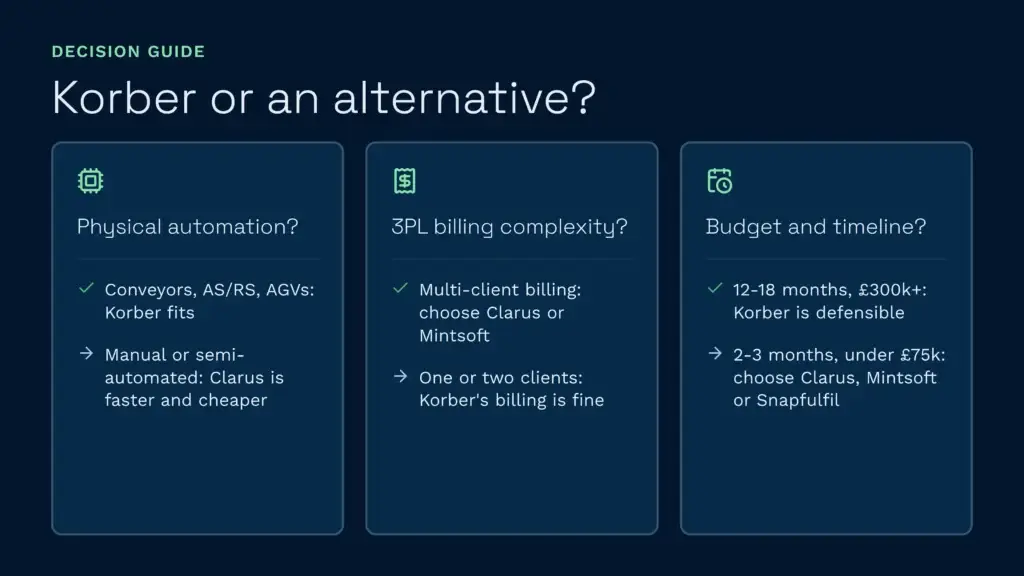
1. Benötigen Sie eine Integration in die physische Automatisierung?
Wenn in Ihrem Lager Förderbänder, Sortieranlagen, automatische Lager- und Retrieval-Systeme (AS/RS) oder fahrerlose Transportfahrzeuge (AGVs) im Einsatz sind und Sie den Materialfluss durch ausgefeilte Automatisierungslogik optimieren möchten, ist Körber die bessere Wahl als jedes cloudnative WMS. Seine Kernkompetenz liegt in der Koordination physischer Systeme. Clarus und seine Mitbewerber sind für manuelle und halbautomatisierte Abläufe konzipiert.
Wenn Sie Gabelstapler, Scanner und Regalsysteme einsetzen oder in zwei bis drei Jahren eine Automatisierung in Betracht ziehen, ist ein cloud-natives System wie Clarus die bessere Wahl: Es lässt sich schneller bereitstellen, kostengünstiger skalieren und einfacher an das Wachstum Ihres Betriebs anpassen.
2. Wie komplex ist Ihre 3PL-Abrechnung?
Wenn Sie mehreren Kunden Lagerung, Kommissionierung, Verpackung und Mehrwertdienste in Rechnung stellen und absolut keine Abrechnungslücken zulassen dürfen, entscheiden Sie sich für ein System, das von Grund auf für 3PL entwickelt wurde: Clarus oder Mintsoft. Eine Nachrüstung von Körber für die 3PL-Abrechnung ist zwar möglich, jedoch kostspielig und fehleranfällig.
Wenn Sie nur einen oder zwei Hauptkunden haben und die Abrechnung unkompliziert ist (eine feste monatliche Gebühr), reicht die allgemeine Abrechnungs-Engine von Körber völlig aus.
3. Wie hoch ist Ihr Budget für die Einführung und wie sieht der Zeitplan aus?
Wenn Sie über einen Zeitrahmen von 12 bis 18 Monaten sowie ein Budget auf Unternehmensniveau für die Implementierung und Lizenzierung verfügen, ist Körber eine vertretbare Wahl für große, komplexe Betriebsabläufe.
Wenn Sie in weniger als drei Monaten den Betrieb aufnehmen müssen und nur über ein knappes Budget verfügen, entscheiden Sie sich für Deposco oder Canary7.
Wenn Sie zwei bis drei Monate Zeit und ein moderates Budget für die Implementierung haben, entscheiden Sie sich für Clarus, Mintsoft oder Snapfulfil.
Migration von Körber zu einem cloud-nativen WMS
Wenn Sie bereits mit Körber arbeiten und einen Wechsel in Betracht ziehen, ist eine Migration zwar möglich, erfordert jedoch eine sorgfältige Planung.
- Datenexport: Körber exportiert Daten in CSV- oder Flat-Dateien. Der aktuelle Lagerbestand, Stammdaten, offene Aufträge und Kundendaten können extrahiert und für Ihr neues System angepasst werden.
- Umstellungsansatz: Planen Sie entweder eine vollständige Umstellung (an einem Wochenende oder über Nacht) oder eine schrittweise Umstellung (Migration jeweils einer Produktlinie nach der anderen). Sowohl Clarus als auch Mintsoft unterstützen die schrittweise Umstellung.
- Zeitplan: zwei bis vier Wochen Vorbereitung, ein bis zwei Wochen für die eigentliche Datenmigration und Tests sowie eine Woche Support bei der Inbetriebnahme.
- Schulung der Mitarbeiter: Clarus und andere Cloud-native Systeme sind deutlich einfacher zu bedienen als Körber, sodass Ihr Team in der Regel nur ein bis zwei Wochen Schulung benötigt und nicht sechs bis acht.
- Integrationen: Ihre ERP-, TMS- und E-Commerce-Anbindungen müssen auf die APIs des neuen Systems umgestellt werden. Dies ist in der Regel der zeitaufwändigste Teil der Migration und dauert normalerweise zwei bis vier Wochen.
Sprechen Sie mit einem Lagerfachmann
Wenn Sie gerade Ihre Optionen abwägen und sehen möchten, wie ein speziell entwickeltes WMS in der Praxis funktioniert, lohnt es sich, mit Clarus ins Gespräch zu kommen. Wir arbeiten mit 3PL-Anbietern und Distributoren in ganz Großbritannien zusammen, um Lagerverwaltungssoftware zu implementieren, die sich Ihren Arbeitsabläufen anpasst – und nicht umgekehrt.
Kontaktieren Sie unser Team um Ihre Anforderungen zu besprechen.