

If you’re a UK 3PL, distributor, or warehouse operator evaluating Linnworks, you’ll quickly discover a gap: Linnworks was built for ecommerce sellers managing their own inventory across marketplaces, not for third-party logistics providers juggling multiple clients, bespoke billing rules, and complex multi-site operations. It’s a solid tool for what it does. But what it does isn’t warehouse management, it’s order and channel management. The moment you add 3PL complexity, client portal visibility, per-client billing, FEFO rotation, automated invoicing, the cracks appear. In this guide, we’ll cover what Linnworks is, where it falls short for warehouse operations, and introduce you to purposeful alternatives, starting with Clarus WMS, the purpose-built 3PL alternative already running in 800+ warehouses worldwide.
Quick Comparison: Linnworks vs. The Best Alternatives
| Feature | Clarus WMS | Linnworks | Mintsoft | Deposco | Extensiv |
|---|---|---|---|---|---|
| Purpose | Purpose-built 3PL WMS | Multichannel ecommerce | 3PL + warehouse | 3PL focus | 3PL + fulfillment |
| Multi-client architecture | Native | Retrofitted | Native | Native | Native |
| Automated client billing | Yes (real-time) | Manual, add-on | Yes | Yes | Yes |
| Client self-service portal | Yes (white-labelable) | Limited | Yes | Yes | Yes |
| Cloud-native (no servers) | Yes (serverless) | Cloud-hosted | Cloud | Cloud | Cloud |
| FEFO/FIFO/LIFO logic | Configurable | Basic | Yes | Yes | Yes |
| Real-time scan verification | Yes (99.9% accuracy) | Add-on module | Yes | Yes | Yes |
| Pricing model | £1,000/month rolling | £35+/user, add-ons scale | £159+/month | Custom (mid-market focus) | Custom (tiered) |
| Implementation speed | Weeks (cloud-native) | Weeks to months | Weeks | Months | Weeks to months |
| Lock-in contract | Month-to-month | Annual (with increases) | Flexible terms | Typically annual | Annual |
Why warehouse operators are leaving Linnworks
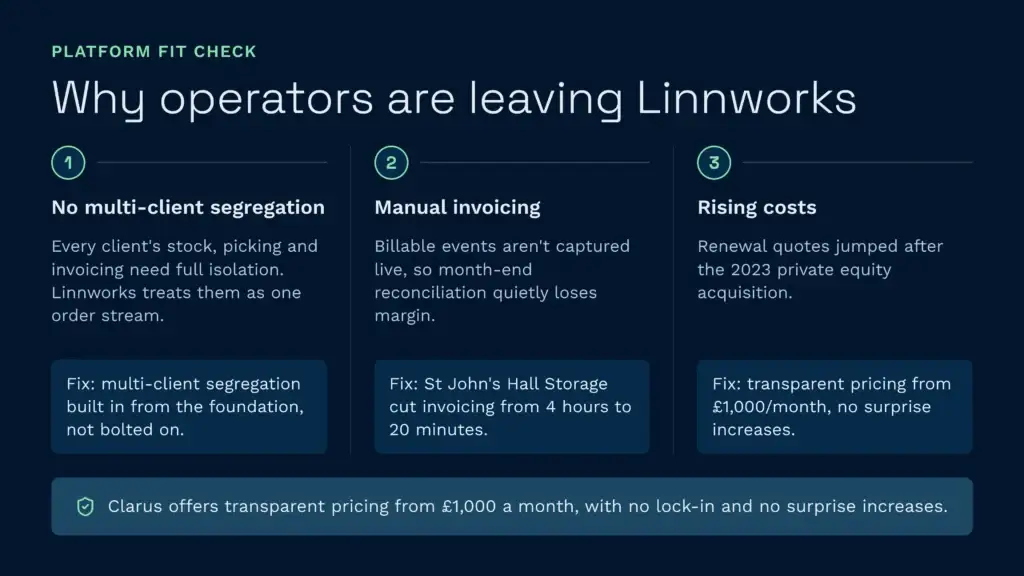
Linnworks’ business model and architecture centre on ecommerce sellers. The product roadmap reflects this: channel integration (Amazon, eBay, Shopify), listing management, and multichannel order routing dominate development. Warehouse management is bolted on as an add-on module. For small teams selling their own stock, this works fine. For 3PLs and warehouse operators, it creates three structural problems.
No native multi-client segregation
In a 3PL warehouse, every client’s inventory must be completely isolated: separate stock counts, separate picking, separate reporting, separate invoicing. Linnworks treats all clients as orders flowing through a single system. To isolate them, you’re managing workarounds: separate Linnworks instances (costly and operationally fragmented), or manual workflows to separate client data. Neither scales. A proper WMS has multi-client segregation baked in from the foundation: each client’s stock, rules, and reporting exist in one system but completely isolated.
Invoicing is manual and leak-prone
Billing is the lifeblood of 3PL profitability, and it’s where Linnworks breaks down. The system doesn’t capture billable events in real time: receiving, storage, handling, despatch, returns. Instead, you’re reconciling invoices at month-end by counting picks, weighing pallets, or cross-checking spreadsheets. One of the most common failure points we’ve seen: a client’s goods are moved from ambient storage to chilled mid-month, but the billing rule change never gets flagged, and the invoice doesn’t reflect it. That’s margin lost. With automated billing, as Clarus WMS delivers it, every billable event is captured at the point of transaction. St John’s Hall Storage cut their invoicing from four hours to twenty minutes, eliminating a two-person manual reconciliation entirely.
What is Linnworks, and who it’s really for?
Linnworks is inventory and order management software for multichannel ecommerce retailers. It connects your sales channels (Amazon, eBay, Shopify, TikTok Shop, and 100+ others) with real-time inventory synchronisation to prevent overselling. It auto-generates pick lists, manages carrier integrations, and bundles warehouse features like barcode printing and kit assembly.
It’s good at what it was designed for: helping an ecommerce seller manage inventory and orders across multiple sales channels. Linnworks’ 4.3/5 G2 rating reflects that fit, for sellers, it works well.
But that mission is not 3PL warehouse management. If you’re:
- A warehouse or 3PL managing multiple clients under one roof
- Responsible for per-client billing and cost recovery
- Needing client-facing visibility (stock levels, orders, invoices)
- Handling food, beverage, or high-compliance stock requiring FEFO and traceability
- Scaling operations that need real-time, not month-end, invoicing
then Linnworks isn’t the right answer. It’s a square peg in a round hole. 3PL software is built for these workflows, and Linnworks isn’t it.
The best alternatives to Linnworks: a fair breakdown
Clarus WMS: purpose-built 3PL cloud WMS (recommended for UK 3PLs)
Best for: UK 3PLs, wholesale distributors, and warehouse operators managing 10+ users and multi-client operations. Food & beverage, cold chain, and high-compliance environments especially.
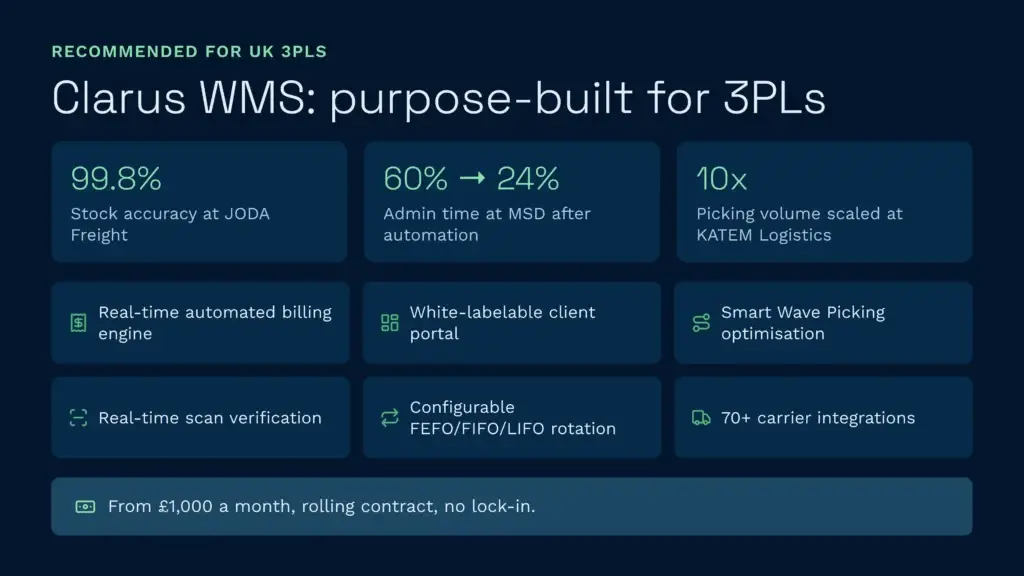
What makes it different: Clarus was born from frustration with legacy WMS software that treated every client the same. It’s serverless (no on-premise infrastructure to maintain), cloud-native, and designed from day one for multi-client 3PL operations. Every billable event, receiving, storage, picking, packing, despatch, returns, is captured in real time and automatically invoiced. Clients get a white-labelable portal where they see live stock levels, shipments, and invoices without needing to call you.
Proof points: JODA Freight brought stock accuracy from the low 90s to 99.8%. MSD cut admin workload by 60% with automated invoicing and workflows. KATEM Logistics increased monthly picking volumes 10x and hit 99% accuracy after switching to Clarus.
Standout features:
- Real-time automated billing engine: every transaction captured, no month-end reconciliation
- White-labelable client portal: stock visibility, orders, invoicing, all self-service
- Smart wave picking: batches orders and optimises picking routes (claimed 50% travel time reduction)
- Real-time scan verification: barcode must match or the system stops the packer (99.9% accuracy)
- Configurable FEFO/FIFO/LIFO rotation per client or product
- Batch and lot control for full recall readiness
- 70+ carrier integrations out of the box
- Monthly rolling contracts, no lock-in
Pricing: from £1,000 per month on month-to-month contracts. No add-ons, no surprise increases. What you pay is what you get.
Where Clarus isn’t a fit: small single-client webshops, pure B2C parcel-only volume (fewer than 10 warehouse users), or operations that don’t need automated billing. If you’re a solo seller using Shopify, Linnworks is simpler. If you’re a 100-site enterprise with dedicated IT infrastructure, enterprise WMS (SAP EWM, Manhattan Active) may be more suitable. Clarus sits in the sweet spot: growing 3PLs and mid-market warehouse operations looking for purpose-built, cloud-native software.
Implementation: weeks, not months. Cloud-native architecture means no servers to install, no lengthy version upgrades. Go live quickly and evolve as your needs change.
Mintsoft: 3PL with strong transparency and UK support
Best for: UK 3PLs wanting transparent pricing and a platform designed for warehouse operations. Strong for single-location and smaller multi-location setups.
What it does well: Mintsoft is a UK-based 3PL WMS with native multi-client architecture, automated invoicing, and a client portal. Pricing is transparent and published in clear tiers rather than quoted case-by-case, and its Trustpilot score is 4.7/5 (“Excellent”). Warehouse management is included in the base price, not an add-on. Mobile picking with Android apps and barcode scanning comes standard. Automation is a genuine strength here, cutting the manual admin that eats into warehouse teams’ time.
Where it can lag: Mintsoft’s pricing and feature scaling becomes complex across large multi-location networks. Implementation can stretch to weeks or months. For food and beverage operations needing advanced FEFO/expiry tracking, Clarus has deeper specialisation.
Pricing: transparent, published tiering, with warehouse management included in the base price rather than as an add-on. Cost grows with users and warehouse locations.
Deposco: enterprise 3PL focus, longer implementation window
Best for: mid-market to enterprise 3PLs wanting a comprehensive cloud platform with strong operational scalability. Suitable for operations managing 20+ sites.
What it does well: Deposco is frequently featured in mid-market 3PL software roundups, and positions itself around four capabilities: speed to onboard new clients (configurable, not custom), operational scalability (handles volume spikes and automation additions), configurability (adapts without heavy development), and total cost of ownership (predictable, though custom-priced).
Where it lags behind alternatives: implementation typically takes months, not weeks. Pricing is custom and not transparent upfront, making budgeting difficult. For smaller 3PLs (under 15 users), simpler purpose-built platforms like Clarus are often more cost-effective.
Pricing: custom quote. Expect enterprise-level pricing for enterprise capabilities.
Extensiv: SMB-friendly 3PL option with accessible pricing
Best for: smaller 3PLs and fulfilment operators wanting affordable cloud WMS with multi-location support. Strong for operations using multiple 3PL networks.
What it does well: Extensiv offers accessible, tiered pricing that starts lower than enterprise alternatives, and is built for SMB fulfilment operations. If your logistics run through multiple 3PL partners and visibility across that network is your bottleneck, Extensiv’s integrations with carrier and 3PL networks are a genuine advantage.
Where it falls short: feature depth for complex billing scenarios (multiple storage tiers, activity-based pricing per client) is shallower than purpose-built platforms. For food and beverage or temperature-controlled environments, feature maturity is lower.
Pricing: tiered, starting lower than enterprise options. Custom quotes for larger deployments.
Cin7: best for manufacturing and wholesale hybrids
Best for: operations mixing manufacturing, assembly, wholesale, and retail. Also strong for SMBs wanting a unified inventory and WMS solution.
What it does well: Cin7 offers two products: Core (for SMBs) and Omni (mid-market, with EDI, multi-entity, and deeper 3PL support). If you’re managing kitting, assembly, or a hybrid wholesale-to-retail operation, Cin7’s approach is valuable. Built-in manufacturing and assembly workflows set it apart from pure fulfilment WMS.
Where it isn’t ideal: for pure 3PL operations without manufacturing complexity, Cin7 adds feature overhead you won’t use. Pricing becomes steep for multi-location networks. 3PL billing automation, while present, is less mature than on Deposco or Clarus.
Pricing: tiered by product (Core vs Omni), custom for large deployments.
How to choose: a decision framework
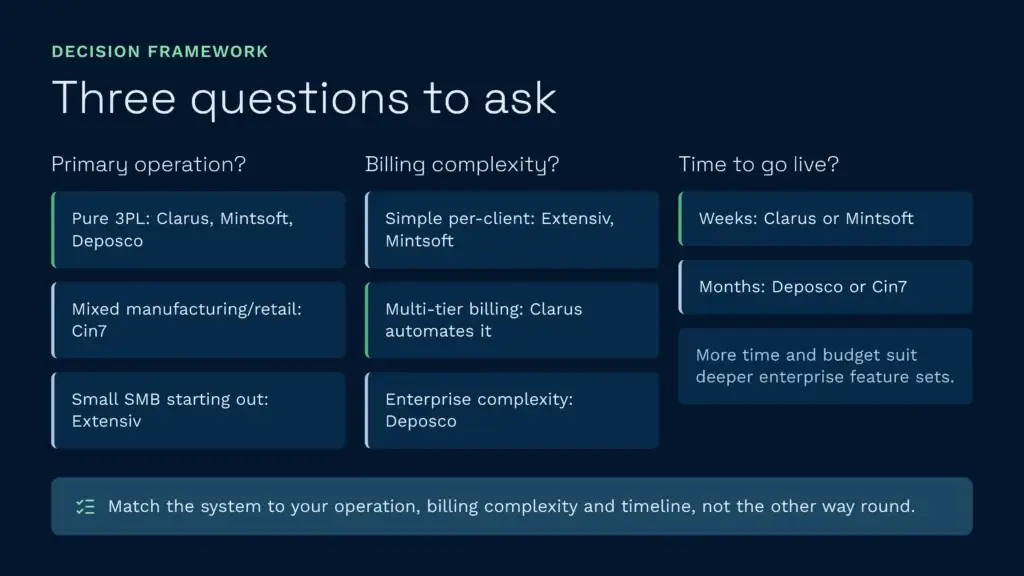
Ask yourself three questions.
What’s your primary operation?
If it’s pure 3PL (warehousing goods for multiple clients), choose a purpose-built 3PL WMS (Clarus, Mintsoft, Deposco). If you’re mixing manufacturing, wholesale, and retail, Cin7 may fit better. If you’re a small SMB just starting out, Extensiv or Clarus’ entry-level offer is sensible.
How complex is your billing?
Simple per-client storage? Extensiv or Mintsoft. Multi-tier billing (storage plus handling plus activity-based surcharges, per-client SLA rules)? Clarus’ automated billing engine is designed exactly for this. Enterprise complexity? Deposco.
How fast do you need to go live?
Weeks, not months? Clarus (serverless cloud) or Mintsoft. Can you commit to months? Deposco or Cin7 offer deeper enterprise feature sets if you have the time and budget.
Speak to a warehouse expert
If you’re evaluating your options and want to see how a purpose-built WMS works in practice, Clarus is worth a conversation. We work with 3PLs and distributors across the UK to implement warehouse management software that fits the way you operate, not the other way around.
Get in touch with our team to talk through your requirements.