

Als je een logistieke dienstverlener, dan weet u al dat succes afhangt van efficiëntie. 3PL-software vormt de ruggengraat die ervoor zorgt dat uw magazijnactiviteiten, orderbeheer en klantrelaties soepel verlopen. Het gaat niet alleen om het verplaatsen van dozen, maar ook om inzicht, snelheid en nauwkeurigheid in elke fase.
In deze gids wordt uitgelegd wat 3PL-software doet, waarom deze belangrijk is en hoe u de juiste oplossing voor uw bedrijf kunt kiezen. Of u nu één vestiging beheert of een netwerk van magazijnen, het juiste systeem zorgt voor een transformatie van uw bedrijfsvoering en groeit met u mee naarmate uw bedrijf zich uitbreidt.
Wat is 3PL-software?
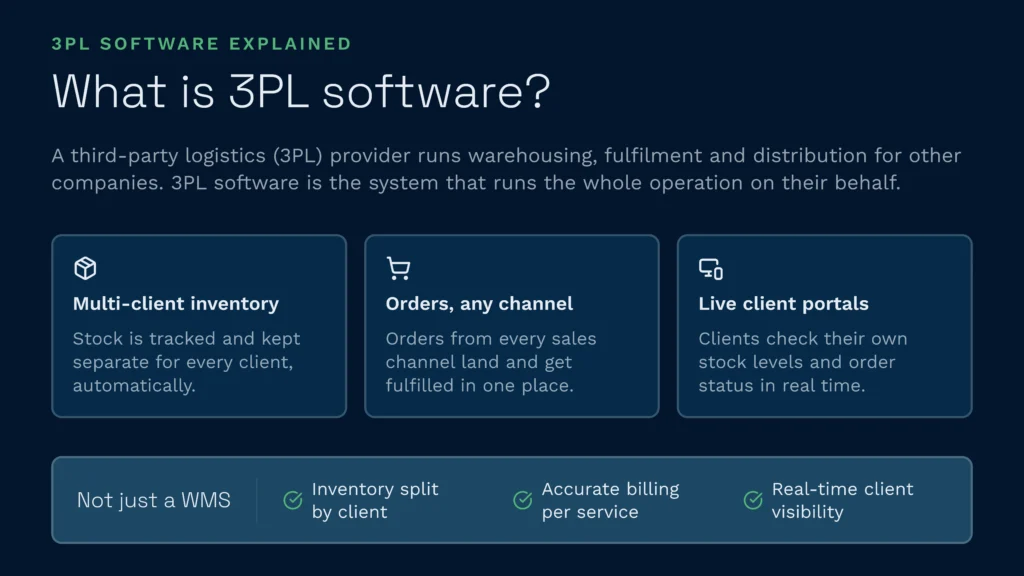
3PL staat voor externe logistiek. In de praktijk betekent dit dat je opslag-, orderafhandelings- en distributiediensten levert aan andere bedrijven. Zij zijn niet de eigenaar van het magazijn en beheren hun voorraad niet zelf; dat doe jij namens hen.
3PL-software is een gespecialiseerd platform dat is ontworpen om alle onderdelen van dit bedrijfsmodel te beheren. Het houdt de voorraad van meerdere klanten bij, verwerkt bestellingen uit verschillende verkoopkanalen, organiseert de magazijnruimte en houdt klanten bij elke stap op de hoogte. Zie het als het zenuwstelsel dat uw magazijnactiviteiten, uw personeel en uw klanten met elkaar verbindt.
In tegenstelling tot een standaard magazijnbeheersysteem is 3PL-software vanaf de basis ontworpen om omgevingen met meerdere klanten te ondersteunen. Het systeem splitst de voorraad per klant op, factureert de gebruikte diensten nauwkeurig en biedt elke klant een portaal waar hij in realtime zijn voorraadniveaus en de status van zijn bestellingen kan bekijken.
Waar staat 3PL voor?
3PL is de afkorting van “third-party logistics”. Met “third party” wordt u, de dienstverlener, bedoeld. De ‘first party’ is de leverancier en de ‘second party’ is de eindklant. U bevindt zich in het midden en biedt logistieke diensten aan als uw kernactiviteit.
Sommige mensen vragen zich af waarom het “third party” wordt genoemd in plaats van “second party”. Het antwoord is historisch van aard en ligt in de manier waarop de rollen binnen de toeleveringsketen zich hebben ontwikkeld. Uw klanten (de verladers of detailhandelaren) besteden hun logistiek volledig aan u uit in plaats van deze zelf te beheren. U wordt een verlengstuk van hun bedrijfsvoering, zonder dat zij eigenaar zijn van de middelen.
Het is belangrijk om dit onderscheid te begrijpen, omdat 3PL-software iets moet verwerken wat een standaard magazijnbeheersysteem vaak niet het geval: multi-tenancy. De voorraad, bestellingen en facturering van elke klant moeten volledig gescheiden en correct zijn.
Hoeveel kost 3PL-software?
De kosten van 3PL-software dit varieert sterk, afhankelijk van de oplossing, de omvang van uw faciliteit en de complexiteit van de functies. De meeste leveranciers hanteren een van de volgende prijsmodellen:
- Prijs per transactie: U betaalt per verwerkte bestelling, per opgeslagen SKU of per verzonden doos. Dit systeem schaalt mee met uw bedrijfsvolume en is gebruikelijk bij cloudgebaseerde platforms.
- Maandelijks abonnement: Een vast of gestaffeld maandelijks bedrag op basis van het aantal klanten, magazijnen of gebruikers. Bij sommige tariefniveaus is een basisvolume aan transacties inbegrepen; voor transacties boven dat volume worden extra kosten in rekening gebracht.
- Hybride model: Een vast maandelijks bedrag plus kosten per transactie. Dit combineert voorspelbaarheid met een eerlijke schaalbaarheid.
- Bedrijfslicenties: Voor grote projecten gelden prijzen op maat, afhankelijk van de implementatie, de integratiebehoeften en het ondersteuningsniveau.
Op de Britse markt kunt u rekenen op maandelijkse kosten die variëren van een paar honderd pond voor kleine bedrijven tot enkele duizenden pond voor implementaties bij grote ondernemingen. De transactiekosten kunnen, afhankelijk van het platform, tussen de £ 0,05 en £ 0,50 per order bedragen.
De belangrijkste vraag is niet de catalogusprijs, maar de totale eigendomskosten. Een goedkoper platform dat meer handmatig werk of aangepaste integraties vereist, kost op de lange termijn vaak meer. Kijk eens naar magazijnkosten in zijn geheel. Betere software betaalt zichzelf terug door minder fouten, snellere verwerking en tevredenere klanten.
Wat is de beste 3PL-software voor magazijnbeheer?
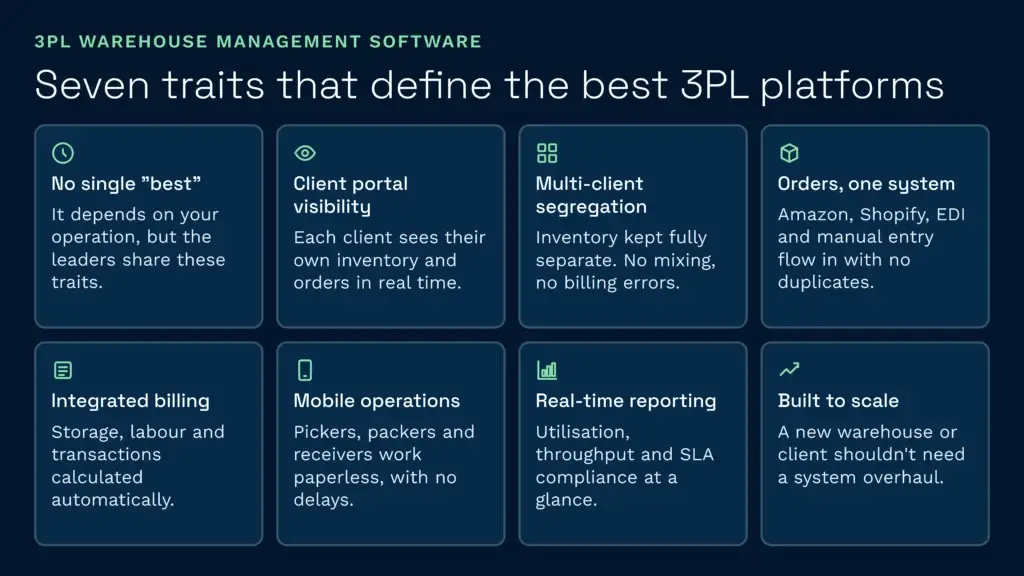
Er bestaat geen algemeen geldend “beste” – het hangt af van je bedrijfsvoering. Maar er zijn duidelijke marktleiders, en die hebben bepaalde kenmerken gemeen:
Belangrijkste kenmerken van de beste 3PL-oplossingen
- Zichtbaarheid op het klantenportaal: Elke klant kan zijn eigen voorraad en bestellingen in realtime bekijken. Dit is een absolute must voor elk serieus 3PL-platform.
- Scheiding tussen verschillende klanten: De voorraad wordt per klant volledig gescheiden gehouden. Geen vermenging, geen factureringsfouten, geen verwarring.
- Orderbeheer via verschillende kanalen: Bestellingen van Amazone, Shopify, EDI-feeds en handmatige invoer worden allemaal in één systeem verwerkt zonder dat er dubbele gegevens ontstaan.
- Geïntegreerde facturering: Het systeem berekent automatisch de kosten op basis van opslag, arbeid en transacties, waardoor de facturering snel en nauwkeurig verloopt.
- Mobiele magazijnactiviteiten: Magazijnmedewerkers, inpakkers en ontvangers werken met mobiele apparaten. Geen papier, geen vertragingen, geen zoekgeraakte documenten.
- Realtime rapportage: Op de dashboards zijn de bezettingsgraad, de doorvoer en de naleving van de SLA’s voor klanten in één oogopslag te zien.
- Schaalbaarheid: Het systeem groeit met u mee. Het toevoegen van een nieuw magazijn of een nieuwe klant zou geen ingrijpende aanpassing van het systeem moeten vereisen.
Tot de populaire platforms op de Britse markt behoren onder meer Mintsoft, CartonCloud, en FarEye. Elk heeft zijn eigen sterke punten, afhankelijk van je niche. De 3PL-gids van GetApp en De 3PL-vermeldingen van Capterra bieden een zij-aan-zij-vergelijking van de beschikbare oplossingen.
Voor bedrijven die op zoek zijn naar een speciaal ontwikkelde 3PL-oplossing die specifiek is afgestemd op de Britse markt, een 3PL-beheersysteem Systemen die vanaf het begin zijn ontworpen voor activiteiten met meerdere klanten, presteren vaak beter dan aangepaste, generieke systemen. Het verschil zit in de architectuur: systemen die vanaf het begin zijn gebouwd voor 3PL kunnen omgaan met een complexiteit die achteraf toegevoegde functies niet kunnen evenaren.
Welke functies moet 3PL-software hebben?
De juiste functies zijn bepalend voor het succes van uw bedrijf. Dit is wat uitstekende 3PL-software onderscheidt van de rest:
Kernactiviteiten van het magazijn
- Goederen in de automatisering: Zodra de voorraad binnenkomt, goederen in bewerking zou snel moeten gaan. Het scannen van barcodes, het automatisch toewijzen van locaties en kwaliteitscontroles zijn binnen enkele minuten geklaard, niet binnen uren.
- Scheiding van voorraden: De voorraad van elke klant wordt in een aparte ruimte opgeslagen. Het systeem houdt precies bij waar elke SKU zich bevindt, waardoor het orderverzamelen nauwkeurig en snel verloopt.
- Bestelbeheer via meerdere kanalen: Bestellingen via alle kanalen (Amazon FBA, Shopify, Etsy, directe API, EDI) komen op één plek binnen. Handmatige samenvoeging is niet nodig.
- Slim orderverzamelen: Algoritmen voor wave- en batch-picking zorgen voor een minimalisering van de verplaatsingstijd en de arbeidskosten. Mobiele apparaten leiden uw orderverzamelaars langs de meest efficiënte route.
- Verpakken en verzenden: Integratie met koeriersdiensten (DPD, DHL, Parcelforce) voor het automatisch genereren van verzendlabels en updates over de trackingstatus.
Klantenportaal en communicatie
- Realtime inzicht in de voorraad: Klanten loggen in en zien precies hoeveel voorraad ze hebben, waar die zich bevindt en wanneer deze wordt geleverd. Er hoeven geen e-mails meer te worden gestuurd om de voorraad te controleren.
- Bestelling volgen: De klanten van uw klanten kunnen zendingen rechtstreeks volgen. Dit zorgt voor minder supportverzoeken en versterkt het vertrouwen.
- Geautomatiseerde meldingen: Waarschuwingen bij lage voorraad, verwerkte bestellingen, verzonden zendingen: klanten ontvangen automatisch updates.
- Rapportage op maat: Klanten hun eigen rapporten opstellen over de voorraad, bestellingen en KPI’s, zonder dat we je hoeven te bellen.
Facturering en financiële controle
- Geautomatiseerde berekening van de kosten: Opslagkosten, arbeidskosten voor het picken en verpakken, verzendtoeslagen: dit alles wordt door het systeem berekend op basis van de daadwerkelijke activiteiten.
- Gebruiksstatistieken: Elke transactie wordt geregistreerd. De opslagruimte wordt dagelijks gemeten. De arbeidsuren worden per opdracht of taak geregistreerd. Facturering is nooit een gokspel.
- Facturering aan klanten: Maak snel nauwkeurige facturen aan. Sommige systemen kunnen worden gekoppeld aan boekhoudsoftware voor een naadloze afstemming.
- Tariefbeheer: Update prijzen per klant, per soort dienst en per seizoen, zonder dat er opnieuw gecodeerd hoeft te worden.
Rapportage en inzichten
- KPI’s voor magazijnen: Realtime statistieken over bezettingsgraad, doorvoer, nauwkeurigheid en arbeidsproductiviteit.
- Prestaties van de klant: Krijg inzicht in welke klanten het meest winstgevend zijn, welke de hoogste foutpercentages hebben en waar u uw inspanningen het beste kunt richten.
- Trendanalyse: Uit historische gegevens blijken seizoensgebonden ontwikkelingen en groeipatronen. Stem de personeelsbezetting en capaciteit hierop af.
- Aangepaste dashboards: Stel rapporten op die zijn afgestemd op uw bedrijf. Geen standaardweergaven meer.
Waarin verschilt een 3PL-WMS van een standaard-WMS?
Een norm het beste magazijnbeheersysteem is bedoeld voor één organisatie die haar eigen voorraad beheert. Een 3PL-WMS heeft een heel ander karakter.
De fundamentele verschillen
Scheiding van klanttegoeden: Een standaard WMS heeft één “eigenaar” van de voorraad. Een 3PL-WMS ondersteunt tientallen of honderden klanten, elk met een volledig afzonderlijke voorraad, bestellingen en facturering. Het systeem moet op elk niveau deze scheiding handhaven: geen kruisbesmetting, geen gedeelde SKU-codes, geen gemengde pallets.
Orderbeheer: Standaard WMS-systemen verwerken bestellingen van één bedrijf. Een 3PL-WMS verwerkt bestellingen van meerdere klanten, via verschillende kanalen, vaak met verschillende bestelformaten en afhandelingsregels. De ene klant maakt misschien gebruik van dropshipping, terwijl een andere klant bestellingen in batches verwerkt. Het systeem moet beide situaties naadloos kunnen afhandelen.
Complexiteit van de facturering: Een standaard WMS verzorgt geen facturering; dat gebeurt intern. Een 3PL-WMS moet elke geleverde dienst, elke kubieke voet opslagruimte en elk uur arbeid bijhouden en elke klant nauwkeurig factureren. Fouten in de facturering ondermijnen het vertrouwen, dus dit is geen optie.
Inzicht voor de klant: Standaard WMS-systemen hebben één of twee interne gebruikers. 3PL-software moet een zelfbedieningsportaal bieden waar tientallen klanten 24/7 de voorraad kunnen controleren, bestellingen kunnen volgen en rapporten kunnen downloaden, zonder dat ze daarvoor contact hoeven op te nemen met uw team.
Operationele complexiteit: Standaard WMS-systemen zijn geoptimaliseerd voor één workflow. 3PL-WMS-systemen moeten zich aanpassen aan de verschillende workflows van klanten en rekening houden met verschillen in de regels voor ontvangst, orderverzameling, verpakking en verzending per klant.
Waarom dit belangrijk is
Je zou kunnen denken dat je een standaard WMS voor 3PL-activiteiten kunt gebruiken door “multi-client” als een extra functie toe te voegen. In de praktijk leidt dit echter tot een kwetsbaar systeem dat traag en foutgevoelig is en je groei beperkt. Een speciaal voor dit doel ontwikkeld 3PL-systeem – zoals een 3PL-WMS dat specifiek is ontworpen voor multi-client-activiteiten – voorkomt deze valkuilen omdat de architectuur vanaf het begin al klopt.
A 3PL-beheersysteem Dit speciaal voor dit doel ontwikkelde systeem kan de complexiteit aan waar standaardsystemen moeite mee hebben. De integratie verloopt soepeler, de facturering is betrouwbaar en uw klanten krijgen het inzicht dat ze verwachten.
Functies van 3PL-software: orderbeheer en klantenportalen
Twee functies verdienen bijzondere aandacht, omdat ze bepalend zijn voor de dagelijkse bedrijfsvoering en de klanttevredenheid: orderbeheer en klantenportalen.
Orderbeheer
Bij 3PL zijn bestellingen van levensbelang. Uw klanten sturen voortdurend bestellingen, via verschillende kanalen en in verschillende formaten. Een gebrekkig orderbeheersysteem leidt tot knelpunten.
De beste 3PL-software:
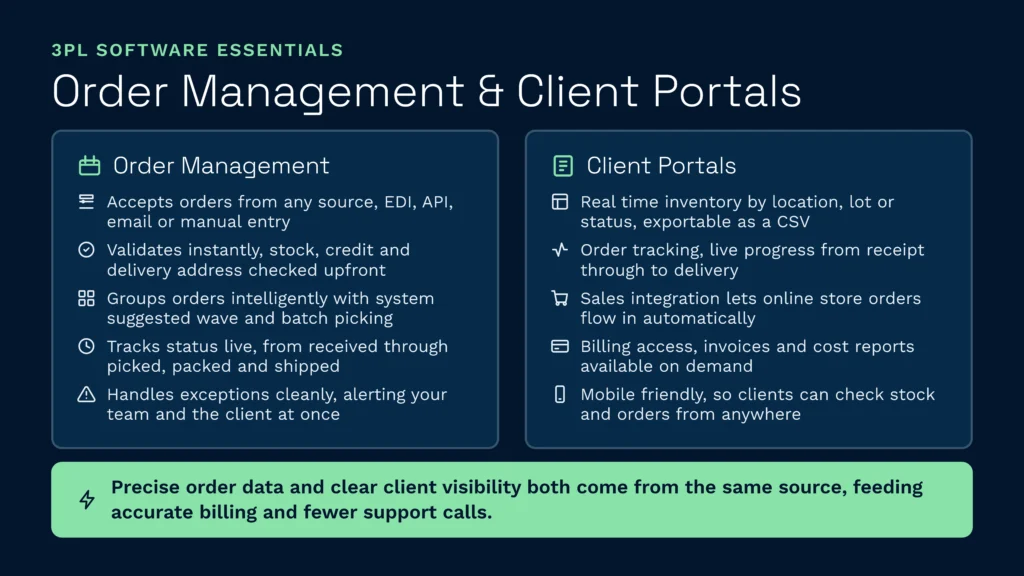
- Verwerkt bestellingen uit verschillende bronnen: EDI-feeds, API-integraties, e-mail, FTP, handmatige invoer en directe uploads door klanten.
- Verifieert bestellingen onmiddellijk: controleert of de voorraad aanwezig is, of de klant voldoende krediet heeft en of de afleveradressen geldig zijn, voordat de bestelling wordt geaccepteerd.
- Bestellingen worden op slimme wijze gegroepeerd: bij ‘wave picking’ worden bestellingen die naar dezelfde regio of dezelfde klant gaan, gebundeld. Bij ‘batch picking’ worden vergelijkbare SKU’s gegroepeerd. Het systeem stelt de meest efficiënte aanpak voor.
- Volgt de status in realtime: elke bestelling doorloopt verschillende fasen (ontvangen, gepickt, verpakt, verzonden). Klanten zien deze status direct bijgewerkt worden.
- Gaat soepel om met uitzonderingen: als een artikel niet op voorraad is, waarschuwt het systeem zowel uw team als de klant. Gedeeltelijke leveringen, nabestellingen en annuleringen worden netjes afgehandeld.
- Integratie met koeriersdiensten: etiketten worden automatisch afgedrukt. Updates over de verzendstatus worden automatisch doorgegeven aan het klantenportaal, zonder dat er handmatig ingegrepen hoeft te worden.
De 3PL-beheersysteem Een bedrijf dat uitblinkt in orderbeheer, is vaak ook het bedrijf dat het beste is in facturering. Waarom? Omdat elke bestelling kosten met zich meebrengt: orderverzameling, verpakking en de doorberekening van verzendkosten. Als je bestellingen nauwkeurig bijhoudt, vloeit de facturering vanzelf voort uit diezelfde gegevens.
Klantportalen
Uw klanten willen inzicht hebben zonder u voortdurend te hoeven bellen. Een goed klantenportaal verdient zichzelf terug doordat het de ondersteuningswerkzaamheden vermindert.
De beste magazijnbeheersysteem voor 3PL biedt:
- Real-time voorraad: Klanten loggen in en zien direct de voorraadstanden. Geen “Ik zal het even nakijken en u terugbellen.” Filter op locatie, partijnummer of status. Download een CSV-bestand voor hun administratie.
- Bestelling volgen: Plaats een bestelling en volg de voortgang ervan, vanaf de ontvangst tot en met de verzending. Bekijk wanneer de bestelling wordt gepickt, wanneer deze het magazijn verlaat en wanneer deze wordt afgeleverd.
- Verkoopintegratie: Als een klant van een klant een bestelling plaatst via diens Shopify-winkel, verschijnt die bestelling in het portaal en wordt deze automatisch aan jouw magazijn toegewezen.
- Toegang tot facturering: Klanten bekijken facturen, krijgen inzicht in de kosten en downloaden rapporten voor controledoeleinden.
- Verslaggeving: Laat niet alleen gegevens zien, maar geef klanten de mogelijkheid om deze zelf te analyseren. Bied kant-en-klare rapporten aan over voorraad, bestellingen en kosten. Geef hen de mogelijkheid om deze te exporteren voor hun eigen analyse.
- Geschikt voor mobiele apparaten: Klanten controleren de voorraad in de trein. Het portaal werkt op smartphones en tablets.
Een robuust klantenportaal vermindert het aantal e-mails met 40–50%. Dat is niet alleen handig, maar levert ook een besparing op de kosten voor ondersteunend personeel op.
Klaar om uw 3PL-activiteiten te transformeren?
Als u klaar bent om uw logistieke dienstverlening voor derden naar een hoger niveau te tillen, staat het team van Clarus voor u klaar. Wij begrijpen de unieke uitdagingen die gepaard gaan met het beheer van voorraden voor meerdere klanten, ingewikkelde factureringscycli en diverse kanalen voor orderafhandeling. Ons speciaal ontwikkelde 3PL-beheersysteem is ontworpen om u de operationele efficiëntie te bieden die u nodig hebt om moeiteloos op te schalen, terwijl het tegelijkertijd de realtime inzichtelijkheid biedt die uw klanten verlangen.
Of u nu uw huidige uitdagingen op magazijngebied wilt bespreken, de mogelijkheden van ons platform wilt verkennen of een op maat gemaakte demonstratie van onze software in de praktijk wilt zien, we horen graag van u. Neem contact op Neem vandaag nog contact op met Clarus, dan bespreken we graag hoe we u kunnen helpen een slimmer en winstgevender magazijn op te zetten.