

Cross docking is a warehouse method in which goods are unloaded, checked and moved straight to an outbound vehicle, with little or no time in storage. It skips the usual put-away and pick cycle for stock that already has a destination. For a 3PL, it can cut handling and storage costs, but only when inbound timings, pallet labels and outbound transport line up. Most cross docking problems start when one of those three slips.
This guide covers what the term means, the types of cross docking, how the process runs at the dock, when it suits a third-party logistics operation and when it does not, the risks, and what a warehouse management system (WMS) has to do to run it.
What is cross docking?
Cross docking, also written cross-docking and often shortened to cross dock, means moving goods from the receiving side of a warehouse to the dispatch side without putting them into racking or bulk storage. The name describes the route: product crosses the dock rather than going into the building. Maersk’s logistics explainer describes it as transferring products from suppliers or manufacturers directly to a customer, with minimal to no storage time in between. The DHL logistics dictionary has its own entry on the term, and the Wikipedia article on cross-docking covers the definition in more detail.
Types of cross docking
A cross docking warehouse is built around that movement. It needs enough dock doors, staging space and a process that moves stock from inbound to outbound quickly. The types below differ in when the destination is decided and how the load is handled.
| Typ | What happens | Typical fit |
|---|---|---|
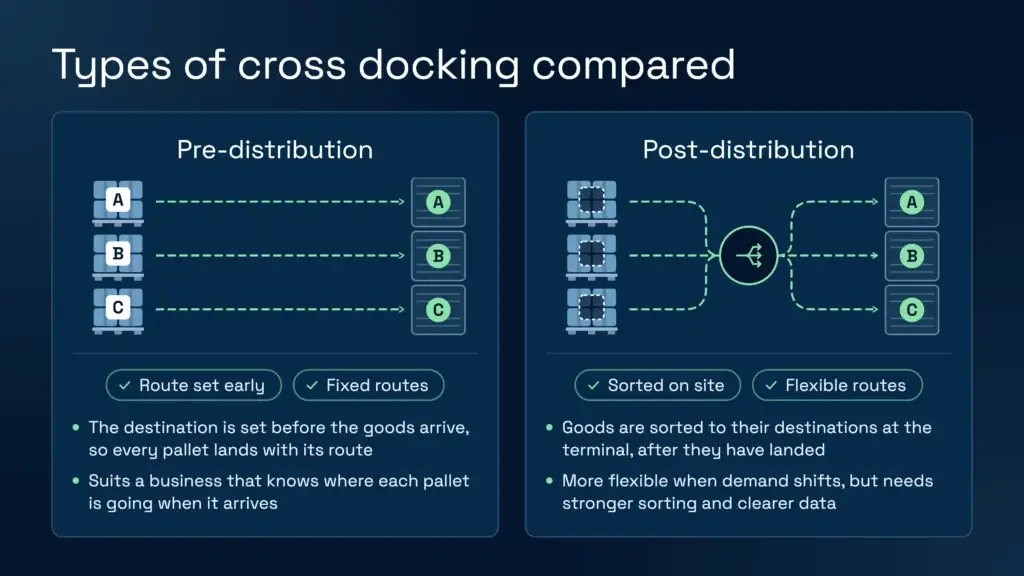
| Pre-distribution | The destination is set before goods arrive | Outbound routes are already fixed |
| Post-distribution | Goods are sorted to their destinations at the terminal | Demand shifts after goods land, and sorting is in place |
| Continuous | Goods move from inbound to outbound with minimal storage | High-demand lines with steady volume |
| Consolidation | Smaller shipments are combined into larger loads | Several suppliers feeding one destination |
| Deconsolidation | One large inbound load is split into several outbound deliveries | One load serving several customers or sites |
Pre-distribution suits a business that knows where each pallet is going when it arrives. Post-distribution gives more flexibility when demand changes after goods land, but it needs stronger sorting and clearer data at the dock. Maersk draws the same pre- and post-distribution line. Some operators also describe case-load, hybrid and opportunistic variants. Most are combinations of the types above, and the names vary from one operator to the next.
Cross docking compared with other methods
Cross docking is easiest to understand next to the methods it is often confused with. The main difference is how long stock stays in the building.
| Methode | Is stock stored? | Where it fits |
|---|---|---|
| Cross docking | Only briefly, on the dock or in a cross-dock location | Known inbound and outbound timings |
| Traditional warehousing | Yes, until an order or a demand peak calls for it | Stock held for future orders or seasonal cover |
| Dropshipping | Not in your warehouse, because the supplier ships to the customer | Suppliers hold and despatch the stock |
| Direct shipment | Not at all, because the goods travel from origin to destination | A single consignment with one final destination |
Cross docking is measured in hours or a few days. Traditional warehousing holds stock until an order needs it. Many 3PLs run both in the same building, so the WMS has to tell the two apart on every pallet.
How cross docking works, step by step
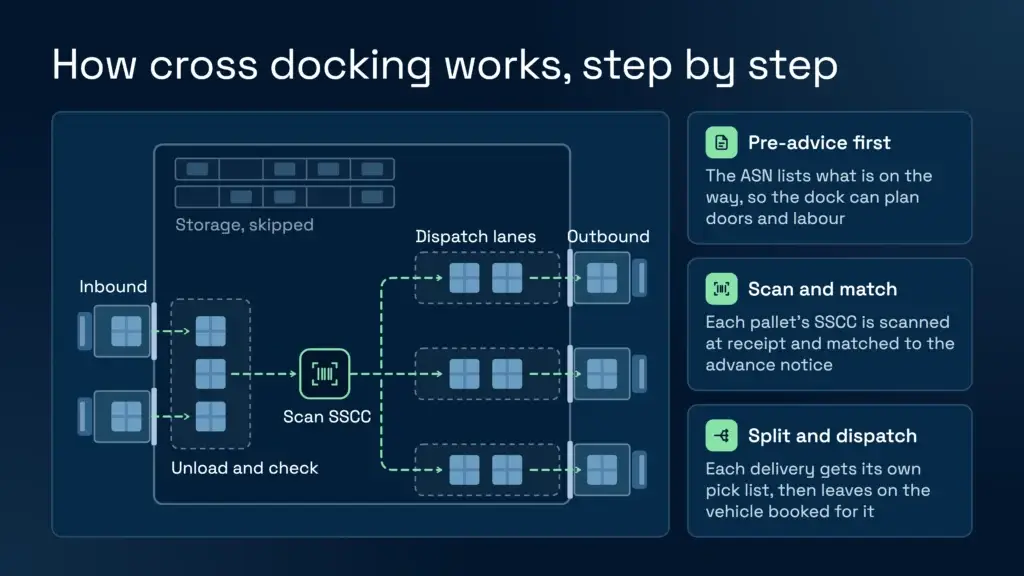
Cross docking works by matching each inbound pallet to a known outbound destination before it reaches the dock, then moving it straight across to that destination. The process depends on advance notice, a fast scan at receipt and a clear rule for where each pallet goes next. A gap at the start shows up at the far end, at the door, with a vehicle waiting.
- Pre-advice. The supplier sends an advance ship notice (ASN) listing what is on the way, how many pallets there are and the identifiers on them. The dock uses it to plan doors and labour before the vehicle arrives.
- Arrival and unload. The vehicle is booked to a door and unloaded. Staff check the load against the ASN and note any damage before the pallets are moved.
- Receipt and scan. Each pallet is scanned at its SSCC, the serial shipping container code that identifies a pallet. The scan matches the pallet to the advance notice. The receiving steps are covered in our goods-in guide, and the labels themselves are explained in the SSCC labels guide.
- Assign a destination. Each pallet goes to a cross-dock location or straight to a dispatch lane, rather than to a storage location. Clarus can automate this step through its cross-docking feature, and the rules run on event triggers and automations. Mathew Buttar, Head of Solutions at Clarus, describes the flow like this: “We can set up automations so that when we receive a product, it’s put away straight into a cross-dock location. We can automate all the way through to dispatch, so as soon as you receive that pallet, you can dispatch it.”
- Split by destination. A single inbound load may serve several customers or delivery runs. Each delivery gets its own pick list and dispatch. As an illustration, 26 pallets might become 13 deliveries of two pallets each. That is an example, not customer data. For how mixed loads are built, see our guide to mixed palletising.
- Load and dispatch. Outbound loads are built, secured and despatched on the vehicle booked for each one. Where a load is rebuilt from several inbound pallets, securing it correctly is the operator’s responsibility, and the DVSA guidance on load securing sets out what is expected. For the outbound half of the flow, see our guide to the warehouse dispatch process.
When cross docking suits a 3PL, and when it does not
Cross docking suits a 3PL when stock has a known destination, arrives at predictable times and gains nothing from being stored. It is a poor fit when inbound arrivals are unpredictable or outbound transport is not confirmed. A UK fulfilment operator, Whistl, publishes its own explainer on cross-dock fulfilment, and its description matches the flow above.
Goods that suit the method tend to share a few traits. They are perishable or time-critical, they come in seasonal or promotional volumes, they move in high and steady quantities, they need no inspection, or they are temperature-sensitive and should not wait on a floor. Each trait shortens the time stock sits in the building, which is where the method earns its keep.
Dwell time matters too. Mathew Buttar’s estimate, given on a call and not independently verified, is that a cross-dock pallet should be gone within one or two days. That is his view of the norm, not a measured benchmark. A pallet that stays longer usually means the flow is wrong somewhere upstream or downstream.
Charging is a separate decision. A 3PL can apply a charge to a cross-dock pallet, or choose not to, because the pallet is never put into storage. Clarus lets you make that choice within its facturatie van de klant features. The 3PL rate card and storage charges guide covers how storage and handling charges are usually structured.
Risks and what goes wrong at the dock
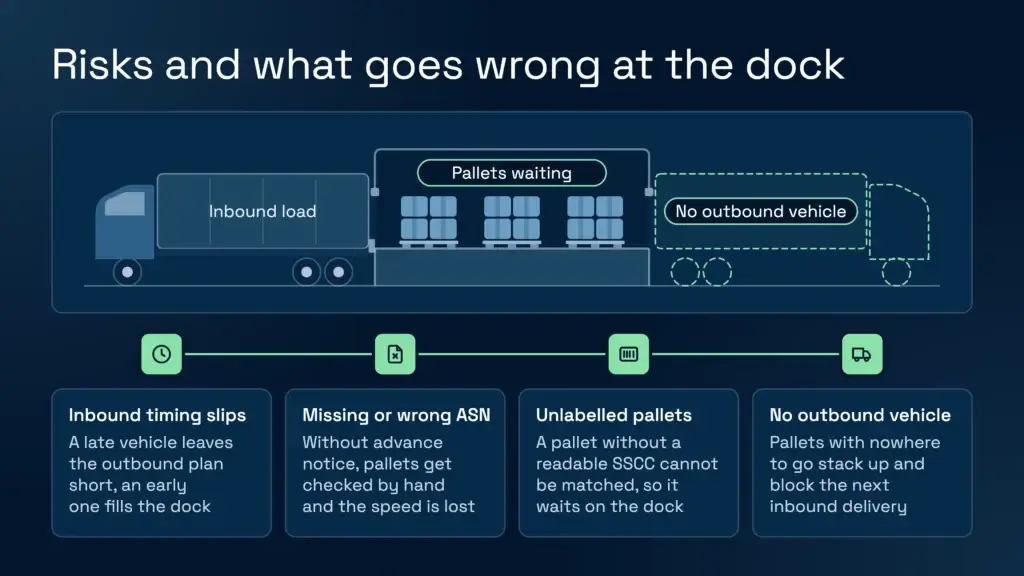
Cross docking removes a storage step, which also removes the buffer that absorbs mistakes. These are the failures that come up most often.
- Late or early inbound. The method depends on timing. A late vehicle leaves the outbound plan short, and an early one fills the dock before the outbound vehicles are ready. Maersk lists the timing and synchronisation of inbound and outbound shipments as a main challenge, with weather and transport delays adding to the risk.
- A missing or wrong ASN. Without advance notice, the dock cannot tell what has arrived or where it is going. Pallets get checked by hand, and the speed advantage disappears.
- Unlabelled or damaged pallets. A pallet without a readable SSCC cannot be matched to its destination, so it waits until someone resolves it. Damage found late leaves the record of what arrived, and in what condition, in dispute.
- No outbound vehicle. Cross-dock pallets then have nowhere to go. They stack up and block the next inbound delivery.
- Forecasting errors. If demand changes after stock is committed to a route, the stock goes to the wrong place or has to be rerouted, which costs time.
- Supplier and carrier coordination. Every partner has to label, time and document shipments in the same way. One partner that does not is enough to break the flow.
- Rebuilding loads. Breaking down inbound pallets and rebuilding them for outbound runs means more handling, more forklift movements and more chances of damage. The HSE guidance on loading and unloading is a useful baseline for dock safety.
How a WMS runs cross docking
A WMS that handles cross docking has to do three things well. It must know what is arriving, route each pallet by rule rather than by memory, and record every movement so the operation can be audited. A spreadsheet can track a few pallets. It struggles once several clients share a dock and every inbound load has its own split.
In Clarus WMS, a receipt can trigger the next move automatically, so a pallet can be routed to a cross-dock location and then dispatched without a manual stop. Each split delivery gets its own pick list and dispatch, which keeps one inbound load traceable to every outbound run. Every action and stock movement is recorded in the audit trail, so a dispute about what left the building can be checked against the system rather than a clipboard.
Neem contact op met een magazijnexpert
If you’re evaluating your options and want to see how a purpose-built WMS works in practice, Clarus is worth a conversation. We work with 3PLs and distributors to implement warehouse management software that fits the way you operate, not the other way around.
Neem contact op met ons team om uw wensen te bespreken.