

Running a 3PL-magazijn or ecommerce fulfilment operation means managing hundreds, or thousands, of purchase orders every week. Whether you’re ordering stock from suppliers, managing supplier relationships, or coordinating inbound goods, the right software for purchase order processes makes all the difference. Without it, you’re stuck manually tracking orders in spreadsheets, missing delivery dates, and spending hours on admin that could be spent growing your business.
The challenge isn’t just placing orders. It’s tracking them from placement through to receipt, updating inventory in real time, handling multi-currency payments, and ensuring your goods-in process integrates seamlessly with your warehouse operations. That’s where dedicated purchase order software comes in. In this guide, we’ll explore what to look for in a purchase order system, how it transforms your ordering workflow, and how it fits into a broader magazijnbeheersysteem that automates your entire operation.
What Is Purchase Order Software?
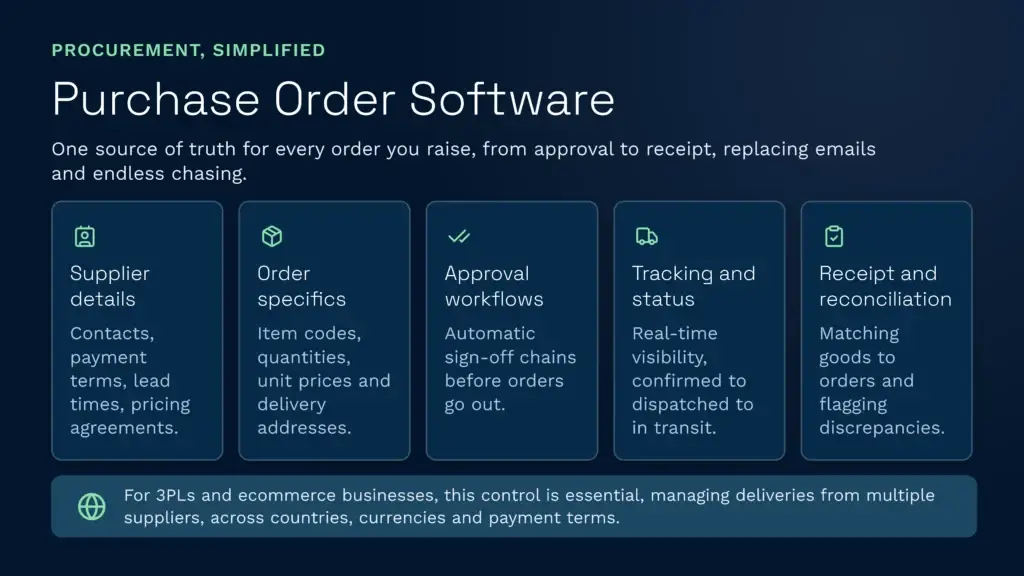
Purchase order software is a digital solution that automates the creation, approval, tracking, and management of purchase orders. Rather than emailing suppliers, chasing confirmations, or hunting through email chains, you have a single source of truth for every order you’ve raised.
At its core, the software captures:
- Supplier details: Contact information, payment terms, delivery lead times, and pricing agreements.
- Order specifics: Item codes, quantities, unit prices, and delivery addresses.
- Goedkeuringsprocessen: Automatic approval chains so the right people sign off before orders go out.
- Tracking and status: Real-time visibility of whether an order is confirmed, dispatched, or in transit.
- Receipt and reconciliation: Matching incoming goods to orders and flagging discrepancies before they hit your inventory.
For 3PLs and ecommerce businesses, this level of control is essential. You’re not just managing your own stock, you’re managing deliveries from multiple suppliers, often across different countries, with different payment terms and currencies.
Why Your 3PL Needs Dedicated Purchase Order Software
Many businesses assume general accounting software or spreadsheets are enough. They’re not. Here’s why purpose-built purchase order software matters for warehousing operations:
Speed and Accuracy
Manual purchase order entry is slow and error-prone. A typo in a product code, a wrong quantity, or a missed decimal point ripples through your entire supply chain. Software eliminates data entry errors by pulling product information from your existing inventory system. Your order is accurate before it leaves your system.
Real-Time Visibility
You need to know whether a delivery is on track. Is it arriving tomorrow or next week? Are there any delays? Good purchase order software integrates with supplier systems and tracking tools, so you always know where your goods are. This feeds directly into your goods-in process and helps you plan warehouse labour and space.
Supplier Relationship Management
When you consolidate all purchase orders in one system, you get a complete view of each supplier’s performance. How often do they deliver on time? What’s their lead time? Are there quality issues? This data helps you make smarter procurement decisions and negotiate better terms.
Multi-Currency and Multi-Supplier Complexity
If you’re sourcing globally, purchase order software handles multi-currency transactions, exchange rates, and payment terms automatically. It also scales to manage dozens of suppliers at once without breaking a sweat.
Compliance and Audit Trails
For regulated industries and large clients, you need a complete record of every order, approval, and amendment. Software maintains an immutable audit trail, which is invaluable for compliance and dispute resolution.
Key Features of Effective Purchase Order Software
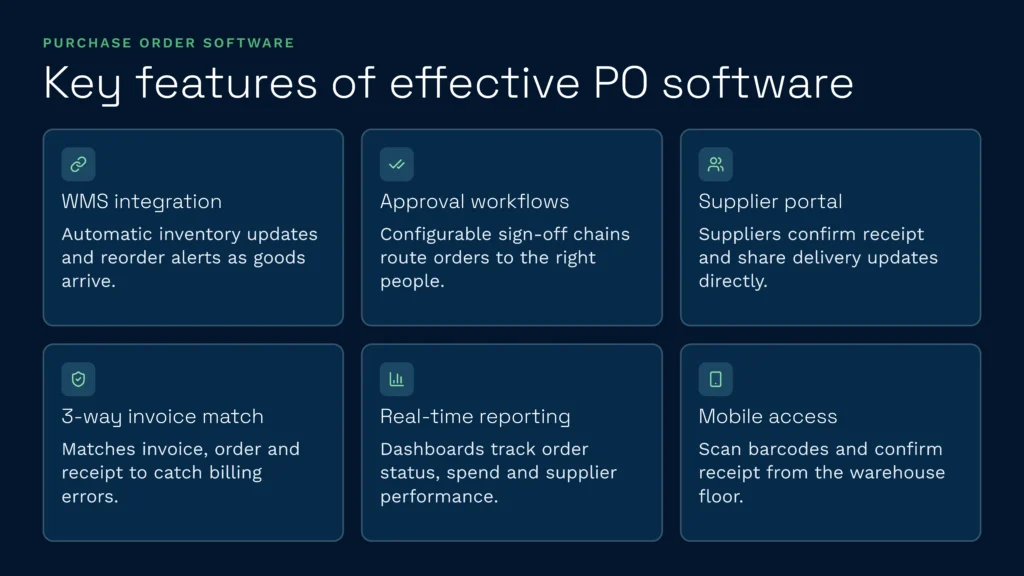
Not all purchase order tools are created equal. When evaluating options, look for these core features:
Integration with Your Warehouse Management System
Your purchase order software should feed directly into your WMS. When you receive goods, your system automatically updates inventory levels. When stock runs low, the system can even trigger automatic reorder alerts. This closed-loop integration eliminates manual data entry and ensures inventory accuracy. A good WMS to choose from will have built-in PO management or tight API integrations with standalone PO software.
Automated Approval Workflows
Large orders shouldn’t just go out the door without review. The software should support configurable approval chains. You might require sign-off from a manager if an order exceeds a certain value, or from the finance team before payment is authorised. Automation routes orders to the right people automatically.
Supplier Portal
The best systems give suppliers access to a portal where they can see orders, confirm receipt, and provide delivery updates. This reduces email back-and-forth and keeps everyone aligned.
Invoice Matching (3-Way Match)
When an invoice arrives, the system compares it against your original purchase order and the goods receipt. If quantities, prices, or delivery dates don’t match, it flags the discrepancy. This protects you from overpaying and catching facturering errors before they slip through.
Real-Time Reporting and Analytics
Good software provides dashboards showing order status, supplier performance, spend by category, and forecast cash outflows. These insights help with planning and strategic procurement decisions.
Mobiele toegang
Your receiving team doesn’t work from a desk. Mobile access to purchase orders means they can scan barcodes, confirm receipt, and flag issues on the warehouse floor in real time.
How Purchase Order Software Transforms Your Purchasing Process
Let’s walk through how a typical order flows through dedicated purchase order software versus the old way:
The Traditional Approach (Manual)
You email a supplier with quantities and delivery date. They email back a quote. You copy it into a spreadsheet, route it to your manager via email, they approve it by reply-all, you send the order back to the supplier, they confirm, you print it and pin it in the warehouse, goods arrive, someone checks the delivery note against the spreadsheet, you manually update your inventory spreadsheet, an invoice arrives in email, you forward it to finance, they pay it. Throughout this process, multiple people juggled documents, dates get confused, and errors slip through.
With Purchase Order Software
You log into the system, select the supplier, enter the quantities, set the delivery date, and submit. The system routes it automatically to your manager. They approve it in the system (or it auto-approves if within limits). The supplier receives the order electronically and updates their end. On receipt day, your warehouse team scans the barcode, confirms the items match, and the system auto-updates inventory. The supplier’s invoice matches automatically against the order and receipt. Finance approves and pays. Cycle time drops from days to hours. Errors become rare.
This transformation isn’t just about speed. It’s about eliminating the manual work that takes your team away from higher-value tasks. It’s about reducing the risk of stockouts or overstocks caused by miscommunication. And for 3PL’s managing stock for dozens of clients, it’s the only way to scale without hiring a dedicated procurement team.
Purchase Order Software and Supplier Management
Supplier management and purchase order management are intertwined. The best software gives you tools to:
- Centralise supplier data: Contact details, payment terms, lead times, and performance metrics all in one place, eliminating scattered spreadsheets.
- Track supplier performance: On-time delivery rate, quality issues, responsiveness, and cost competitiveness, data that informs contract renegotiations.
- Manage order management seamlessly: Once you know your suppliers well, ordering becomes frictionless. Preferred suppliers, standing orders, and blanket agreements all work within the system.
- Forecast demand and plan inventory: By analysing historical order patterns, you can predict future needs and plan procurement accordingly.
For 3PLs, this is critical. Your clients depend on you to keep their stock moving. The more efficiently you manage suppliers, the faster you can fulfil their orders.
Choosing the Right Software for Purchase Order Management
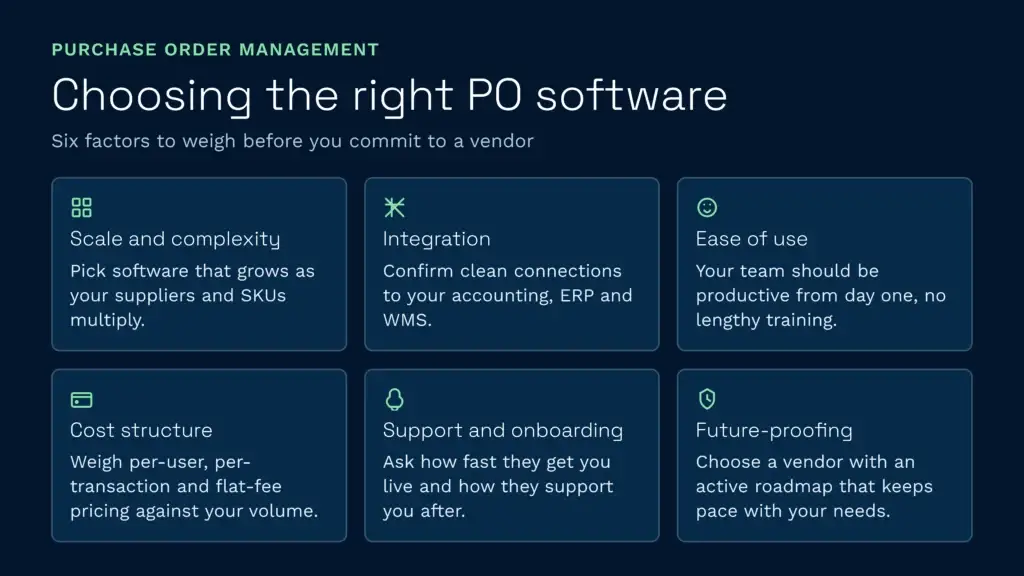
So which solution is right for your business? Consider these factors:
Scale and Complexity
Are you managing 10 suppliers or 100? Are you ordering a handful of SKUs or thousands? A simple SME-focused tool might be fine for a small operation, but as you grow, you’ll outgrow it. Look for software that scales with you.
Integration Requirements
Does the software integrate with your accounting system? Your WMS? Your ERP? Poor integration means manual data entry, which defeats the purpose. Check the vendor’s API documentation and ask existing customers how tight the integration is.
Gebruiksgemak
The best software in the world is useless if your team won’t use it. Look for intuitive interfaces that don’t require extensive training. Your receiving team and procurement staff should be able to jump in quickly.
Cost Structure
Some vendors charge per user, others per transaction, others a flat monthly fee. Work out what makes sense for your volume and team size. Factor in implementation costs and training too.
Support and Implementation
A good vendor will help you set up the system, migrate existing data, and train your team. They should have responsive support for when things go wrong (and they will). Ask about onboarding timelines, can they get you live in weeks or does it take months?
Future-Proofing
Does the vendor have a roadmap? Are they adding features you’ll need? Will the system stay current with new supplier integrations, compliance requirements, and payment methods?
Industry leaders like Xero en Salie offer solid purchase order functionality integrated with accounting. Independent review sites like Software Advies can help you compare options based on your specific needs.
Purchase Order Software as Part of a Broader 3PL Solution
Purchase order management doesn’t exist in isolation. It’s one part of a comprehensive warehouse operation. A true 3PL management system ties together:
- Beheer van inkooporders: Automating inbound orders from suppliers.
- Goods-in processing: Receiving, quality checking, and updating inventory in real time—your goederenontvangstproces is where purchase orders become physical inventory.
- Inventory management: Tracking stock levels, locations, and movements in your warehouse.
- Order fulfilment: Picking, packing, and shipping customer orders accurately and quickly.
- Stock rotation: Ensuring older stock moves first (FIFO/LIFO), reducing shrinkage and obsolescence. Learn more about stock rotation best practices.
- 3PL-facturering: Automating invoices to your clients based on actual warehouse activities (orders received, units stored, lines picked), not estimates.
When these systems work together, you’ve built a seamless operation. Your procurement team knows exactly when stock will arrive. Your receiving team updates inventory the moment goods hit the dock. Your picking team has accurate locations and quantities. Your billing team invoices clients automatically. This is the kind of operational excellence that wins contracts and keeps clients happy.
The purchasing process is the starting point of this chain. Get it right, and everything downstream improves.
Ready to Transform Your Purchase Order Process?
If you are ready to stop wrestling with chaotic spreadsheets and start treating your purchase order process as a strategic advantage, the team at Clarus is here to help. We understand that relying on disconnected systems and manual data entry not only slows down your daily operations but also stifles your ability to scale your 3PL or ecommerce business effectively. By upgrading to a purpose-built solution, you can seamlessly connect your inbound supplier orders with your wider warehouse management strategy, giving you the real-time visibility you need to succeed.
Neem contact op with us today to discuss your unique operational challenges, and let’s explore how our tailored software solutions can streamline your supply chain, eliminate costly errors, and set your business up for sustainable, long-term growth.