

OrderWise is a well-established ERP and WMS platform with a strong following among UK wholesalers and distributors. For businesses that want stock control, sales order processing, and basic warehousing under one roof, it’s a credible option. But it isn’t the right fit for every operation, particularly 3PLs managing multiple clients, teams that need true cloud flexibility, or warehouses that have outgrown the ERP-first model and want something purpose-built. This guide covers the strongest OrderWise alternatives available in the UK in 2026, with honest assessments of where each one works and where it doesn’t.
Quick comparison
| Platform | Best for | 3PL multi-client | True cloud | Automated billing |
|---|---|---|---|---|
| ClarusWMS | 3PLs, eCommerce fulfilment, specialist WMS | Yes — built-in | Yes — serverless | Yes — native engine |
| OrderWise | UK wholesale/distribution needing ERP + WMS | Limited | No — remote desktop | Limited |
| Mintsoft | 3PLs, eCommerce fulfilment centres | Yes | Yes | Yes |
| Linnworks | Multi-channel eCommerce sellers | Limited | Yes | No |
| Cin7 | Inventory-led retail and wholesale | No | Yes | No |
ClarusWMS
ClarusWMS is a cloud-native, serverless warehouse management system built specifically for 3PLs and warehouse operations that need specialist WMS depth without the overhead of a full ERP platform. It runs entirely in a browser: no servers, no remote desktop sessions, no version upgrade cycles. Every customer is always on the latest release.
Where Clarus wins is multi-client complexity. Each client’s inventory, reporting, billing rules, and workflows are completely isolated within a single warehouse environment. The automated billing engine captures every billable event, including goods in, storage, picks, packs, despatch, returns and value-added services, in real time, so month-end invoicing becomes a review, not a reconstruction exercise. St John’s Hall Storage, a UK 3PL, used to have its managing director spend around four days a month personally checking invoices. After switching to Clarus, that time was eliminated, freeing up the equivalent of two full-time staff, and the business moved from monthly to weekly invoicing.
The client self-service portal is another differentiator. Clarus gives each 3PL customer a branded login where they can check real-time stock levels, order status, shipment tracking, and billing summaries. For 3PLs still fielding daily stock-level calls, this alone typically pays for the system.
JODA Freight brought stock accuracy from the low 90s up to 99.8% after switching to Clarus. KATEM Logistics scaled its monthly picking volumes tenfold while keeping administrative headcount low, since the platform automates reporting, stock validation, and invoicing. The platform connects to 70+ carriers, including DHL, Royal Mail, DPD, Evri, and more, and 200+ eCommerce integrations including Shopify, WooCommerce, Amazon, eBay, and TikTok Shop, all maintained and updated by Clarus, not handed off to the customer to manage.
Where Clarus is a good fit: 3PLs managing multiple clients; eCommerce fulfilment centres; wholesale distributors that need WMS depth without full ERP; operations running 10 to several hundred warehouse users.
Where Clarus is a poor fit: Businesses that need integrated accounts, CRM, and purchasing in the same system as their WMS. Clarus is a specialist WMS and integrates with ERPs like Sage 200, Dynamics, and SAP rather than replacing them. Very small single-client operations under five users will likely find it oversized.
Pricing: From £1,000/month on monthly rolling contracts. No implementation lock-in or perpetual licence commitment.
OrderWise: what it does well and where it falls short
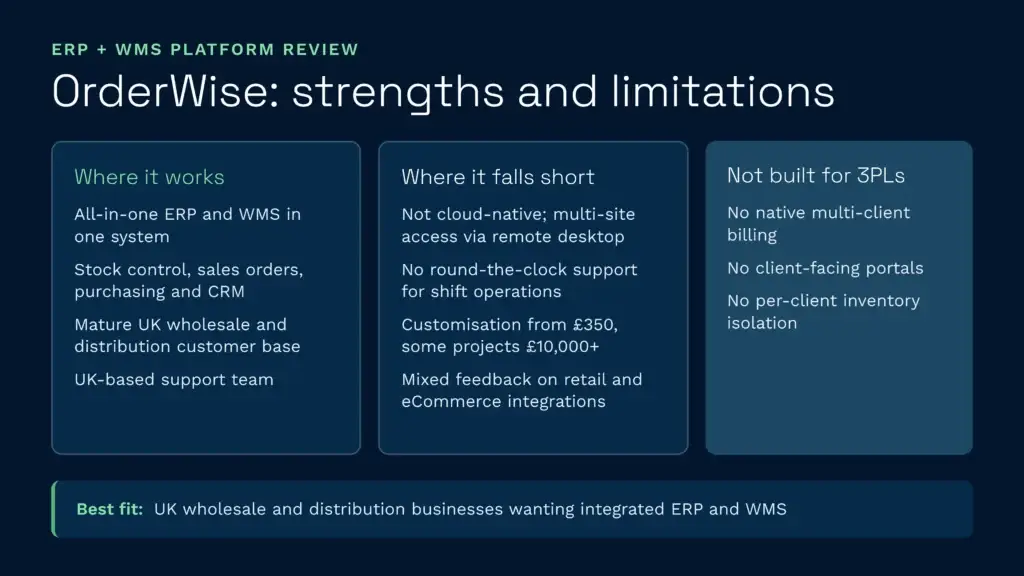
OrderWise is a comprehensive ERP platform with a built-in WMS module. It’s been serving UK wholesalers and distributors for many years, and its broad functional coverage, stock control, sales order processing, purchasing, CRM, and warehousing in one system, is a genuine advantage for businesses that want a single platform to run their operation.
For UK wholesale or distribution businesses that don’t manage multiple clients’ stock simultaneously, OrderWise is worth evaluating. The UK customer base is mature, the support team is UK-based, and the system handles purchase order management, supplier management, and demand planning alongside warehouse workflows.
However, several limitations come up consistently in independent user reviews. OrderWise’s core platform has traditionally been an on-premise desktop system, and multi-location businesses have typically accessed it via remote desktop, which adds infrastructure cost, complexity, and a point of failure. OrderWise has more recently launched OrderWise Cloud, a browser-based subscription option, so it’s worth clarifying which deployment model is actually being quoted during evaluation, since the two differ significantly in day-to-day experience. On support, G2 reviewers report rising costs alongside declining service levels, with one noting that “many issues are classed as chargeable development or training despite being bugs.” Any change, integration, or customisation requires going back to OrderWise’s development team, and reviewers consistently describe this work as expensive, with one stating that “anything you want must be done via their development team and this can be quite costly.” A technical partner reviewing the platform also noted a lack of readily available documentation or an open API, which can make third-party integration work harder to build.
For 3PLs specifically, OrderWise is not designed for the job. Multi-client billing automation, client-facing portals, and the per-client inventory isolation that 3PL operations require are not native capabilities. Businesses in that category tend to find themselves building workarounds that erode the efficiency gains the system was supposed to deliver.
Where OrderWise is a good fit: UK wholesale and distribution businesses needing integrated ERP and WMS; organisations that want stock control, sales order processing, purchasing, and warehousing in one system; businesses comfortable with a perpetual licence, cloud subscription, or quote-based pricing model.
Pricing: Quote-based and not published. OrderWise offers both a traditional on-premise licence and the newer OrderWise Cloud subscription; costs vary significantly by deployment model, user count, and configuration, so it’s worth getting a like-for-like quote for both before comparing.
Mintsoft
Mintsoft is a cloud-based WMS built for 3PLs and eCommerce fulfilment centres. Like Clarus, it supports multi-client operations with client portals and billing functionality. It has a broad integration library and a strong user base among UK 3PLs, particularly those handling high-volume eCommerce parcels.
Mintsoft is now part of The Access Group, which brings stability and resource but also means the product roadmap sits within a larger corporate structure. For some 3PLs, that’s reassuring; for others, it raises questions about responsiveness and pricing trajectory over time.
Where Mintsoft is a good fit: UK 3PLs with strong eCommerce parcel volumes; operations already in the Access Group ecosystem.
Where Mintsoft is a poor fit: Warehouses with complex food traceability requirements, bonded stock, or hazardous goods handling, areas where Clarus has more specific depth.
Linnworks
Linnworks is a multi-channel order management and inventory platform primarily built for eCommerce sellers who need to synchronise stock and orders across Amazon, eBay, Shopify, and other channels. It handles listings, orders, and fulfilment workflows well for that specific audience.
For warehouse-centric operations, Linnworks is less well-suited. It’s an inventory and order management tool rather than a purpose-built WMS: features like directed putaway, wave picking optimisation, FEFO/FIFO rotation logic, and real-time scan verification at packing are either absent or limited. Businesses that started on Linnworks and grew their warehouse complexity tend to outgrow it in predictable ways.
Where Linnworks is a good fit: eCommerce businesses managing multi-channel listings and orders with relatively straightforward fulfilment.
Where Linnworks is a poor fit: 3PLs, food and beverage operations with batch/lot control needs, or any warehouse requiring deep WMS functionality.
Cin7
Cin7 is a cloud-based inventory and order management platform that covers product catalogue, purchasing, sales orders, and basic stock management. It’s well-suited to retail and wholesale businesses that sell across multiple channels and need inventory visibility without complex warehouse operations.
Cin7 is not a specialist WMS. It doesn’t support multi-client 3PL operations, and its warehouse functionality is designed for simpler pick-and-pack environments rather than operations with complex routing logic, barcode-directed workflows, or compliance requirements.
Where Cin7 is a good fit: Retailers and wholesale businesses needing inventory management with multi-channel sales.
Where Cin7 is a poor fit: Any operation that needs WMS-grade control over warehouse movements, putaway logic, or scanning-verified accuracy.
How to choose the right OrderWise alternative
The right choice depends on where your operation sits and what you’re trying to solve.
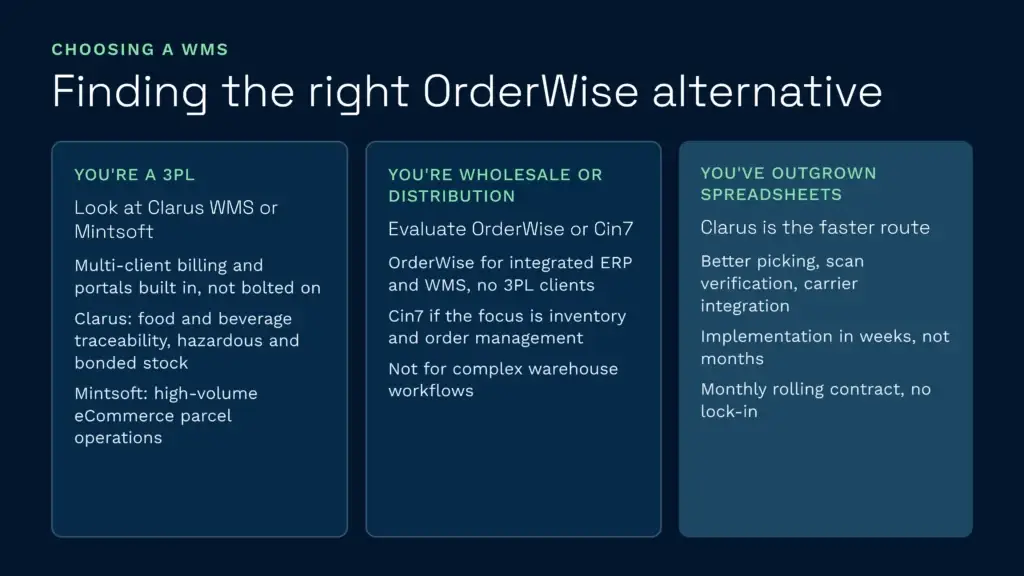
If you’re a 3PL managing multiple clients, look at ClarusWMS or Mintsoft. Both are built for the job: multi-client billing, client portals, and inventory segregation are native, not bolted on. Clarus has a stronger track record in food and beverage traceability, hazardous goods, and bonded stock; Mintsoft has depth in high-volume eCommerce parcel operations. Both offer monthly rolling contracts without perpetual licence commitments.
If you’re a wholesale or distribution business looking for integrated ERP and WMS in one system, and you’re not running 3PL clients, OrderWise is worth a proper evaluation. So is Cin7 if your operation is primarily inventory and order management rather than complex warehouse workflows.
If you’re a growing warehouse operation that has outgrown spreadsheets or a basic WMS and needs more control (better picking, scan verification, carrier integration, client visibility) without the cost and complexity of a full ERP project, Clarus is typically the faster and lower-risk route. Implementation is measured in weeks, not months, and the monthly rolling contract means you’re not locked in if the system isn’t working for you.
The UK warehousing sector has expanded significantly over the past decade. The Office for National Statistics recorded 88% more transport and storage business premises in 2021 compared with 2011, and the pressure to do more with the same team is real. The right WMS doesn’t just replace a spreadsheet, it changes what’s operationally possible.
Speak to a warehouse expert
If you’re evaluating your options and want to see how a purpose-built WMS works in practice, Clarus is worth a conversation. We work with 3PLs and distributors across the UK to implement warehouse management software that fits the way you operate, not the other way around.
Get in touch with our team to talk through your requirements.