

Proof of delivery software captures evidence that a delivery was made and keeps that evidence linked to the order. A good record holds the recipient’s name or signature, a timestamp, a location, any photos and any exception notes, so you can show what happened without searching through paper dockets.
Most buyers need one of two things. Some need a driver app that captures the handover itself. Others need a warehouse system that proves what left the building and in what condition. Those are different jobs, and the right choice depends on which one you are buying. Track-POD offers an electronic proof of delivery (ePOD) app for the first job, and Paragon’s guide to the benefits of POD software and Smartroutes both explain why paper is slow to reconcile. This guide covers both jobs, shows where a warehouse system fits alongside a POD app, and gives a checklist for choosing.
| Option | Who records the proof | Strongest evidence | Main limit |
|---|---|---|---|
| Paper docket, scanned later | Driver and recipient | Handwritten signature | Slow to return, and easy to lose or misread |
| Driver ePOD app | Driver on a phone or handheld | Signature, photo, location and timestamp at handover | Needs working devices and a process for exceptions |
| Carrier portal or app | The carrier | Depends on the carrier | You see only what the carrier chooses to share |
| Clarus WMS at despatch | Warehouse operatives | Photos of condition at despatch, time stamped to the order | Not a driver app, and no signature at the door |
What proof of delivery has to show
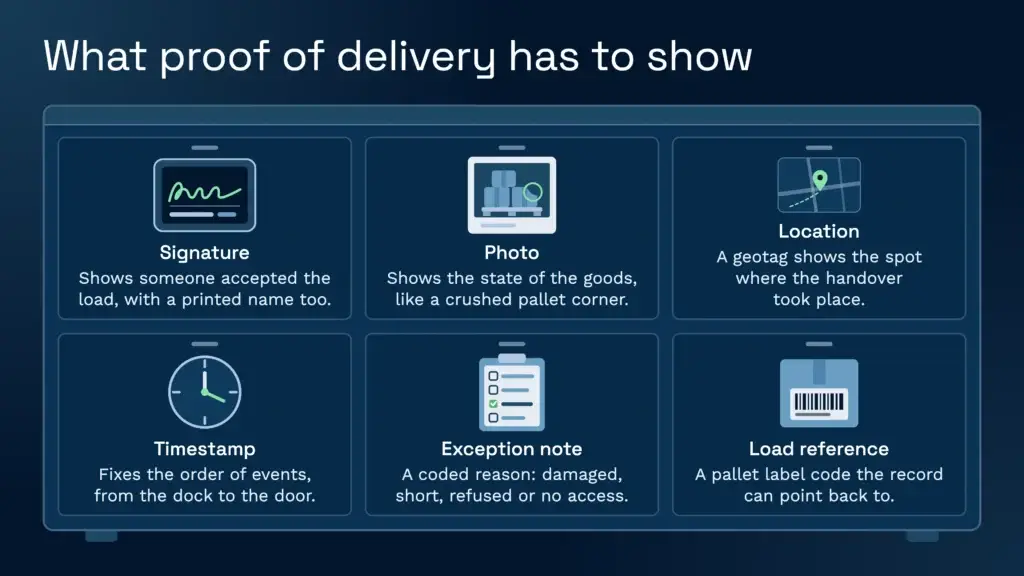
A proof of delivery answers one question if a delivery is challenged later: who received what, where, when, and in what state? Ask whether the record would still make sense to someone who was not there. If it needs explaining, it is not evidence yet.
In the UK, section 7 of the Electronic Communications Act 2000 says an electronic signature, and any certification of it, is admissible in evidence on questions about the authenticity or integrity of the communication or data it is linked to. Admissible does not mean conclusive: a court still decides how much weight to give it, and other countries have their own e-signature rules, so check your contracts with a legal adviser. For international road freight, the CMR convention governs the contract of carriage and the consignment note is prima facie evidence of it. The Carriage of Goods by Road Act 1965 gives that convention effect in UK law.
Signature
A signature shows that someone accepted the load. It proves much less when the name is illegible. Electronic capture can add a printed name next to the signature, which closes that gap.
Photo
A photo shows the state of the delivery: a parcel left in a safe place, a pallet with a crushed corner, a door that was locked. Track-POD lists photos alongside signatures, geotags and timestamps among its capture methods.
GPS location and timestamp
A geotag shows where the handover happened, which settles many disputes about the wrong address. A timestamp fixes the order of events. Pallet-level identifiers such as the GS1 SSCC give each load a reference that the record can point back to.
Paper vs electronic POD
Paper still works where drivers have no devices and volumes are low. Its weakness is time. Paragon’s guide cites one customer, Product Care, whose paper proofs took up to three days to be fully processed. That is a single example, not a benchmark. Smartroutes makes the general point: with paper, teams wait for dockets to come back to the depot, and paper records can be lost or damaged.
Electronic POD fixes the delay, provided the device works. Track-POD says its app works offline and syncs when the connection returns, which matters on rural routes and in basements. Smartroutes says electronic proof is uploaded in real time or as soon as the driver has a signal.
Be cautious with any claim that paperless POD cuts a fixed percentage from your costs. Touchstar’s PODStar page quotes customer testimonials on paper savings. Those are single customers, and your saving will depend on your volumes and how much paper you use today.
Damage, shortages and refused deliveries
The most useful proof of delivery is the one that records a problem at the door. A signed docket that says “delivered” hides the broken bottles, the two missing cartons and the pallet the driver refused. Use coded exception reasons such as damaged, short, refused or no access, so the record can be searched and counted. PODStar describes the same approach: discrepancies are recorded with customisable descriptions, which it says means fewer mistakes from poor driver handwriting.
Under the CMR, a consignee who finds damage or a shortage should check the goods with the carrier, or send reservations no later than delivery if the loss or damage is apparent. If it is not apparent, Article 30 of the CMR allows seven days from delivery, not counting Sundays and public holidays, and the reservations must be in writing. Without them, taking delivery counts as prima facie evidence that the goods arrived as described. Check how this applies to your own contracts with a legal adviser.
The same logic applies inside the warehouse. Mathew Buttar, Head of Solutions at Clarus, makes the point that condition should be captured at the point of arrival, because damage found later is harder to pass back once you have taken ownership of the stock. In Clarus, damaged or short stock can be placed on hold with a reason code, so it is kept out of available stock while a decision is pending. Shortages on outbound orders are handled in the open too. If there is not enough stock, the order sits as part allocated, and the team can either wait and reprocess it or short the missing lines with a reason code, which closes the order with a short status. Clarus also keeps order management records that show each of these states.
Disputes and chargebacks
Most disputes come down to one question: can you show the delivery was made, and in the condition the customer says it was not? Timestamped, geotagged photos and signatures let a team answer that quickly, often without a phone call. Smartroutes links strong POD records to better chargeback defence, but it cites external research without giving figures, so treat the link as a reasoned argument rather than a measured result.
Two practical points matter most. First, consistency. If one driver photographs every drop and another only ticks a box, the weaker record is the one a customer will challenge. Second, storage. Keep the record against the order, not inside a driver’s app, so it survives a change of driver, device or supplier.
Customers who want to check progress for themselves are better served by a client portal than by a phone call. The Clarus customer self-service portal gives clients real-time stock, orders and tracking. DGS Transports built live warehouse visibility with Clarus WMS in place of a legacy system.
Linking POD to invoicing
For a 3PL or haulier, the payoff is faster and cleaner invoices. Track-POD says a signed POD can automatically create a credit invoice in an ERP or accounting system, and that its API supports real-time import and export. Paragon says delivery data can supply job outcome data to finance so invoices go out sooner. PODStar links its records to faster invoicing and fewer debtor days. These are vendor statements, so ask each supplier to show the invoice trigger in a live demonstration before you rely on it.
Clarus WMS does not create invoices from proof of delivery. What it can do is send a confirmation file or a dispatch note automatically when a sales order completes, which a connected accounts or ERP system can use as its trigger.
How POD data flows back to the WMS
Think of proof of delivery as the last step in a chain. The warehouse proves what left the building. The driver app or carrier proves what arrived. A good system makes the handover between those two records clean.
- Confirm dispatch. When a sales order completes, an automation can create a confirmation file and send it to another system by SFTP, or email a dispatch note. See our shipping management software page for the wider picture.
- Send the ASN from the scan. Clarus can generate an advanced shipping notice (ASN) file automatically when a load is dispatched and drop it to SFTP, so nobody retypes the despatch details.
- Record condition at despatch. Operatives take photos on the handheld during a task. Each image is time stamped and tied to the task, user, location and time, and it can be included automatically in shipment confirmations. That is the warehouse half of the evidence, covered in our image evidence capture feature.
- Pick by carrier and collection time. If one carrier collects at 2pm and another at 4pm, the system can pick the first carrier’s orders first. Our pack and dispatch strategies cover the options.
- Carrier links. Clarus integrates with carriers including DPD, DHL, UPS, FedEx, Evri, Royal Mail, Parcelforce, Palletways and Pallex. Each one connects your despatch data to the carrier. Check which delivery events come back into the order before you rely on them.
- Route data into the pick. Orders can carry a load reference and a priority, so picks can be grouped by outbound load. Mathew Buttar, Head of Solutions at Clarus, makes the point that a transport system should feed these in, so the pick order matches the order in which loads need to leave. Our Qargo TMS integration is one example.
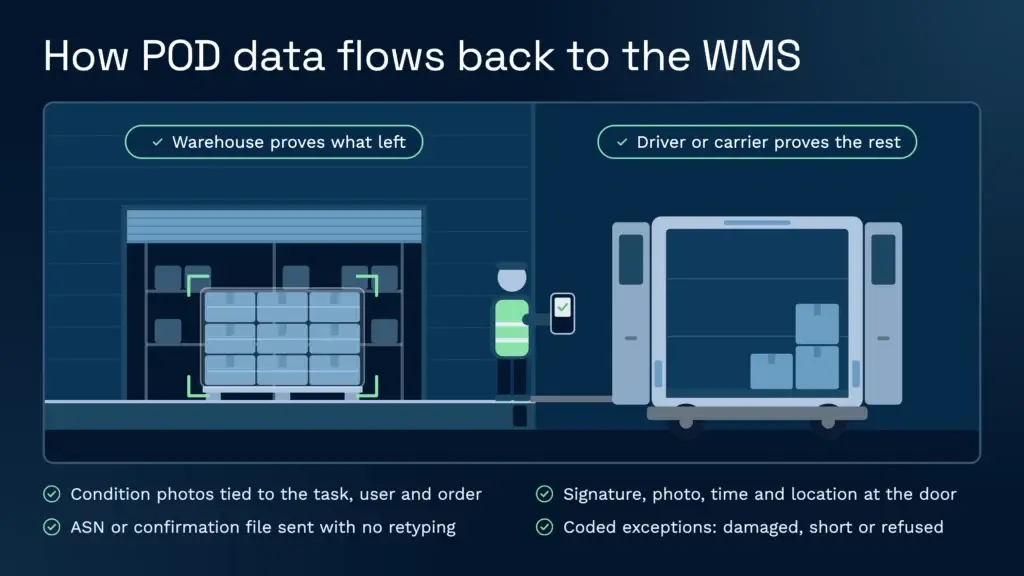
The boundary matters. A warehouse system can show the load was right at the back door. What happens on the truck is outside it, so the driver app or carrier has to prove the rest.
To be clear, Clarus WMS does not include a driver app for capturing signatures at the door. If that is your gap, pair the WMS with a POD app or route platform, and use the warehouse record for despatch condition and counts.
Which option fits? Best app, what to use, how to start
What is the best proof of delivery app?
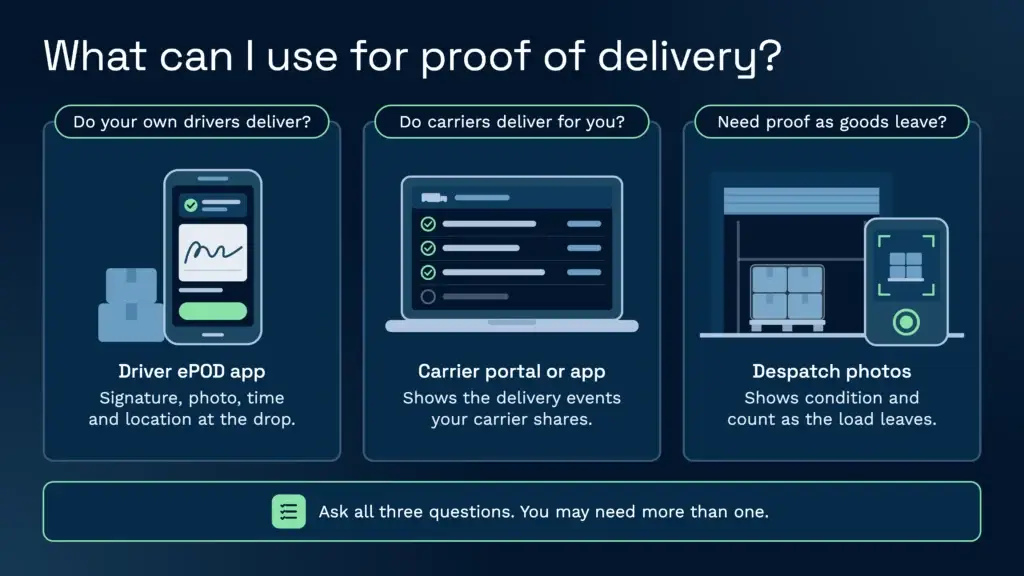
There is no single best app, because the right one depends on who makes the drop. Own-fleet operators need an ePOD app with offline capture and an export to their accounts system. Warehouses that rely on carriers need strong despatch evidence and clean delivery data coming back. Shortlist two or three apps against your delivery volume, device fleet and invoicing system, then run a pilot route before you commit.
What can I use for proof of delivery?
Three things work, and most operations combine two of them: a driver ePOD app for the handover, a carrier portal where you cannot change the carrier’s process, and warehouse evidence at despatch for condition and count. Paper with a scan-back is the fallback. It works, but it adds delay and handling at every drop.
How do I get proof of delivery?
- Decide who captures it. The driver, the carrier or the warehouse, or a mix of them, for each type of delivery.
- Set the mandatory fields. For every drop, require a name or signature, a photo, a timestamp and a location.
- Code the exceptions. Use a short list such as damaged, short, refused and no access, so problems can be counted.
- Test offline capture. Run the app in the areas where your drivers lose signal, and check that records sync afterwards.
- Connect the record to the order and the invoice. Then review one month of exceptions to see where the process is still failing.
What to look for when buying
- Offline capture and sync. The app should keep working without signal and upload records once the connection returns.
- A complete handover record. Signature with a printed name, photos with time and location, and coded exception reasons.
- An audit trail. Records should show who captured what, when, and whether anything changed afterwards.
- Export to your systems. Look for a documented API or file format that feeds your accounts package or WMS, not a one-off CSV.
- Retention and access. Photos of doorways and people can be personal data. Check how long records are kept, who can see them, and what your data protection obligations are.
- Pricing in writing. Some vendors publish per driver or per vehicle prices and others quote on request. Either way, ask for a written quote per driver or vehicle that states whether devices, support and integrations are extra. If you run your own vehicles, our haulage software page sets out how the warehouse and transport sides fit together.
- Check the trade bodies. If you run hauliers or carriers, the Road Haulage Association is a useful place to check standards and guidance.
How we compared this
We compared four approaches on what each one captures, where the record lives, and what it can and cannot prove. Vendor facts come from the public pages of Track-POD, Paragon, Smartroutes and Touchstar, checked in November 2026. Clarus capabilities come from our own feature pages and internal product notes. Prices change and some vendors quote on request, so this guide does not compare prices. Clarus is our product, so check the Clarus rows against a live demonstration before you decide.
Speak to a warehouse expert
If you’re evaluating your options and want to see how a warehouse system and a POD app fit together in practice, Clarus is worth a conversation. We work with 3PLs, hauliers and distributors to set up warehouse management software around the way they already operate. Clarus WMS publishes its platform fee, from £1,000 a month, with users and implementation quoted on top.
Get in touch with our team to talk through your requirements.