

If you’re comparing warehouse management systems for your 3PL or fulfilment operation, Clarus and Mintsoft will probably both be on your shortlist. Both are cloud-based, both handle multi-client third-party logistics and both connect to the major marketplaces and carriers. The differences show up in the detail: how far billing automation goes, how contracts and support work, and who else each platform is built to serve. Mintsoft, part of Accessgruppen, sells to 3PLs, retailers and ecommerce brands alike. Clarus is an agentic AI-driven WMS focused on 3PL and contract warehouse operations. Choosing the wrong fit costs months in implementation and creates friction you’ll feel every day.
Quick verdict
Välj Clarus om: you run a 3PL or contract warehouse with multiple clients and complex tariffs, need each client’s stock kept separate with full audit trails, want support that responds in under 5 minutes, or don’t want to be tied into a long contract.
Choose Mintsoft if: you’re an ecommerce brand or retailer fulfilling your own orders across Shopify, Amazon and other channels, or a smaller 3PL whose order volumes and client count sit comfortably within its published tiers, and you want voice-assisted picking on the warehouse floor.
Feature comparison table
| Funktion | Clarus | Mintsoft |
|---|---|---|
| Arkitektur | Cloud-native WMS | Cloud-based SaaS, part of The Access Group |
| Separering av aktier för flera kunder | Each client’s stock separated with firm rules, audit trails and client-specific controls | Built for 3PLs; tiers banded by number of clients |
| Kundportal | Client self-service with live data, branded to match your service | Branded portal for stock, orders, ASNs, reports and invoices |
| Client billing | Client-specific tariffs: flat fees, tiered bands, minimums and maximums, surcharges, seasonal rates | Activity-based invoicing at rates set per client |
| Plockning | Handheld guides each step; mis-picks cut to under 1% | Mobile app picking with voice-assisted picking |
| Integrationer | Over 200 systems | 130+ standard integrations per package |
| Shopify | Native: order import, allocation, tracking, inventory sync | Integration with inventory sync |
| Amazon | Amazon Shipping: order and stock sync, despatch, labels | Marketplace integration; FBA set up separately |
| Transportörer | DHL, UPS, FedEx, Royal Mail, Parcelforce, DPD, Evri, TNT, The Pallet Network and more | Multiple couriers, including DPD |
| Prissättning | Published monthly tiers plus user licences and a one-off implementation fee | Tiered by monthly order volume and number of clients |
| Contract term | No tie-ins, pay monthly | Ask about minimum term |
| Svarstid för support | Under 5 minutes | Ej publicerad |
| Implementering | A few weeks to a few months, depending on sites, integrations and data | Not published; dedicated onboarding contact |
Multi-client stock segregation and 3PL billing
For any 3PL, the biggest operational question is how a system keeps each client’s inventory, billing and reporting separate inside one warehouse. Both platforms are built to do this, but they handle billing differently.
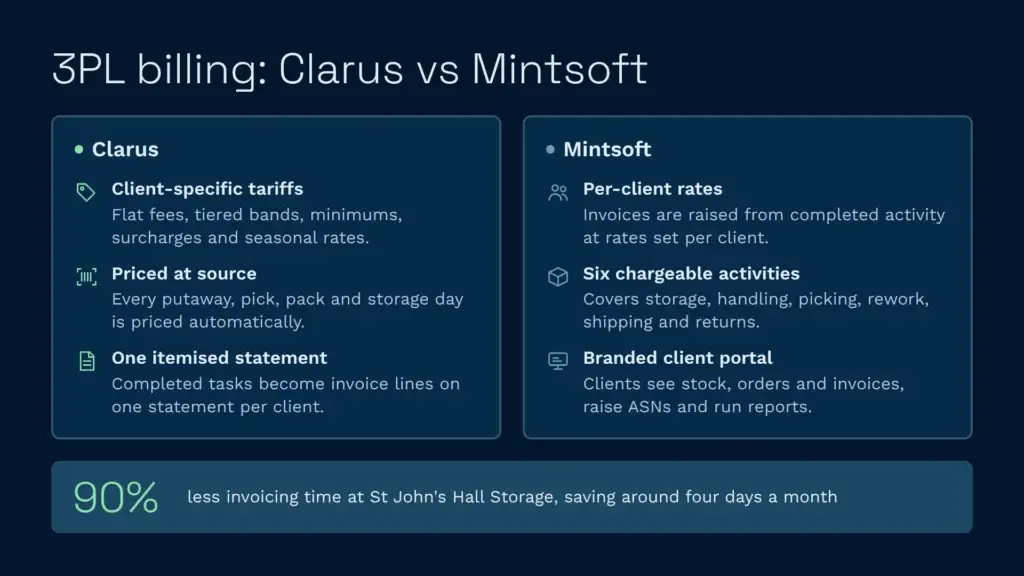
In Clarus, each client’s stock is kept separate with firm rules, audit trails and client-specific controls. Every putaway, pick, pack, cycle count, value-added service and storage day is recorded at source and priced automatically against that client’s tariff. Tariffs can include flat fees, tiered bands, minimums and maximums, surcharges and seasonal rates. Rules then turn completed tasks into invoice lines, which roll up into one itemised statement per client. You can read more about how Clarus automates 3PL client billing. Förvaring i St John’s Hall, a third-party warehousing provider, cut its invoicing time by 90% after moving to Clarus, saving around four days of invoice checking every month.
Clarus’s agentic AI also catches missed pallet charges across multiple customer accounts and recovers missed billing charges.
Mintsoft supports multi-client billing too. Its 3PL product raises client invoices from the activities completed in the system, charged at the rates you set for each client, covering storage, handling, picking, rework, shipping and returns. Clients get a branded portal where they can view stock, orders and invoices, raise ASNs and run their own reports. Mintsoft’s 3PL pricing tiers are banded by monthly order volume and number of clients, so check where your client count will sit as you grow. If your tariffs rely on seasonal rates, minimum charges or surcharges, ask Mintsoft to show you how those are set up before you commit.
Picking, accuracy and automation
Both systems take picking off paper, but they focus on different things.
The Clarus handheld walks your team through each step of the pick, and Clarus says this cuts mis-picks to under 1%. JODA Frakt saw stock accuracy climb into the 90% to 97% range in its first year on Clarus, reaching 99% by year two. Clarus also handles uppföljning av utgångsdatum and shelf-life picking for operations that need strict stock rotation.
Mintsoft’s mobile app covers order picking, inbound receipts, stock transfers, pallet ID management and parcel verification, and it lists voice-assisted picking as part of its core functionality. For ecommerce fulfilment at volume, that’s a familiar, practical set-up.
If your pickers work across a complex, multi-client layout, ask both vendors to demo picking against your own SKU and location data. If voice picking matters to your team, Mintsoft has it built in.
Integrations and carrier support
Both platforms connect to the major marketplaces and carriers, but the scope is different.
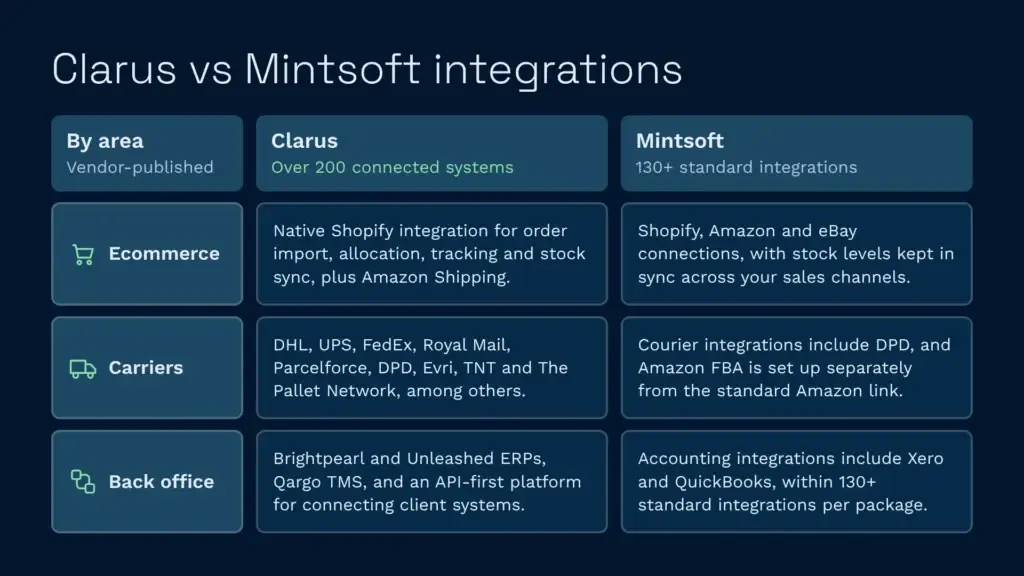
Mintsoft lists 130+ standard integrations in each of its packages, including Shopify, Amazon, eBay, Xero, QuickBooks and DPD, and keeps inventory levels in sync across channels such as Amazon and Shopify. Amazon FBA functionality is set up separately from its standard Amazon integration.
Clarus connects to over 200 systems across marketplaces, ERPs, accounting packages and carriers. That includes:
- Ecommerce: native integrations with Shopify (order import, allocation, tracking and inventory sync) and Amazon-frakt
- Carriers: DHL, UPS, FedEx, Postverket, Parcelforce, DPD, Evri, TNT och The Pallet Network
- ERPs: Brightpearl och Unleashed
- TMS: Qargo
That range matters for a 3PL whose clients all run different systems: one on Shopify, another on its own ERP, a third on a different marketplace. Clarus connects them through ready-made connectors or its API-first platform. You can browse the full list on the Clarus integrations page.
If you’re a brand fulfilling your own orders across Shopify and Amazon, either system covers the basics. For a multi-client 3PL with a mix of client systems, Clarus’s integration library is a real advantage.
Implementation and support
Clarus is cloud-native, so there’s no server setup and no on-premise infrastructure to maintain. Most 3PL go-lives take between a few weeks and a few months, depending on the number of sites, integrations and how much data you’re migrating. Familjen Campeys från Selby was up and running in under two months. Support responds in under 5 minutes, which matters when your picking operation hits a snag during peak.
Mintsoft doesn’t publish implementation timescales, though it provides onboarding support with a dedicated team member. It doesn’t list support response times or contract terms on its pricing pages either, so ask about all three during your evaluation.
Clarus has no tie-ins and you pay monthly. For a 3PL with unpredictable demand, fast support and no lock-in make switching a lower-risk decision.
Who each solution best suits
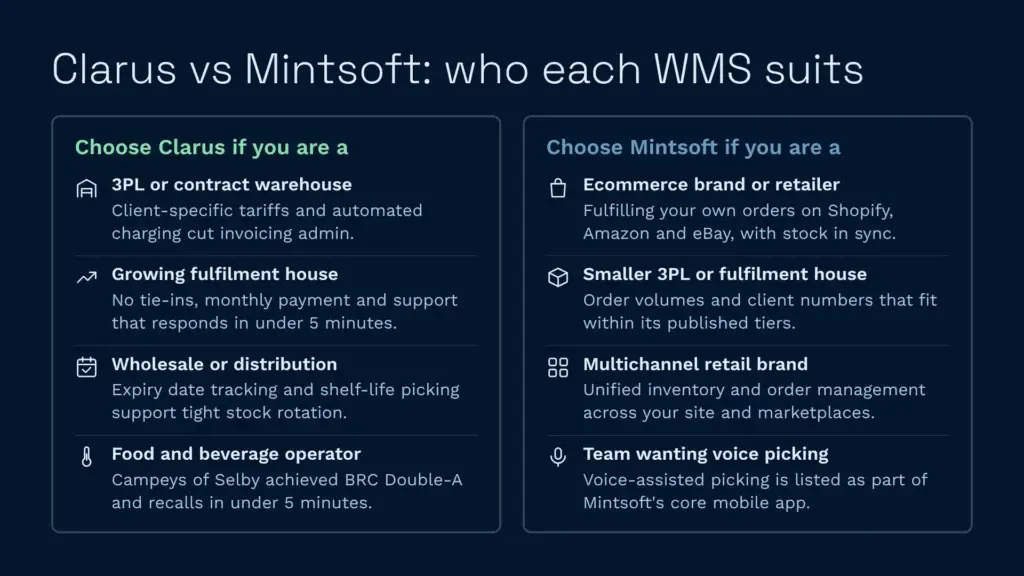
Choose Clarus if you are a:
- 3PL or contract warehouse operator managing several clients with different stock, billing and reporting needs. Client-specific tariffs and automated charging take the manual work out of invoicing.
- Growing fulfilment house that doesn’t want a long-term contract. No tie-ins and monthly payment let you adjust as volumes change.
- Wholesale or distribution business where accuracy and inventory visibility matter more than ecommerce-specific features. Expiry date tracking and shelf-life picking support tight stock rotation.
- Food and beverage operator needing BRCGS compliance, fast recalls or temperature-controlled storage. Familjen Campeys från Selby achieved BRC Double-A accreditation with Clarus and completes traceability recall tests in under 5 minutes.
- Team that values responsive support and wants to avoid lengthy contracts. Support responds in under 5 minutes, with no lock-in.
Choose Mintsoft if you are a:
- Ecommerce brand or retailer fulfilling your own orders across Shopify, Amazon, eBay and other channels, and wanting inventory kept in sync across them.
- Smaller 3PL or fulfilment house whose monthly order volumes and number of clients fit within Mintsoft’s published tiers.
- Multichannel retail or fashion brand that needs unified inventory and order management across your own website and marketplaces.
- Warehouse team that wants voice-assisted picking as part of the core mobile app.
Migration and implementation considerations
Moving to a new WMS is a logistics project in its own right. Here’s what to expect with each.
Clarus migration: Because Clarus is cloud-native, there’s no server setup or infrastructure planning. Your timeline depends on how much historical data you carry forward and how clean your master data is. Most 3PL go-lives take between a few weeks and a few months.
Mintsoft migration: If you’re moving from a single Shopify store, setup will be simpler. If you’re a 3PL moving from a legacy on-premise system with lots of client billing rules, you’ll need to rebuild those rates in Mintsoft’s configuration, so allow time for it. Check the minimum contract term before you sign.
Whichever system you choose, data preparation is the biggest variable: standardising SKU names, validating location hierarchies, confirming carrier accounts and setting up client master records. Clarus’s one-off implementation fee covers bespoke configuration, SKU cleaning and custom courier logic (see the Clarus pricing page), so ask any vendor exactly what’s included in theirs.
Honest trade-offs
Här utmärker sig Clarus: 3PL billing depth with client-specific tariffs, agentic AI that recovers missed charges, a branded client portal with live data, no tie-ins, support in under 5 minutes, 200+ integrations and cloud-native architecture.
Här utmärker sig Mintsoft: a broader fit for retailers and ecommerce brands as well as 3PLs, voice-assisted picking, and published entry tiers that may suit smaller operations.
Where Clarus is a poor fit: if you’re a single-client ecommerce brand with low order volumes, you’ll be paying for multi-client depth you don’t need. Mintsoft is likely the better choice.
Where Mintsoft is a poor fit: if you’re a 3PL with a large client base and complex tariffs (seasonal rates, minimum charges, surcharges, mid-month rate changes), check carefully how far its per-client rates go. Its published 3PL tiers are also capped by client numbers.
Before you shortlist, read independent reviews of Clarus on Gartner Peer Insights och Mintsoft on G2.
Tala med en lagerarbetare
If you’re weighing up your options and want to see how a WMS built for 3PLs works in practice, Clarus is worth a conversation. We work with 3PLs and distributors to implement warehouse management software that fits the way you operate.
Kom i kontakt med vårt team att diskutera dina krav.