

Third-party logistics (3PL) providers manage inventory, fulfilment and distribution for multiple clients in shared warehouse space. Juggling dozens of inventory streams, separate billing rules and client-specific requirements by hand is slow, costly and easy to get wrong. A purpose-built 3PL WMS automates that work, giving you live visibility, accurate billing and an operation that can keep up as you take on more clients.
What is a 3PL logistics WMS?
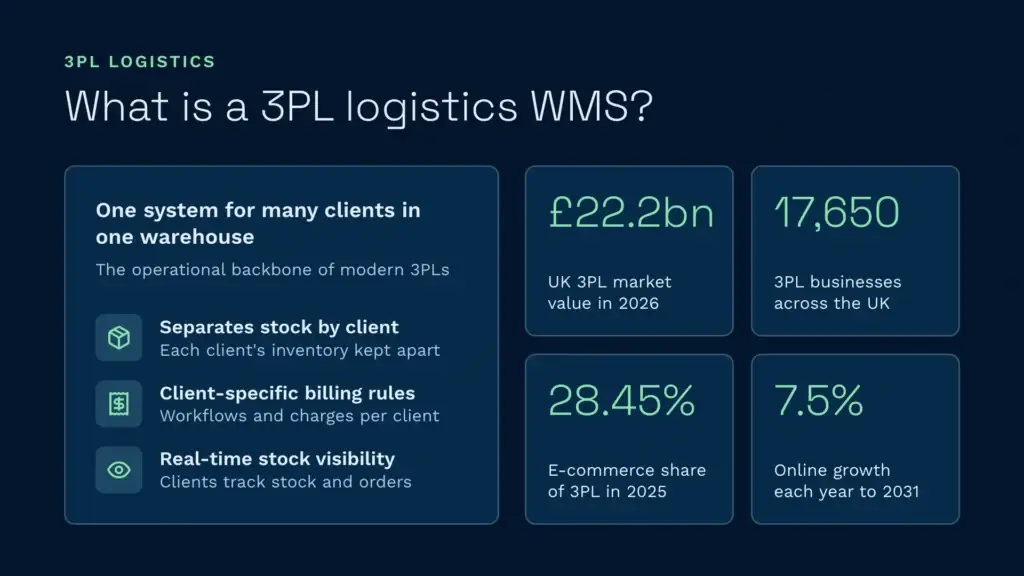
A 3PL logistics WMS (warehouse management system) is software built to manage multiple clients’ inventory, orders and billing in one physical warehouse. Standard WMS platforms are usually built around a single business. A 3PL WMS separates inventory by client, applies each client’s own workflows and billing rules, and gives every customer live access to their stock and order status. For most modern 3PLs, it’s the system the whole operation runs on.
According to IBISWorld, the UK third-party logistics market is worth £22.2 billion in 2026, with 17,650 businesses operating in the sector. Competition is tough. The biggest players, including DHL Supply Chain, GXO Logistics and Kuehne+Nagel, hold a large share of the market, but specialist providers are winning work by using better technology to serve niche sectors and regional markets.
Retail and e-commerce are a big part of that growth. Mordor Intelligence puts retail and e-commerce at 28.15% of the UK 3PL market in 2025, growing at a 5.40% CAGR through 2031. That means higher order volumes and tighter delivery expectations, and a 3PL WMS is what lets you handle them without adding headcount at the same rate.
How does a WMS support third-party logistics operations?
Running multiple customers out of one warehouse creates problems a single-business WMS was never designed for. A 3PL-focused system is built from the start to keep client data separate, automate billing and give clients visibility without exposing anyone else’s information.
Multi-client inventory segregation
Each client’s stock has its own identifiers and is tracked separately, even when it sits in the same building. Picking lists, inventory reports and replenishment triggers are generated per client, so one client’s stock never ends up in another client’s order. Batch and lot control and serial number capture can be set up per client, and stock rotation methods (FIFO, LIFO, FEFO) can be applied per account to meet each customer’s requirements. For food and pharma clients, expiry date tracking keeps short-dated stock moving first.
Automated client billing
Billing errors are one of the biggest sources of lost revenue in manual 3PL operations. Spreadsheet invoicing struggles to capture every storage, handling and fulfilment charge. A 3PL WMS ties client billing directly to warehouse transactions, so each pick, pack, shipment and storage day is logged and applied to the right client’s invoice automatically.
Billing rules are set per client. Some pay per pick, others per order or per pallet stored. The WMS applies the right logic as work happens and produces client statements automatically, which cuts out manual reconciliation and most disputes. Clarus’s AI goes a step further, catching missed pallet charges across customer accounts and recovering billing charges that would otherwise slip through. St John’s Hall Storage cut its invoicing time by 90% after moving to Clarus.
Real-time visibility for clients
Clients want to know what’s happening with their stock without having to ask. A 3PL WMS includes a client portal where each customer can see their current stock levels, order status, inbound shipments and open issues as they happen. That means fewer support queries, more trust, and clients who can plan their own operations properly.
System integration
Modern 3PL operations depend on connected systems. A 3PL WMS connects directly with e-commerce platforms (Shopify, Amazon, eBay), shipping carriers (Royal Mail, DPD, Parcel2Go), accounting software and transport management systems such as Qargo TMS. Orders come in automatically, stock levels update back to marketplaces, and billing data flows into your accounts software, with no re-keying.
What features does a 3PL logistics WMS need?
Choosing a 3PL WMS is a long-term decision. The system has to support growth across more clients, more warehouse locations and higher order volumes. These are the features to evaluate:
| Feature | Why it matters for 3PLs |
|---|---|
| Multi-client management | Keeps inventory and billing separate per customer, preventing errors and supporting compliance. |
| Configurable billing | Supports different pricing models (per pick, per order, storage-based) and generates invoices automatically from warehouse activity. |
| Real-time inventory tracking | Tracks stock through receiving, storage, picking, packing and staging, with live updates across all clients. |
| Client-facing portal | Gives each customer self-service access to inventory, orders and reports, cutting support queries. |
| E-commerce and carrier integration | Connects to Shopify, Amazon, Royal Mail, DPD and accounting systems, removing manual order entry and reconciliation. |
| Scalability | Cloud architecture handles seasonal peaks, multiple sites and growing order volumes without new infrastructure. |
| Order automation | Automates picking, packing and shipping workflows, reducing labour and human error. |
| Analytics and reporting | KPI dashboards covering accuracy, labour productivity, billing and client performance. |
For 3PLs serving e-commerce clients, the system also needs fast order throughput, returns processing and flexible label printing. For providers handling high-mix, low-volume manufacturing stock, the WMS needs lot tracking, serial number management and quality hold workflows.
How does a 3PL WMS improve operational efficiency?
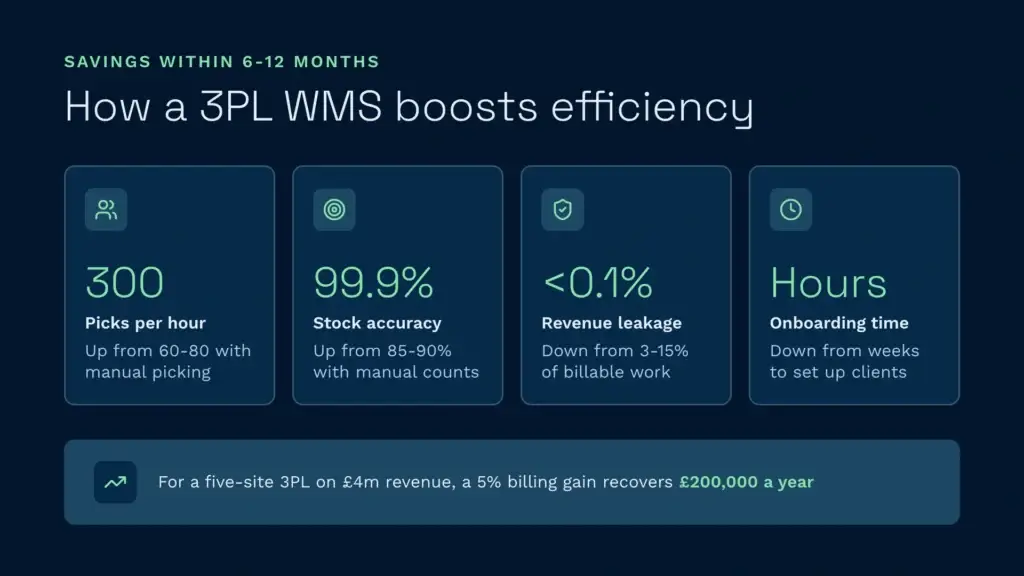
In 3PL logistics, small inefficiencies multiplied across every client and every order decide whether a contract makes money. A well-implemented 3PL WMS improves labour, inventory and billing at the same time.
Labour productivity
Labour is one of the biggest costs in any warehouse. A 3PL WMS reduces wasted effort through task interleaving, better pick routes and automated workflows, so the same team can handle far more volume. When KATEM Logistics, which stores stock and runs pick-and-pack for multiple customers, moved from a paper-based system to Clarus, monthly picks grew from around 1,000 to between 10,000 and 12,000, a 10x increase.
Inventory accuracy and fewer returns
Inaccurate stock leads to costly mistakes: overstocks, stockouts, wrong shipments and customer returns. A 3PL WMS records every movement at the point it happens, so the system matches what’s on the shelf. JODA Freight reached 99% stock accuracy with Clarus and cut routine stock takes from weeks to a single day. KATEM’s order accuracy rose from an estimated 80% to between 98% and 99%. Better accuracy means fewer returns, faster shipping and stronger client relationships.
Revenue protection and billing capture
In manual or poorly connected systems, billable work goes uncharged: forgotten storage fees, missed handling charges, incomplete pick charges. Because a 3PL WMS records every billable event at source, those charges land on the invoice automatically. Centralised 3PL billing also means you can spot missing charges before invoices go out, rather than after a client has paid.
Faster client onboarding
Onboarding a new client involves understanding their business, setting up stock locations, configuring billing rules and training staff. In a manual operation, that’s spread across spreadsheets, emails and separate systems. A 3PL WMS keeps it in one place, so you can set up a new client’s locations, products and charging rules once and start receiving their stock sooner.
How should you choose a 3PL logistics WMS?
The wrong 3PL WMS can lock you into rigid processes, cap your growth or leave clients underserved. Your evaluation should cover functionality, integration, scalability and vendor support.
1. Define your 3PL model
Are you sharing a single warehouse across many clients, or running multiple dedicated sites? Are your clients e-commerce retailers, manufacturers or food and drink producers? The answers shape what you need. E-commerce clients need live visibility and fast throughput. Manufacturing clients need lot tracking and quality holds. Multi-site operations need multi-warehouse support. Your WMS has to fit your model.
2. Assess client data segregation
Check that the WMS truly separates client inventory, orders and billing in the database and application, not just through user permissions. A poorly segregated system creates security risks and makes billing errors more likely. Ask vendors for references from 3PLs already running on their platform.
3. Test integration breadth
Your clients will expect their own systems (Shopify, Amazon, their ERP) to connect to your WMS without fuss. Confirm the vendor already integrates with the platforms your clients use. Pre-built connectors to the major e-commerce platforms and carriers are the minimum. Custom integration work adds cost and ongoing maintenance.
4. Evaluate scalability and architecture
A cloud, multi-tenant architecture handles growth better than on-premise or single-tenant systems. Cloud systems cope with seasonal peaks without capital spend on servers, and they take IT maintenance off your team’s plate so they can focus on running the warehouse.
5. Review client portal capability
Your clients will want live access to their inventory and order status. A good client portal reduces support queries and keeps clients happier. Look for a portal you can brand with your own logo, and check how it works on mobile, since clients increasingly expect it.
6. Investigate vendor stability and roadmap
A WMS is a long-term platform, so look at the vendor as well as the software. Research their financial health, how long customers stay with them and what’s on their roadmap. Are they investing in AI and automation? Will they support your growth into new markets or client sectors? Clarus publishes its product roadmap openly, and independent reviews on Gartner Peer Insights show what existing customers think.
If you’re looking to modernise, Clarus’s 3PL solution is an agentic AI-driven WMS built for multi-client logistics. It connects to e-commerce platforms, supports flexible billing per client and gives every stakeholder clear reporting. You can see the 3PL WMS features that matter most in our guide. If you’re comparing 3PL software providers, judge each one on multi-client capability, integration breadth and long-term direction.
Improving billing accuracy and client satisfaction
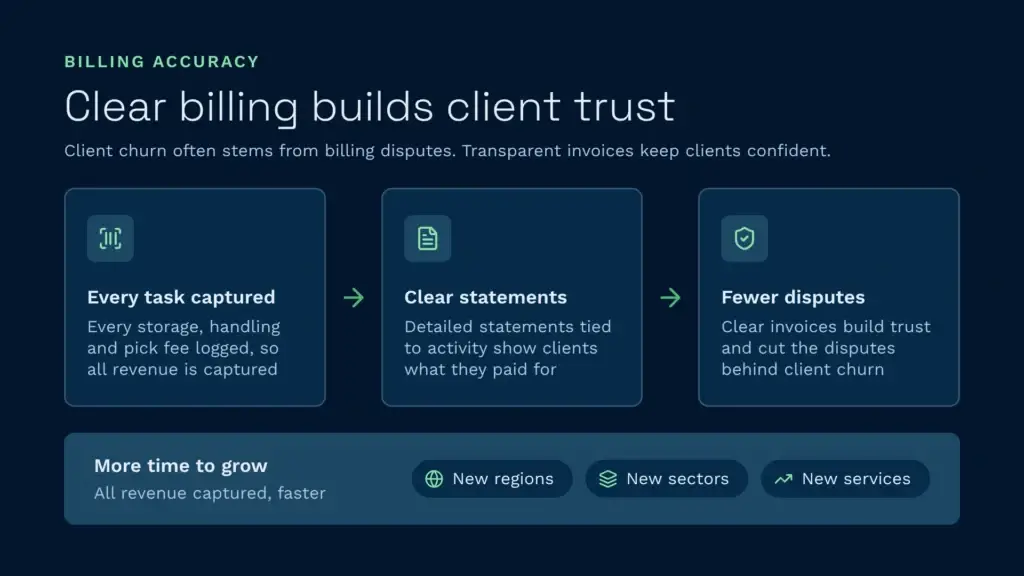
Better billing is one of the clearest wins from a 3PL WMS. Client churn often starts with billing disputes: invoices that look wrong or don’t make sense. A 3PL WMS produces detailed statements tied directly to warehouse activity, so clients can see what they’re paying for and why. That clarity builds trust and cuts disputes.
Centralised billing through your WMS also makes accounting simpler. All client revenue is captured, reconciliation is faster, and your finance team spends its time on analysis rather than chasing data.
Over time, a well-run 3PL WMS becomes a real competitive advantage. It shows clients you run a professional operation, takes friction out of daily work and frees up management time for growth, whether that’s new regions, new sectors or new services.
Is it time to move to a 3PL WMS?
If your 3PL still manages clients through spreadsheets, email or a general-purpose WMS, the costs add up. Missed billing, inefficient picking and frustrated clients all compound over time. A dedicated 3PL WMS gives you the foundation to grow profitably.
The right time to switch is when you recognise the problems it solves: revenue lost to billing gaps, slow picking and packing, or difficulty onboarding new clients quickly. If those sound familiar, it’s time to evaluate vendors and plan the move.
Start with a clear list of your requirements, benchmark how your operation performs today, and choose a vendor that fits where you want to take the business. Get in touch with our team to talk through your requirements.