

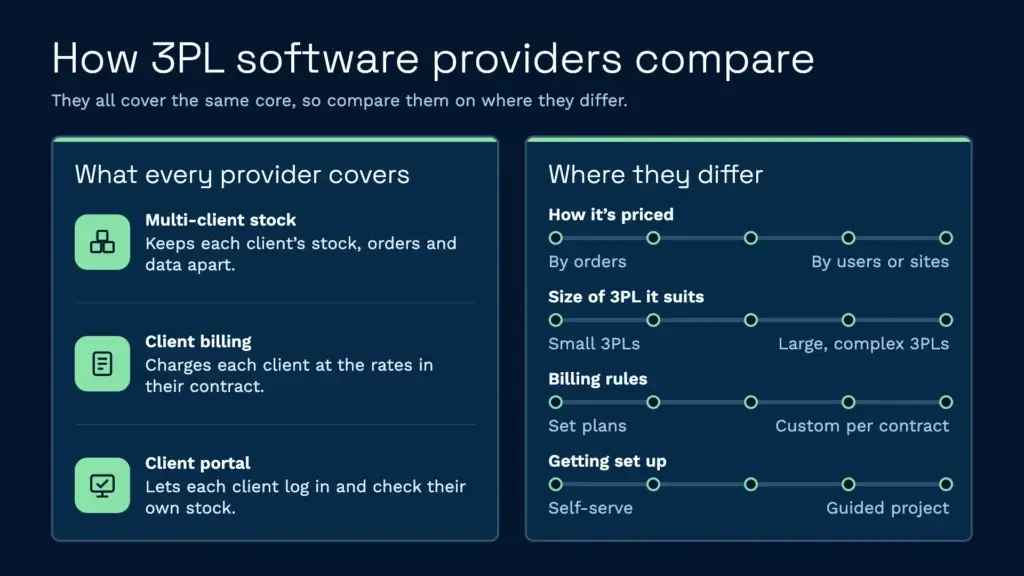
The best 3PL software keeps each client’s stock, orders and billing separate inside one warehouse, without spreadsheet workarounds. Six 3PL software providers worth comparing for that job are Clarus, Mintsoft, Helm, Snapfulfil, Canary7 and Extensiv. All six handle multiple clients, client billing and a client portal. They differ most on how they charge, the size of 3PL they suit and how far billing can be set up for each client.
If you run a third-party logistics (3PL) operation, managing stock, orders and billing for many clients in one warehouse is a different job from running a single-company warehouse. You might also see this called third party logistics software or 3PL management software. It’s the same category of system. Below you’ll find a side-by-side comparison, what 3PL software costs, the features to look for and how to choose. This guide covers the software 3PLs use, not 3PL service providers themselves.
Best 3PL software providers compared
| Provider | Billing and client portal | How pricing works |
|---|---|---|
| Clarus WMS | Client billing and client portal | Sites and users, not order volume. Plans from £1,000 a month base |
| Mintsoft (The Access Group) | Client billing and client portal | Plans with a monthly order and client allowance |
| Helm (formerly Despatch Cloud) | Client billing and branded portals | Plan subscription, with a discount for an annual contract |
| Snapfulfil (Synergy Logistics) | 3PL billing and client portal | Quoted individually |
| Canary7 | Activity-based billing and branded client portals | Per user, per month, quoted individually |
| Extensiv | Billing Manager with a client portal | Quoted individually |
Some of these providers publish prices and some don’t. We haven’t listed competitor prices, because they change and we can’t vouch for them. Ask each provider for a written quote based on your client count, order volumes and sites.
Clarus WMS
Clarus is a cloud WMS for 3PLs and multi-site distributors, with client billing, a client portal and multi-client stock control. It’s priced on sites and users rather than orders, so orders and shipments are unlimited. Plans start from £1,000 a month base for a single site, and the Scale plan for multi-site operations starts from £1,500 a month base. Your final quote is tailored to your sites and users.
Mintsoft
Mintsoft, part of The Access Group, publishes its 3PL plans. Each plan comes with a monthly order and client allowance, and there’s an Enterprise plan for larger 3PLs. Every 3PL plan includes client billing, a client portal and unlimited browser users.
Helm
Helm, formerly Despatch Cloud, offers a Fulfilment plan for 3PLs as a plan subscription, with a discount for an annual contract. It includes client billing, branded portals and unlimited users.
Snapfulfil
Snapfulfil is a cloud WMS from Synergy Logistics. Its 3PL offering covers multi-client control, client-specific workflows, 3PL billing and a client self-service portal. It’s quoted individually.
Canary7
Canary7 is aimed at 3PLs with many clients, complex billing and bespoke workflows. It offers activity-based billing with rate cards, branded client portals and EDI. It’s priced per user, per month, and quoted individually.
Extensiv
Extensiv is a US-based provider. Its 3PL Warehouse Manager is paired with a separate Billing Manager, which includes a client portal for viewing rates, charges and payments. It’s quoted individually.
Third party logistics software and 3PL warehouse management systems
Third party logistics software, 3PL management software and 3PL warehouse management software are three names for one need. A 3PL warehouse management system (WMS) runs the stock, orders and picking for several companies in one building, and keeps each company’s data, billing and reporting apart.
Whichever phrase you search for, judge each product on the same questions. Can it hold many clients in one warehouse? Can it bill each one under its own contract? Can it show each client only their own stock? Ask each provider to show you a multi-client setup in a live demo, not on a slide.
How much does 3PL software cost?
3PL software is usually a monthly subscription, but providers price it in different ways:
| Pricing model | How it works | Example |
|---|---|---|
| Order and client allowance | Plans set by monthly orders and number of clients | Mintsoft |
| Plan subscription | A fixed plan price, often cheaper on an annual contract | Helm |
| Per user, per month | A monthly fee for each user | Canary7 |
| Sites and users | A base fee per plan, priced on sites and users | Clarus, from £1,000 a month base |
Some costs don’t show on pricing pages. Ask each provider about:
- Implementation and onboarding: some include it in the subscription, others charge a one-off fee.
- What happens above your allowance: if a plan includes a set number of orders or clients, check the cost of going over it.
- Contract length: some prices depend on signing an annual contract.
- Mobile or scanner users: some plans charge separately for handheld device users.
- Integrations and add-ons: extra modules, bespoke integrations and EDI can be priced separately.
Our WMS cost guide explains each of these in more detail.
3PL software for small businesses
If you’re a small 3PL, look for a plan that matches your current client count and order volumes, and room to grow without a big jump in cost. Check what happens when you go over a plan’s order or client allowance, because that’s where costs can rise as you win new clients. Compare what each option would cost at the size you expect to be in two or three years, not just today. Our guides to 3PL software for small businesses and the best WMS for small businesses cover this in more depth.
What is a 3PL software provider?
A 3PL software provider supplies warehouse management software built for third-party logistics companies. Unlike software for a single company, 3PL software keeps each client’s stock, orders and data separate within the same warehouse.
A traditional WMS manages one company’s stock. A 3PL WMS manages stock for many companies in the same building, with separate data, accurate billing and separate reporting for each client.
Core jobs of 3PL software
- Multi-client control: keep each client’s stock, orders and data separate on one platform.
- Billing and invoicing: charge storage, pick and pack, handling and other fees according to each client’s contract.
- Client portal: give clients real-time visibility of their stock, orders and shipments.
- Data protection: handle other companies’ data in line with GDPR and their own requirements.
What does 3PL stand for?
3PL stands for third-party logistics. The first party is the business that owns the goods, the second party is its customer, and the third party is the logistics company that stores, picks and ships the goods for them. If you run a 3PL, your clients hand that work to you but still own the stock.
That’s why 3PL software has to keep every client’s stock, orders and billing apart. You’re holding stock you don’t own, for several owners at once, in the same building.
What software do 3PL companies use?
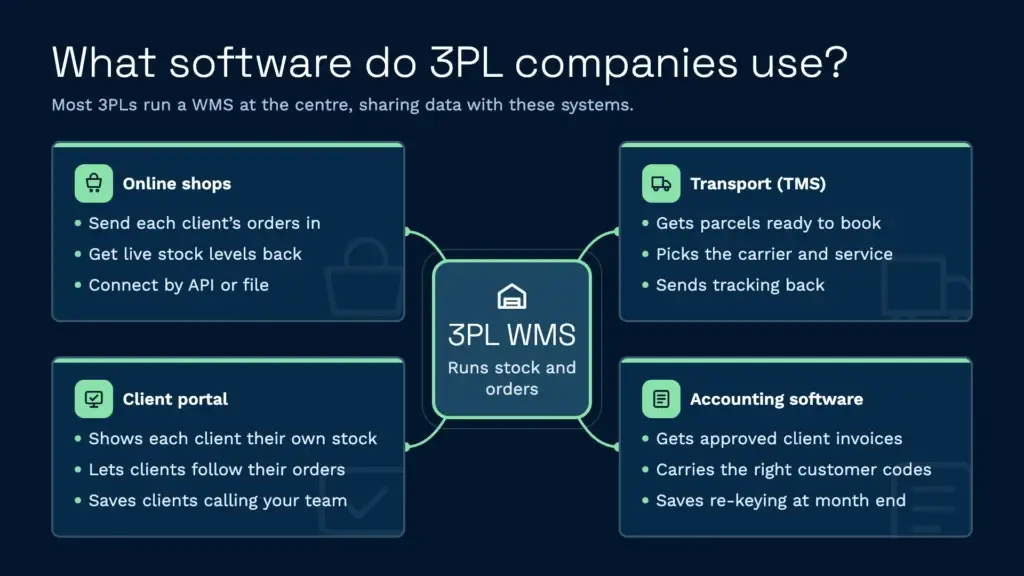
Many 3PLs run a WMS at the centre, connected to other systems. A typical setup includes:
- Warehouse management system (WMS): inventory, orders, picking and packing.
- Transport management system (TMS): carrier selection and shipment tracking, such as Qargo, which connects to Clarus.
- Accounting software: invoicing and financial reporting.
- Client communication: email, portal and API updates on orders and stock.
The links between those systems matter as much as the systems themselves. Mathew Buttar, Head of Solutions at Clarus, gives the example of a TMS sending load references to the WMS so the pick order matches the dispatch order: “I’m in London. I’ve got a truck going to Scotland. I don’t want to pick an order that’s going to London… I should pick that last.”
Your WMS needs to connect to these without manual workarounds, so check each provider’s integrations.
How does 3PL software differ from a standard WMS?
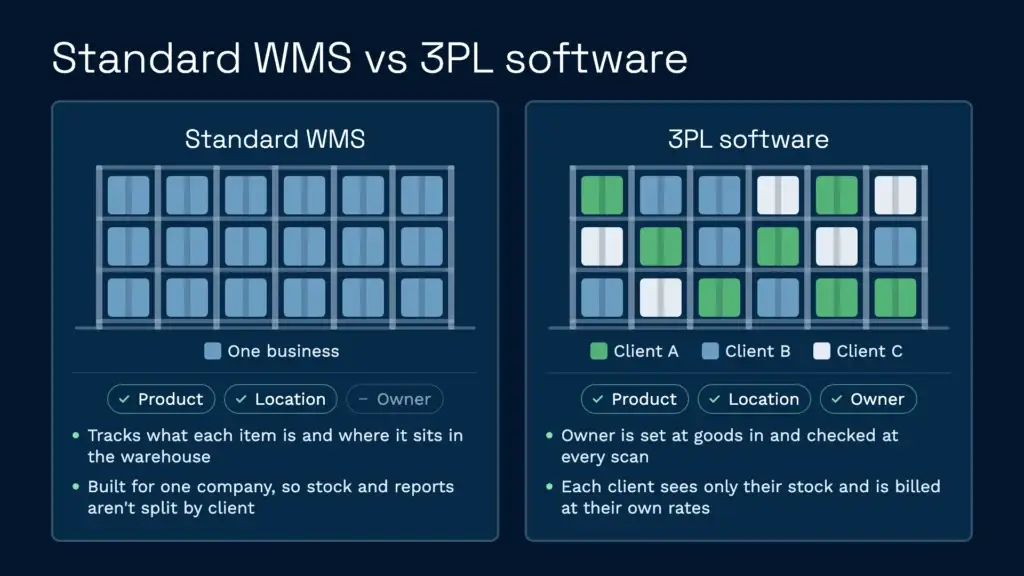
A standard WMS is built for one company’s warehouse. Using it for a 3PL can mean workarounds for billing, client separation and client reporting.
| Feature | Standard WMS | 3PL software |
|---|---|---|
| Multiple clients | Limited, or needs workarounds | Built in |
| Billing | General cost tracking | Charges based on each client’s contract |
| Client visibility | Manual reports | Client portal with set permissions |
| Data separation | Built for one company | Separate data and audit trails per client |
A standard WMS tracks stock by product and location. A 3PL WMS tracks stock by product, location and client. That extra layer affects billing, reporting and client access across the whole system.
The difference shows up in the detail. In a 3PL warehouse, a picking rule that suits one client can be wrong for another. In Clarus, FIFO (first in, first out) runs on the creation date of each stock record, down to the millisecond, and date-controlled stock can use FEFO (first expiry, first out) instead. Ask each provider to show you how they’d set stock rotation for two clients with different rules, rather than accepting “we can do that” as an answer.
What features should 3PL software have?
Look for these when you compare providers:
- Real-time stock visibility: each client sees only their own stock, updated as it moves.
- Flexible billing: storage, picks, minimum charges and custom rules for each client contract.
- Client self-service portal: clients check stock, download reports and track orders without calling you.
- Open API: connect to your clients’ ecommerce platforms, accounting software and other systems.
- Performance dashboards: pick accuracy, order cycle time and utilisation across all clients.
- Audit trails: detailed logs of transactions and changes, for disputes and compliance.
- Barcode and batch tracking: scanning, batch labels and carton tracking.
Order management across clients
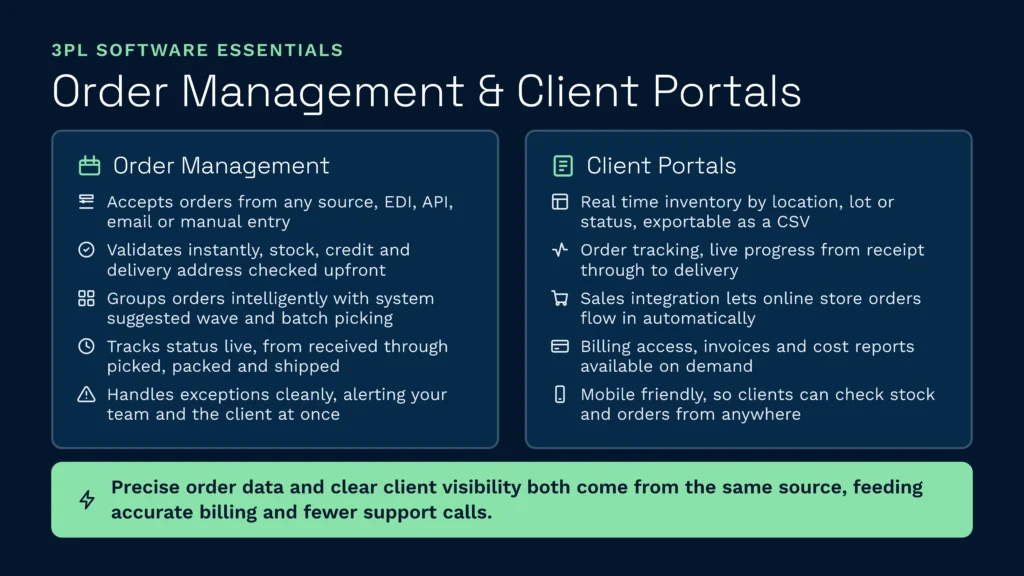
Orders reach a 3PL from every client’s channels at once, often in different formats. Ask each provider to show you how their system will:
- Take orders from EDI, API, ecommerce platforms, file uploads and manual entry into one queue.
- Check stock and delivery details before an order is released to the floor.
- Show each order’s status, from received through picked, packed and despatched.
- Flag exceptions, such as a stock shortage, to your team and the client straight away.
- Print carrier labels and pass tracking back to the client.
Clarus has integrations with platforms including Shopify, Amazon and eBay, and carriers such as Royal Mail and DPD. The integrations page has the full list.
What a 3PL client portal should show
- Stock by location, batch or status, with an export your client can keep.
- Each order’s progress from receipt through to delivery.
- Orders flowing in from the client’s own online shop.
- Invoices and the charges behind them.
- A layout that works on a phone as well as a desktop.
Billing rules to check
Every client contract is different, so ask each provider to set up one of your real rate cards in the demo. Common rules include:
- Storage per unit, per pallet or per cubic metre, charged by how long it stays.
- Activity charges per pick, pack, despatch or return.
- Value-added services such as kitting and labelling.
- Minimum monthly charges.
- Different rates for different products within one client’s account.
The test is whether every billable event is recorded against the right client as it happens, so month-end invoicing comes from warehouse data rather than a spreadsheet. In Clarus, client billing works from that warehouse activity, and the AI assistant can also catch missed pallet charges across customer accounts.
How to choose a 3PL WMS provider
Step 1: Define your requirements
Before you speak to providers, write down how many clients you have, your order volumes in a normal and a peak month, whether you need more than one site, and the billing rules in your client contracts.
Step 2: Check reviews and case studies
Read reviews on sites such as G2 and Capterra, and ask each provider for case studies from 3PLs like yours. The UK Warehousing Association and similar trade bodies in other countries can also be a useful source of guidance.
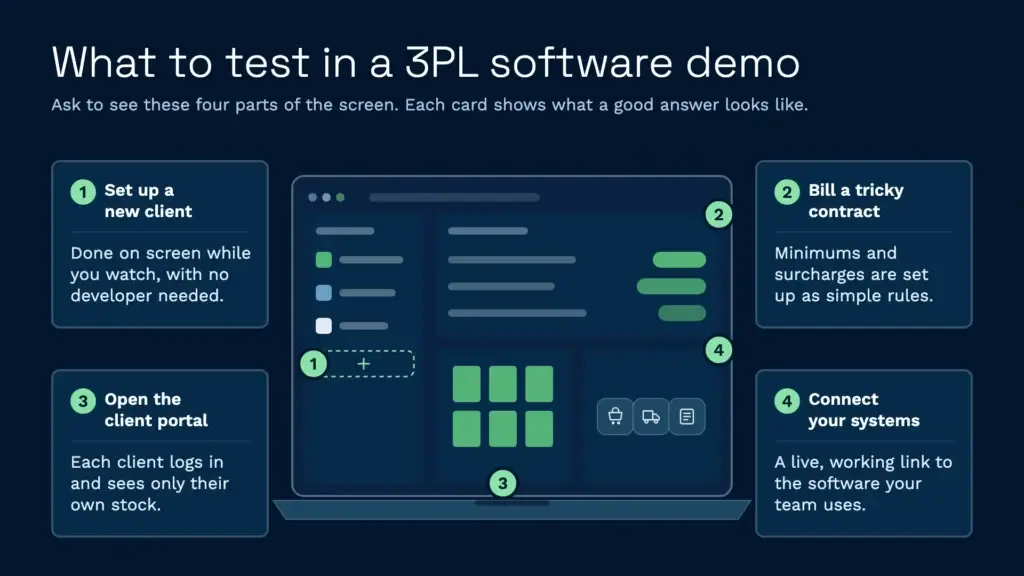
Step 3: Test the system on your own scenarios
Ask each provider to show you:
- How they set up a new client.
- How they’d configure billing for one of your more complex contracts.
- What the client portal looks like.
- How integrations with your existing systems work.
Step 4: Check implementation and support
Ask how long go-live usually takes for an operation like yours, who supports you during go-live, and what training is included. Mathew Buttar puts a standard Clarus project at around 12 weeks to go-live, for an off-the-shelf, mildly complex setup “with correct support on both sides”. Projects with many clients, sites or features take longer.
He’s also wary of phased rollouts: “I hate phased rollouts… I think they’re capacity drainers.” Going live in one go can work, but only with a full user acceptance testing (UAT) schedule that every party, including your clients, signs off. Our WMS implementation guide explains each stage.
Step 5: Compare the total cost
Work out what each option costs at your expected size, including onboarding, users, add-ons and what happens if you go over a plan’s allowance.
3PL software for different types of 3PL
The core jobs are the same for every 3PL, but each sector adds its own demands. Check these on top of the basics:
- Ecommerce fulfilment: fast throughput of small orders and live connections to each client’s online shops and marketplaces.
- B2B distribution: pallet, case and each picking, a mix of ecommerce and EDI orders from retail customers, and more complex billing.
- Food and drink: best-before tracking with FEFO stock rotation, batch traceability for recalls, and temperature-controlled storage.
- Pharmaceutical and healthcare: serial number capture, expiry date tracking and quarantine of suspect stock.
Campeys unlocked sub-5 minute recalls with Clarus, which shows why traceability matters so much in food.
What 3PL software can’t do for you
A warehouse system records what your team does and tells them what to do next. It can’t control what happens physically, and it won’t fix a process that’s broken on the floor. The system shows what a user said they did with a scan, not always what they actually did.
Mathew Buttar’s advice is not to lean on the screen alone: “you can’t rely too much on what the system tells you all of the time.” For supervisors, he says, “being on the floor is as important as it is to sit in front of a PC.” Before you buy, ask each provider where your team will still need to check by hand.
Data quality matters too. A 3PL system needs each client’s product codes, barcodes and expiry rules set up correctly before it can help. A scan tells the system what the label says, so a wrong label means a wrong record. GS1 UK publishes the barcode standards that help here, and Clarus reads GS1 barcodes, including application identifiers that carry details such as the batch.
What is the best 3PL software?
There’s no single best option, because it depends on your size, your clients and how you want to pay. As a starting point:
- Smaller 3PLs that want a published entry price: Mintsoft and Helm both publish their 3PL plan prices.
- 3PLs with complex billing or bespoke workflows: Canary7, Snapfulfil and Clarus all offer configurable billing and client portals.
- 3PLs that don’t want costs tied to order volume: Clarus is priced on sites and users, with unlimited orders and shipments.
Browns Distribution chose Clarus for its 3PL operation for customer stock visibility, batch and hold control, and automated EDI and invoicing. St John’s Hall Storage cut its invoicing time by 90% after moving to Clarus. For a wider comparison, see our guide to the best WMS for 3PLs.
How we compared these providers
We compared six providers on client billing, client portals and pricing model, using each provider’s own website, checked in November 2026. We haven’t listed competitor prices, because they change and we can’t vouch for them, and we haven’t estimated any. Clarus is our own product, so check the comparison against each provider’s site before you decide.
See Clarus for your 3PL
If you’d like to see how Clarus handles multi-client billing and client portals for an operation like yours, check our pricing or get in touch to book a demo.