

If you’re running a 3PL operation or multi-client warehouse in the UK, you’ve probably come across Access Delta WMS. It’s a solid legacy system if you need basic visibility and mobile picking. But many operators find it falls short of what a modern 3PL needs: true multi-client invoice automation, a client self-service portal that actually works, or the flexibility to onboard new clients without a long implementation. The good news is that a newer generation of cloud-native WMS platforms has been built around how 3PLs operate today. This guide walks you through the best alternatives to Access WMS, with an honest look at what each does well and where it falls short.
Quick comparison table
| Solution | Best for | Multi-client billing | Client portal | Deployment time | Cloud-native |
|---|---|---|---|---|---|
| Clarus WMS | 3PLs wanting billing automation and fast go-live | Yes — automated, real-time event capture | Yes — white-labelable, full visibility | Around 12 weeks | Yes — serverless |
| Access WMS | Businesses needing basic visibility and integrations | Manual/limited — often requires spreadsheet supplements | Yes — but limited functionality | 12–18 weeks typical | Cloud-hosted, not cloud-native |
| Mintsoft | Smaller 3PLs and e-commerce fulfilment | Basic multi-client support, some automation | Yes — basic client visibility | 8–12 weeks | Cloud-based |
| Deposco | Mid-market 3PLs wanting unified billing and WMS | Yes — activity-based billing engine built-in | Yes — comprehensive client reporting | 8–12 weeks | Yes |
| Körber Supply Chain WMS | Large enterprises and high-volume operations | Yes — but requires significant configuration | Limited or via third-party modules | 18–24 months typical | Hybrid deployment options |
| Snapfulfil | E-commerce and fast-moving retail | Limited multi-client depth — can work for small 3PLs | Basic order tracking portal | 12–16 weeks | Cloud-based |
1. Clarus WMS: best for 3PLs needing billing automation and speed
Clarus is an agentic AI-driven, cloud-native warehouse management system built for 3PLs and multi-client operations. It isn’t trying to be everything to everyone. It goes after the specific problems that hold 3PL businesses back: invoicing that reflects what actually happened in the warehouse, a client portal that cuts support overhead, and a deployment that doesn’t eat up half your year.
What it does well
- Automated billing engine: With 3PL billing in Clarus, you set rates once. Every billable event (receiving, storage, pick, pack, despatch, returns, value-added services) is captured as the work happens, with a full audit trail. St John’s Hall Storage, a UK third-party warehousing provider, cut its invoicing time by 90% and saves the equivalent of about two staff members’ workload. Clarus’s AI assistant also catches missed pallet charges across customer accounts and calculates the revenue you’d otherwise have lost.
- True multi-client inventory segregation: Each client’s stock, reporting and billing is kept separate within one warehouse environment. No shared queues, no data bleeding, no “whose order is this?” confusion. Read more in our guide to multi-client WMS.
- Branded client portal: With Customer Self-Service, your clients log in to a portal carrying your brand. They see live stock, order milestones, shipment tracking and charging data, with access set per role. At MSD, customer emails and calls about stock levels and costs fell by about 60%.
- Deployment you can plan around: A standard Clarus implementation goes live in around 12 weeks, with time built in for data work and training. Through Clarus Onboarding, you get a dated plan up front rather than an open-ended project.
- No long-term tie-ins: Clarus is pay monthly with no tie-ins, and pricing is published on the website rather than hidden behind a sales call.
- Support response in under five minutes: When something goes wrong, you hear back fast rather than waiting days in a ticket queue.
Where it’s a poor fit
Clarus is designed for multi-client operations. If you’re a single-client warehouse moving low volumes, you might be paying for 3PL capabilities you don’t need. And if you need heavily bespoke workflows that take months of custom engineering, a larger enterprise platform may suit you better.
Customer proof points
MSD (Mitchell Storage & Distribution) cut warehouse admin by 60% and added new revenue streams. These include cross-docking for the Palletforce network and bespoke tasks that are now recorded as chargeable. KATEM Logistics scaled monthly picks ten-fold, from around 1,000 to 10,000 or more, with order accuracy now at 98% to 99%. JODA Freight reached 99% stock accuracy and cut stock takes from weeks to a single day. Edge Transport is a BRCGS-accredited distribution and warehousing business serving food customers. It reports stock accuracy of over 99% and books goods onto the system within two to three minutes of paperwork reaching the gatehouse. These are real businesses using the system every day, and you can read each one in the Clarus customer stories library.
Pricing
Clarus publishes its base plans on the pricing page, paid monthly with no long-term tie-in. There’s a one-off implementation fee, and user costs are tiered so the cost per user falls as you grow. The Core plan includes unlimited courier integrations and unlimited ecommerce and marketplace connectors, so you’re not paying extra each time a client wants a new channel.
Sample scenario
You’re a 3PL with six clients, and three of them have bespoke billing rules: one charges by pallet-week, another by pick count, a third by cubic metre plus handling. On a system without an activity-based billing engine, that usually means manual reconciliation or spreadsheet workarounds. Clarus captures all three billing models in configuration and builds the invoices automatically. A standard implementation takes around 12 weeks, and from your first month live, automated billing starts paying back the admin time you were losing.
2. Access WMS: the incumbent, with known limitations
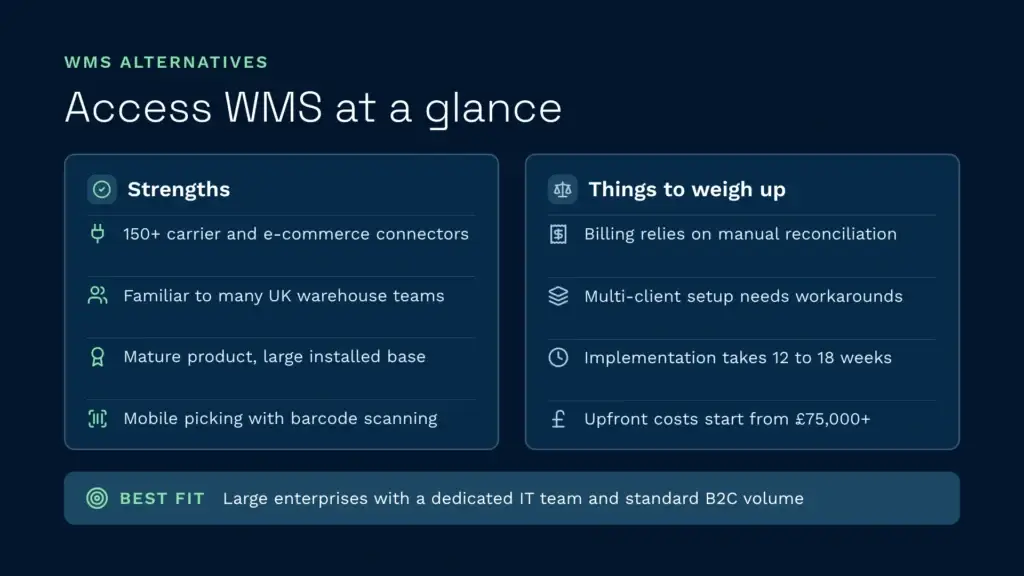
Access WMS, from The Access Group, is a mature, widely installed system. If you’ve been in UK warehousing for a decade, you’ll know it. It’s sold as two products, Access Delta and Access Mintsoft (covered separately below), and can be deployed on-premise or in the cloud. It handles the basics: receiving, putaway, picking, packing, mobile barcode scanning, and integration with couriers and sales channels. The problem is that it wasn’t designed around the way modern 3PLs operate.
Strengths
- Broad integration library, with The Access Group citing 150+ pre-built integrations covering sales channels, couriers and accounting software.
- Familiar to many UK warehouse teams. If your staff have used it before, there’s little learning curve.
- Mature product with a large installed base.
- Mobile barcode scanning app for goods-in, picking and stock transfers.
- 24-hour client portal where clients can view stock, track orders and see invoices.
Real limitations
- Billing relies on workarounds: Access lets you attach storage billing rules to location types and shows invoices in the client portal. But it doesn’t describe a dedicated activity-based 3PL billing engine. Ask how picks, value-added services and returns get charged, and how much reconciliation happens in spreadsheets outside the system.
- Multi-client depth is shallow: The system can handle multiple clients, but check how far reporting, billing rules and workflows can be separated per client before you commit.
- Long implementation: Expect significant configuration, testing and parallel running before go-live. If you need to move fast, ask for a dated plan before you sign.
- Opaque pricing: Access prices per feature, so you’ll need a formal quote to know what you’ll actually pay.
- Feature gaps: One Capterra review of Access Delta cites missing picking interleaving and no location-sensitive picking. The same review says you’re limited to one screen at a time, so you can’t view reports and stock side by side.
- Support can be unpredictable: The same reviewer noted: “The support is good if there’s an easy answer, otherwise it tends to get closed off as an unknown issue.”
- Not cloud-native: Access WMS can run on-premise or in the cloud, but a system that’s been moved to the cloud isn’t the same as one built for it. Our guide to cloud warehouse management software explains the difference.
Who it works for
Access WMS is still a reasonable choice if you’re a larger business with a dedicated IT team, you’re comfortable with a long implementation, and you’re mainly moving standard B2C ecommerce volume. If you already run other Access Group software, there’s an integration benefit. But for modern 3PLs, the friction and cost often outweigh the benefits.
Pricing
Access prices per feature, so total cost depends on which modules you need and can climb as you add advanced features. There’s no published monthly figure, so you’ll need a formal quote.
3. Mintsoft: the lightweight option for smaller 3PLs
Mintsoft is a cloud-based WMS designed for smaller 3PLs and ecommerce fulfilment operations. Be clear on one thing before you shortlist it: Mintsoft has been owned by The Access Group since 2020 and is now sold as Access Mintsoft alongside Access Delta. Moving from Delta to Mintsoft keeps you with the same vendor.
Strengths
- Built for 3PL operations, so multi-client support is native rather than a retrofit.
- Generally more affordable than enterprise platforms.
- Client portal where each client gets their own login for queries, notifications and reports.
- Large integration library for carriers and ecommerce platforms, with Mintsoft citing over 150.
Limitations
- Billing automation is basic: Mintsoft lets you create client invoices from storage, handling and shipping charges. That doesn’t match Clarus’s approach of capturing every billable event as it happens, so expect some manual reconciliation or reporting exports for complex billing rules.
- Less flexible for complex workflows: If you need bespoke picking logic, advanced automation or complex customer requirements, Mintsoft can hit a ceiling. You may need custom development or workarounds.
- Same vendor as Access Delta: If you’re leaving Access Delta over the vendor relationship, support model or roadmap, moving to Mintsoft keeps you with The Access Group.
Who it works for
Mintsoft is a sensible choice if you’re a small to mid-size 3PL with a handful of clients, you want something lighter than Access Delta, and you’re comfortable with billing reconciliation still needing some manual input. It costs less than enterprise platforms. If you’re weighing it up, see our guide to Mintsoft alternatives.
Pricing
Pricing varies with transaction volume and the number of clients, so ask for a quote based on your current and forecast volumes.
4. Deposco: mid-market 3PLs wanting one platform
Deposco is a cloud platform that brings warehouse management, order management and a 3PL client portal together. It’s aimed at 3PLs and mid-market logistics operators.
Strengths
- 3PL client portal: Deposco’s Bright Portal, launched in 2026, gives clients real-time access to inventory levels, order status, SLA performance and billing.
- Built with 3PLs in mind: Multi-client operation is part of the pitch rather than an afterthought. Ask to see your own rate cards set up in a demo.
- One platform: Warehouse management and order management sit in the same system, so there’s less switching between tools.
- Cloud platform: Designed to scale as volumes grow.
Limitations
- Higher price point: Deposco sits at the premium end and pricing climbs with scale, so it may not suit smaller 3PLs on tight budgets.
- Implementation still takes time: Deposco talks about reaching operational efficiency in 90 days or less. Ask for the timeline in writing, with the milestones behind it, before you sign.
- Gaps for niche systems: Deposco lists 150+ integrations, but you may still need custom API work for some legacy systems or niche UK carriers.
- US-headquartered: Deposco is a US company with a UK office in London. Check what level of UK support and local carrier coverage you’d get.
Who it works for
Deposco suits a growing mid-market 3PL that wants warehouse management, order management and a client portal in one platform and is willing to pay a premium for it. It’s a direct competitor to Clarus, so the choice often comes down to geography, implementation speed and specific feature fit.
Pricing
Custom quotes are required, with pricing scaling by transaction volume and number of clients.
5. Infios (formerly Körber Supply Chain): enterprise grade, for large operations
Körber Supply Chain Software rebranded as Infios in March 2025, and its WMS is now called Infios Warehouse Management. It’s an enterprise-class system designed for large, complex warehouse networks.
Strengths
- Highly scalable: Built for large, complex multi-warehouse, multi-site operations.
- Depth of functionality: Suited to highly automated, high-volume sites.
- Extensive customisation: If you need bespoke workflows, Infios has the resources to build almost anything.
- Global support: A large vendor with an established international support set-up.
Limitations
- Long, expensive implementations: Expect a long project and significant implementation cost. This is an enterprise system with enterprise complexity.
- Multi-client billing needs configuration: Check how much setup multi-client billing logic needs, as it adds time and cost.
- Overkill for most 3PLs: Unless you’re running very high volumes, you’re paying for capability you won’t use.
- Harder to leave: The more custom configuration you build, the more expensive switching away becomes.
Who it works for
Infios is appropriate for very large 3PLs or enterprise logistics divisions running large operations. If you’re in this category, you probably already know it.
Pricing
Custom enterprise pricing, plus substantial implementation and support costs. There’s no published pricing, so budget time for a lengthy quoting process.
6. Snapfulfil: ecommerce focused, limited for multi-client 3PLs
Snapfulfil, from Synergy Logistics, is a cloud-based WMS optimised for ecommerce and fast-moving retail. It’s built for picking speed and carrier integration rather than multi-client complexity.
Strengths
- Strong ecommerce picking workflows, optimised for speed and accuracy.
- Good carrier integration, with streamlined label printing and despatch.
- Good order batching and wave picking logic.
- Mobile picking app with advanced routing.
Limitations
- Multi-client support is shallower: Snapfulfil offers additional 3PL functionality, but check whether it has the billing automation and client portal depth that purpose-built 3PL systems offer.
- Billing may need workarounds: If multi-client invoice generation isn’t native for your setup, you’ll export data and reconcile manually or run a separate billing system.
- Not purpose-built for 3PL complexity: If your clients have different SLAs, bespoke workflows or complex billing rules, Snapfulfil may feel limiting.
- Implementation timeline: Timelines vary with scope, so ask for a dated plan.
Who it works for
Snapfulfil suits 3PLs that mainly handle ecommerce volume and have simple, standardised billing (for example, a flat fee per order). If you’re managing complex logistics or bespoke client requirements, look elsewhere. For a closer look, see our Mintsoft vs Snapfulfil comparison.
Pricing
Pricing varies by volume and configuration and is available on request.
How to choose the right WMS alternative
Here are the questions to ask when deciding between Access WMS and the alternatives.
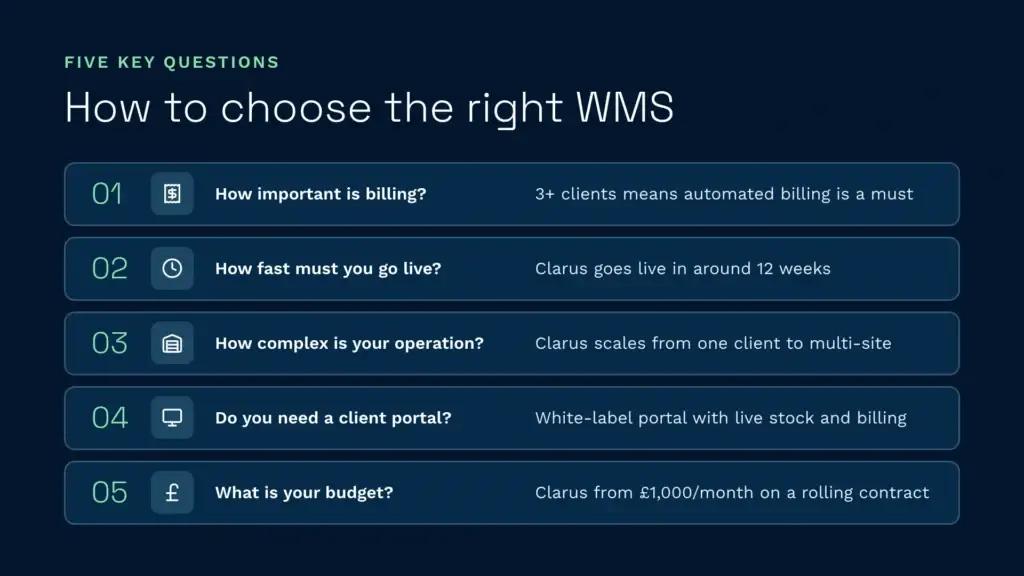
Question 1: How important is billing automation?
If you have more than three clients or complex billing rules, billing automation is non-negotiable. Spending three days a month on invoice reconciliation eats straight into your margin. In that case, Snapfulfil and Access WMS are hard to justify. Clarus is built around activity-based billing, so ask Deposco and Mintsoft to demo your own rate cards before you compare. For a deeper look, see our guide on how to automate 3PL billing.
Question 2: How fast do you need to go live?
If you’re under time pressure (onboarding a major new client, fixing a broken system, or moving off a legacy solution), deployment speed matters. Enterprise platforms like Infios commonly run for many months, and Access WMS is a long project too. A standard Clarus implementation takes around 12 weeks. Mid-market cloud platforms like Mintsoft and Deposco quote in weeks, so ask each one for the figure in writing with the milestones behind it. Every week you’re live earlier is a week you’re capturing data and billing accurately.
Question 3: What’s your volume and complexity?
- Small 3PLs (one to three clients): Mintsoft or Clarus. Deposco and Infios are overkill.
- Growing 3PLs (three to ten clients): Clarus or Deposco. Both are built for this scale.
- Large 3PLs (ten or more clients): Deposco, Infios, or Clarus if you prioritise flexibility and speed.
- Enterprise operations (multiple sites, complex automation): Infios, though Clarus also runs large networks. It automates invoicing across Palletforce’s 120+ depot network.
Question 4: Do you need a client portal?
A self-service client portal cuts support overhead. All the systems above offer one in some form, but Clarus’s Customer Self-Service portal carries your own brand and shows clients live stock, order status, tracking and charges. If you’re fielding 50 or more stock and order queries a week, a strong portal pays for itself in time saved.
Question 5: What’s your budget and risk tolerance?
- Lower budget, lower risk: Clarus or Mintsoft. Clarus is pay monthly with no tie-ins, so there’s no long-term commitment.
- Mid-budget: Deposco. Higher cost, but a broad feature set built with 3PLs in mind.
- Enterprise budget: Infios, but only if you’re large enough to justify it. It isn’t cheaper than purpose-built alternatives, just more comprehensive.
Feature-by-feature comparison: Clarus vs Access WMS
[TABLE PLACEHOLDER: Clarus vs Access WMS feature comparison]
Why 3PLs are switching away from Access WMS
Here’s what tends to push 3PLs to look beyond Access WMS.
Billing has become a competitive differentiator. If you can invoice clients accurately and on time without manual reconciliation, you have an edge over competitors still reconciling in spreadsheets. Clarus’s 3PL billing captures charges as the work happens, so invoices build themselves.
Time to revenue matters. A standard implementation runs to around 12 weeks, and the sooner your billing is accurate, the sooner you stop leaking revenue. Ask any vendor for the dated plan, not just the headline figure.
Client expectations have changed. Your clients expect a portal, real-time visibility and self-service reporting. A basic portal isn’t enough any more, and a branded portal with clear billing visibility is fast becoming the standard.
Operations are more complex. Clients coming to 3PLs today have more SKUs, more omnichannel requirements and more compliance demands (food traceability, BRCGS, hazardous goods handling). A modern WMS handles this without bespoke customisation, from batch and lot control for recall-readiness to stock rotation rules for short-dated goods.
Cost is more transparent. Per-feature pricing plus separate support costs make Access WMS hard to budget for. Clarus publishes its pricing and runs on a pay-monthly basis with no long-term tie-in, which is easier to plan around and justify to your finance team.
Migration path: moving from Access WMS to Clarus
If you’re on Access WMS and considering a move, here’s what’s realistic.
Data migration: Stock data, client master records and SKU files are exported from Access WMS (for example, as CSV) and imported into Clarus, using templates and guidance from the Clarus team. Picking history and old invoices can stay in the legacy system for audit purposes, so you don’t need to migrate them.
Go-live approach: Teams typically run a short period of checks to confirm picking, packing and invoicing are correct in Clarus before cutting over. The Clarus onboarding team keeps your operation running during the move.
Training: Training is planned into the implementation, and Clarus is designed to be intuitive, especially if your team already knows WMS concepts.
Timeline: From kick-off to go-live, a standard migration lands at around 12 weeks. That allows proper time for data work, configuration and training rather than rushing the cutover.
Carriers and integrations: Clarus connects to over 200 systems, including Shopify, Amazon Shipping, DPD and Royal Mail, so the carriers and sales channels you already use are very likely covered. See the full list on the integrations page.
Speak to a warehouse expert
If you’re weighing up your options and want to see how a purpose-built WMS works in practice, Clarus is worth a conversation. We work with 3PLs and distributors across the UK and Europe to implement warehouse management software that fits the way you operate, not the other way around.
Get in touch with our team to talk through your requirements.