

If you’re choosing a warehouse management system in 2026, the question usually isn’t whether to go cloud. It’s which cloud system to pick, and whether it’ll fit the way your operation runs. Operators who once worried about uptime, security and data control now ask different questions: how fast can we go live, what does it cost, and will it fit a 3PL that runs ten clients on one floor? This guide answers those questions in plain language, for anyone comparing cloud or online warehouse management software.
We’ll cover what a cloud WMS is, what “web-based” means, how it differs from on-premise software, how to check security, what it costs and how long it takes to roll out. Along the way we’ll show how Clarus WMS features handle the needs of 3PL operators.
What is cloud warehouse management software?
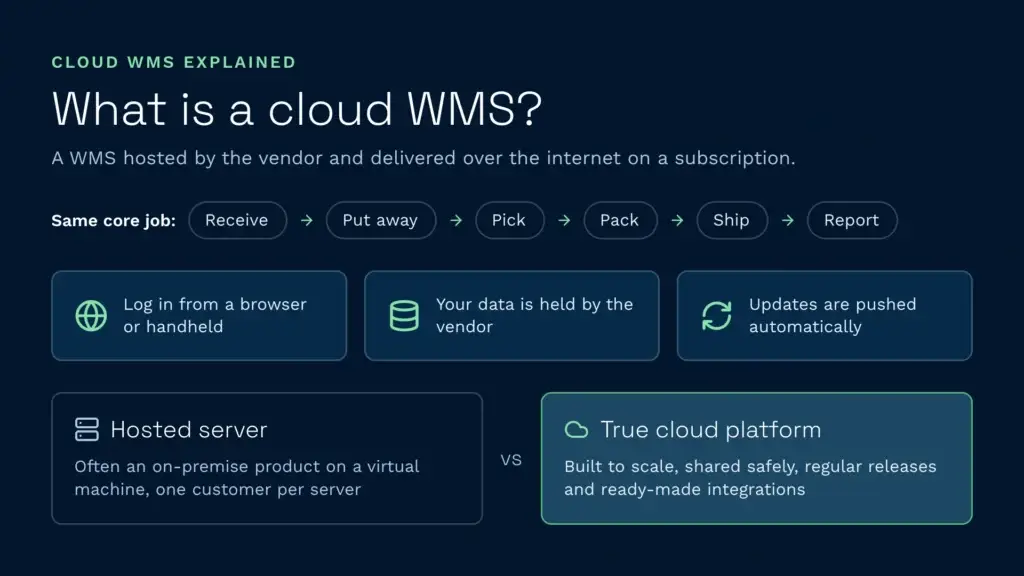
Cloud warehouse management software is a WMS hosted by the vendor and delivered over the internet, usually on a subscription. You log in through a browser or a handheld app, your data sits with the vendor, and updates are pushed automatically. The core function of a WMS stays the same: receive stock, put it away, pick orders, pack, ship and report. What changes is the plumbing underneath.
The shift is more than where the server lives. A well-built cloud WMS has modern APIs and ready-made integrations, so it talks to Shopify, your couriers, your ERP and your client portals without bespoke middleware. For a deeper look at the fundamentals, see our overview of what a warehouse management system actually does. For the business case, including where the savings come from and what they cost, read cloud WMS benefits for modern warehouse operations.
How a cloud based WMS system differs from a hosted server
Be careful with vendor language. A “hosted” WMS often means an on-premise product running on a virtual machine somewhere, with one customer per server, slow upgrades and limited room to scale. A true cloud based WMS system is built to scale, share infrastructure safely between customers and release new features regularly. If the vendor talks about “their server” rather than “the platform”, that’s a signal.
What does web-based warehouse management software mean?
Web-based warehouse management software is a WMS you open in a browser, but the browser tells you nothing about how the software is hosted or shared. Three models sit behind the phrase, and the difference matters for updates, data separation and cost. In other words, warehouse management software that’s web based can still be very different underneath.
A WMS “can either be hosted locally or installed on the cloud, allowing the WMS to be accessed from anywhere online” (Wikipedia, Warehouse management system). Multi-tenant software is one in which “a single instance of software runs on a server” and serves several customers (Wikipedia, Multitenancy). That shared model is what most people mean by software as a service, or SaaS WMS.
| Model | What it means | What to ask the vendor |
|---|---|---|
| Browser access to on-premise | Software installed on a server you own or rent, reached through a browser | Who applies updates, and how long do they take to go live? |
| Hosted single-tenant | The vendor runs a separate instance for each customer | Who controls upgrade timing, and what backup and recovery apply? |
| Multi-tenant SaaS WMS | One platform serves many customers, and releases reach all of them | How is your data separated from other customers’ data, and how are releases tested? |
Is web-based WMS the same as cloud WMS?
Not quite. Web-based describes how you reach the software, and cloud describes where it runs. A web-based WMS can be hosted in either style, so ask whether the vendor runs one shared platform for all customers, which is what most people mean by cloud WMS, or a separate instance for you.
Can I run a browser based WMS on handheld scanners?
Plan for a dedicated handheld app rather than a desktop browser on the floor. Clarus runs its handheld workflows on Android devices such as Zebra and Honeywell units. Whatever you choose, ask the vendor to run a pick on the actual scanner you plan to buy, because screen design and scan speed only show up on the device.
Is a web-based WMS secure?
It can be, and the test is what the vendor can prove, not whether the software runs in a browser. Ask for current certification against ISO/IEC 27001, the global standard for an information security management system. Clarus is ISO 27001 certified. Then ask where your data is held, how it’s separated from other customers’ data and how access is controlled. The National Cyber Security Centre’s cloud security guidance sets out the shared responsibility model, which splits security tasks between provider and customer. Check what sits with you.
How long does a web-based WMS take to implement?
A standard project with the right support on both sides can go live in around 12 weeks. Mat Buttar, Head of Solutions at Clarus, puts the aim this way: “we’d aim to get live within 12 weeks”. That assumes an off-the-shelf set-up with no development. Complex projects with several clients, high volumes and most of the system’s features can take much longer, up to two years in the extreme.
What does a web-based WMS cost?
Clarus WMS plans start from a monthly base fee. The full quote adds tiered user licensing and a one-off implementation fee, and it’s shaped around your sites and users. Check the Clarus pricing page for current plans, and read what a WMS really costs for the wider picture, including the costs that sit outside the monthly fee. Compare the pricing model as well as the figure: a subscription, a licence with separate hosting and a licence with support contracts all spread cost differently.
Cloud vs on-premise WMS: an honest comparison
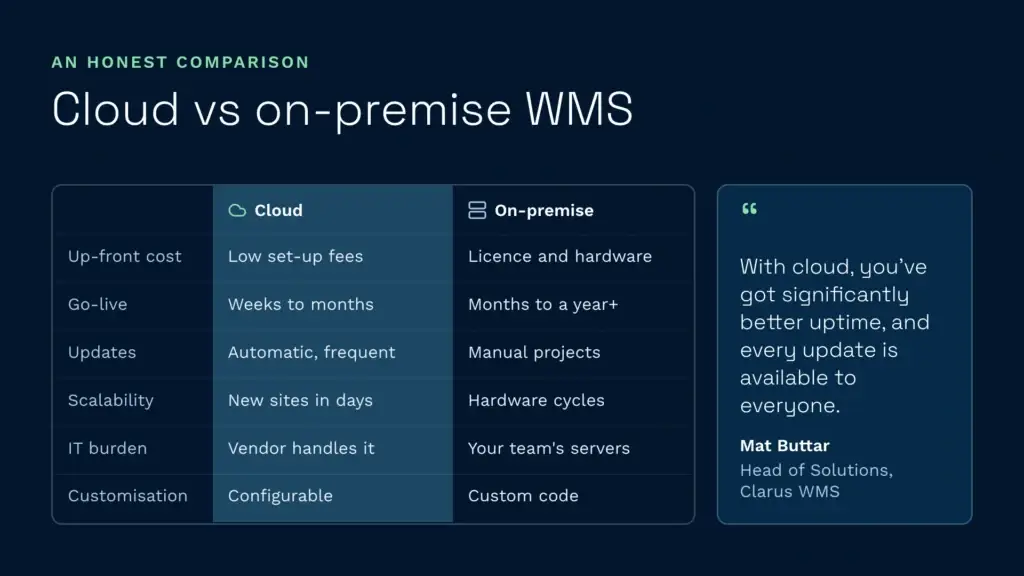
On-premise WMS still runs in older plants and some large retail operations. The real question has moved from where the server sits to how the vendor runs the platform.
| Factor | Cloud WMS | On-premise WMS |
|---|---|---|
| Up-front cost | Low, mostly set-up fees | High licence and hardware spend |
| Time to go live | Weeks to months | Months to a year or more |
| Updates | Automatic, frequent | Manual, project-based |
| Scalability | Add users and sites in days | Hardware purchase cycle |
| IT burden | Vendor handles infrastructure | Internal team owns servers |
| Customisation depth | Configurable, less custom code | Heavily customisable but rigid after |
Mat Buttar, Head of Solutions at Clarus WMS, explains the difference on the cloud side: “cloud-based, you’ve got significantly better uptime… being a SaaS product, any update we do is available to anybody that wants it once it’s developed. On-premise solutions, you’re limited by server life, server size, manual updates, downtime to update.”
The trade-off used to be customisation against convenience. Modern cloud platforms cover most 3PL workflows through configuration, such as client-specific rules, workflow automations and flags, and the remaining requirements are usually met through APIs.
How secure is cloud WMS?
Security is the question that stops most boards from approving a move, and the right question is about the vendor’s evidence rather than the label. Independent certification such as ISO/IEC 27001 is one way to check a vendor’s controls. The answer depends on the vendor, so ask for the certificate and the scope it covers, not a verbal assurance.
What to ask your vendor about security
- Certifications: Ask for the ISO 27001 certificate or a SOC 2 Type II report, not marketing claims.
- Data location: Confirm which regions your data sits in, so you know where you stand on UK GDPR.
- Backups and recovery: What’s the recovery point and recovery time if a region goes down? A good answer is minutes, not days.
- Access controls: Role-based permissions, single sign-on and audit logs as standard.
- Tenant isolation: In multi-tenant cloud, how is your data separated from other customers’ data?
- Data-processing terms: Ask to see them in the contract. If you hold personal data about your clients’ customers, the ICO’s guidance on international transfers explains when a restricted transfer applies, which matters if the vendor’s support or hosting sits outside the UK.
How much does cloud WMS cost?
Most cloud warehouse management software is priced as a monthly subscription, with the fee scaling by users, sites or order volume depending on the vendor. The headline figure is not the full picture. Watch for:
- Implementation fees: These can be a big share of first-year cost, so get them in writing before you compare quotes.
- Per-transaction charges: Some vendors charge per order, per line or per shipping label.
- Integration costs: Pre-built connectors are usually included; custom connectors usually aren’t.
- Hardware: Scanners, label printers and Wi-Fi infrastructure usually sit outside the WMS budget.
- Training and change management: Often under-budgeted, so give it its own line in the project plan.
Whichever vendor you look at, build a five-year total cost of ownership model before signing. For Clarus’s own prices see the pricing page, and for the wider picture read what a WMS costs.
Implementation timeline for a cloud WMS
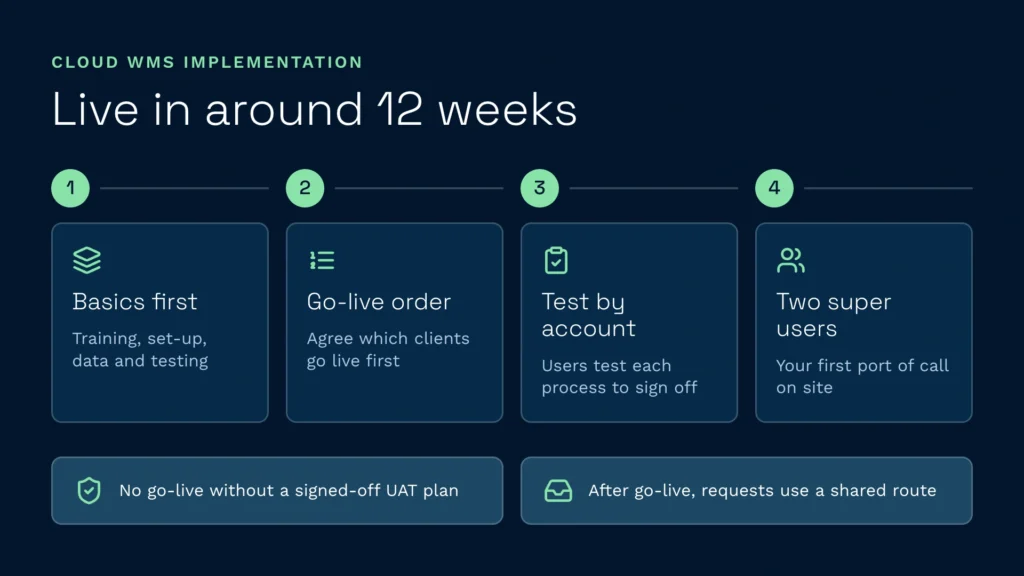
An old enterprise rollout could run for many months. A cloud WMS project depends on the complexity of your operation and the support both sides give it. A standard Clarus project aims to go live within around 12 weeks, and the sequence Clarus follows is:
- Basics first: Super user training, domain set-up, master data gathering and population, and testing. The question at this stage is whether the system works the way your business works, for every client.
- Agree the go-live order: Decide with the customer which clients or accounts go live first, based on how complex their requirements are.
- Manual user acceptance testing, by account: Each process is tested by the people who will use it, and the UAT schedule is the sign-off.
- Name at least two super users: Two people inside your business learn why the system was set up the way it was, run the testing and become the first port of call on site.
Clarus is firm on phasing. A big-bang go-live is “fine if you have time for UAT”, but don’t do one without a full UAT schedule that every party signs off, including the customer. After go-live, requests go into a shared requests route, so the product team can judge whether they belong in the system. Talk to the team about what a go-live would look like for your operation.
For 3PLs running multiple clients on one floor, see our guide to a 3PL-ready warehouse management solution and how multi-client billing, separate client logins and per-client SLAs work in practice.
Why 3PLs benefit most from cloud WMS
3PLs onboard new clients often, bill each one differently and need to scale up and down without buying servers, which is where a cloud platform earns its place. In Clarus, client billing, customer self-service and reporting per client are part of the core system. For a full comparison, read our guide to the best WMS for 3PLs, and for the cost and benefits case, see cloud WMS benefits for modern warehouse operations.
Where Clarus is built differently
Clarus WMS is cloud-native and serverless, and it’s ISO 27001 certified. It’s built for multi-client operations, with more than 200 out-of-the-box integrations and an AI assistant that works on live warehouse data. A standard project aims to go live within around 12 weeks. For more context on the UK market, see our UK WMS guide.
Integrations, APIs and reporting in a cloud WMS
A cloud WMS is judged on three things beyond the core warehouse workflow: integration depth, reporting, and the quality of the mobile app on the warehouse floor. A platform with weak integrations leaves you typing tracking numbers by hand. Weak reporting leaves you exporting CSVs to Excel every Monday. A clunky scanner app slows every pick.
A web-based WMS is only as useful as its connections. Clarus is API-first and supports API, EDI, XML and CSV files over SFTP. It also runs an MCP server, so AI tools can query live warehouse data. The library holds more than 200 out-of-the-box integrations, including Shopify and carriers such as DHL, UPS, FedEx and Royal Mail, and the full list is on the integrations hub.
Where a system has an API, the link is near-instant. Where it doesn’t, as with some older ERP systems, interface files can be mapped and exchanged instead. Mat’s test is simple: “What do you want to send us? What can you send us? What do you want to do with it when it gets here?” Ask the same three questions of any vendor you shortlist.
When you evaluate a cloud based WMS system, run three tests:
- Plug your top carrier in: If it’s not a standard connector, ask how long a custom integration takes.
- Pull a real report: Ask the vendor to show client-level profitability for a week of demo data.
- Walk a pick on the device: Use the actual scanner, not a tablet demo. Latency and screen design matter.
Support, multi-site and handheld use
Support: Ask any vendor for its response and resolution targets in writing, and ask for a reference customer you can call about how support actually performed.
Multiple sites: Clarus runs multi-warehouse and multi-site operations from a single environment. Setting up a new site means creating the warehouse, importing the location and stock data, then receiving orders. Mat’s caveat is the one that matters: “As long as you got the data.” Scanner-based working at a new site takes a little longer to set up than the back-office side. For a stock accuracy example, see how RTS achieved 99% stock accuracy across Europe with cloud WMS.
Handheld use on the floor: The handheld app checks each scan against the task. If a picker scans a location that doesn’t match, the screen shows a red message and the right location, so the picker sees the mistake before the pallet moves. The scanning and handheld workflows pages cover the detail.
Common pitfalls when picking cloud WMS
The mistakes we see most often:
- Buying on features, not fit: A 500-feature platform you’ll use 30 of is worse than a focused tool that fits your workflow. Smaller operations should read our guide to the best warehouse management software for small business.
- Ignoring the floor team: If pickers hate the scanner app, the project fails however clever the back office is.
- Skipping reference calls: Talk to two or three live customers and ask about support response times. Independent reviews on Capterra and G2 are a useful second check.
- Underestimating integration work: “Pre-built” doesn’t always mean zero configuration.
- Choosing the cheapest option: Switching cost is high, and a cheaper platform that fails you in 18 months costs more than the right one.
For a wider shortlist, see our round-up of the best warehouse management system software for 2026, or get in touch to talk through your operation with the Clarus team.