

If you’re comparing warehouse management systems, you’ve probably come across both Clarus WMS and Linnworks. They solve different problems. Linnworks is an inventory and order management platform for ecommerce sellers who trade across lots of channels. Clarus WMS is a cloud-native warehouse management system built for 3PL operations, distributors, and businesses that need bin-level control, multi-client billing and tight fulfilment workflows.
This comparison looks at how each one is built, what it can do and where it fits, so you can work out which suits your operation.
Quick verdict
Choose Linnworks if: you’re an ecommerce seller managing inventory across several sales channels (Amazon, Shopify, eBay and so on) and your main need is order aggregation, stock sync and multichannel visibility. You run one warehouse, or a small number of sites, and you don’t need automated per-client billing.
Choose Clarus WMS if: you’re a 3PL, distributor or wholesaler managing stock for multiple clients. You need automated client billing, per-client stock control, scan-confirmed picking and a branded client portal. You’re moving off spreadsheets or a legacy system and want a cloud-native WMS with nothing to host on your own servers.
Head-to-head comparison
| Feature | Clarus WMS | Linnworks |
|---|---|---|
| Primary use case | 3PLs, multi-client operations, distributors | Ecommerce sellers, multichannel inventory and orders |
| Multi-client | Multi-client inventory control with automated per-client billing | Multi-client inventory and order management for 3PLs; client billing isn’t mentioned on its 3PL page |
| Bin and location management | Directed putaway, FIFO/FEFO rotation, replenishment, LPN pallet tracking | Bin locations and pick routes through its SkuVault Core warehouse product |
| Scan verification | Barcode scans confirm item identity at pick | Barcode scanning and quality control through SkuVault Core |
| Automated 3PL billing | Charges captured automatically and pushed to invoicing | Not mentioned on its 3PL page |
| Client portal | Branded portal showing stock, orders, charges, KPIs and shipment tracking | 3PL Business Hub, where clients can view their own inventory |
| Integrations | 200+ systems: marketplaces, ERPs, accounting packages, carriers, TMS | 100+ native sales channels and 70+ shipping providers |
| Deployment | Cloud-native on ISO-certified AWS infrastructure | Cloud-hosted |
| Pricing model | Published base monthly fee per tier plus user licences; no volume-based pricing | Based on order volume; quote required; add-on modules |
| Implementation | Most 3PL go-lives take a few weeks to a few months, depending on scope | One-off onboarding fee based on needs, timing and internal resources |
What is Linnworks?
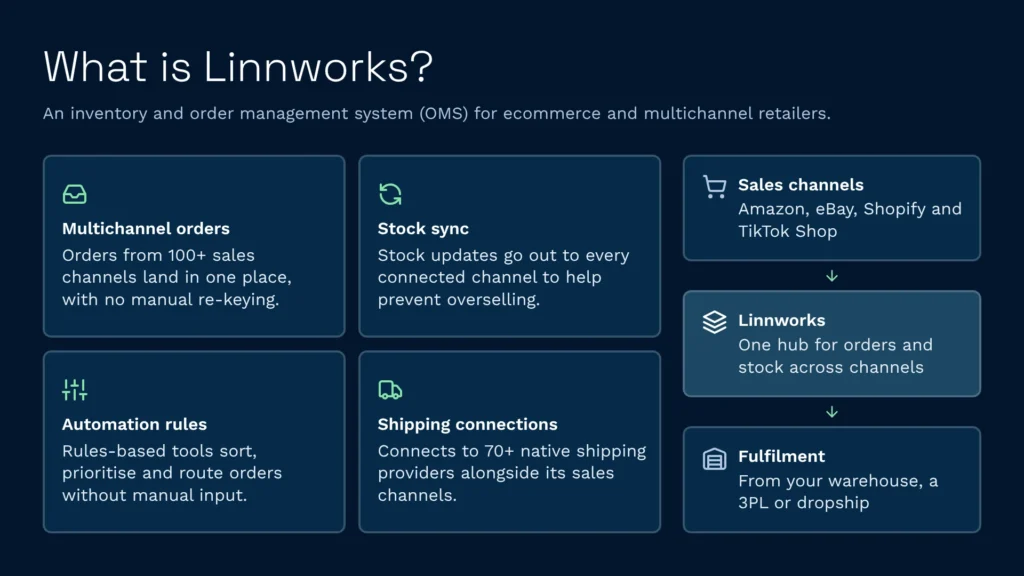
Linnworks is an inventory and order management system (OMS) for ecommerce and multichannel retailers. It brings orders from 100+ sales channels, including Amazon, eBay, Walmart, Shopify, TikTok Shop, Etsy and Temu, into one place. It then routes those orders for fulfilment from your own warehouse, a 3PL or a dropship supplier.
Think of Linnworks as a commerce operations hub. It sits in the middle of your sales channels, syncs stock across all of them so you don’t oversell, and manages the order from purchase to despatch.
Linnworks strengths
- Multichannel order aggregation: one place to see and manage orders from every channel, which cuts out manual re-keying.
- Stock sync across channels: inventory updates go out to every connected channel, which helps prevent overselling.
- Ecommerce focus: native integrations with 100+ sales channels and 70+ shipping providers.
- Automation rules: rules-based tools sort, prioritise and route orders without manual input.
- Forecasting (add-on): analyses sales trends to predict future stock needs.
Where Linnworks falls short for multi-client warehouse operations
Linnworks’ core platform is built around orders and channels, not the warehouse floor. Its warehouse features come from SkuVault Core, a separate warehouse management product that Linnworks sells, which adds bin locations, pick routes, barcode scanning and quality control. For 3PLs specifically, here’s what to look at:
- Client billing: the Linnworks 3PL page covers multi-client stock, listings and order fulfilment, but doesn’t mention client billing or invoicing. If you charge clients for storage, handling and value-added services, check how you’d capture and invoice those.
- Expiry and recall control: if you handle short-life or batch-controlled stock, check how far FEFO rotation and batch traceability go before you commit.
- Not built for B2B complexity: if you manage raw materials, work in progress or B2B orders with complex fulfilment rules, an ecommerce-first model can get in the way.
- Onboarding: there’s a one-off onboarding fee based on your needs, your timeline and the internal resource you can give it.
What is Clarus WMS?
Clarus WMS is a cloud-native warehouse management system for 3PLs, distributors and food and beverage businesses. It runs the physical warehouse, from goods in and putaway to replenishment, picking, packing and despatch. Every movement is tracked and scanned, and the billable ones are charged to the right client.
Clarus runs on ISO-certified AWS infrastructure, so there’s nothing to install or host yourself. It’s built for multi-client operations: each client’s stock, workflows and billing are kept separate inside the same system, so you can run every client from one place.
Clarus WMS strengths
- Automated multi-client billing: 3PL billing captures billable activity, including storage, handling and value-added services, as it happens and sends it to invoicing. St John’s Hall Storage, a UK 3PL, cut its invoicing time by 90% and moved from monthly to weekly invoicing.
- Bin-level inventory control: directed putaway, FIFO/FEFO rotation, serial number capture, expiry date tracking and batch and lot control. You know where every item is and when it expires.
- Scan-confirmed picking: with barcode scanning, GS1/EAN scans confirm each item at pick, so a lookalike SKU gets caught before it’s packed. Clarus customers report 99% stock accuracy, with mis-picks cut to under 1%.
- Client portal: a secure, branded portal where clients see live stock, order milestones, shipment tracking, charges and KPIs, which means fewer stock enquiries by email.
- Cloud-native: no servers to manage and nothing to install.
- 200+ integrations: marketplaces, ERPs, accounting packages, carriers and TMS platforms, with an API-first architecture for custom connections.
Clarus customer results
JODA Freight, a UK refrigerated logistics provider, moved off an Excel database and reached 99% stock accuracy by its second year on Clarus, with stock takes cut from weeks to a single day. KATEM Logistics grew monthly picks tenfold, from around 1,000 to more than 10,000, with order accuracy of 98 to 99% and goods-in processing cut from about five minutes per item to 30 seconds. You can read more results on the customer stories page.
When Clarus may not be the right fit
- Small single-site ecommerce: if you run a small webshop from one location and don’t bill clients for storage or handling, an ecommerce-focused platform like Linnworks may be all you need.
- Heavy automation at very high volume: if you run fully automated conveyor and sortation systems at very high throughput, you may need a specialist automation WMS like Infios (formerly Körber Supply Chain Software) or Blue Yonder.
- Deep legacy integration: if your ERP is tightly tied to an existing WMS, replacing it carries technical and organisational risk, so plan the migration carefully.
Is Linnworks a warehouse management system?
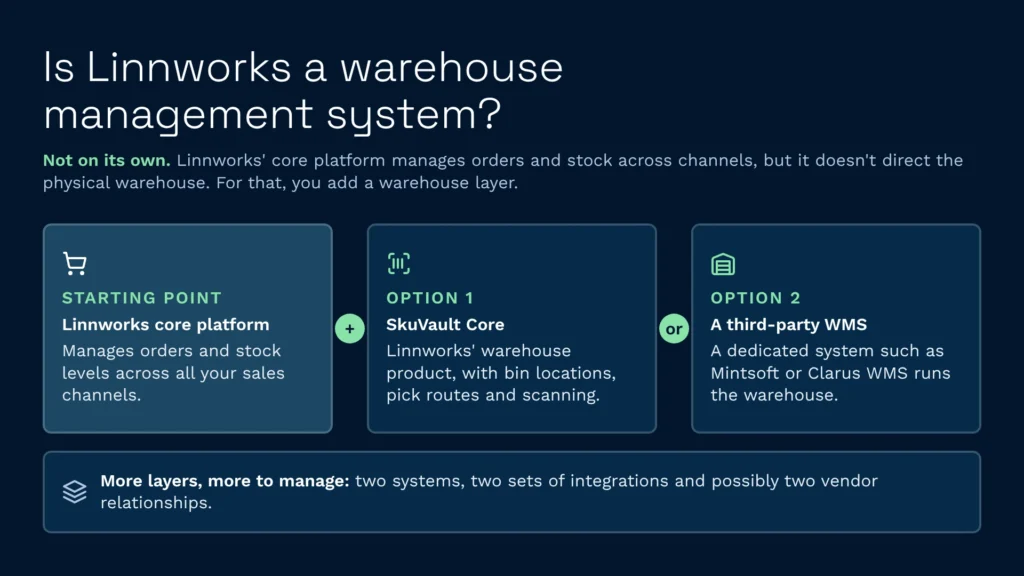
Not on its own. Linnworks’ core platform manages orders and stock levels across channels, but it doesn’t direct the physical warehouse. For bin locations, pick routes and scanning, you’d add SkuVault Core, the warehouse management product Linnworks sells, or connect a third-party WMS such as Mintsoft or Clarus WMS.
Layering systems like this means more to manage: two systems, two sets of integrations and possibly two vendor relationships.
Linnworks pricing model
According to Linnworks’ pricing page, pricing is based on monthly order volume, not revenue, and there are no percentage-of-sales fees. Plans are tiered by order volume, and overage charges apply if you go over your tier. Prices aren’t published, so you’ll need to speak to Linnworks for a quote.
Add-on modules cost extra, and forecasting is charged separately at a flat fee.
Onboarding is a one-off fee based on the complexity of your setup, your timeline and the internal resource you have available. Linnworks recommends investing in it.
On G2, Linnworks has no published price and a “$$$$$” perceived-cost rating. One reviewer’s main complaint is rising costs at a time when prices were meant to be frozen.
Clarus WMS pricing model
Clarus publishes its pricing. There are three tiers (Core, Scale and Enterprise), each with a base monthly fee plus a tiered user licence, and the cost per user falls as you grow. Core covers a single site. Scale adds multi-warehouse support, cluster and batch picking, white-labelled client portals and AI insights. Enterprise adds a staging environment, a 24/7 priority SLA and custom workflow scripts.
None of the tiers charges by volume. Orders, SKUs, locations, carriers and integrations are unlimited on every tier, so a busy peak doesn’t push up your bill.
There’s a one-off implementation fee covering layout configuration, SKU cleaning and custom courier logic.
Feature-by-feature deep dive
Architecture and cloud model
Clarus WMS: cloud-native, running on ISO-certified AWS infrastructure. Nothing to install, no servers to maintain.
Linnworks: cloud-hosted. Your data moves onto Linnworks’ platform during onboarding, and you manage everything through a web interface.
Verdict: a draw. Both are cloud platforms, so the real difference is what each system is built to control: orders and channels, or the warehouse floor.
3PL and multi-client capability
Clarus WMS: built for multi-client operations. Each client gets:
- Multi-client inventory control, with each client’s stock kept separate
- Their own billing rules, activity-based or storage-based, including tiered rental billing
- A branded client portal
- A full audit trail of scans and movements
Linnworks: its 3PL offering lets you manage multiple clients’ stock, listings and orders from one platform, and the 3PL Business Hub gives clients a view of their own inventory. Its 3PL page doesn’t mention client billing or invoicing.
Winner for 3PLs: Clarus. If billing clients accurately is central to your business, automated charging and invoicing saves hours of admin every month.
Bin, location and inventory accuracy
Clarus WMS: full bin-level management:
- Directed putaway (the system tells the receiver which bin to use)
- FIFO and FEFO rotation
- Serial number and expiry date tracking
- Batch control for recall readiness
- Continuous replenishment that keeps pick faces topped up from bulk
- Licence plate (LPN) pallet tracking
Linnworks: bin locations, zones and pick routes are available through SkuVault Core. Expiry-led rotation and recall workflows are worth checking in a demo if you handle short-life stock.
Expiry control matters most in food and beverage. Campeys runs recall tests in under five minutes on Clarus.
Winner for accuracy and compliance: Clarus, especially if you handle temperature-controlled, expiry-controlled or hazardous stock.
Order picking and wave picking
Clarus WMS: optimised picking logic chooses the right method (tote, batch, zone, wave, bulk or single item) and can switch between them mid-shift as queues change, cutting travel as routes and waves adjust to what’s due out. Pickers use handheld devices with customisable scanning workflows, and scans confirm each item at pick, so errors are caught before packing.
Linnworks: digital pick lists and batch processing through SkuVault Core, which also generates pick routes. On its own, the core Linnworks platform aggregates and routes orders but doesn’t direct the pick.
Winner for fulfilment efficiency: Clarus. Flexible picking methods plus scan confirmation mean faster throughput and fewer errors.
Client visibility and portals
Clarus WMS: a dedicated client portal. Clients log in to see:
- Live stock levels
- Order milestones
- Shipment tracking
- Charges and KPIs
The portal carries your branding, so it feels like part of your service. Clients answer their own stock and order questions instead of emailing your team.
Linnworks: the 3PL Business Hub gives clients a view of their own inventory.
Winner for client relationships: Clarus, because clients also see charges, KPIs and tracking alongside their stock.
Integrations and API approach
Clarus WMS: connects to over 200 systems through APIs, middleware or CSV. That includes marketplaces such as Shopify, Amazon, Etsy, WooCommerce and eBay, and carriers including DHL, UPS, FedEx, Royal Mail, Parcelforce and Evri. On the business systems side it connects to ERPs and accounting packages such as Brightpearl and OneAdvanced, and to TMS platforms such as Qargo and Maxoptra. Clarus also has an MCP server, so AI tools can work with live warehouse data.
Linnworks: native integrations with 100+ sales channels and 70+ shipping providers, plus logistics, accounting and Open API connections.
Verdict: it depends on where your integrations sit. Linnworks covers more sales channels. Clarus covers the warehouse side: carriers, ERPs, TMS and client billing.
Setup and implementation
Clarus WMS: most 3PL go-lives take between a few weeks and a few months, depending on scope. Campeys implemented Clarus in under two months. Because Clarus is cloud-native:
- There are no servers to provision
- Setup is mostly configuration rather than custom code
- Training can run alongside setup
Linnworks: onboarding depends on:
- Data migration complexity (channel feeds, SKU counts, order history)
- Which add-on modules you take
- Integration testing, especially if you add a separate WMS
Verdict: no clear winner. For either system, timelines depend on how complex your operation is.
Pricing transparency and flexibility
Clarus WMS: base prices are published on the pricing page, with a quote tailored to your sites and users. No volume-based pricing, and orders, SKUs, locations, carriers and integrations are unlimited.
Linnworks: you’ll need a quote, since prices aren’t published. Pricing follows order volume, with overage charges and add-on modules on top.
Winner for predictability: Clarus. Published base prices and no volume-based charges make it easier to budget.
Which should you choose?
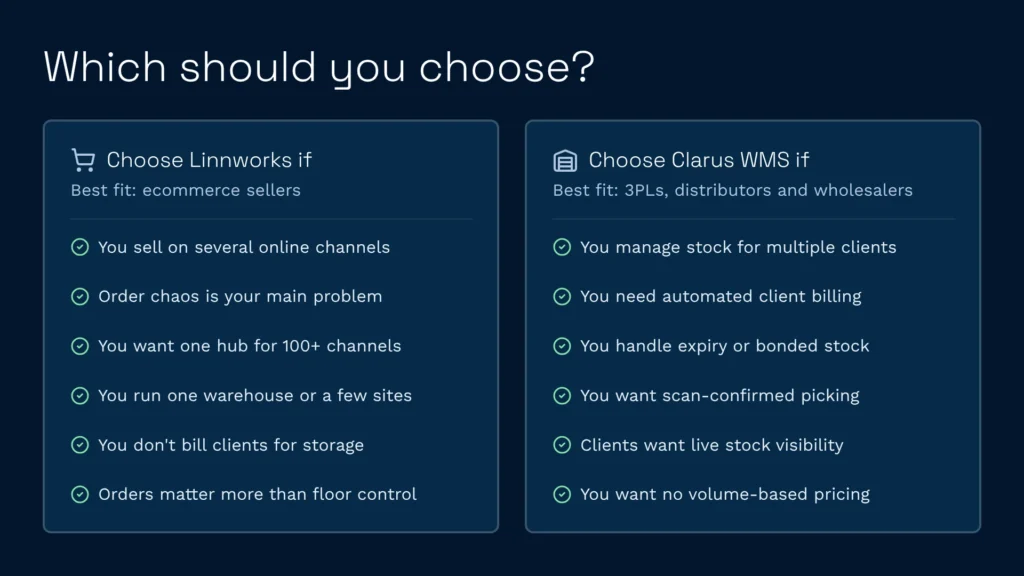
Choose Linnworks if:
- You’re an ecommerce seller (B2C, consumer goods, retail) with stock listed on multiple channels.
- Your main problem is managing orders across Amazon, Shopify, eBay and other marketplaces.
- You run one warehouse or a small number of sites.
- You don’t need automated per-client billing.
- You need order aggregation more than warehouse floor control.
Choose Clarus WMS if:
- You’re a 3PL, distributor or wholesaler managing multiple clients or product lines.
- You need automated multi-client billing covering storage, handling and value-added services.
- You handle temperature-controlled, expiry-critical, hazardous or bonded stock.
- You want scan-confirmed picking and bin-level inventory control.
- You want a client portal so your customers can see their stock live.
- You’re moving off spreadsheets, paper or a legacy WMS.
- You want published pricing with no volume-based charges.
Using Clarus and Linnworks together
Linnworks and Clarus solve different problems, so they can work well together. Clarus WMS and Linnworks can be connected through Patchworks’ pre-built connector. That gives you Linnworks’ multichannel order management alongside Clarus’s warehouse controls.
In this setup, Linnworks manages your sales channels and Clarus runs the warehouse. The workflow looks like this:
- Order flow: orders gathered in Linnworks from your sales channels pass into Clarus WMS with the customer, delivery and line-item details.
- Warehouse execution: your team allocates stock and carries out scan-confirmed picking, packing and labelling in Clarus.
- Despatch updates: once an order is packed and despatched in Clarus, shipment confirmations and carrier tracking go back to Linnworks.
- Stock sync: as stock is moved, picked or replenished, Clarus updates availability in Linnworks, which pushes accurate stock levels out to your channels to prevent overselling.
This lets 3PLs and growing distributors keep Linnworks’ marketplace connections while getting bin-level control, multi-client stock separation and automated billing on the warehouse floor.
Speak to a warehouse expert
If you’re weighing up your options and want to see how a purpose-built WMS works in practice, Clarus is worth a conversation. We work with 3PLs and distributors across the UK and beyond to set up warehouse management software that fits the way you operate.
Get in touch with our team to talk through your requirements, or book a product tour.