

A WMS RFP (request for proposal) is the document you send to shortlisted warehouse management system vendors asking them to propose, in writing, how they would meet your requirements, how they would implement it and what it would cost. A good one describes your operation and asks vendors to show how they handle it; a bad one is a 400-row feature list that every vendor answers “yes” to. This guide covers what a warehouse management system RFP should include, how it differs from an RFI and an RFQ, a structure you can copy, and how to score what comes back.
One point of scope first. If you are a public body, your tender is governed by the Procurement Act 2023 and its guidance, and the process below has to fit inside those rules. If you are a private 3PL, wholesaler or manufacturer, nothing obliges you to run a formal WMS tender at all. You run one because it forces you to write down what you need before a salesperson tells you.
What is a WMS RFP, and when do you need one?
A WMS request for proposal is a structured invitation to a small number of vendors, usually three to five, to submit a comparable written proposal against the same requirements, on the same date, in the same format. Its job is comparison. Without it, each vendor presents its strengths in its own order and you end up comparing three different conversations.
You need one when the decision is expensive to reverse, when more than one department has a say, or when a board or owner will ask how the choice was made. You probably don’t need one if you are a small single-site operation choosing between two systems you have already seen. A structured demo and a reference call will tell you more, faster.
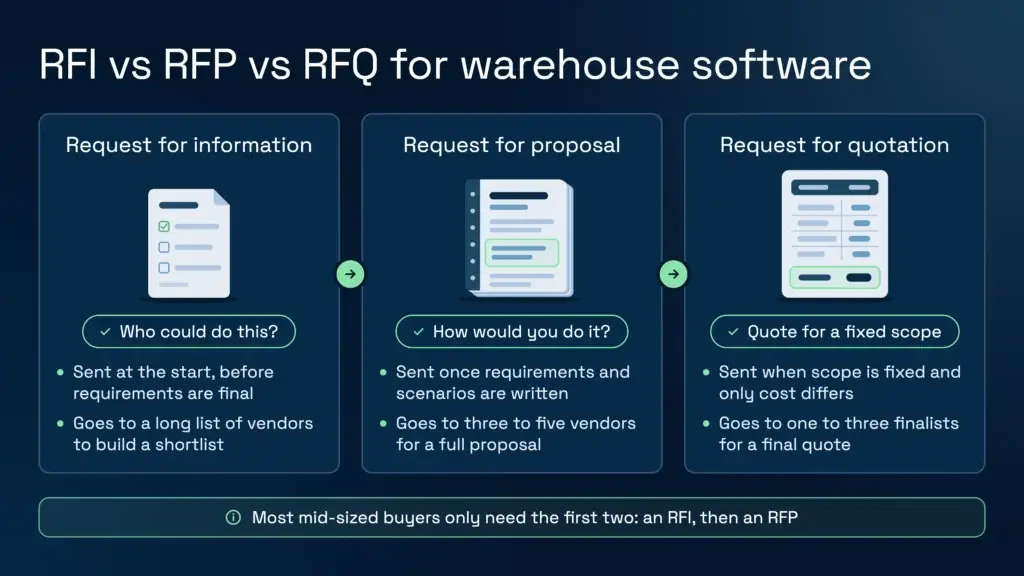
RFI vs RFP vs RFQ for warehouse software
An RFI asks vendors who they are and whether they are a plausible fit, an RFP asks how they would solve your specific problem, and an RFQ asks for a price against a specification that is already fixed. They are three stages of WMS vendor selection, and most mid-sized buyers only need the first two.
| Document | Question it answers | When to send it | Sent to | What you get back |
|---|---|---|---|---|
| RFI (request for information) | Who could do this? | Start of the search, before requirements are final | A long list of vendors | Short company and capability answers used to build a shortlist |
| RFP (request for proposal) | How would you do it, and for how much? | Once requirements and scenarios are written | A shortlist of three to five | A full proposal: fit, approach, plan, price |
| RFQ (request for quotation) | What is your price for exactly this? | When the scope is fixed and only cost differs | One to three finalists | A like-for-like quotation |
A WMS RFI is worth doing when you don’t yet know the market. If you already have a shortlist from a WMS comparison, skip it. An RFQ on its own rarely works for warehouse software, because price depends on scope, and scope is the thing the RFP exists to pin down.
Who should write the WMS RFP?
The operations lead should own it, with input from IT, finance and whoever deals with clients or customers. If procurement or IT writes it alone, the document tends to ask about hosting and contract terms in detail and about the warehouse floor in generalities. Put a supervisor who runs goods in and a team leader who runs picking in the room when requirements are drafted. They know where the current process bends.
If you lack the time, a consultant can run the process, and trade bodies such as the UK Warehousing Association are a reasonable place to ask peers how they ran theirs. Just make sure the requirements stay yours. Published examples such as the ExploreWMS WMS RFP template are a useful starting point for layout, but a template can’t describe your operation.
What should a WMS RFP include?
A WMS RFP should include seven sections: your company background, an operations profile with real volumes, functional requirements written as scenarios, integrations, technical and security requirements, implementation and support, and commercials. Add the rules of the process itself: deadline, format, a single contact and how you will score.
Here is a WMS RFP template structure you can copy and adapt.
- Company background. Who you are, what you store, who your customers are, why you are changing system now and what you use today.
- Operations profile. Sites, square footage, location count, SKU count, pallets in and out per day, order lines per day, peak against average, shifts, headcount, handheld devices in use, and for a 3PL the number of clients and how different they are from one another.
- Functional requirements. Scenarios by process, each marked must-have or nice-to-have. See the checklist below.
- Integrations. Every system that must exchange data with the WMS, the direction of each flow and the method available.
- Technical and security. Hosting model, uptime commitments, backup and recovery, data residency, access control, certifications and audit logging.
- Implementation and support. Proposed plan, who does what, how scope is controlled, training approach, testing, go-live support and day-to-day support terms.
- Commercials. Licence model, implementation fees, what triggers extra cost, contract length, notice period and price changes over the term.
- Process rules. Timetable, question deadline, response format, scoring criteria and weights, demo and reference stages.
Share the scoring weights. Vendors put effort where the marks are, and a vendor that knows integrations carry real weight will answer that section properly.
The WMS functionality checklist, by process
The functional section is where most RFPs go wrong, because a list of features invites a list of ticks. Write each requirement as something that happens in your warehouse and ask the vendor to describe how the system handles it. “Supports batch tracking: Y/N” tells you nothing. “A pallet arrives with two batches of the same SKU on it. Show how it is received, stored and picked so the older batch leaves first” tells you a lot.
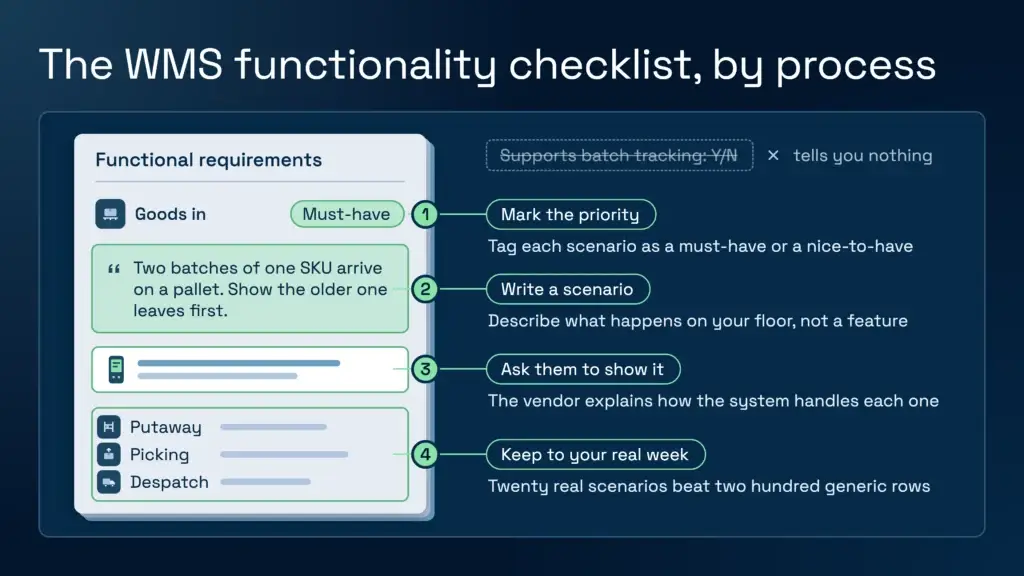
Use this WMS functionality checklist as a prompt for your own WMS RFP questions.
- Wareneingang. Receiving against a pre-advice and blind receiving. Scanning supplier labels, including GS1 standards such as the SSCC pallet label. Capturing batch, expiry and serial data at the dock. Recording overs, shorts and damages with evidence.
- Putaway. Suggested locations and the rules behind them. Segregation by client, product group, hazard class or temperature zone. What the operator sees on the handheld when the suggested location is full.
- Kommissionierung. Pick methods available, how the walk sequence is set, how replenishment is triggered before a pick face runs empty, and what happens on a short pick.
- Despatch. Packing checks, label and paperwork production, carrier and pallet network booking, and how a part-shipped order is handled.
- Stock control. Cycle counting without stopping the operation, stock holds and quarantine with reason codes, rotation rules per product or client, and the audit trail for an adjustment.
- Client billing, for 3PLs. Covered separately below, because it is the section most often left thin.
Keep the list to what you do. Twenty scenarios that reflect your real week are worth more than two hundred generic rows.
Client billing questions every 3PL should ask
Billing is where a 3PL’s margin leaks, and it is hard to judge from a brochure. Don’t ask “do you support 3PL billing?”. Ask every vendor the same specific questions and score the evidence.
- Which billable events does the system record as charges without anyone keying them, and which need manual entry today?
- Can each client have its own tariff, and how long does a tariff change take to set up?
- How is storage charged: per pallet, per location, per cubic metre, by day or by week, and at what point in the day is the count taken?
- If a client disputes an invoice line, what record can you show them for that charge?
- How do invoices reach the accounts package, and is anything re-keyed?
Ask for these to be demonstrated on a live system, with a reference customer who runs billing the same way. That applies to every vendor, Clarus included.
Integrations, technical and security requirements
List every system by name. “Must integrate with our ecommerce platform and carriers” produces a yes. “Orders arrive from Shopify and by EDI from two retail clients; labels are produced for DPD und Königliche Post; invoices post to Sage” produces an answer you can check. For each one, ask whether the connection already exists and is in use by a customer, or would be built for you, and who pays if it is the latter.
Decide early whether the WMS replaces or sits alongside your ERP’s stock module, because it changes which system owns the item master and the order. Our ERP vs WMS guide covers where that line usually falls. If your suppliers or customers use GS1 barcodes, ask which GS1 application identifiers the scanner reads out of a single scan, since that decides how much typing happens at goods in.
On security, the National Cyber Security Centre’s cloud security principles give you a neutral set of headings to ask a cloud vendor about, from data protection in transit to how the supplier manages its own staff access. Ask for certificates, not statements. Clarus WMS, for example, is ISO 27001 certified, so ask to see the certificate.
Implementation, support and commercials
This section predicts whether the project lands. Ask each vendor for a plan with named stages, the hours expected from your team, and how they stop scope drifting. Scope is where WMS projects overrun, so ask how requirements are agreed and what counts as sign-off.
As a reference point, Clarus controls scope in four steps: requirements are evidenced in workshops, documentation is issued afterwards for the customer to sign off, training is built around the agreed configuration, and the UAT schedule is the sign-off. Whatever a vendor’s method, you want it written into the proposal.
Ask for a go-live date and the conditions attached to it. “12 weeks is a good standard because you need to allow people time,” says Mathew Buttar, Head of Solutions at Clarus WMS. That figure is for a standard, off-the-shelf project with no development and the right support on both sides; complex, high-volume projects take longer, and any vendor should tell you which kind yours is. Our Leitfaden zur WMS-Implementierung sets out the stages to expect.
On commercials, ask for the full cost over the term you expect to keep the system: licences, implementation, integrations, devices, support tier and price rises. Ask what the notice period is. Models differ widely. Clarus, for instance, publishes its platform fee, from £1,000 a month, with users and implementation quoted on top, while other vendors quote on application. Neither is wrong, but you can only compare them over the same period. The WMS-Kosten guide breaks down what goes into the total.
How do you score vendor responses?
Score WMS RFP responses against weighted criteria agreed before any proposal arrives, with each scorer marking independently and the price section scored last. Agreeing weights first stops the team rearranging them around a favourite.
The weights below are an example to start from, not a standard. A 3PL with unusual billing would move marks into functional fit; a business with a fragile ERP link would move them into integrations.
| Kriterium | Example weight | What earns a high score |
|---|---|---|
| Functional fit to your scenarios | 30% | Standard product handles the scenario, shown in the demo |
| Implementation approach and scope control | 20% | Named stages, a written sign-off method, a dated plan with conditions |
| Integrationen | 15% | Connections already live with a named reference customer |
| Commercials and total cost | 15% | Complete cost over the term, clear triggers for extra charges |
| Technical and security | 10% | Current certificates and specific answers on access and recovery |
| Support and vendor fit | 10% | Stated response terms, references in your sector and size |
Use a simple scale for each answer: 0 for not met, 1 for met with development or a workaround, 2 for met with configuration, 3 for met as standard and evidenced. The distinction between “configuration” and “development” matters more than any other in the document, so define both terms in the RFP and make vendors use yours.
Scripted demos and reference checks
A written response is a claim. The demo is where you test it. Send the top two or three vendors a script built from your scenarios and your data: your SKUs, a real inbound delivery, a real awkward order. Ask them to run it in the order you set, on the product as it ships today.
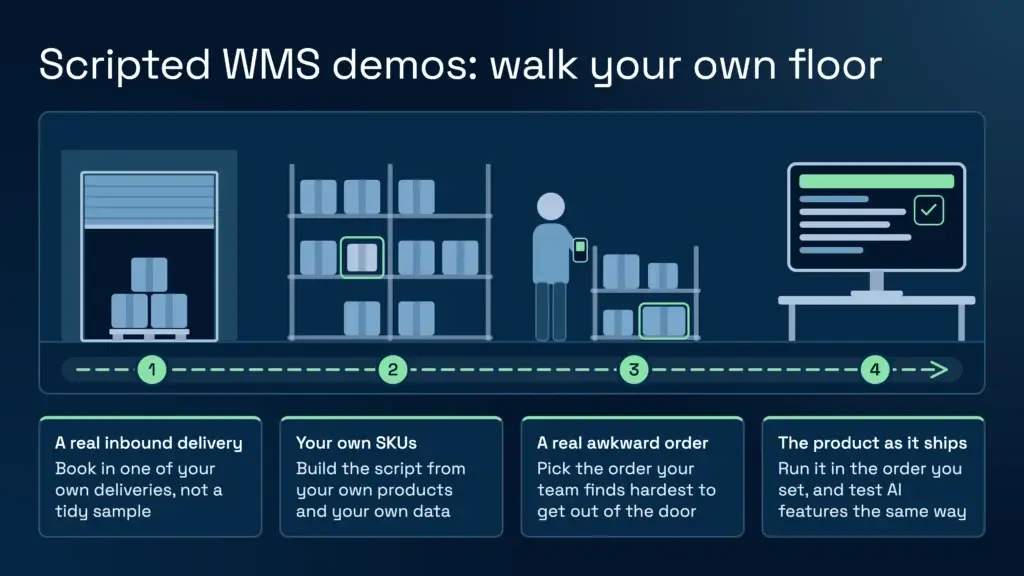
If a vendor sells AI features, test those the same way. With the Clarus AI assistant, the fair test is to name a function you use every week and ask the assistant to complete it end to end in front of you. Apply that test to any vendor making a similar claim.
For references, ask for customers of your size and sector, then ask them what took longer than planned, what they would scope differently and what the measured result was. Specific answers are a good sign. JODA Fracht, for instance, reports stock accuracy reaching 99% in its second year on Clarus, which is the kind of dated, checkable outcome a reference should be able to give you.
How long does a WMS RFP process take?
There is no fixed length for a WMS RFP process; it depends on how quickly you can write requirements and how many people must agree the result. The one hard benchmark comes from public procurement, where section 54 of the Procurement Act 2023 sets a minimum tendering period of 25 days when tenders are submitted electronically and all documents are issued together. Private buyers can go shorter, but a response window much tighter than that tends to get recycled answers.
| Stage | What happens | What sets the pace |
|---|---|---|
| 1. Requirements | Map current processes, write scenarios, agree must-haves | Availability of your operations team |
| 2. RFI and shortlist (optional) | Short questionnaire to a long list, cut to three to five | How well you already know the market |
| 3. RFP issued | Vendors ask questions and write proposals | The response window you set |
| 4. Scoring | Independent marking, then a moderation meeting | Number of scorers and proposals |
| 5. Demos and references | Scripted demos for finalists, reference calls | Diaries on both sides |
| 6. Decision and contract | Final pricing, terms, board approval | Your approval process and the contract length on offer |
What mistakes turn a WMS RFP into a box-ticking exercise?
The common thread is asking questions that can be answered without thinking about your warehouse.
- Yes/no feature lists. Every credible vendor ticks most rows, so the scores bunch together and price decides by default.
- Describing today’s workarounds as requirements. If you specify the spreadsheet step you want to get rid of, you will be sold a system that reproduces it.
- No volumes. A vendor can’t size hardware, licences or a plan without order lines, SKUs and users.
- Too many vendors. Ten proposals means nobody reads any of them properly. The best vendors may decline a crowded WMS tender.
- Leaving out the people who use it. A system chosen without the floor team gets resisted by the floor team.
- Treating price as the tie-breaker when nothing else separates the bids. That usually means the questions were too easy, not that the systems are the same.
- Ignoring the incumbent option. Score “keep what we have” honestly alongside the bids. Sometimes it wins, and it’s better to know before you sign.
For another view on avoiding these, Lowry Solutions has a short piece on creating a successful WMS RFP. When you build your shortlist, our guide to the best WMS software covers the main options and who each suits. As a rule of thumb, Clarus WMS tends to suit 3PLs and multi-client warehouses that want a cloud system; it may not be the best fit for a very small single-client webshop or a heavily automated distribution centre.
Sprechen Sie mit einem Lagerfachmann
If you’re evaluating your options and want to see how a purpose-built WMS works in practice, Clarus is worth a conversation. We work with 3PLs and distributors to implement warehouse management software that fits the way you operate, not the other way around.
Kontaktieren Sie unser Team um Ihre Anforderungen zu besprechen.