

Astro WMS is a warehouse management system developed by Consafe Logistics, a Swedish supply chain software provider that has been working with customers since 1978. It’s aimed at retail, food and beverage, wholesale, pharmaceutical, manufacturing and third-party logistics operations. Grand View Research forecasts the global WMS market to grow at a 21.9% CAGR between 2026 and 2033, so businesses looking at Astro WMS have more alternatives to compare than ever. This guide covers what Astro WMS does, what users say about it, and how it compares with other platforms, including Clarus WMS.
What is Astro WMS and who is it built for?
Astro WMS is a warehouse management system for operations that want a choice of deployment models and support for warehouse automation. Consafe Logistics is headquartered in Lund, Sweden, and has a presence in eight European countries, including the UK.
Consafe lists these sectors for Astro WMS:
- Retail and e-commerce
- Eten en drinken
- Groothandel
- Pharmaceutical
- Productie
- Third-party logistics (3PL), supported by a dedicated 3PL Billing module
Astro WMS is available on-premise or as SaaS. The SaaS version runs on a single-tenant cloud setup. For smaller businesses, Consafe also sells Astro Go WMS, a cloud-based product that was previously called SOLID WMS.
What features does Astro WMS include?
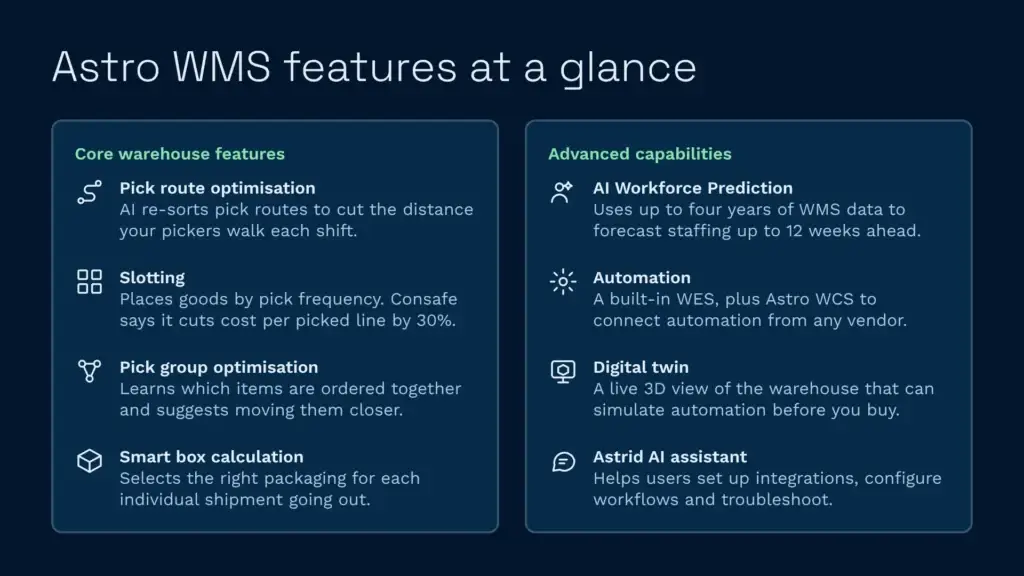
Astro WMS covers core warehouse operations, automation and workforce planning. Consafe uses AI in several modules that go beyond basic stock and order management.
Core warehouse features
- Pick route optimisation: AI re-sorts pick routes to cut the distance pickers walk
- Slotting: places goods based on how often they’re picked. Consafe says this lowers operating costs by 30% per picked line
- Pick group optimisation: learns which items are ordered together and suggests moving them closer to each other
- Smart box calculation: picks the right packaging for each shipment
- Day-to-day warehouse functions: inventory tracking, barcoding and RFID, dock management, returns and shipping management, as listed on Capterra
Advanced capabilities
- AI Workforce Prediction: uses up to four years of historical WMS data to forecast staffing needs up to 12 weeks ahead
- Automation: Astro WMS has a built-in warehouse execution system (WES), and Astro WCS connects to automation equipment from any vendor
- Digital twin: a real-time 3D view of the warehouse that can also simulate automation equipment before you buy it
- Astrid: an AI assistant launched in November 2025 that helps users set up integrations, configure workflows and troubleshoot problems
What do real users say about Astro WMS?
There aren’t many public reviews of Astro WMS. At the time of writing, it has two reviews on Capterra VK with an average of 3.0 out of 5. On SelectHub, 78% of 18 reviewers recommend it. Reviewers like how flexible it is. The main complaints are about how long changes take.
What users praise
- Adaptability: reviewers say the software fits different business processes and grows with the company
- Efficiency gains: users credit it with better inventory management and faster order processing
- Ease of use: Capterra reviewers rate it 4 out of 5 for ease of use, although only two reviews have been left
What users criticise
- Delays to changes: SelectHub’s most common complaint is long waits for changes to the system, which frustrates teams that need timely updates
- Support and updates: one Capterra review from 2018 says vendor support was slow and that updates sometimes broke existing functionality
- Pricing transparency: Consafe doesn’t publish Astro WMS pricing, so you’ll need to request a quote before you can compare costs
How much does Astro WMS cost?
Astro WMS pricing isn’t published. Consafe Logistics gives custom quotes. Capterra describes the pricing model as per feature, and SelectHub describes it as a quote-based, per-user monthly price. This is common among enterprise WMS platforms, but it makes early comparison harder.
When you ask for a quote, it’s worth checking how each of these affects the price:
- Number of warehouse sites
- Deployment model, as on-premise and SaaS usually have different cost structures
- Integrations with automation equipment
- Aantal gebruikers
- Implementation, training and ongoing change requests, which are often quoted separately
By comparison, Clarus publishes base pricing for each tier on its prijspagina. It doesn’t bill on throughput, and the final quote depends on your sites and users.
How does Astro WMS compare with alternatives?
Businesses evaluating Astro WMS usually compare it with other mid-market and enterprise WMS platforms. The right choice depends on your operation type, where you’re based, and whether automation or speed of deployment matters more to you.
| Functie | Astro WMS | Clarus WMS | Manhattan Active WM |
|---|---|---|---|
| Beste voor | Multi-sector and automated operations | 3PLs and multi-client operations | Grote onderneming, multichannel |
| Implementatie | On-premise or SaaS | Wolk | Cloud-native |
| 3PL-facturering | 3PL Billing module | Native, with client-specific tariffs | Not detailed on product page |
| Implementatietijd | Niet gepubliceerd | Campeys went from first contact in early December to fully operational by the end of January | Niet gepubliceerd |
| Automation support | Built-in WES, plus Astro WCS for any vendor’s equipment | API-first integrations | Built-in vendor-agnostic WES (AS/RS, robotics, sortation) |
| AI capabilities | Workforce prediction, slotting and picking AI, Astrid assistant | Agentic AI that answers questions from live data and takes action under guardrails | Native AI agents for waves, labour and frontline staff |
| Prijzen | Custom quote only | Published base pricing, tailored quote | Niet gepubliceerd |
| UK presence | UK office (Sweden HQ) | UK-headquartered | Wereldwijd |
For 3PL operations, the difference matters. Astro WMS handles 3PL work through a dedicated billing module inside a platform that serves many sectors. Clarus WMS is built around 3PL work: facturatie van de klant turns completed warehouse tasks into priced invoice lines for each client, and a klantenportaal gives customers live stock and order status without having to email your team.
Implementation speed is another difference. Campeys uit Selby got in touch with Clarus in early December and was fully operational by the end of January. Operational setup took one day, and Campeys passed its BRC audit at the first attempt.
What should you consider before choosing Astro WMS?
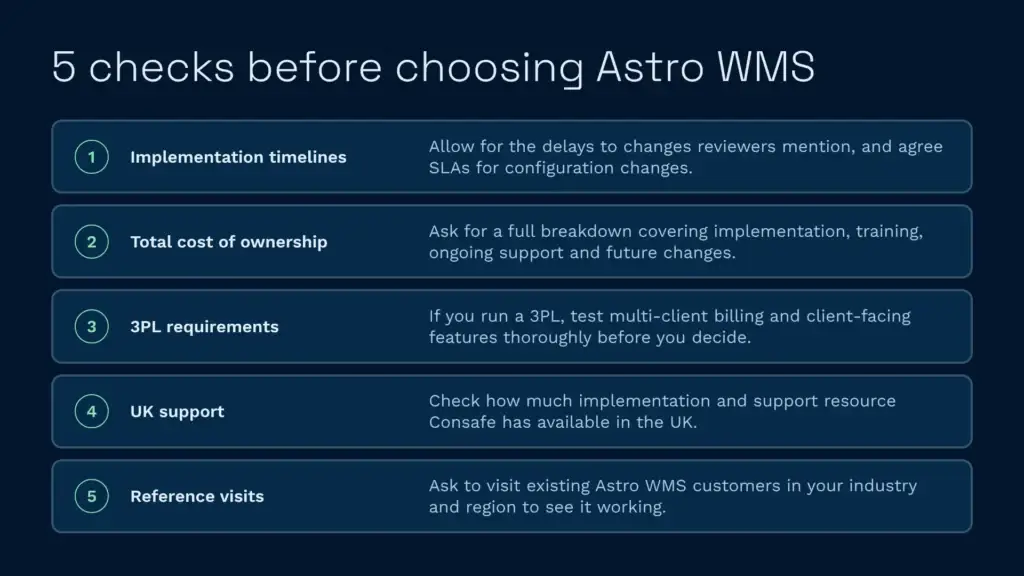
Astro WMS is a capable platform with real strengths in automation and workforce planning. However, your evaluation should cover the points users raise most often.
- Implementation timelines: plan realistic timelines that allow for the delays to changes that reviewers mention, and agree contractual SLAs for configuration changes
- Total cost of ownership: ask for a full breakdown covering implementation, training, ongoing support and future changes
- 3PL requirements: if you run a 3PL, test multi-client billing and client-facing features thoroughly during your evaluation
- UK support: check how much implementation and support resource Consafe has in the UK
- Reference visits: ask to visit existing Astro WMS customers in your industry and region
Ready to compare WMS platforms for your operation?
Choosing a WMS means testing platforms against your own workflows, not just comparing feature lists. If you run a 3PL or a multi-client warehouse, look closely at how each platform handles client billing, client access and onboarding.
Clarus WMS is built for 3PL and multi-client warehouses, with agentic AI that works on your live operational data. Watch the product demo, read our klantverhalen, of neem contact op to talk through your operation with our UK-based team.