

Ongoing WMS is a cloud-based warehouse management system from Ongoing Warehouse AB, a software company in Gothenburg, Sweden, built for third-party logistics providers and for companies that run their own warehouses. De Ongoing homepage calls it “Europe’s Leading Warehouse Management System” and says it powers more than 700 warehouses. Both are Ongoing’s own descriptions of its product.
This guide sets out what Ongoing publishes about the product, who owns the company, how it is priced and set up, and what a buyer should check before choosing it. It also covers when a 3PL might look at an alternative such as Clarus WMS. It is written for operations and IT managers who have seen “Ongoing WMS” on a shortlist. Every Ongoing fact comes from Ongoing’s own pages or from Cinven’s, and the sources are linked.
What is Ongoing WMS?
A magazijnbeheersysteem (WMS) directs the day-to-day work in a warehouse: receiving, putaway, picking, packing and despatch. Ongoing WMS does that as software as a service. The homepage describes “a cloud-based SaaS solution with a user-based monthly fee” and says it has more than 14,000 users.
The company’s About us page says Henrik Ekman and Gerhard Guron founded Ongoing Warehouse in 2008, and that the company serves customers in more than 30 countries from its office in Gothenburg.
The name causes some confusion. “Ongoing” is also a common English word, so a search for “ongoing WMS” can return generic pages about warehouse systems. This guide covers the product from Ongoing Warehouse AB only.
Who owns Ongoing Warehouse?
Ongoing’s About us page says the private equity firm Cinven invested in Ongoing in 2026. Cinven’s announcement of 6 May 2026 says the co-founders remain significant shareholders and the CEO, Fredrik Einarsson, continues to run the business.
For a buyer, ownership matters for continuity and roadmap, not for day-to-day use. Cinven says the investment is meant to accelerate product development and international expansion. If you are signing a multi-year commitment, ask Ongoing how that plan affects support and product direction for customers in your region.
What does Ongoing WMS do?
De features page lists the functions by warehouse process. In summary:
- Inbound: deliveries with or without an inbound order, and location suggestions at receipt.
- Storage and inventory: stocktaking, moves and refills as structured tasks, plus expiry date, batch and serial number tracking.
- Plukken: standard or customised picking logic, including FIFO, FEFO and LIFO, and multi-order or batch picking.
- Packing and outbound: pack control with item scanning, automatic printing of lists and labels, partial deliveries with backorders, and cross-docking.
- Returns, kitting and production: return orders that tell the warehouse about consumer returns in advance, kits built from other articles, and a production order module.
- Security: ISO 27001 certification, single sign-on through Microsoft Entra ID, multi-factor authentication and user activity logs.
Scanning runs in a browser. Ongoing’s mobile app page says the interface can be installed as an app on Android, Windows or iOS devices, and that Zebra, Honeywell and Datalogic devices are common among its customers. It says barcode, QR, EAN and RFID input are supported. Interface languages are fully supported in English, the Scandinavian languages and German, and partly in the Baltic languages and Spanish, according to the same page.
How does Ongoing WMS handle 3PL work?
Ongoing’s 3PL page is the clearest statement of how it treats multiple clients. It describes each goods owner having its own setup, with flows, billing and portal access configured per client, in one system. It says a “3PL Economy” module is included at no extra cost, records activities such as storage, inbound, picking, packaging and returns, and turns them into invoice data per client. Invoice data then goes to your accounting system or can be pulled through the API.
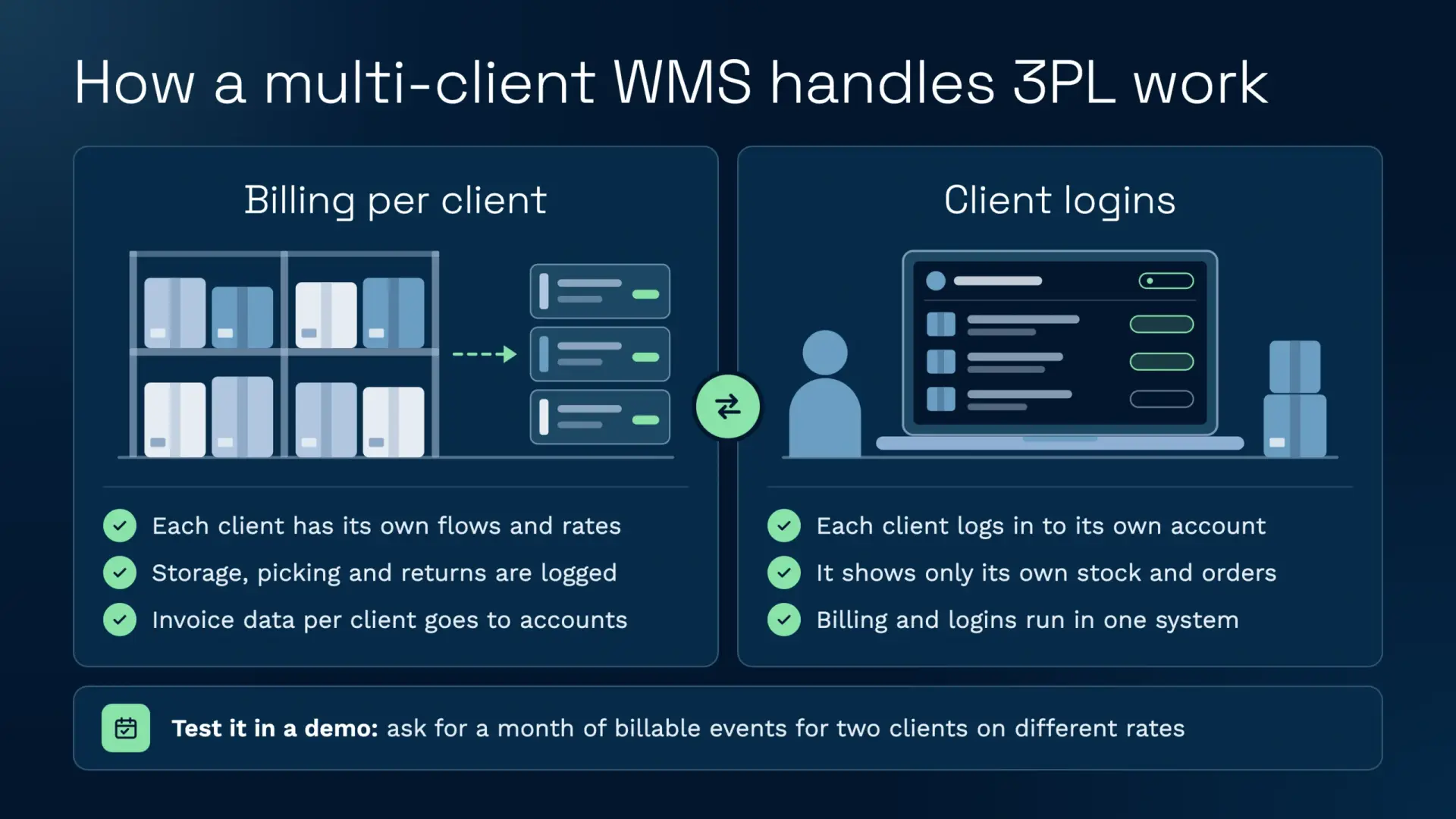
The same page describes a client login with the client’s own stock, orders and dashboard. Ongoing’s pricing page adds that 3PL clients can log in free of charge to track their inventory.
For a 3PL, billing and client visibility are usually where a WMS decision is won or lost. A system can pick and pack well and still leave you rebuilding invoices from spreadsheets at month end. Whatever you shortlist, ask to see a month of billable events for two clients with different rate cards, from receipt to invoice file. Our guides to 3PL WMS en 3PL-softwareleveranciers list the other questions worth asking.
What integrations and API does Ongoing WMS offer?
Ongoing’s pagina ‘Integraties’ groups its ready-made connections into ecommerce platforms, ERP systems, shipping platforms and carriers, transport planning systems, customs systems, and purchasing and inventory software. It names Shopify, WooCommerce and Adobe Commerce, and the ERPs Microsoft Dynamics 365 Business Central and Oracle NetSuite. The 3PL page says there are over 200 integrations, and the homepage says the same. A full list sits in Ongoing’s documentation.
On the API side, the integrations page lists REST and SOAP APIs, webhooks, and an Automation API for hardware. The features page names AutoStore, conveyors and vertical lifts as supported automation. A news post dated 20 November 2026 says nearly all interface functions are available through the API, an updated MCP server connects AI assistants to the system, and an Advisor that suggests ways to work more efficiently is being rolled out gradually.
For carriers, the integrations page lists direct integrations from Ongoing for DB Schenker, DHL Freight, Bring, PostNord, Helthjem, Porterbuddy and Gordon Delivery, and explains that other bookings and labels can go through a shipping platform. Ongoing’s pages don’t list every carrier service available that way, so ask how the carriers you use for parcels and pallets would be connected.
How much does Ongoing WMS cost?
Ongoing publishes prices. Its prijspagina, which shows an international price list in euros, states a platform fee of €1,299 a month that includes five warehouse users, and a one-time onboarding fee of €6,200 that includes 40 hours. It lists additional warehouse users from €179 each a month for users 6 to 10, falling for larger teams, and says shipments through direct-to-carrier integrations developed and maintained by Ongoing cost €0.03 each, while Ongoing does not charge for shipments sent through shipping platforms. Ongoing says its subscription covers every module, its native integrations and full API access. Enterprise pricing above 50 users is on request. We read the page on 23 November 2026, and prices can change.
Those figures are Ongoing’s own and are in euros for an international list, so ask for a written quote in your own currency that covers licences, onboarding hours, carrier integrations and support. For the wider costs that sit around any software fee, see our guide to the cost of a WMS.
How is Ongoing WMS implemented?
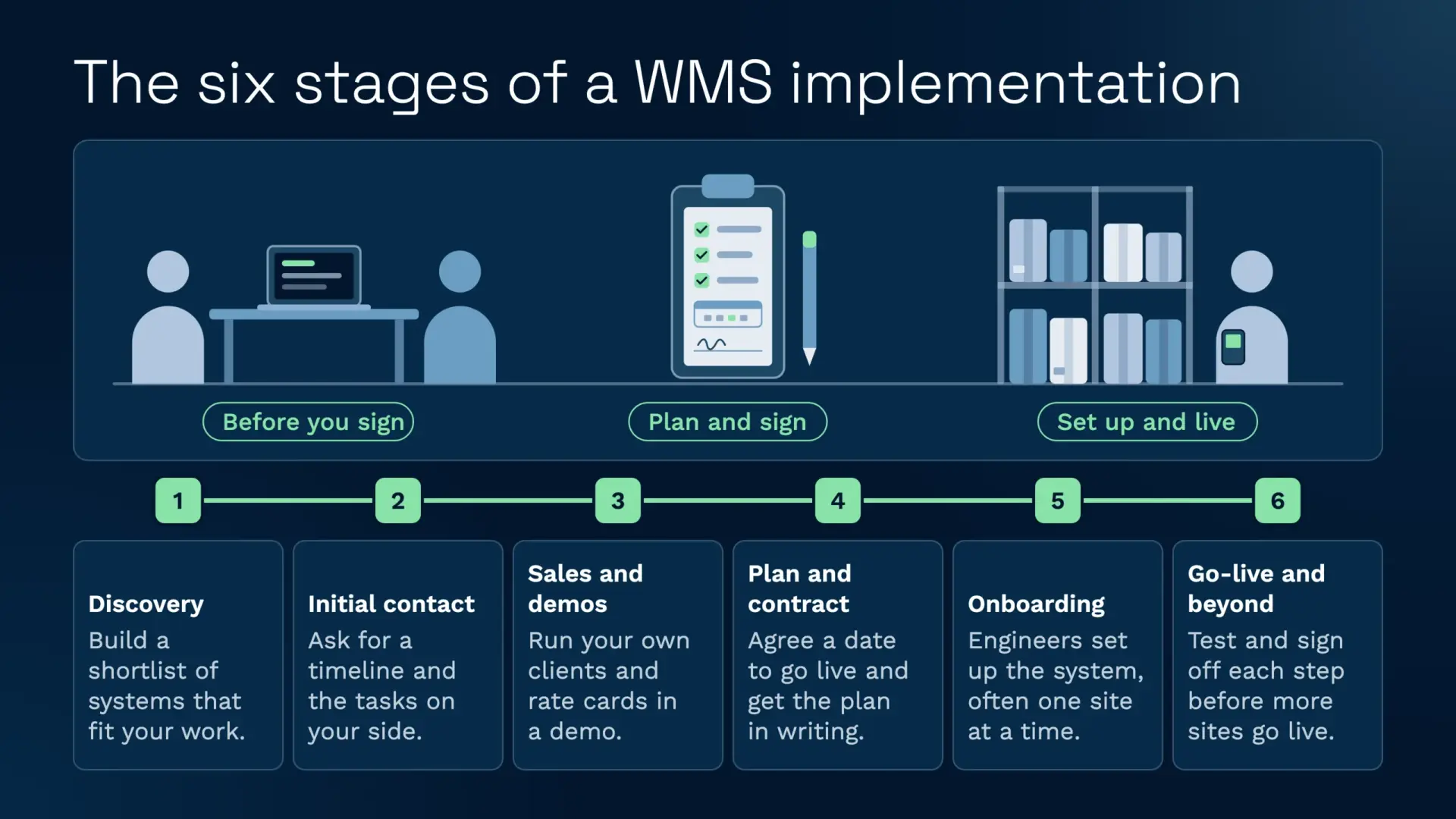
Ongoing’s customer journey page sets out six stages: discovery, initial contact, sales process and demonstrations, implementation plan and contract signing, onboarding and configuration, and go-live and beyond. It says the onboarding team consists of senior engineers, and that you and Ongoing agree a go-live date together. It does not give a standard duration, and rollout is typically one warehouse at a time. The pricing page adds that an approximate timeline is scoped with you during the sales process.
Ask for that timeline in writing, with the dependencies on your side. Our WMS implementatiegids covers the testing and sign-off steps that apply to any system. Mat Buttar, Head of Solutions at Clarus WMS, puts the test for any WMS this way: “Everything from the WMS, it doesn’t necessarily have to do the function. It should complement the function and process of the business that needs it.”
What to check before you choose Ongoing WMS
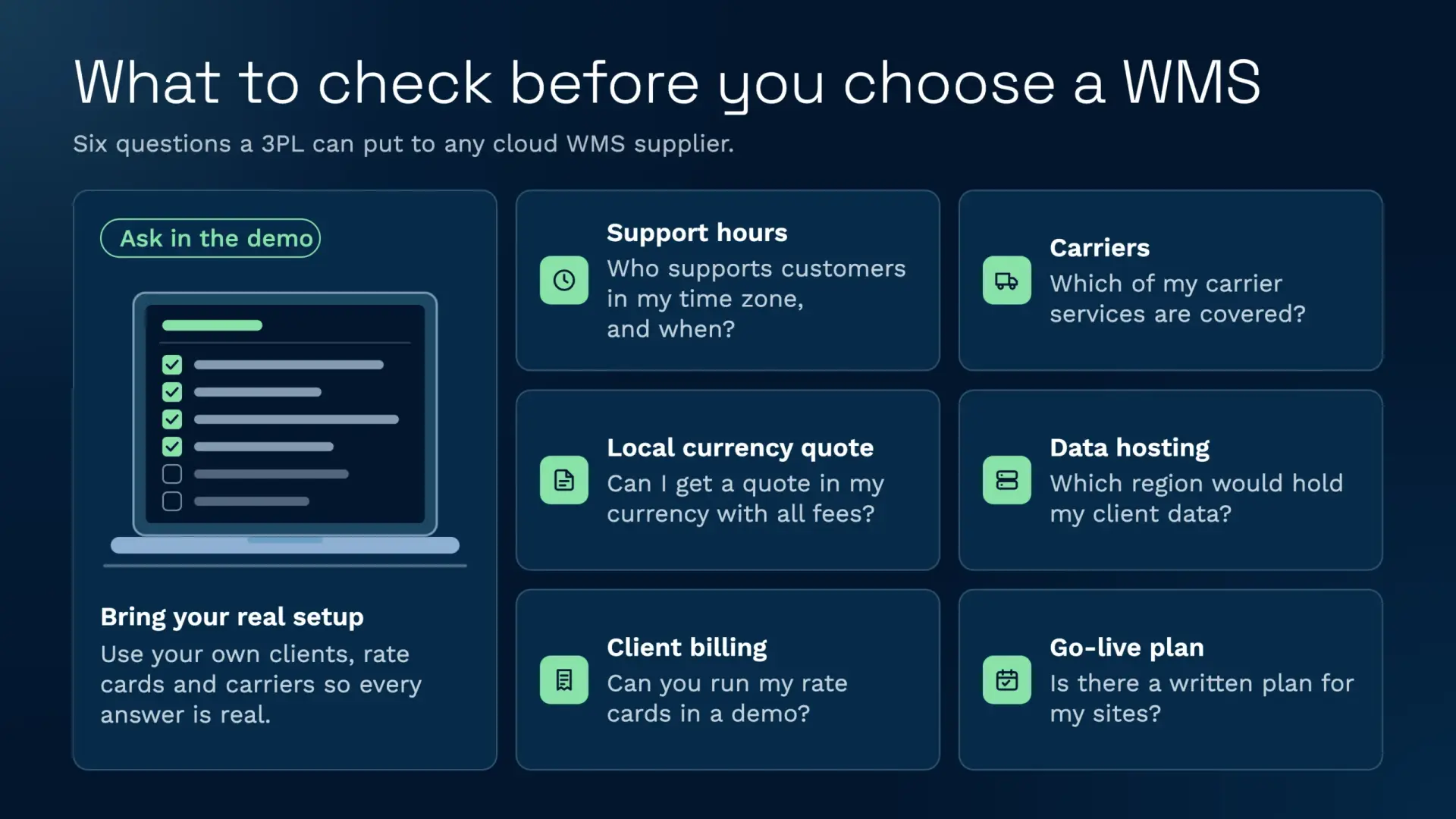
The table lists what Ongoing publishes on each point and a question to put to them. It describes the vendor’s stated position and does not score it.
| Area | What Ongoing publishes | Source page | Question to ask |
|---|---|---|---|
| Location and support | Office in Gothenburg, customers in 30+ countries, extended support times for other time zones | About us, homepage | Who supports customers in my time zone, and in which hours? |
| Vervoerders | Direct integrations for carriers such as DB Schenker, DHL Freight and PostNord, others through shipping platforms | Integraties | Which of my carrier services are covered, and by which route? |
| Prijzen | Published in euros, enterprise on request | Prijzen | Can I have a quote in my currency with all fees listed? |
| Go-live time | Approximate timeline scoped during sales, go-live date agreed together | Customer journey | What is the written plan for my sites? |
| Data hosting | ISO/IEC 27001 certified, cloud providers with EU processing listed in its Trust Center | Compliance, Trust Center | Which region holds my data, and how are sub-processor changes agreed? |
| 3PL-facturering | 3PL Economy module included, invoice data per client | 3PL page | Can you run my rate cards end to end in a demo? |
Two of those rows deserve a note. On hosting, Ongoing’s compliance page says it is ISO/IEC 27001 certified and complies with the NIS2 Directive, and its Trust Center lists Amazon Web Services and Microsoft Azure as cloud providers, with processing in the EU. If you are based in the UK, the ICO’s guidance on international transfers explains what UK organisations should consider when personal data is handled outside the UK, and the NCSC’s cloud security guidance is a useful checklist for any cloud supplier.
On labels, a scanner app only helps if your barcodes are reliable. GS1 UK, part of the global GS1 network, publishes the barcode standards most retailers and carriers expect, and it is worth confirming that whichever WMS you choose reads and prints them.
Who does Ongoing WMS suit?
On its own evidence, Ongoing suits logistics-intensive companies, in its words, across the Nordics, the rest of Europe and the world, including 3PLs and own-warehouse operators. Its published strengths are a single multi-client system, a per-client billing module, a long integration list, browser-based scanning and support for automation hardware. A company with sites in several European countries, or one that runs AutoStore or conveyors, has a clear reason to look at it. So does an own-warehouse business that wants a cloud WMS with published prices.
A 3PL outside Ongoing’s home markets has a different set of questions, mostly about local carriers, support hours, billing currency and where data sits. Those are checks, not criticisms, and a demo should answer them.
When might a 3PL look at an alternative?
Usually when the local details above come back unclear, or when the 3PL wants a supplier based in its own market. Clarus WMS is a cloud WMS built for 3PLs, with multi-client stock, facturatie van de klant and a klantenportaal, plus carrier integrations for services such as Koninklijke Post en DPD. Pricing is published on the Clarus pricing page, with plans from £1,000 a month. St John’s Hall Storage, a 3PL, cut its invoicing time by 90% after moving to Clarus, as its customer story sets out.
No single system is the right answer for every operation. If you need a returns module, yard management or temperature mapping, check how each shortlisted system, Clarus included, handles them. Our best WMS for 3PL guide walks through how to compare options on the points that matter to a 3PL. This guide makes no claim about any link between Ongoing WMS and Clarus. The right test is the same for every vendor: run your own clients, rate cards and carriers through a demo.
Neem contact op met een magazijnexpert
If you’re evaluating your options and want to see how a purpose-built WMS works in practice, Clarus is worth a conversation. We work with 3PLs and distributors to implement warehouse management software that fits the way you operate, not the other way around.
Neem contact op met ons team om uw wensen te bespreken.