

If you’re evaluating Indigo WMS and looking for alternatives, you’re likely considering a switch for one of a few specific reasons: legacy architecture, inflexible multi-client billing, slow implementation, or difficulty integrating with modern carriers and ecommerce platforms. This guide covers the landscape of Indigo WMS alternatives and how Clarus WMS stands out as a purpose-built 3PL solution.
We’ll walk through what Indigo offers, why teams look for alternatives, a side-by-side comparison of your options, and specific guidance on which system fits which operation.
Quick comparison: Indigo WMS vs alternatives
| Functie | Clarus WMS | Indigo WMS | Snapfulfil | Mintsoft | NetSuite |
| Architectuur | Cloud-native, serverless | In de cloud of op locatie | Cloud-based SaaS | Cloud-based SaaS | Enterprise cloud |
| Facturering voor meerdere klanten | Purpose-built, automated | Supported, manual reconciliation | Supported, module-dependent | Supported via add-on | Via integration only |
| Implementation speed | Around 12 weeks typical | 4–8 weeks | 6–12 weeks | 4–8 weeks | 12+ weeks |
| Carrier integrations | 70+ out of the box | ~30 supported | ~40 supported | ~35 supported | Via third-party |
| Beste voor | 3PLs, mid-market distributors, fast-scaling 3PL | Mid-market, requires customisation | Large 3PLs, e-commerce fulfillment | UK SME 3PLs, parcel fulfilment | Large enterprises, ERP-first operations |
| Support SLA | Sub-2-minute response | Business hours typical | Tiered, 4-hour typical | Tiered, 4-hour typical | Vendor-dependent |
Clarus WMS: purpose-built for 3PL operations
Clarus is a cloud-native, serverless WMS designed specifically for 3PLs, wholesale distributors, and multi-site operations. Unlike generic platforms retrofitted for multi-client billing, Clarus treats multi-client complexity as a first-class problem.
Where Clarus excels
- Automated 3PL billing engine: every billable event, receiving, storage, pick, pack, despatch, returns, value-added services, is captured in real time, segregated by client, and ready to invoice. Opslagruimte in St John’s Hall, a 3PL, cut invoicing time from four hours to twenty minutes and eliminated manual reconciliation entirely.
- Multi-client stock segregation: each client’s inventory, reporting, and workflows run independently within a single warehouse. No cross-contamination, no re-keying between systems.
- Client self-service portal: clients see real-time stock, order status, and tracking. White-labelable. Stops your team fielding “what’s my stock” calls all day.
- Straightforward implementation: cloud-native architecture means around 12 weeks from contract to go-live for a standard project. No server procurement, no lengthy version upgrades, no IT infrastructure bottlenecks.
- Meer dan 70 integraties met vervoerders: DHL, UPS, FedEx, Koninklijke Post, Parcelforce, DPD, Evri, TNT, and 60+ others. Updates automatically. EDI, XML, CSV via SFTP all supported.
- No long-term lock-in: monthly rolling contracts from £1,000/month. Clarus earns your business every month, you’re never trapped in a multi-year agreement.
Where Clarus may not be the best fit
Clarus is purpose-built for warehouses with 10+ users handling multi-client complexity, 3PL billing, or high-volume ecommerce. If your operation is:
- A tiny single-client webshop (under £500k revenue) with simple parcel-only fulfilment, a less expensive ecommerce order management tool may suffice.
- Heavily dependent on bespoke integrations with legacy enterprise systems, Clarus’s out-of-the-box integration library may require custom API work to bridge.
- An automated logistics centre (ALC) with complex robotics, pick-to-light, or conveyor systems, larger enterprise vendors (Körber, Kion, Dematic) with deep automation partnerships may be better suited.
Proof point: JODA Freight (3PL)
Stock accuracy improved from the low 90s to 99.8%. Stocktakes that used to take weeks now complete in days. Real-time scan verification and automated rotation logic did the work.
Indigo WMS: what it is, what it replaces
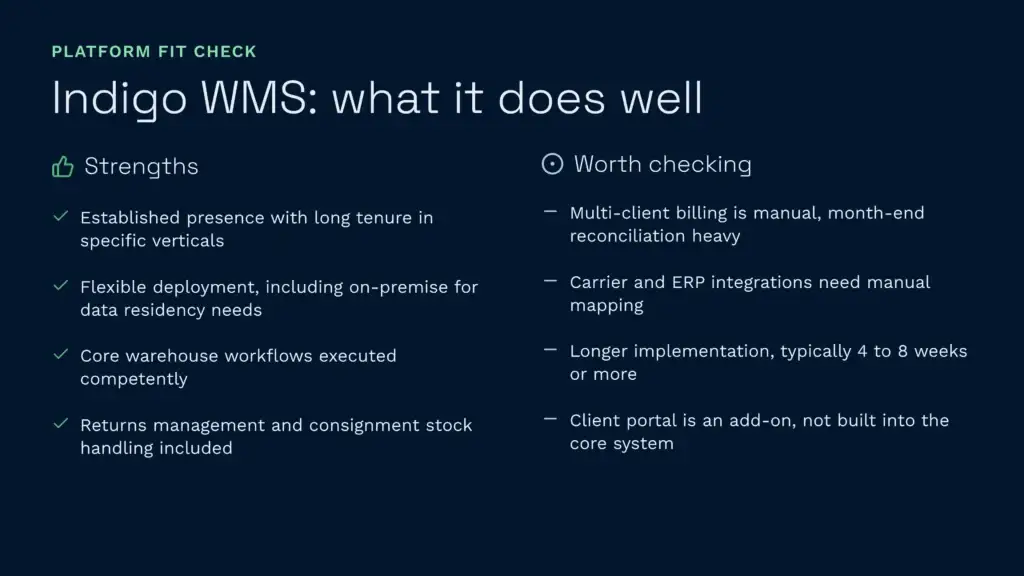
Indigo WMS is an established cloud or on-premise warehouse management system with a presence in UK and European markets. It handles core WMS functionality: inventory tracking, receipt, putaway, picking, packing, despatch, and reporting.
Indigo strengths
- Established market presence with long customer tenure in specific verticals.
- Flexible deployment: an on-premise option appeals to operations with strict data residency or legacy infrastructure requirements.
- Core warehouse workflows executed competently.
- Returns management and consignment stock handling available.
Indigo limitations
- Multi-client billing is manual: unlike Clarus’s automated real-time billing engine, Indigo requires significant month-end reconciliation work. Storage and handling charges often go uncaptured.
- Slower modern integrations: carrier, ecommerce, and ERP integrations exist but require manual mapping and API work. Not plug-and-play.
- Longer implementation: typically four to eight weeks; on-premise deployments push beyond that. Server procurement and setup adds time.
- Rigid pricing structure: custom quotes, typically annual contracts with long lock-in. Smaller operations or those wanting flexibility struggle.
- Client portal is an add-on: not built in. Many Indigo users manage client visibility through separate portals or spreadsheets.
- Legacy architecture creeping in: on-premise licensing increases operational overhead, including server maintenance, version upgrades, data backups, and IT resource allocation.
Who Indigo suits
Indigo works well for mid-market operations with:
- Stable, predictable warehouse workflows requiring limited customisation.
- In-house IT resource to manage upgrades and server infrastructure (if on-premise).
- Willingness to invest in lengthy implementation to gain bespoke configuration.
- Operations not primarily driven by multi-client billing complexity.
Snapfulfil: large 3PL and ecommerce focus
Snapfulfil is a cloud-based WMS built for large 3PLs and ecommerce fulfilment operators. Strong in the Benelux, Germany, and UK markets. Purpose-built for multi-client, multi-warehouse complexity.
Snapfulfil strengths
- Deep 3PL heritage. Multi-client billing is a first-class feature, not an afterthought.
- Wave picking and labour optimisation tools built in. Significant focus on picking efficiency.
- Extensive carrier integration library.
- Scales to large, complex multi-warehouse operations.
Snapfulfil limitations
- Pricing gated by tier: full functionality requires higher tiers, and the jump between tiers can be steep.
- Longer implementation: typically six to 12 weeks. Large 3PLs tolerate this; mid-market and scale-ups find it slow.
- Steeper learning curve: feature-rich but complex. More training overhead than simpler cloud-native alternatives.
- Enterprise-grade contract lock-in: multi-year contracts typical. Less flexibility for growing businesses.
Who Snapfulfil suits
Best for large 3PLs (50+ users, five or more sites) with complex multi-client requirements and budget for a lengthy, feature-heavy implementation.
Mintsoft: UK SME 3PL and parcel focus
Mintsoft is a cloud-based WMS built for UK SME 3PLs and ecommerce parcel fulfilment. Owned by the Access Group. Strong in the independent 3PL space.
Mintsoft strengths
- Built specifically for UK 3PLs. Speaks the right language for multi-client billing and parcel-heavy workflows.
- Fast implementation. Comparable to Clarus in speed.
- Good carrier integration library (parcel-focused).
- UK-based support and community.
Mintsoft limitations
- Fewer integrations beyond parcels: less deep in manufacturing, wholesale, or complex B2B workflows.
- Ownership transition impact: since the Access Group acquisition, roadmap changes and consolidation pressures affect product direction.
- Pricing uncertainty: quoted per configuration rather than published, so it’s less transparent than Clarus’s published starting rate.
- Limited scalability: better suited to 10 to 50 user operations. Very large 3PLs may outgrow it.
Who Mintsoft suits
UK SME 3PLs with 10 to 50 users, parcel-heavy fulfilment, and existing relationships with the Access Group ecosystem.
NetSuite: enterprise ERP with WMS module
NetSuite is Oracle’s flagship enterprise resource planning (ERP) platform, with warehouse management as an integrated module.
NetSuite strengths
- Enterprise grade. Financial, procurement, order management, and WMS all in one system.
- Deep customisation possible. If you have the budget and timeline, you can build almost anything.
- Scales to very large operations.
NetSuite limitations
- Expensive: enterprise-level, custom-quoted pricing that scales with user count and modules.
- Long implementation: 12+ weeks typical for WMS functionality alone. Full integration with finance and procurement: six to 12 months.
- Overkill for pure WMS: if your core problem is warehouse execution, NetSuite’s full ERP footprint is bloat. You’re paying for modules you don’t need.
- WMS is not the focus: NetSuite is an ERP first. Warehouse features lag purpose-built WMS platforms in sophistication.
- Rigid workflow: NetSuite’s workflows are built for traditional manufacturing and distribution. 3PL complexity and multi-client billing require heavy customisation.
Who NetSuite suits
Large enterprises (£100M+ revenue) needing unified finance, procurement, and warehouse management, with budget for long implementation and ongoing customisation.
How to choose: decision framework
Stel jezelf deze vragen eens.
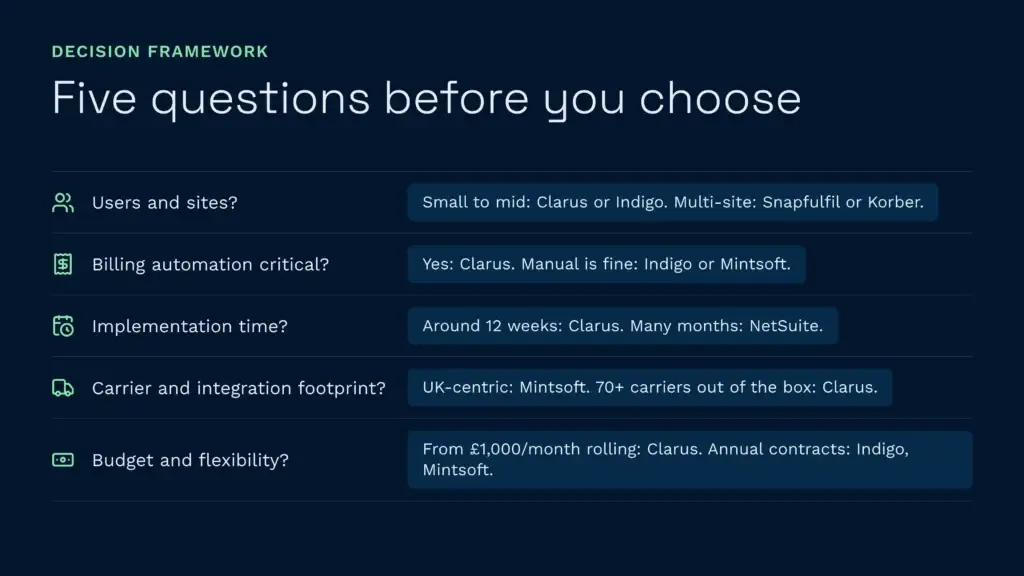
How many users and sites?
- 10 to 50 users, one to three sites: Clarus, Mintsoft, or Indigo.
- 50 to 200 users, five or more sites: Snapfulfil or Körber.
- 200+ users, enterprise scope: NetSuite or Körber.
Is multi-client billing critical?
- Yes, and it needs to be automated: Clarus (best), Snapfulfil (good, more complex).
- No, or you can live with manual month-end reconciliation: Indigo, Mintsoft, generic platforms.
- It’s part of a broader ERP requirement: NetSuite (if budget allows).
How much time do you have for implementation?
- A standard Clarus implementation runs to around 12 weeks, which allows time to train people properly rather than rushing a cutover.
- Indigo and Mintsoft quote in weeks. Ask for the figure in writing, and for what happens if it slips.
- Snapfulfil depends on how much configuration your tier and setup need.
- NetSuite and other full ERP builds commonly run for many months.
What’s your carrier and integration footprint?
- UK-centric, five to 10 main carriers: Mintsoft handles this well.
- Multichannel (ecommerce, EDI, ERP, 70+ carrier options): Clarus out of the box.
- Very specific legacy integrations: all require custom work, but Clarus’s API-first architecture makes it fastest.
What’s your budget and contract flexibility?
- Want monthly rolling terms and a published starting price? Clarus, from £1,000/month.
- Comfortable negotiating an annual contract for a mid-market platform? Indigo or Mintsoft.
- Have budget for a feature-heavy, multi-year enterprise contract? Snapfulfil.
- Need a multi-module ERP with long-term, custom-quoted pricing? NetSuite.
Migration: from Indigo to an alternative
If you’re moving from Indigo, expect three to four weeks of preparation.
- Data audit: validate your master data (locations, SKUs, client accounts, suppliers, carriers). Indigo migration often surfaces data quality issues, fix these before moving.
- Process mapping: map how your team actually works (picking routes, putaway logic, billing rules) versus how the original process was designed. Don’t assume legacy rules apply to the new system.
- Historical data: decide what historical data you need (12 months? 24 months?). Most moves don’t require a full five-year history. Reduce migration volume by archiving old data.
- Testing and sign-off: allocate one to two weeks for full parallel testing, both systems running side by side, same transactions, comparing results.
- Cutover day: final stock count, final reconciliation with Indigo, switch systems. Because most of the work happens in the weeks of preparation and testing beforehand, the cutover itself is typically quick.
The biggest variable is your master data quality. Indigo systems with poor SKU master data, duplicate location records, or inconsistent client account structures take longer to migrate. Budget an extra week if your data audit surfaces issues.
Neem contact op met een magazijnexpert
Als u uw opties aan het verkennen bent en wilt zien hoe een speciaal ontwikkeld WMS in de praktijk werkt, is Clarus zeker het overwegen waard. Wij werken samen met 3PL’s en distributeurs in heel het Verenigd Koninkrijk om magazijnbeheersysteem software that fits the way you operate, not the other way around.
Neem contact op met ons team om uw wensen te bespreken.