

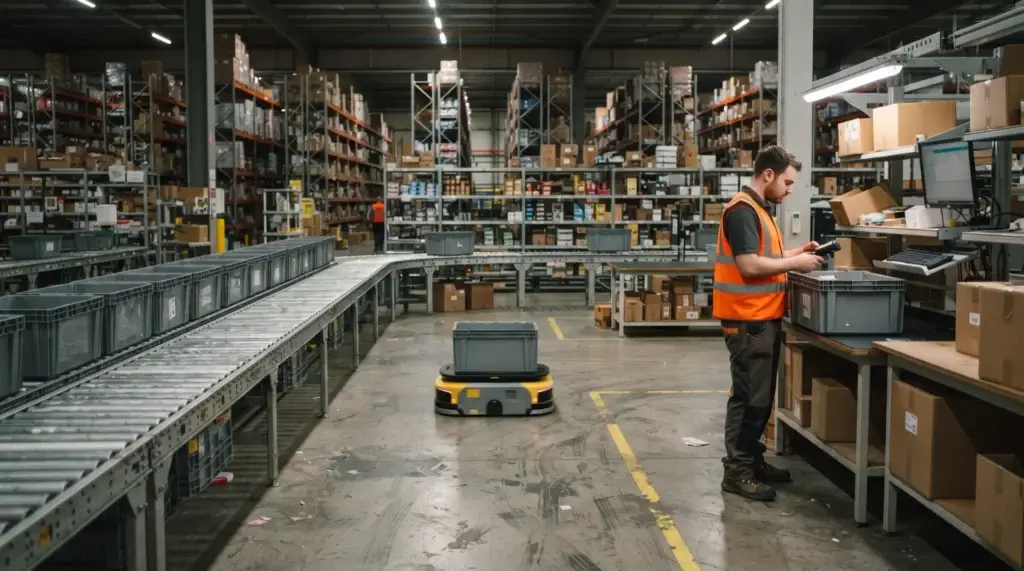
The Dematic warehouse management system is the WMS software that Dematic sells to control warehouse work, and its own product page names it “Dematic WMS, formerly Matflo WMS”. A magazijnbeheersysteem directs stock, labour and order flow inside a site, and Dematic positions its version as one that coordinates processes and prioritises activities across your entire facility, from handheld RF operations through to fully automated robotics. Dematic itself is mainly known as a maker of warehouse automation, so the WMS is best understood as the software layer that sits above Dematic’s equipment.
This guide sets out what Dematic publishes about its WMS, what it does not publish, and where a buyer should look harder. It also compares the product with Clarus WMS, a purpose-built 3PL system, so that a 3PL operations manager can see the questions that matter to them.
What Dematic’s WMS is built to do
Dematic describes its WMS as software that coordinates processes and prioritises activities across a whole facility. On its product page, the company says the software works from manual operations on handheld terminals to fully automated robotic systems, and that it handles the data and protocols needed for conveyor, sortation and autonomous mobile robot equipment. It says the product provides key data and event streams using standard API specifications and best practices, which is the part a buyer will want to test against their own ERP and carrier systems.
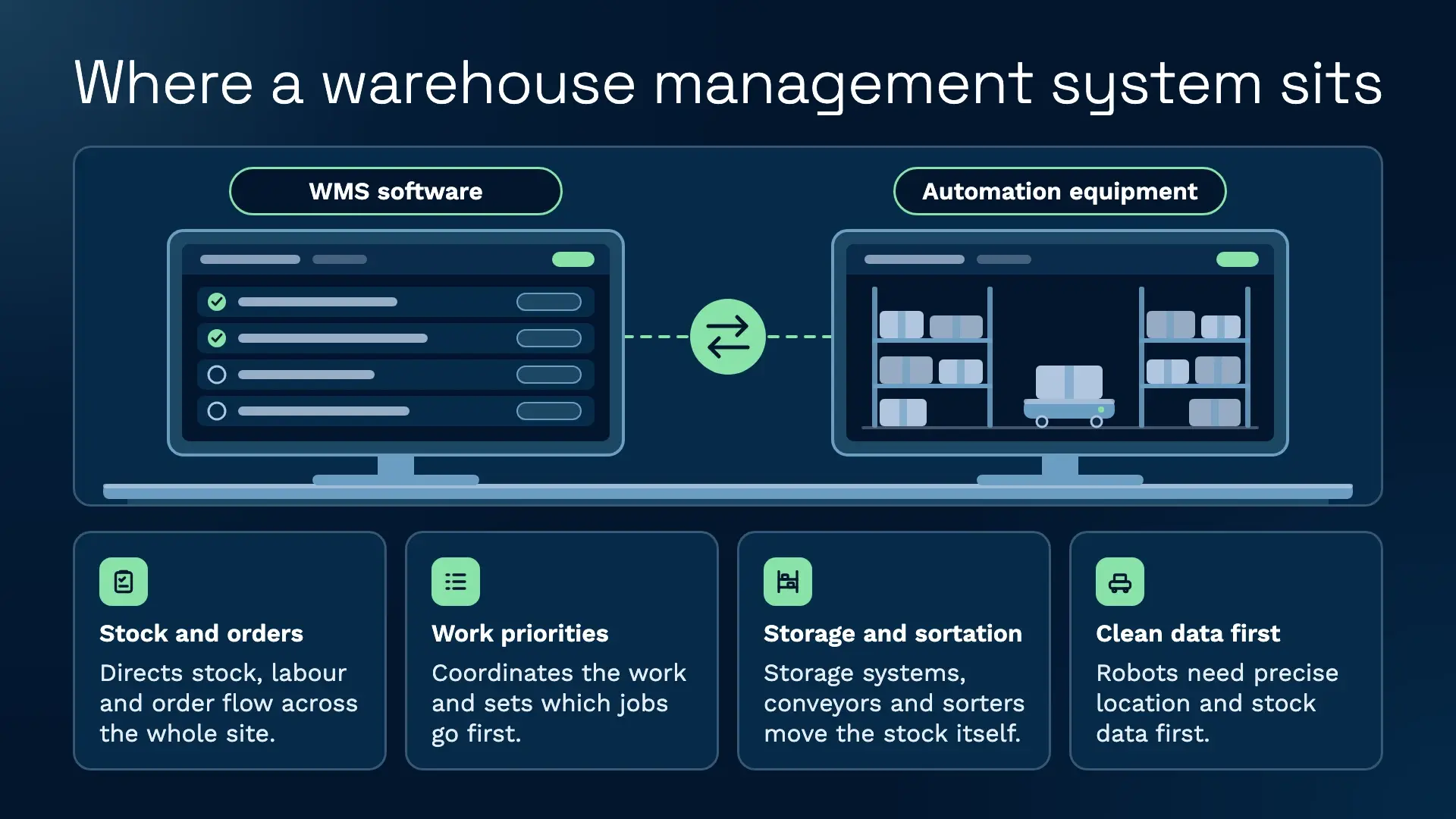
The page does not list modules, and it does not say whether the software is hosted in the cloud or run on site. It also gives no customer count beyond saying the product has been implemented by “numerous industry-leading companies worldwide”. Those are the facts a buyer should ask about in the first meeting.
Where the WMS sits in Dematic’s range
Dematic’s core business is material handling equipment. The company’s history, as set out on its Wikipedia entry, goes back to 1819 in Wetter, Germany. It is part of KION Group, and its equipment range includes automated storage and retrieval systems, conveyors, sortation systems and order picking systems. Dematic also sells software, and the WMS is one of those products.
That context matters. A WMS that is designed to run next to a sortation line or a shuttle system is a different purchase from a WMS for a shared-user 3PL site with mostly manual picking. The first is often bought as part of an automation project. The second is often bought by an operator who has to serve many clients on the same floor. Both can be correct, but a buyer should be clear which of the two they are.
Dematic has also started to talk about its wider software layer. In April 2026, at the MODEX show, it introduced Dematic Command Center, a platform that pulls data from several sources into one view so that operations teams can see performance as it happens. The trade press report on the launch describes a platform designed to work across a range of systems, and it does not present it as part of the WMS.
What Dematic publishes, and what it leaves out
A fair reading of Dematic’s public material shows a clear split. The product claims are detailed in terms of operating range, from manual to automated. Commercial and operational detail is thinner. The WMS page says nothing about pricing, deployment model or modules. On implementation, it says Dematic’s software consultants work closely with your team, but it does not set out the steps. The comparison later in this guide marks each of those gaps.
When a vendor does not publish a fact, a buyer should not assume the answer. It means the question has to go to the vendor in writing.
Questions to put to any WMS vendor before you buy
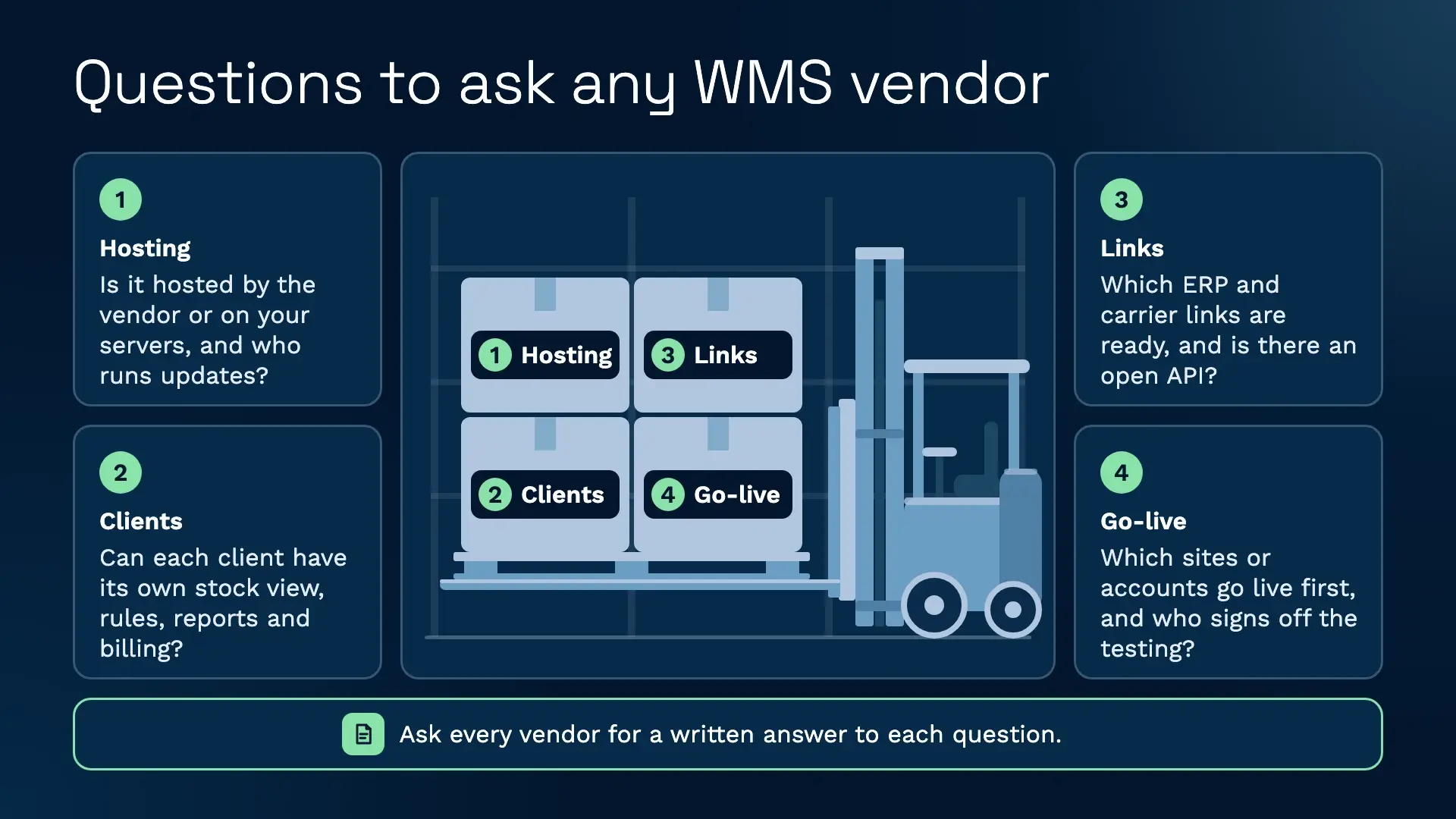
Whatever system you are considering, the answers that decide the project are rarely on a product page. Start with the points below, and ask each vendor for a written response.
- Implementatie: is the system hosted by the vendor, on your servers, or both, and who carries out updates and when?
- Pricing basis: is the price set by site, user, order, SKU, carrier or connector? Ask for the price in your busiest month, not your average month. The guide to WMS-kosten sets out the parts of a quote that are most often missed.
- Multi-client work: if you run one warehouse for several clients, can each client have its own stock view, rules, reports and billing?
- Integration: which ERP, ecommerce and carrier connections are standard, and and is there an open API for the rest?
- Go-live: what is the go-live plan, which sites or accounts go live first, and who signs off acceptance testing?
A structured comparison across these points is more useful than a feature list. The warehouse management systems comparison walks through how to score each one against your own operation. If you are building a wider shortlist, the best warehouse management system software guide covers the main options side by side.
Clarus WMS vs Dematic: how they compare
The comparison below uses Dematic’s WMS product page and Dematic’s published company information, both checked on 26 November 2026, together with Clarus’s own prijspagina and product information. Where Dematic does not publish something, the table says so.
| Area | Dematic WMS | Clarus WMS |
|---|---|---|
| Built for | Sites from manual RF operations to fully automated robotics | Purpose-built for 3PLs and multi-client warehouses |
| Deployment model | Not stated on the WMS page | Cloud-native SaaS, with no servers to maintain |
| Updates | Upgrades offered through Dematic’s lifecycle services; release model not stated | Continuous updates with no downtime, each release listed in the in-app changelog |
| Published pricing | Niet gepubliceerd | Plans from £1,000 a month, published on the pricing page |
| What pricing is based on | Niet gepubliceerd | Sites and users; orders, SKUs and couriers are unlimited |
| Multi-client 3PL work | Logistics providers named among its users; multi-client features not described on the WMS page | Client-specific stock views and a client portal |
| Automation equipment | Designed to control conveyor, sortation and robotic equipment | Browser-based handheld workflows on most RF guns, rugged handhelds, tablets and phones; open API and MCP server for other systems |
| Implementation approach | Consultant-led with Dematic’s software team; steps not set out on the WMS page | Basics first, then sites or accounts go live in an order agreed with you |
Where Clarus WMS has the edge
- A starting price you can see before the first meeting. Dematic’s WMS page publishes no price. Clarus publishes its plans on the prijspagina, from £1,000 a month.
- Orders are not metered. The Clarus pricing page says there is no volumetric pricing and that orders, SKUs and couriers are unlimited. Ask any vendor what happens to the bill when your busiest month doubles your average.
- Built around the 3PL. Clarus is designed for 3PL warehouse management, and the Scale tier is aimed at 3PLs and multi-site distributors. That matters if your work is mostly manual picking across many clients.
- A realistic go-live. Mathew Buttar, Head of Solutions at Clarus, puts a standard project at around 12 weeks to go live, with the right support on both sides. Complex, multi-feature projects take longer.
Where Dematic is the better fit
If you are building a large automated site, or Dematic conveyors, sortation, shuttle or robotic equipment are already specified, Dematic’s WMS is likely the better fit. Dematic is a materials handling maker first, its product page describes control from handheld operations through to robotics, and buying the equipment and the control software from one supplier gives one point of accountability for the whole floor.
How a WMS fits a mixed-use warehouse
Many warehouses are not fully automated, and many do not need to be. A 3PL site often runs a mix of manual picking, a few narrow aisles, bulk storage and a handful of client-specific steps. The WMS has to keep stock accurate across all of them, and the stock record is only as good as the scan at each step.
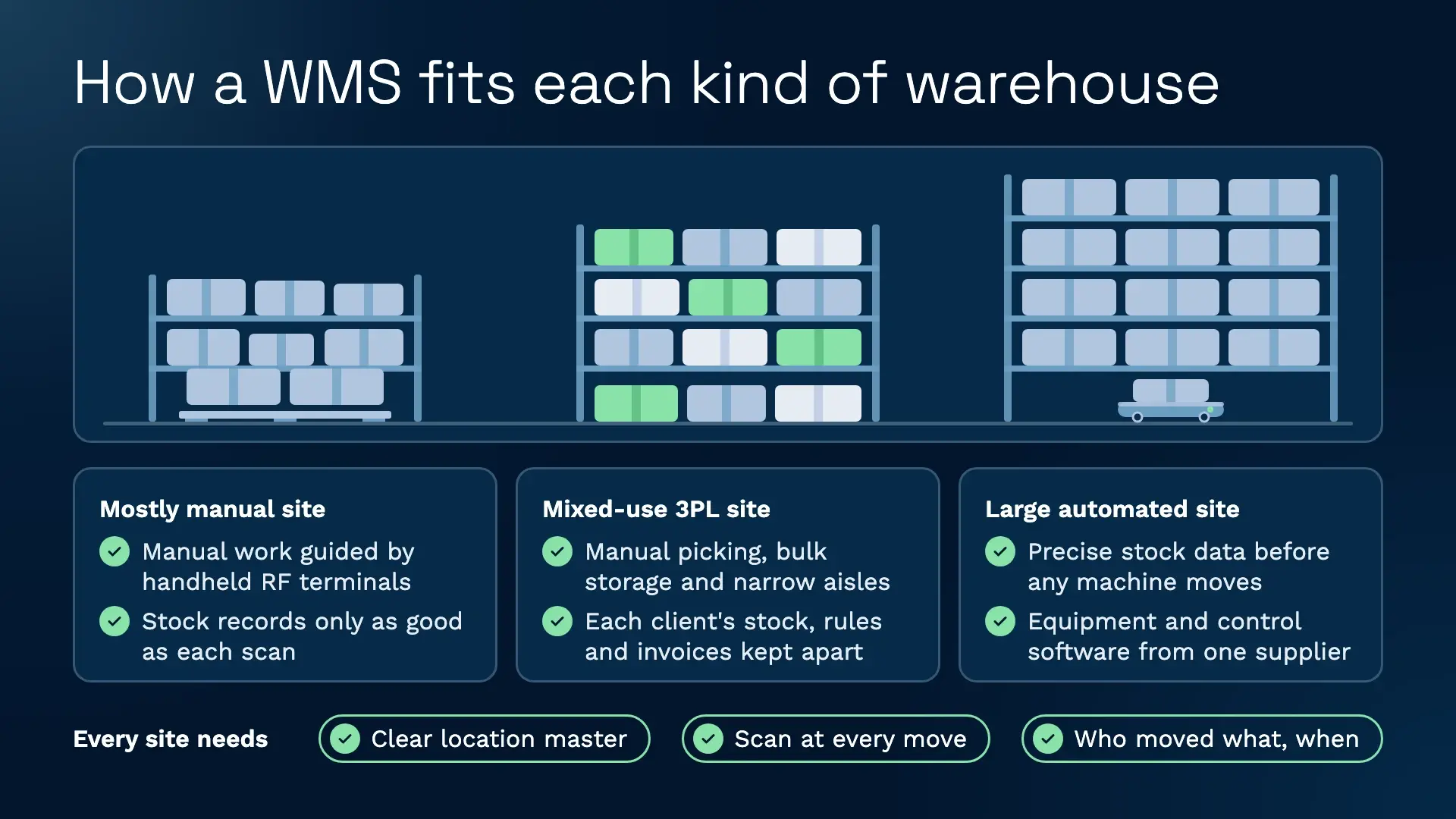
This is where the design question becomes practical. A system built to direct robots needs precise location and stock data before any machine moves a pallet. A system built for a 3PL needs the same precision, plus the ability to keep several clients’ stock, rules and invoices apart on the same racking. Neither requirement is hard on its own. Together they are where older setups can struggle, especially when the data sits in one person’s spreadsheet and the audit trail is thin.
The fix is usually not more features. It is a clear location master, a scan at every movement, and a record of who moved what and when. Those are the basics a buyer should check in any system, whatever its origin.
Go-live and implementation
The implementation plan deserves as much scrutiny as the software. Mathew Buttar, Head of Solutions at Clarus, describes the same order whether a project goes live in one go or account by account: agree who the stakeholders are, do the basics first (super user training, then gathering, loading and testing master data), and then take sites or accounts live in an order set by how complex each one is. The users themselves run acceptance testing and sign off each step.
For a buyer comparing vendors, the useful question is not “how quick is your go-live?” It is “show me the plan, the people who sign it off, and the first site you would take live.” The WMS implementatiegids sets out the steps that most projects need, whichever system is chosen.
Neem contact op met een magazijnexpert
If you’re evaluating your options and want to see how a purpose-built WMS works in practice, Clarus is worth a conversation. We work with 3PLs and distributors across Europe, North America, the Middle East and Asia-Pacific to implement warehouse management software that fits the way you operate, not the other way around.
Neem contact op met ons team om uw wensen te bespreken.