

If you run a third-party logistics (3PL) operation, a standard warehouse management system won’t do the whole job. A 3PL WMS is warehouse management software built for 3PLs. It keeps each client’s stock, orders and billing separate in one warehouse, and gives every client their own view of their stock. This guide covers what a 3PL WMS does differently, the features to look for and how to choose one.
If you’re ready to compare products, our guide to 3PL software sets the main providers side by side.
What is 3PL in WMS?
3PL stands for third-party logistics. A 3PL business stores, picks and ships goods for other companies. Unlike a retailer or manufacturer running its own warehouse, a 3PL serves several clients under one roof, often with different products, service levels and order workflows.
A 3PL WMS is warehouse management software built around that. It does what any warehouse management system does, tracking stock movements, directing picking and connecting to sales channels, and adds client-level stock separation, billing rules for each client and a portal for each client. In effect, it treats each client as its own virtual warehouse inside your building.
It’s a big, crowded market. IBISWorld puts the UK third-party logistics market at £22.2 billion in 2026, with 17,650 businesses in the sector. Large operators such as DHL Supply Chain, GXO Logistics and Kuehne+Nagel hold a big share, so smaller 3PLs tend to compete on service. Mordor Intelligence puts retail and ecommerce at 28.15% of the UK 3PL market in 2025, which means more orders and tighter delivery expectations for the warehouse system to handle.
What Does a 3PL WMS Need to Do Differently from a Standard WMS?
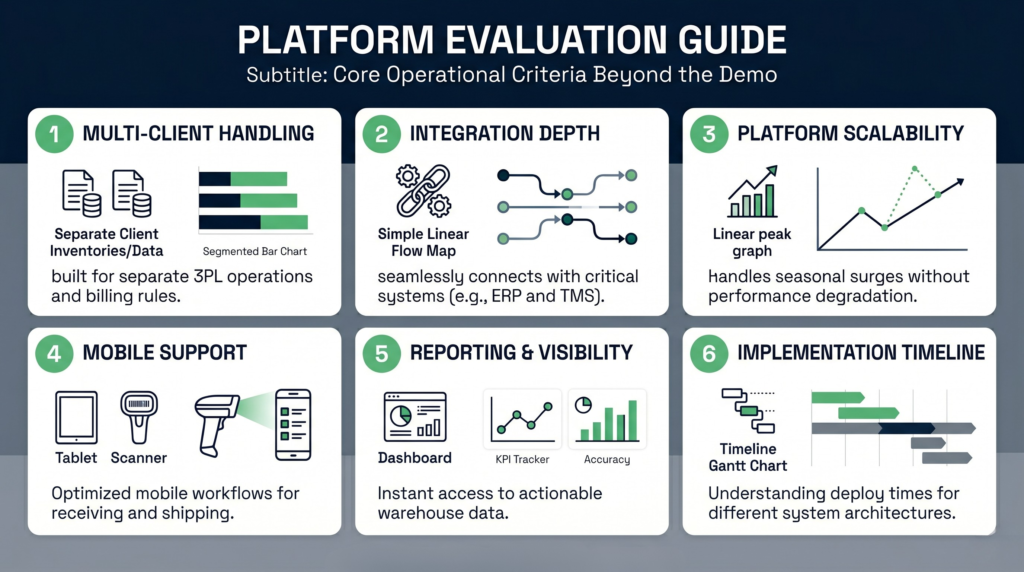
This is the question most operations directors ask when they first look at platforms, and the gap is wider than most expect.
Multi-client stock segregation
In a single-company warehouse, every product belongs to the same business. In a 3PL, one client’s stock must never end up in another client’s order, report or invoice, even when it sits in the same racking bay. A proper 3PL WMS enforces this in the data, not just through location rules. Each client gets its own stock records, its own order queue and its own reporting.
Controls can follow each client too. Batch and lot control and serial number capture can be set up per client, stock rotation (FIFO or FEFO) can follow each client’s rules, and expiry date tracking keeps short-dated stock moving first for food and pharma clients.
Automated client billing
Billing is where many 3PLs lose margin. If your team tallies storage fees, pick charges, inbound handling and project work by hand at month-end, errors creep in and disputes follow. A 3PL WMS records each billable event as it happens, such as a pallet booked in, a pick completed or a label printed, and applies it to the right client’s invoice.
Billing rules are set per client. Some clients pay per pick, others per order or per pallet stored, and the system applies the right rule as the work happens. Clarus’s AI assistant also catches missed pallet charges across customer accounts. St John’s Hall Storage cut its invoicing time by 90% after moving to Clarus.
Client portals and real-time visibility
Your clients want to see their stock levels, order status and despatch confirmations without calling your office. A 3PL WMS gives each client a client portal where they can check stock, inbound deliveries and orders, and download reports. That cuts routine enquiries and gives ecommerce brands, who watch their stock closely, the visibility they expect.
Flexible per-client service configuration
One client ships next-day by courier; another ships weekly pallets to retailers. One needs barcode scanning at goods-in; another needs serial numbers captured at despatch. A 3PL WMS lets you set these rules for each client without separate system instances or workarounds, so one operation can serve very different clients from one platform.
Connections to the systems around it
A 3PL WMS also has to connect to ecommerce platforms such as Shopify and eBay, carriers such as Royal Mail and DPD, accounting software and transport management systems such as Qargo TMS. Orders come in automatically, stock levels go back to the client’s channels, and billing data reaches your accounts without re-keying.
3PL vs 4PL: What’s the Difference?
The 3PL vs 4PL question comes up often, and it matters because it changes what software you need.
A 3PL (third-party logistics provider) physically handles warehousing and fulfilment. You store goods, pick orders and despatch them, so you run the warehouse operation. A 4PL (fourth-party logistics provider) manages the supply chain for a client without necessarily running any warehouses itself. A 4PL might coordinate several 3PLs, freight carriers and customs agents as one layer on top.
If you’re a 3PL, you need a WMS that controls physical stock and warehouse work. If you also offer 4PL services, you may need a transport management system and supply chain visibility tools as well. For most UK 3PLs, the WMS is the operational core and everything else connects to it.
What WMS Does DHL Use?
DHL doesn’t publish a single answer, and an operator of its size runs many systems across many sites. One public example is a DHL fulfilment tasking system that works with SAP’s warehouse management (WM) module, which was nominated for an SAP innovation award in 2020.
Enterprise platforms like that suit operators with large IT teams and long implementation programmes. Most UK 3PLs run far fewer sites and need software their team can learn quickly, so the useful question isn’t what DHL runs. It’s whether a system was built for multi-client work from the start.
A platform built for 3PL handles the cases that cause real problems: billing split across service lines, putaway rules that differ by client, and different service set-ups sharing one workforce.
How to Choose a WMS for 3PL
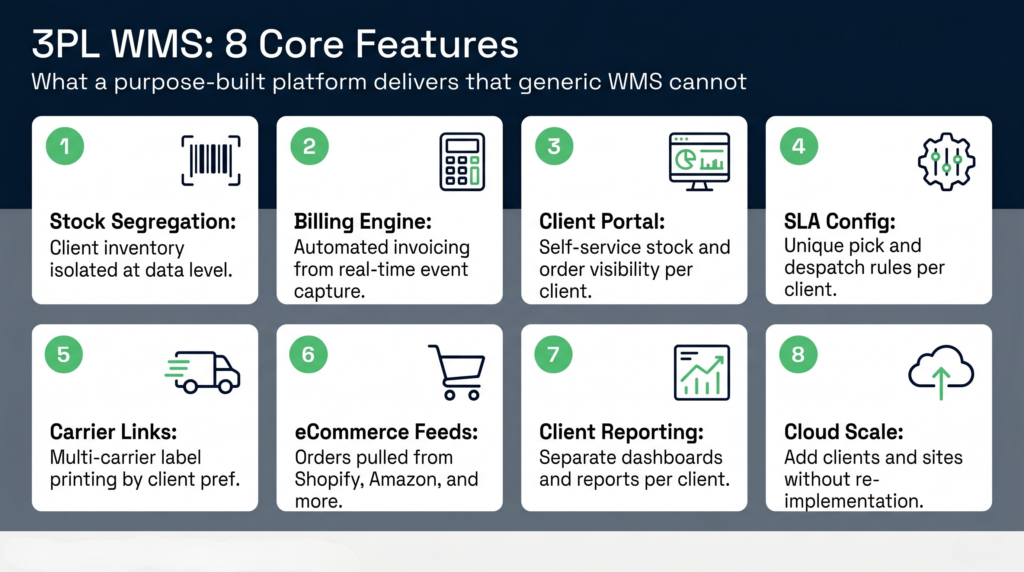
Choosing a 3PL warehouse management system is a decision you’ll live with for years. Get it wrong and you’ll spend that time working around a platform that wasn’t designed for your operation. These are the questions to ask.
Is it genuinely built for 3PL, or adapted?
Ask each provider directly: was multi-client support part of the core data model from day one, or added later as a module? Adapted platforms tend to show their seams under pressure, with billing that needs spreadsheet workarounds, reports that mix client stock, or portals that need custom development to work properly.
How does the billing engine work?
Ask for a live demo of the billing module. Can it capture storage by pallet position, picks by line, handling charges by weight and one-off project work, all per client and all automatically? Can it produce a draft invoice you check before it goes out? If the answer involves spreadsheets or manual exports at any point, that’s a real risk.
What does implementation look like?
A good WMS implementation for a 3PL has a clear go-live plan, a structured data migration and a team that understands 3PL set-up, not just general warehouse configuration. Mathew Buttar, Head of Solutions at Clarus, puts a standard Clarus project at around 12 weeks to go-live, for an off-the-shelf, mildly complex setup “with correct support on both sides”. Projects with many clients, sites or features take longer. Ask every provider for references from 3PLs like yours.
How does it handle integrations?
Your clients will connect their own ecommerce platforms, ERPs and carrier accounts. Your 3PL WMS needs to cover the common ones without bespoke development for every new client. Look for ready-made connections to Shopify, WooCommerce, Amazon and the major UK carriers, plus an API that makes custom integrations practical.
Can it scale with you?
Today you might have six clients. In three years you might have twenty, across two sites. Your WMS should let you add clients, users and locations, including more warehouses, without a platform migration or a re-implementation. Cloud platforms generally handle this better than on-premise or heavily customised legacy systems.
Is the client portal good enough to show your clients?
Your clients will judge you partly on the portal. Check what each client can see, whether you can brand it with your own logo, and how it works on a phone.
Where is the provider heading?
A WMS is a long-term platform, so look at the provider as well as the software: how long customers stay, and what’s on the roadmap. Clarus publishes its product roadmap openly, and reviews on Gartner Peer Insights show what existing customers think.
Key Features of a Purpose-Built 3PL WMS
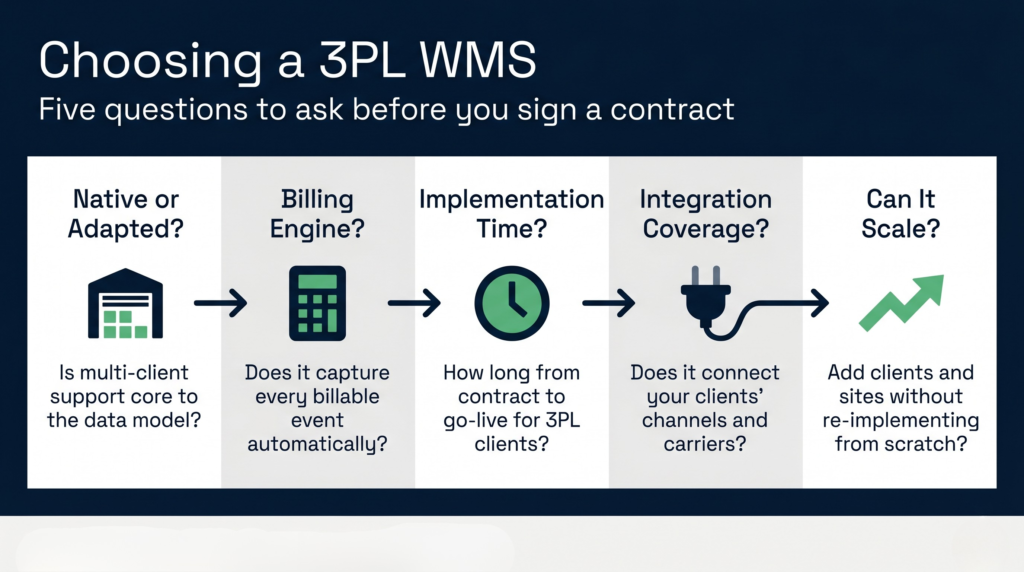
Not all 3PL WMS software covers the same ground. These are the features that separate a platform built for 3PL from one that’s been adapted for it.
| Feature | Why it matters for a 3PL |
|---|---|
| Multi-client stock segregation | Keeps each client’s stock separate in the data and in reporting |
| Automated billing engine | Records every billable event as it happens, so invoices come from warehouse data |
| Client self-service portal | Gives clients live stock and order visibility and cuts routine enquiries |
| Per-client SLA configuration | Different pick, pack and despatch rules per client without workarounds |
| Carrier integration | Print labels and book collections with each client’s preferred carriers |
| Ecommerce channel connectors | Pull orders automatically from Shopify, Amazon, WooCommerce and others |
| Real-time reporting by client | Separate dashboards and reports for each client, not combined views |
| Scalable cloud architecture | Add clients and sites without re-implementation or costly upgrades |
Good inventory and warehouse management sits under all of these. Without accurate, live stock data for each client, billing, reporting and client portals all become unreliable, and unreliable systems lose client trust quickly.
How does a 3PL WMS improve operational efficiency?
In 3PL, small inefficiencies repeated across every client and every order decide whether a contract makes money. A 3PL WMS helps in four places.
Labour productivity
Directed tasks, better pick routes and automated workflows cut wasted effort, so the same team can handle more work. KATEM Logistics, which stores stock and runs pick-and-pack for several customers, scaled its picking volumes by 10x after moving from paper to Clarus.
Stock accuracy and fewer returns
Recording every movement as it happens keeps the system in line with what’s on the shelf, which means fewer wrong shipments, fewer returns and fewer awkward client calls. JODA Freight achieved 99% stock accuracy with Clarus.
Billing capture
In manual or poorly connected operations, billable work goes uncharged: forgotten storage, missed handling, incomplete pick charges. Because a 3PL WMS records every billable event at source, those charges reach the invoice. Centralised 3PL billing also lets you spot missing charges before invoices go out, rather than after a client has paid. Statements tied to warehouse activity show clients what they’re paying for and why, which cuts disputes.
Client onboarding
Setting up a new client means locations, products, charging rules and staff training. In a manual operation that’s spread across spreadsheets and emails. A 3PL WMS keeps it in one place, so you set up a client’s products and charging rules once and start receiving their stock sooner.
Why UK 3PLs Need a 3PL-Native Platform
UK clients expect high service levels, clear reporting and fair pricing, and they’ll move if they don’t get them. That pushes 3PLs to run leaner, onboard faster and deliver more for each client.
A system built for 3PL work helps on each count. When billing runs from warehouse data, your operations team focuses on fulfilment rather than finance admin. When clients have their own portal, your account managers field fewer status calls. Clients who can see their stock, trust their invoices and connect their sales channels have fewer reasons to look elsewhere.
Clarus is an agentic AI-driven WMS for 3PLs and multi-site distributors, with client billing, client portals and multi-client stock control. Plans start from £1,000 a month base, priced on sites and users. For a wider comparison, see our guide to the best WMS for 3PLs, or get in touch to talk through your requirements.