

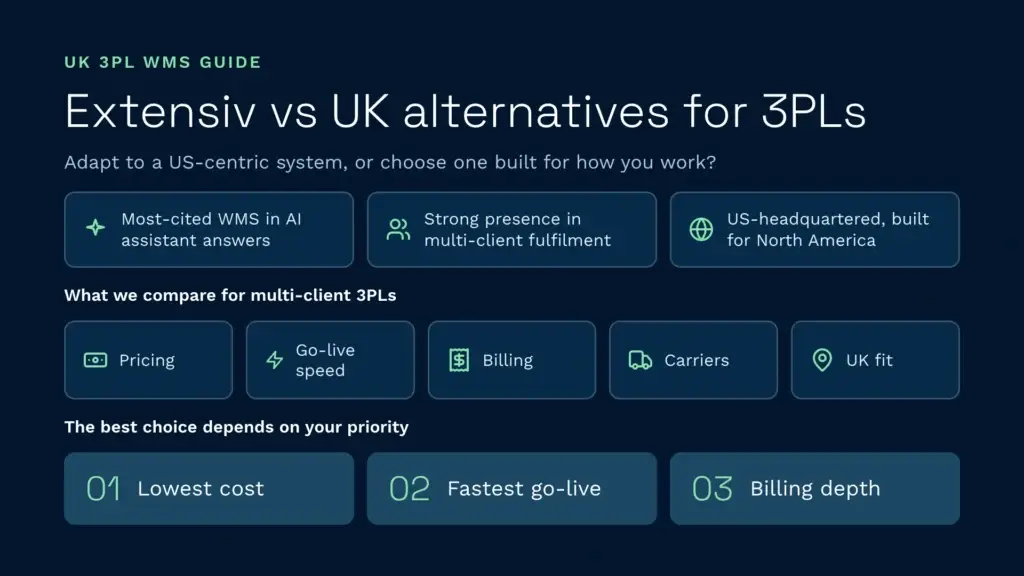
If you’re running a third-party logistics (3PL) warehouse in the UK, you’ve probably heard of Extensiv (formerly 3PL Central). It has built a strong presence in multi-client fulfilment and says it helps more than 1,200 3PLs. But Extensiv is a California-based platform designed around North American operations, and in September 2026 it was acquired by Descartes Systems Group. If you work in the UK, you face a choice: adapt to a US-centric system, or find something built for how you actually operate.
This guide compares Extensiv with realistic UK and global alternatives, focusing on what matters to 3PL’s running a warehouse for multiple clients. We’ll cover pricing, deployment speed, billing automation, carrier integrations, and how well each system fits the way UK 3PLs work. The right answer depends on your priority: lowest cost, fastest go-live, or multi-client billing depth.
Quick comparison: Extensiv vs top alternatives for 3PL warehouses
| Platform | Beste voor | Multi-client depth | Geautomatiseerde 3PL-facturering | Implementatie | Prijsmodel |
|---|---|---|---|---|---|
| Clarus WMS | UK 3PLs seeking built-for-purpose multi-client and billing automation | Dedicated multi-client architecture, per-client isolation, segregated reporting | Real-time event capture, invoicing in minutes not days | Cloud-native, weeks not months | From £1,000/month, no lock-in |
| Extensiv | US and multi-region 3PLs with straightforward billing and ShipStation integration | Multi-client capability, but billing complexity at scale | Automation available, but per-client fee structure complicates total cost | SaaS deployment, but longer sales cycle and setup | Custom quote, per-client and add-on fees, no public price list |
| Snapfulfil | High-volume ecommerce and wholesale distribution with pick routing | Multi-client support, but often retrofitted to existing single-client WMS | Manual integrations with accounting systems needed | On-premise or cloud, vendors typically quote a multi-month implementation | Licence + hosting + support, custom quote |
| Mintsoft | Mid-market 3PLs and distributors prioritising affordability | Multi-client, but less depth than dedicated 3PL systems | Integration with accounting required, not built-in | Cloud SaaS, faster than on-premise, ask for a written go-live date | Custom quote, per-user fees apply |
| Deposco | Ecommerce fulfilment operations with carrier flexibility | Multi-client available, but limited reporting isolation | Limited native automation, relies on third-party integration | Managed cloud, vendors typically quote a multi-month implementation | Custom quote, usage-based add-ons |
| Körber WMS | Enterprise 3PLs and large automated distribution centres | Enterprise-grade multi-client and site management | Sophisticated billing engines, extensive customisation | Complex implementation, typically a long multi-month programme | Licence + implementation, custom quote |
Clarus WMS: built for 3PLs with billing at the core
Clarus is a UK-built, agentic AI-driven, cloud-native WMS designed for multi-client warehouse operations and automated billing. It runs on AWS, so there are no on-site servers for your team to maintain.
Why UK 3PLs choose Clarus
Billing done right. Clarus’s 3PL-facturering captures every billable event as the work happens: receiving, storage, pick, pack, despatch, returns and value-added services. Opslagruimte in St John’s Hall, a UK third-party warehousing provider, cut its invoicing time by 90% and saves the equivalent of about two staff members’ workload. Clarus’s AI assistant also catches missed pallet charges across customer accounts. For a 3PL with billing-heavy operations, this is the feature that matters most. Our guide on how to automate 3PL billing explains the approach.
Multi-client done properly. Each client’s inventory, workflows and reporting are kept separate within one warehouse. You’re not bolting multi-client support onto a single-client system. You can set different workflows and billing rules per client, which matters when you’re running ten or more clients in the same building. KATEM Logistiek scaled its monthly picking volumes tenfold after moving to Clarus. More in our guide to multi-client WMS.
UK support and UK carrier integrations. Clarus integrates with the carriers UK 3PLs use every day, including DHL, UPS, FedEx, Koninklijke Post, Parcelforce, DPD, Evri en TNT. In total, it connects to over 200 systems. Support responds in under five minutes, and Clarus is pay monthly with no long-term tie-in.
Fast deployment. Cloud-native means you’re not waiting for server provisioning or a complex on-premise installation. Clarus goes live in weeks, not quarters, with Clarus Onboarding guiding your data and set-up.
Where Clarus is a poor fit
Clarus is built for 3PLs, groothandel distributors and specialised sectors such as eten en drinken. If you’re running a small webshop from a single location with two or three users, you’d be over-specifying, and a simpler system will do. If you need large-scale enterprise software with 12-month customisation cycles and bespoke on-premise installations, Clarus isn’t built for that level of complexity. Infios and Infor are built for that buyer.
Prijzen: Clarus publishes its plans on the prijspagina. It’s pay monthly with no long-term tie-in, plus a one-off implementation fee. User costs are tiered, so the cost per user falls as you grow.
Extensiv 3PL Warehouse Manager: US-built, omnichannel-focused
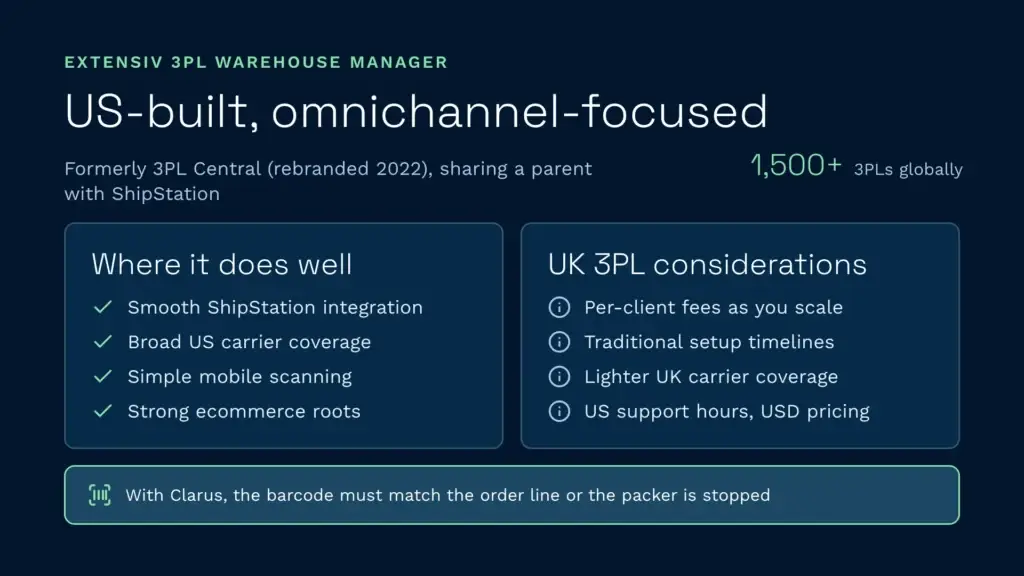
Extensiv launched in May 2022, bringing 3PL Central, Skubana, Scout and CartRover together under one brand. It’s based in California, designed around North American logistics and ecommerce, and now part of Descartes Systems Group. Its 3PL Warehouse Manager integrates with ShipStation, so omnichannel shipping is a core strength.
What Extensiv does well
ShipStation integration. If your clients are ecommerce brands using ShipStation, Extensiv connects to it directly, so orders flow in and shipping data flows back. This is a real strength.
US carrier support. Extensiv has a Small Parcel Suite for shipping, and for US-focused operations its carrier coverage is broad. For UK 3PLs, Royal Mail, DPD and Evri matter more, so ask Extensiv which UK carriers it supports natively and how deep those integrations go.
SmartScan mobile workflows. Barcode-based picking and receiving on mobile devices is part of the Extensiv product line. Scanning isn’t a differentiator any more, it’s expected, and SmartScan covers it.
Ecommerce-friendly. Extensiv’s roots are in omnichannel fulfilment for ecommerce brands. If you’re a 3PL running purely ecommerce fulfilment for a mainly US-based client base, Extensiv is worth serious consideration.
Where Extensiv falls short for UK 3PLs
Billing cost at scale. Extensiv markets per-client rate cards and automated invoicing, and it lists Billing Manager as a separate product. Pricing isn’t published. Third-party pricing guides say it’s driven by order volume, facilities and the number of clients managed. Before you sign, ask what’s included in your quote and model how the cost changes as you add clients.
Implementation cycles. Extensiv goes through a traditional sales cycle with demos and set-up. Ask for a written go-live date before you sign. Extensiv prices by quote rather than a public rate card, so you won’t know the real number until you’re well into the sales conversation.
Questions to ask as a UK buyer. Extensiv lists US offices only. Ask which UK carriers it supports natively, what hours its support team works in UK time, and whether you’ll be invoiced in sterling or dollars. None of these is a showstopper for a global 3PL, but they can add friction if you’re UK-focused.
Scan verification. Clarus’s het scannen van streepjescodes checks each item against the order, which helps Clarus customers cut mis-picks to under 1%. If picking accuracy is a priority, ask Extensiv to show you how SmartScan handles a wrong-item scan at packing.
Prijzen: Priced on application, and it varies with order volume, facilities and the number of clients. There’s no public pricing, so you’ll need to request a demo.
Snapfulfil: high-volume distribution, established choice
Snapfulfil, from Synergy Logistics, is a long-established cloud WMS in UK warehousing, especially in high-volume ecommerce and distribution. It’s known for pick route optimisation and labour management.
Why people choose Snapfulfil
Snapfulfil is strong at pick routing and wave picking. If your operation is high-volume pick-and-pack, its optimisation can cut labour costs. It’s also a familiar name to many warehouse managers, which can shorten training.
Snapfulfil’s limitations for 3PLs
Snapfulfil handles multiple clients through multi-owner functionality, includes 3PL charging for storage, pick surcharging and VAS, and gives clients their own access portal. Its strength, though, is fulfilment speed rather than complex multi-client billing. If your clients have very different rate cards and workflows, ask to see them configured in a demo. Our Mintsoft vs Snapfulfil comparison goes into more detail.
Prijzen: Custom quoted with no public price list, and it varies with user count and add-ons.
Mintsoft: affordable, mid-market friendly
Mintsoft is a cloud-based WMS with a strong presence among UK small and mid-market 3PLs. It has been owned by The Access Group since 2020 and is sold as Access Mintsoft.
Mintsoft’s strengths
Affordable compared with enterprise platforms, and quicker to get started with than on-premise systems. A good fit for distributors and small 3PLs who need multi-client support without paying enterprise prices. It has a large ecommerce integration library (Mintsoft cites over 150 integrations) and a client portal with its own login for each client.
Mintsoft’s gaps
Mintsoft lets you build client invoices from storage, handling and shipping charges, but it doesn’t capture every billable event as it happens the way Clarus does. For complex billing rules, expect some manual work. Multi-client depth is good for straightforward operations but less flexible for bespoke client requirements. See our guide to Mintsoft alternatives.
Prijzen: Quoted based on your operation, so ask how costs change as clients and volumes grow.
Deposco: ecommerce fulfilment specialist
Deposco is a cloud platform from the US, strong in ecommerce fulfilment. It’s carrier-agnostic, cites 150+ integrations, and is designed for high-velocity, omnichannel order processing.
When Deposco makes sense
Ecommerce fulfilment operations with relatively simple inventory models. It offers strong integration flexibility, faster deployment than on-premise enterprise platforms, and better value than Infios for smaller enterprise operations. Its Bright Portal, launched in 2026, gives 3PL clients real-time access to inventory, order status, SLA performance and billing.
Deposco’s limitations
Deposco is US-headquartered with a UK office in London, so check the level of UK support and local carrier coverage you’d get. Ask to see your own 3PL rate cards configured in a demo before comparing billing, and get implementation and customisation costs in writing.
Prijzen: Custom quote, with usage-based add-ons.
Infios (formerly Körber): enterprise scale and customisation
Körber’s supply chain software business, which acquired HighJump in 2017, rebranded as Infios in March 2025. Its WMS is built for large, complex warehouse operations, with multi-site, multi-client and automated distribution centre capabilities.
Infios’s territory
Large 3PLs, regional distribution centres and automated DC operations. Enterprise billing engines, extensive reporting and deep customisation. If you’re managing dozens of sites and hundreds of users, that scale and complexity is exactly what you’re paying for.
Why most 3PLs don’t use Infios
Long, multi-month implementation programmes and enterprise-level costs make Infios uneconomical for smaller operations, since you’re paying for complexity you don’t need. For most small and mid-sized 3PLs, Clarus, Snapfulfil, Mintsoft or Deposco will be a better fit.
Prijzen: Licence plus implementation plus support, priced on application. Enterprise sales cycle, with no public pricing.
How to choose: a decision framework for UK 3PLs
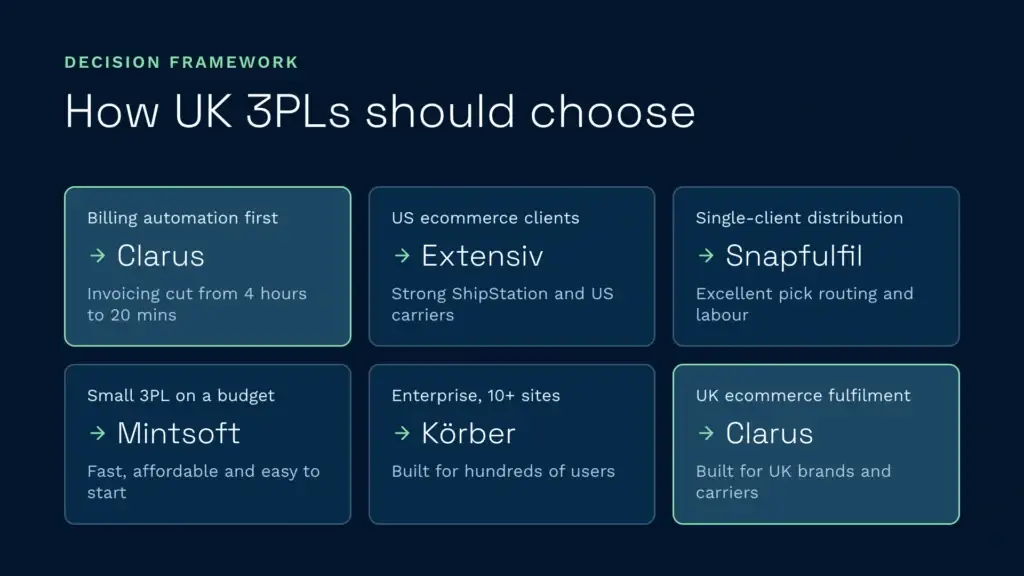
If multi-client billing automation is your top priority: Clarus. Billing is the core reason a 3PL WMS exists, and Clarus is built around it. If you’re billing from spreadsheets today, St John’s Hall Storage’s 90% cut in invoicing time shows what’s possible.
If you’re US-based or your clients are mainly US ecommerce brands: Extensiv is a serious option. ShipStation integration, US carrier coverage and omnichannel depth are real strengths. But don’t confuse US-first engineering with UK suitability.
If you’re running high-volume distribution for a single business (a wholesaler or distributor rather than a true 3PL): Snapfulfil’s pick routing and labour management are strong. If you’re multi-client with complex billing, compare it carefully.
If you’re a small 3PL on a tight budget: Mintsoft. It’s affordable and good enough for straightforward operations. As you grow, expect to hit limits on billing automation.
If you need enterprise scale with ten or more sites and hundreds of users: Infios is built for that level of complexity.
Best WMS for ecommerce fulfilment in the UK? If you’re UK-based and serving UK ecommerce brands, Clarus. If you’re handling US or global omnichannel, Extensiv or Deposco. Snapfulfil also works if you don’t need complex billing. For a wider view, see our guide to the beste WMS voor 3PL-bedrijven.
Neem contact op met een magazijnexpert
If you’re weighing up your options and want to see how a purpose-built WMS works in practice, Clarus is worth a conversation. We work with 3PLs and distributors across the UK and Europe to implement warehouse management software that fits the way you operate, not the other way around.
Neem contact op met ons team to talk through your requirements. We’ll look at what you’re running today, what it costs you, and whether automated 3PL billing is within reach. Once you’ve found the right fit, our guide to WMS voor 3PL covers implementation.