

If you’re running a 3PL, distribution or ecommerce fulfilment operation on Peoplevox and it isn’t giving you the flexibility or cost you need, you’re not alone. Peoplevox has been part of Descartes since February 2020 and markets itself as an ecommerce WMS for high-growth brands, and it does that job well. Teams tend to look elsewhere when the work changes: taking on multiple clients, billing them accurately, connecting to accounting software, or handling food and B2B stock that pure ecommerce tools weren’t designed around. This guide compares the leading Peoplevox alternatives, what each one is built for, and where Clarus WMS fits.
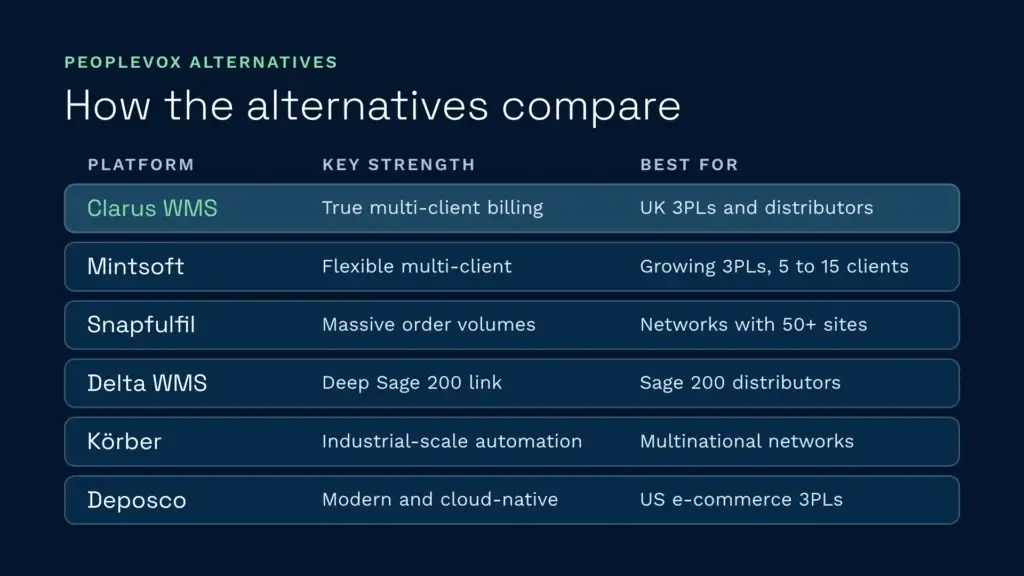
Quick Comparison: Top Peoplevox Alternatives
| Solution | Best for | Multi-client / 3PL | Billing Automation | Integrations | Deployment |
|---|---|---|---|---|---|
| Clarus WMS | 3PLs, distributors, food & beverage | Native multi-client | Full automated engine | 200+ inc. Sage, Shopify, 70+ carriers | Cloud-native, weeks not months |
| Mintsoft | Mid-market e-commerce, 3PL | Yes, with add-ons | Partial — requires manual audit | 100+ integrations | Cloud |
| Snapfulfil | Enterprise e-commerce | Complex, retrofitted | Limited native support | API-heavy, requires development | On-premise or cloud |
| Delta WMS | Large distributors | Yes, but limited | Manual billing workflows | ERP-focused | Cloud or on-premise |
| Körber | Enterprise / automated DC | Yes, but enterprise-grade complexity | Modular, high cost | Enterprise integrations | On-premise, requires IT |
| Deposco | E-commerce, US-focused 3PL | Yes, US-centric design | Basic multi-client billing | Shopify, Amazon, limited others | Cloud |
Clarus WMS: the best Peoplevox alternative for 3PLs
Clarus WMS is an agentic AI-driven WMS built for 3PLs, distributors and food and beverage operations that need proper multi-client control without the cost and timescale of an enterprise platform. Peoplevox’s own pricing tiers are aimed at Shopify and high-growth brands, and its integrations page names NetSuite and Brightpearl but no other accounting packages. Clarus starts from the other end: several clients, each with their own stock, charges and reporting, run from one warehouse.
Where Clarus stands out
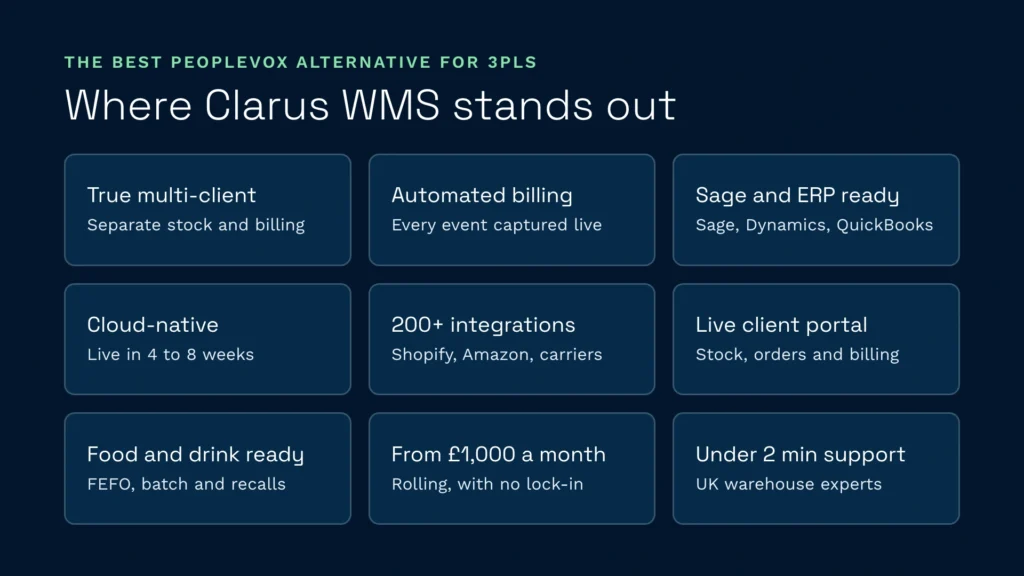
- Multi-client by design: each client’s stock, orders and charges sit against that client, and portal access is set per client, so nobody sees another customer’s data.
- Automated 3PL billing: every putaway, pick, pack, cycle count, value-added service and storage day is recorded at source and rolled into one itemised statement through client billing. St John’s Hall Storage cut invoicing time by 90% and moved from monthly to weekly invoicing.
- AI that does the work: Peoplevox’s AI is demand forecasting, sold as an optional add-on on its Growth tier. Clarus’s AI acts inside the warehouse system: it catches missed pallet charges across customer accounts, quarantines expired stock and alerts the team, and processes around 100 PDF orders in roughly 40 seconds.
- Accounting and ERP integration: Clarus connects to Brightpearl (by Sage), Xero, and Sage 200 through a Patchworks connector. St John’s Hall Storage now exports straight from Clarus into its accounts software instead of re-keying invoices.
- Integrations across the stack: Clarus connects to over 200 systems, including Shopify, Amazon Shipping, DHL, UPS, Royal Mail, Evri, DPD, Yodel and The Pallet Network. See the full list on the integrations page.
- Cloud-native, live in weeks: there are no servers to run on your side. Campeys went live in under two months.
- Client portal: your customers see live inventory, order milestones and shipment tracking in a client portal you can brand as your own. At MSD, emails and calls asking “how much stock have I got?” dropped by about 60%.
- Accurate picking: guided order management and scan checks cut mis-picks to under 1%. KATEM Logistics took order accuracy from an estimated 80% to between 98% and 99%.
- Food and beverage control: FIFO and FEFO run in the background, with expiry, best-before and use-by dates managed automatically and batch and lot control built in. See food and beverage. Campeys can run a full traceability recall test in under five minutes and holds BRC AA grade for food-grade storage.
- Clear pricing, no lock-in: published plans, paid monthly, with no long-term tie-ins. User licences and a one-off implementation fee are quoted on top.
- Fast support: support response is under five minutes, from people who understand warehousing.
Where Clarus isn’t a fit
If you’re a single-brand Shopify store with modest order volumes and no plans to take on clients, a lighter ecommerce tool may be all you need. At the other end, if you’re designing a heavily automated distribution centre with conveyors and robotics at the centre of the build, enterprise platforms like Körber are made for that. Clarus is built for the operations in between: 3PLs, distributors and food and beverage businesses that need multi-client control and accurate billing without an enterprise-sized project.
Proof points: results from Clarus users
- St John’s Hall Storage (3PL): invoicing time cut by 90%, with invoicing moved from monthly to weekly.
- JODA Freight (3PL): stock accuracy reached 99% by year two, and stocktakes went from weeks to a single day.
- KATEM Logistics (3PL): monthly picks scaled 10 times to around 12,000 without inflating admin headcount.
- MSD (Mitchell Storage & Distribution) (3PL): admin load down 60%, with chargeable tasks like re-boxing, kitting and pallet wrapping now logged and billed.
- Campeys (food-grade storage): full traceability recall tests in under five minutes, and BRC AA grade secured.
- Edge Transport (food and third-party warehousing): stock accuracy over 99%, with pick sheets reaching the warehouse within five minutes of a customer call-off email.
Mintsoft: a mid-market ecommerce and 3PL alternative
Mintsoft is a cloud WMS for 3PLs and ecommerce brands, owned by The Access Group, which also sells Access Delta (covered below). It’s a credible choice for parcel-led fulfilment, and its connector library is the thing reviewers praise most.
Strengths
- 131 standard integrations across marketplaces, couriers and accounting, according to its pricing page
- 3PL client portal and mobile scanning app
- Published entry prices, which is more than most WMS vendors offer
- Onboarding plans included in the core software package
- An AI assistant, branded Access Evo Copilot
Limitations
- Pricing is built from four parts: core software, optional modules, onboarding and training, and a customer success plan. The core price is set by user count and monthly order volume, so the bill grows as you grow
- The mobile app needs paid user licences
- The AI assists and answers questions rather than taking action in the system
- One G2 reviewer reports there’s no straightforward way to connect two Mintsoft-run fulfilment sites to a single Shopify store
- It was built primarily for ecommerce and parcel fulfilment, so complex B2B multi-client operations can outgrow it
Who should choose Mintsoft
Ecommerce brands and parcel-led 3PLs who want a wide connector library and published starting prices. If your clients have very different billing rules, or a lot of your work is B2B pallet and food storage, compare billing and multi-client depth closely before you sign.
SnapFulfil: established UK cloud WMS
SnapFulfil is a cloud WMS from Synergy Logistics, a UK company founded in 1972. It serves 3PL, retail and ecommerce operations. In April 2026 it launched ORCA, a second WMS with a hybrid design that combines cloud orchestration with on-site operation, so warehouse work keeps running if connectivity drops.
Strengths
- Long-established UK vendor with a dedicated 3PL offering
- Publishes ISO 27001 and Cyber Essentials certification
- Strong carrier coverage and robotics partners, including 6 River Systems, HAI Robotics and Jungheinrich
- Certified “Built For NetSuite” integration
- ORCA is designed for operations that can’t afford downtime during peak
Limitations
- No pricing on its own site, and every route in starts with a demo
- Its own integrations page names NetSuite as the only ERP and doesn’t list Shopify, Amazon or other marketplaces natively, though third-party listings show some ecommerce connectors
- Its AI predicts and advises, and fully automated action is described as a future step that still needs approval for bigger decisions
Who should choose SnapFulfil
Larger 3PL and retail operations with automation in the building, strict security questionnaires, or NetSuite as their ERP.
Access Delta WMS: UK 3PL focus, licence-based
Access Delta is the second WMS sold under The Access Group’s WMS banner, alongside Mintsoft. It’s UK-built and long-established in UK 3PL, ambient and food distribution.
Strengths
- 3PL management with a client portal where clients view their own stock, order progress and invoices
- Billing automation is one of the things it’s known for
- FIFO and FEFO stock control and GS1 compliance
- Integrates with accounting software including Sage, Pegasus and Exchequer, according to its GetApp listing
- The scale of The Access Group behind it
Limitations
- Review marketplaces list it as a one-time, per-feature licence rather than a monthly subscription, so the upfront cost and what’s included need checking carefully
- GetApp lists its platform as Windows desktop, so ask whether it’s cloud-hosted or server-based and what an upgrade looks like
- Very few public reviews, which makes independent comparison hard
- AI across Access products is a Copilot assistant that helps users rather than acting in the system
Who should choose Access Delta
UK 3PLs and distributors who prefer an upfront licence, or who already run other Access software. If you want a monthly subscription, cloud-native architecture and AI that acts on its own, compare it with Clarus.
Körber (now Infios): enterprise-scale supply chain systems
Körber is a German group, and its supply chain software business rebranded as Infios in March 2025. It’s built for enterprise supply chains and automated distribution centres.
Strengths
- Deep automation and robotics partnerships, including BALYO, Geek+, HAI Robotics and Zebra
- SAP Gold Partner
- Publishes ISO 9001, ISO 27001, SOC 1 and SOC 2 for its cloud platform
- Digital twin simulation built with NVIDIA Omniverse
- Enterprise references including Kühne + Nagel and Heinz
Limitations
- No published pricing, and the only route in is a sales conversation
- Implementations are large, consultancy-led projects
- Its partners page names no ecommerce, marketplace, carrier or accounting integrations
- Its AI focuses on simulation and planning rather than acting in day-to-day operations
Who should choose Körber
Large, multi-site logistics networks with significant automation and the IT and project resource to run an enterprise implementation. For most mid-market 3PLs it’s more platform, and more project, than they need.
Deposco: AI-branded fulfilment platform, US-led
Deposco is headquartered in Alpharetta, Georgia, with an office in London. It positions itself as an “AI-Driven Supply Chain Fulfillment Platform” for 3PLs, brands and retailers.
Strengths
- Over 150 pre-built integrations, by its own count
- A client portal for 3PLs
- A go-live promise of 90 days or less
- Broad scope covering order management, demand planning and inventory planning
- AI agents that monitor order queues, labour and carrier cut-offs
Limitations
- No published pricing, and every route in starts with a demo
- Its AI mainly identifies issues and recommends actions, so your team still has to act on them
- Its marketing, events and reference figures are largely US-focused, so ask about UK carrier coverage and UK support hours
Who should choose Deposco
Brands and 3PLs with US operations, or teams that want order management and demand planning in the same platform. For UK 3PLs that want AI acting in the warehouse and UK carrier integrations ready to go, Clarus is the closer fit.
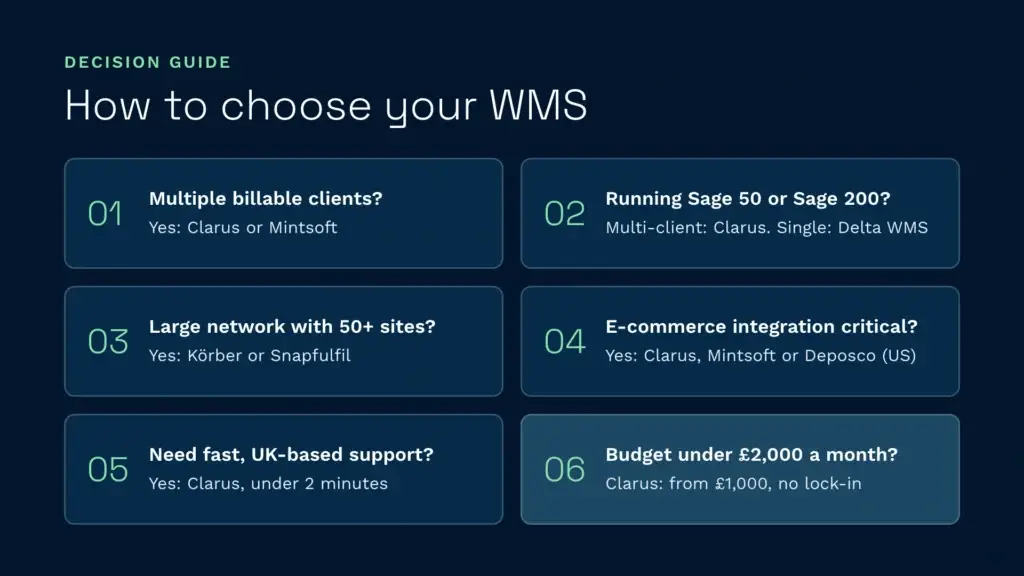
How to choose: decision guide
Use these questions to narrow your search:
- Do you bill multiple clients (3PL or contract warehousing)? Yes: shortlist Clarus, Mintsoft and Access Delta, and compare billing depth. No: move to the next question.
- Do you need tight accounting or ERP integration? Check each vendor’s named connectors. Clarus connects to Brightpearl, Xero and Sage 200, Access Delta lists Sage, Pegasus and Exchequer, and SnapFulfil is certified for NetSuite.
- Are you running a large automated distribution centre or multi-site network? Yes: Körber (Infios) or SnapFulfil. No: move to the next question.
- Is ecommerce channel integration critical? Yes: Clarus, Mintsoft or Deposco, depending on where your customers and carriers are.
- Do you want AI that acts, not just advises? Clarus’s AI recovers missed charges, quarantines expired stock and processes batch orders. Most alternatives here forecast or recommend and leave the action to your team.
- Do you want to avoid a long contract? Clarus is paid monthly with no long-term tie-ins. Ask every vendor for their minimum term and notice period in writing.
Migration steps: moving from Peoplevox
If you’ve decided to switch, here’s what a typical move looks like:
- Data audit: export your master data from Peoplevox, including products, SKU attributes, stock levels and client configurations, and map it to the new system.
- Configuration: set up clients, billing rules, picking workflows and carrier integrations, using your current setup as a starting point and fixing what doesn’t work today.
- Data load: load stock balances, open orders and client settings while Peoplevox keeps running.
- Testing: run picking, packing and billing in parallel, and check reports against your current system until the numbers match.
- Go-live: cut over at a quiet point in the week and archive Peoplevox.
- Post-go-live support: refine automations and train staff on live workflows.
Clarus is built to get you live in weeks, not quarters. Campeys went live in under two months. To see how a move from Peoplevox would work for your operation, compare plans or talk to the team.