

Choosing between a warehouse management system and a retail operations platform depends entirely on what you’re trying to solve. If you’re a 3PL managing multiple clients’ inventory in a single warehouse, or a distributor handling complex warehouse operations, you need a purpose-built WMS for 3PLs. If you’re a retail brand or wholesaler running omnichannel ecommerce operations, you need a retail operating system. Clarus and Brightpearl serve fundamentally different needs, and confusing the two can lead to expensive implementation struggles.
Brightpearl is a retail operations platform built for omnichannel merchants: inventory and order management across Shopify, Amazon, eBay and physical stores, with accounting integration and demand planning. Clarus is a cloud-native WMS built for 3PLs, wholesalers and complex distribution operations, with multi-client stock segregation, automated 3PL billing and real-time warehouse task management.
This guide compares them across the areas that matter: architecture, 3PL and multi-client capabilities, billing automation, warehouse operations, integrations, implementation, pricing and support.
Quick comparison table
| Clarus WMS | Brightpearl | |
|---|---|---|
| Bäst för | 3PLs, wholesalers, distributors, food and beverage, complex warehousing | Retail brands, omnichannel ecommerce, multichannel retailers, wholesalers with retail operations |
| Arkitektur | Cloud-native, no servers to maintain | Retail operating system, part of Sage |
| Flera kunder / 3PL | Built in: stock segregation, per-client workflows, per-client reporting, white-label client portal | Connects to 3PL partners; not designed for multi-client billing within one warehouse |
| Automatisk fakturering | Captures storage, pick, pack, despatch, returns and value-added services in real time | No multi-client 3PL billing; accounting is built around your own brand’s sales |
| Warehouse operations | Wave picking, real-time scan verification, FEFO/FIFO, replenishment, temperature zones | Barcode workflows, batch and wave picking, guided putaway, serial, lot and expiry tracking, built around one merchant’s own stock |
| Integrationer | 200+ out of the box (ecommerce, 70+ carriers, pallet networks, ERP, TMS) | Shopify, BigCommerce, Magento, Amazon, eBay, Walmart, Xero, QuickBooks Online, Sage Intacct, 3PL partner network |
| Implementeringstid | Cirka 12 veckor | Varies: Brightpearl customer stories range from under 40 days to four months |
| Stöd | Support response in under five minutes | Provided by Brightpearl by Sage |
Architecture and deployment
Clarus: cloud-native
Clarus runs entirely in the cloud on ISO-certified AWS infrastructure, with no servers to maintain. Every user runs the latest version, so there are no upgrade cycles or version management to plan around. Your warehouse can add more users, more sites or more complex workflows without infrastructure changes, including through multi-warehouse support. This is especially useful for 3PLs taking on new contracts: you add a new client, define their workflows and billing rules, and go live without touching a server.
Brightpearl: retail operating system
Brightpearl is a retail operations platform that Sage agreed to acquire in December 2021, and it now sits within the Sage ecosystem. It works as an omnichannel retail back office: orders, inventory, accounting and reporting in one place. The platform is designed around retail workflows, so sales channels (Shopify, Amazon, eBay) and accounting integration (Sage Intacct, QuickBooks, Xero) are central to it. Implementation covers channel integration, workflow setup and data migration.
Multi-client and 3PL capabilities
This is where the two platforms differ most.
Clarus: built for multi-client warehousing
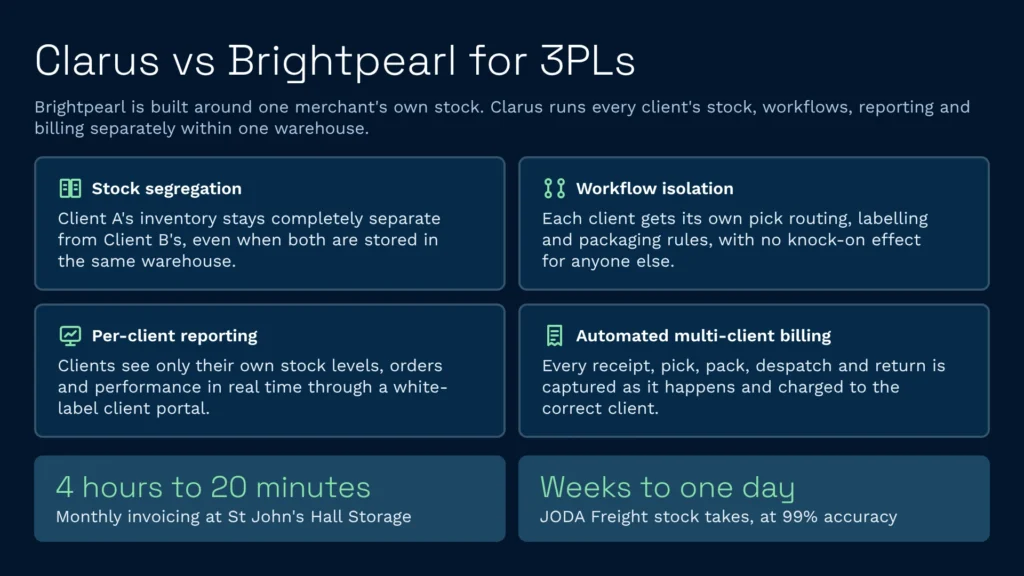
Clarus is built for 3PLs and multi-client warehousing. Every client’s stock, workflows, reporting and billing runs separately within a single warehouse environment. This means:
- Stock segregation: Client A’s inventory is completely isolated from Client B’s, even though both are stored in the same warehouse.
- Workflow isolation: Each client can have different pick routing, labelling and packaging rules without affecting anyone else.
- Per-client reporting: Each client sees only their own inventory levels, orders and performance in real time through a white-label kundportalen.
- Automated multi-client billing: Every billable event (inbound receipt, storage, pick, pack, despatch, returns, value-added services) is captured in real time and tied to the correct client, with no month-end manual reconciliation.
Förvaring i St John’s Hall cut their invoicing workload from 4 hours to 20 minutes a month by removing manual reconciliation. JODA Frakt went from stock takes that took weeks in Excel to stock takes completed in a single day, and reached 99% stock accuracy.
Brightpearl: single-brand retail ERP with 3PL connectors
Brightpearl is designed for a single brand or merchant managing inventory across multiple sales channels and locations (Shopify stores, Amazon, physical shops). It connects to 3PL partners, but it isn’t designed to manage multiple clients’ inventory within one warehouse. If you use Brightpearl and outsource fulfilment to a 3PL, Brightpearl stays your inventory source of truth and the 3PL’s system connects as a fulfilment partner. You don’t get multi-client billing, per-client workflows or client portals within Brightpearl itself.
Faktureringsautomatisering
Clarus: real-time event capture
For 3PLs, Clarus’s billing engine is the biggest operational win. Every action in the warehouse is captured in real time and tagged to the correct client, from receiving a pallet and storing a SKU for 30 days to picking an order, packing a case, despatching through a carrier and processing a return. At month end, invoices are generated through automated charging and invoicing, with no data entry and no reconciliation. MSD cut their warehouse admin by 60% after moving away from manual spreadsheet billing.
Brightpearl: retail accounting integration
Brightpearl’s billing is built around retail operations: order-to-invoice workflows for your own brand’s sales, linked to your accounting system (Sage Intacct, QuickBooks, Xero). If you’re a 3PL, you’d invoice clients outside Brightpearl using a separate billing system or spreadsheets. Brightpearl doesn’t automate multi-client billing.
Warehouse operations and picking optimisation
Clarus: complex warehouse optimisation
Clarus is built for complex warehouse operations, the kind of work that happens in high-touch 3PL warehouses, food distribution and wholesale. Core capabilities include:
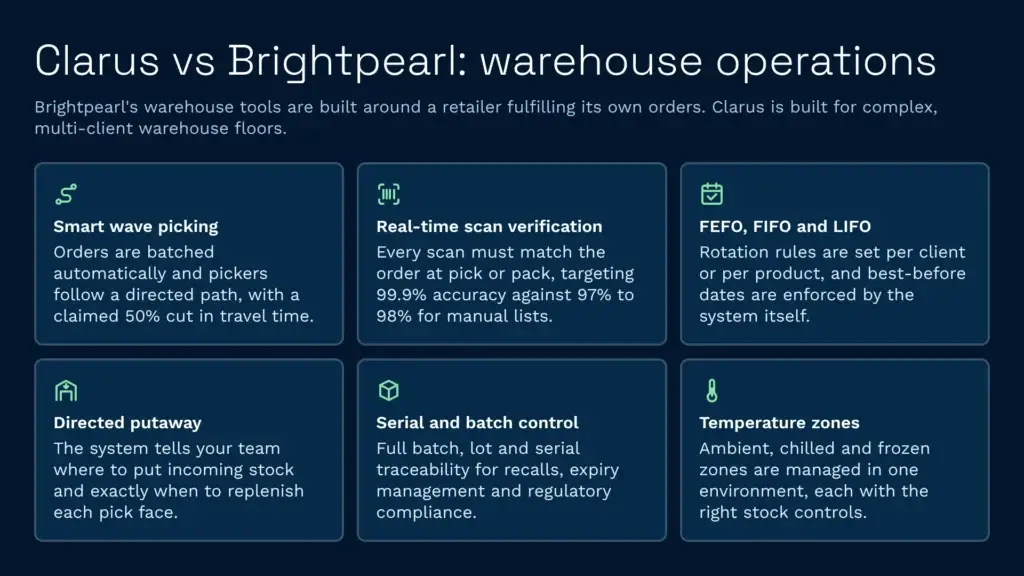
- Smart plockning av vågor: Orders are batched automatically and picking paths are optimised, with a claimed 50% reduction in travel time. Pickers follow a directed path through the warehouse rather than choosing their own route.
- Real-time scan verification: Varje barcode scan must match the order at the point of pick or pack. If there’s a mismatch, the system stops the operation and alerts the supervisor. It targets 99.9% accuracy, compared with the 97% to 98% typical of manual pick lists.
- FEFO/FIFO/LIFO rotation: Stock rotation is configurable per client or per product, and best-before dates are enforced by the system rather than managed on clipboards.
- Replenishment and directed putaway: The system tells warehouse staff where to put incoming stock och when to replenish pick faces.
- Serial and batch control: Full batch and lot traceability och registrering av serienummer for recalls, expiry management and regulatory compliance, which matters most in food and pharmaceuticals.
- Multi-zone support: Ambient, chilled and frozen zones managed in a single environment through temperature-zone management.
Brightpearl: retail-focused warehouse management
Brightpearl’s warehouse management module covers barcode-driven workflows on handheld scanners, batch and wave picking, guided putaway, and serial, lot and expiry tracking. It’s designed around a retailer fulfilling its own orders from multiple sales channels and routing them to the right warehouse or 3PL. What it isn’t built for is a 3PL running many clients’ stock, rules and billing side by side in one building, or managing ambient, chilled and frozen zones as part of that.
Integrationer
Clarus: 200+ warehouse-focused integrations
Clarus integrates with:
- Ecommerce: Shopify, WooCommerce, Amazon, eBay, Etsy, TikTok Shop, BigCommerce, Magento
- Carriers: 70+ shipping providers including DHL, UPS, FedEx, Postverket, Parcelforce, DPD, Evri och TNT
- Pallet networks: Palletways, Pall-Ex, The Pallet Network, Palletforce
- ERP and inventory: Sage 200, Microsoft Dynamics, SAP, QuickBooks, Brightpearl, Zoho Inventory, Unleashed Software
- TMS: Qargo, MaxOptra
- 200+ total out-of-the-box connections across the integrations library
The integration approach is carrier-first: whatever logistics partner a 3PL uses, Clarus is likely to connect to it directly. Shipment data, tracking and returns flow automatically, with no manual carrier uploads or re-keying.
Brightpearl: ecommerce and accounting focused
Brightpearl integrates with:
- Sales channels: Shopify, Shopify Plus, BigCommerce, Magento, Amazon, eBay, Walmart
- Accounting and payments: Sage Intacct, QuickBooks Online, Xero, Stripe, Square
- Fulfilment: a network of 3PL partner integrations
Brightpearl is a strong hub for omnichannel retail, centralising orders and inventory from multiple sales channels and syncing accounting automatically. If you’re a 3PL working with a Brightpearl merchant, though, you connect as their fulfilment partner (incoming orders, outgoing shipments), not as the system that runs your warehouse.
Implementation time and complexity
Clarus: around 12 weeks
Clarus implementations follow a predictable path because the platform’s workflows are pre-built around warehouse operations. Implementation covers data migration from your legacy WMS or spreadsheets, configuration of picking rules and client workflows, carrier and ERP integrations, and user training. As it’s cloud-native, there’s no infrastructure to set up. A standard project goes live in around 12 weeks.
Brightpearl: varies by scope
Brightpearl doesn’t publish a standard implementation timeline. It says customers go live around 25% faster than with legacy ERP projects, and the customer stories on that page range from under 40 days to four months. The scope is wider than a WMS change: you’re centralising orders, inventory, accounting and reporting in one place, so channel setup (Shopify, Amazon and others), workflow design, accounting configuration, data migration and staff training all sit within the project.
Pricing and contract terms
Clarus: transparent, pay monthly
Clarus pricing is tiered across Core, Scale and Enterprise plans. Your quote is made up of:
- A monthly base fee set by your plan
- Tiered user licensing, where the cost per user falls as you scale
- A one-off implementation fee covering bespoke setup such as layout configuration, SKU cleaning and custom courier logic
- Pay monthly, no tie-ins, rather than a long-term commitment
All major features are included: multi-client management, automated billing, integrations and cloud infrastructure. The pricing page also has a Cost of Chaos calculator that estimates what manual processes and legacy tech are costing your operation today.
Brightpearl: custom pricing
Brightpearl doesn’t publish list prices. Pricing is quoted per business, and unlimited users are included in the subscription. Implementation is scoped on top of the software, and multi-location setups, complex channel integrations and accounting workflows all add to the size of that project. When comparing quotes, ask for the full first-year cost, software and implementation together.
Support and service
Clarus: support response in under five minutes
Clarus offers dedicated cloud support with a support response time of under five minutes. That matters for 3PLs: when a client’s stock isn’t moving through the system, you need fast, hands-on help, not a wait for a callback.
Brightpearl: Sage support model
Support for Brightpearl is provided by Brightpearl by Sage. If response times matter to your operation, check the service levels attached to the plan you’re quoted.
Där Clarus utmärker sig
- 3PL and multi-client warehousing: Built for it from day one. Multi-client stock segregation, automated billing and per-client workflows are native to Clarus, whereas Brightpearl is designed around a single merchant’s stock.
- Time to value: A standard implementation runs to around 12 weeks, and the cloud-native architecture means no servers, no downtime and no version upgrades to plan around.
- Warehouse optimisation: Wave picking, scan verification, FEFO rotation, replenishment logic and temperature zones are built in, all designed for running many clients in one warehouse. Brightpearl’s focus is orders and inventory; Clarus’s is warehouse operations.
- Transparent prissättning: Clear monthly pricing and predictable base costs, though a standard one-off implementation fee applies.
- Fast support: Support response in under five minutes.
- No vendor lock-in: Pay monthly, with no tie-ins.
Where Brightpearl wins
- Omnichannel retail: Built for multichannel ecommerce from the ground up. If you’re a retail brand selling on Shopify, Amazon, eBay and your own website at once, Brightpearl centralises orders and inventory across all channels in a way that’s more natural than adding integrations to a WMS.
- Accounting integration: Brightpearl has its own retail accounting module plus pre-built connections to Sage Intacct, QuickBooks and Xero. If your team lives in accounting software and needs real-time order-to-invoice automation, this is where Brightpearl is strongest.
- Demand planning: Brightpearl’s Lagerplanerare uses demand forecasting and seasonality to recommend stock levels and transfers across locations, which is valuable for retail brands managing seasonal peaks. Clarus focuses on warehouse execution rather than retail demand forecasting.
- Sage ecosystem: As part of Sage, Brightpearl suits larger retailers who want their retail operations tightly connected to wider Sage finance systems.
Who should choose Clarus
- 3PLs: managing multiple clients’ inventory in shared warehouse space, billing each client separately, and needing real-time visibility of each client’s stock.
- Wholesalers and distributors: complex warehouse operations, pick optimisation, batch and serial control, and multi-zone management (chilled, frozen, ambient).
- Food and beverage distributors: FEFO/FIFO enforcement, expiry date management and recall readiness. Familjen Campeys från Selby runs recall tests in under five minutes.
- Fast-growing companies: need to go live quickly and scale without replacing their WMS as they grow.
- Operators who want predictable costs: transparent pricing, pay monthly, no tie-ins.
Who should choose Brightpearl
- Retail brands with omnichannel operations: selling on multiple platforms (Shopify, Amazon, eBay, physical stores) and needing unified inventory and order management.
- Multi-location retailers: managing inventory across several stores or warehouses, moving stock between locations, and reporting on each location separately.
- B2B wholesalers with retail operations: selling to retail customers and direct to consumers through ecommerce channels, needing both wholesale and retail workflows in one system.
- Retailers with tight accounting requirements: if your finance team needs order-to-invoice automation linked to Sage Intacct, QuickBooks or Xero, Brightpearl is built for that.
- Larger retailers in the Sage ecosystem: complex multi-site operations that want their retail platform connected to wider Sage systems.
If you’re still weighing up whether you need a WMS, an ERP or both, our guide to ERP vs WMS covers the difference in more detail.
Integrating Clarus and Brightpearl
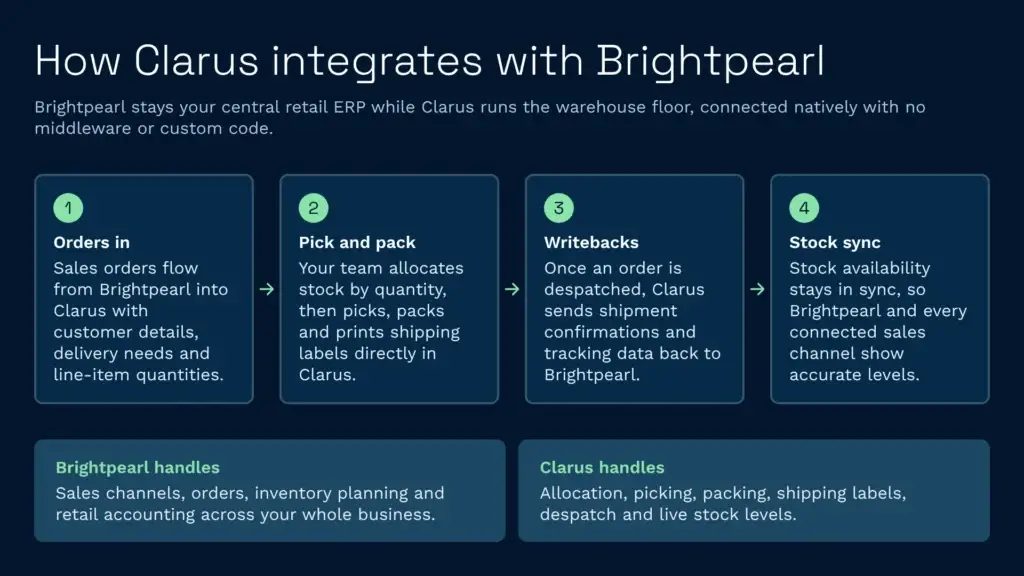
Clarus and Brightpearl serve different primary functions, but you don’t have to pick one or the other. For businesses that need Brightpearl’s omnichannel retail management alongside Clarus’s warehouse controls, the two platforms connect through a native Brightpearl integration, with no third-party middleware or custom code.
When connected, Brightpearl acts as the central retail ERP while Clarus runs the physical work on the warehouse floor. Here’s how the workflow operates:
- Vidarebefordran av order: Sales orders flow automatically from Brightpearl into Clarus, with customer details, delivery requirements and line-item quantities.
- Warehouse execution: Your team allocates stock by quantity, then picks, packs and prints shipping labels in Clarus.
- Real-time writebacks: Once an order is despatched, Clarus pushes shipment confirmations and tracking data back to Brightpearl.
- Inventory synchronisation: Stock availability stays in sync, so Brightpearl and every connected sales channel show accurate, real-time inventory levels.
This integration suits growing retail brands and wholesalers who have outgrown standard ecommerce fulfilment and need purpose-built warehouse management behind their Brightpearl operations.
Tala med en lagerarbetare
If you’re comparing your options and want to see how a purpose-built WMS works in practice, Clarus is worth a conversation. We work with 3PLs and distributors across the UK to implement warehouse management software that fits the way you operate, not the other way round.
Kom i kontakt med vårt team att diskutera dina krav.