

Logiwa is a capable cloud-native WMS built for high-volume ecommerce fulfilment, particularly DTC brands scaling rapidly. However, if you’re a UK 3PL managing multiple clients, operating a food and beverage operation, or need billing automation built into your core platform, Logiwa may force you into workarounds rather than purpose-built workflows. This guide compares Logiwa with genuine alternatives. Systems designed for your specific operational model offer different trade-offs in speed, cost, and multi-client capability.
Logiwa Alternative WMS comparison
| Plattform | Am besten für | Mandantenfähigkeit | Umsetzung | Integrationen |
|---|---|---|---|---|
| Clarus WMS | UK 3PLs, multi-client operations | Automated, event-driven, built-in | 2-6 weeks | 200+ (ecommerce, ERPs, carriers) |
| Snapfulfil | High-volume picking, ecommerce | Rules-based, configurable, additional setup | 45 days | ERP, e-commerce, carriers |
| Mintsoft | DTC brands, omnichannel 3PL | Supported, requires configuration | 4-8 Wochen | 131+ integrations |
| Logiwa | High-volume ecommerce, fulfilment | Manual or API-based, not native | 4 weeks | 200+ ecommerce, ERP, shipping |
| Körber | Enterprise, large networks | Full suite, complex setup | 6-18 months | Extensive |
| Deposco | 3PL, wholesale, B2B/B2C mix | Automated, client-agnostic | 4-8 Wochen | Broad integration library |
Logiwa vs the most common UK alternatives
Logiwa vs Clarus WMS
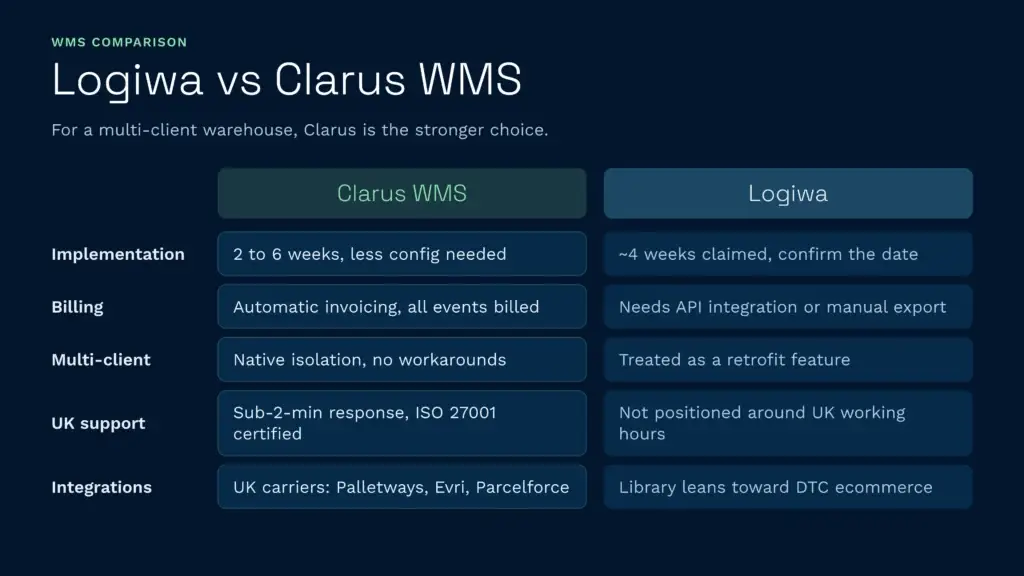
Clarus is a UK-built, cloud-native WMS purpose-designed for 3PLs, wholesalers, and food and beverage operations. For a multi-client warehouse, Clarus is the stronger choice.
Implementation speed: Clarus deploys in 2 to 6 weeks. Logiwa says its typical go-live is around four weeks, though as above, that’s worth confirming against a written date rather than a headline figure. Clarus’s serverless architecture and multi-client-first data model mean less configuration time either way.
Billing automation: Clarus captures receiving, storage, picking, packing, despatch, and returns as first-class billing events. Monthly invoicing is automatic. Logiwa requires API integration or manual export to achieve the same outcome.
Multi-client complexity: Clarus isolates each client’s inventory, reporting, and billing within a single warehouse without system workarounds. Logiwa treats multi-client as a retrofit feature, not a native architecture.
Pricing: Clarus starts from £1,000/month on monthly rolling contracts with no lock-in. Logiwa doesn’t publish pricing, quotes are custom, and 3PLs report that multi-client requirements push costs up from whatever entry-level figure gets quoted first.
UK support and compliance: Clarus offers sub-2-minute support response times, UK phone support during UK working hours, and is ISO 27001 certified. For UK 3PLs operating carrier integrations with DHL, UPS, Königliche Post, and local providers, UK support hours matter.
Integrationen: Both systems claim 200+ integrations. Clarus specialises in UK carrier integrations (Palletways, Pallex, The Pallet Network, Parcelforce, Evri) that matter for 3PLs. Logiwa’s library leans heavily toward DTC ecommerce platforms.
Logiwa vs Snapfulfil
Snapfulfil is a high-speed picking and packing WMS built for volume. If you operate a fulfilment centre where most activity is picking, Snapfulfil’s wave-based workflows are a strong fit. For true multi-client 3PL operations, it requires additional configuration.
Best for: High-volume picking operations, standardised workflows, ecommerce fulfilment centres.
Deployment: 45 days by Snapfulfil’s own account, faster than most, but with a more standardised configuration and less flexibility for complex client contracts.
Pricing: Quote-based. 3PLs consistently describe it as a bigger investment than entry-level cloud WMS options, particularly once multi-client configuration is added.
Multi-client billing: Supported via configurable rules, but requires manual setup per client.
Where Snapfulfil stands out: Wave-based picking workflows built for speed, and a strong fit for high-volume B2C operations.
Where Snapfulfil falls short for 3PLs: Limited flexibility for clients with unique SLAs or complex billing rules. Per-client configuration takes more setup than Clarus. UK 3PLs managing clients with bespoke returns processes or value-added services often report that Snapfulfil forces standardisation rather than enabling customisation.
Logiwa vs Mintsoft
Mintsoft is a UK-based omnichannel order management and warehouse system strong for DTC brands scaling into 3PL operations. If you’re a smaller 3PL or a brand planning to offer white-label fulfilment, Mintsoft is worth evaluating.
Best for: UK DTC brands, smaller 3PLs, omnichannel order complexity.
Stärken: 170+ integrations; strong omnichannel order management; good support for smaller operators.
Deployment: Typically weeks rather than months for a straightforward setup.
Billing automation: Supported, but less native to the architecture than Clarus.
Where Mintsoft is competitive: For a UK brand running its own fulfilment alongside customer orders, Mintsoft’s integrated order management is less fragmented than Logiwa.
Einschränkungen Smaller integration library and user base than Clarus or Snapfulfil; support responsiveness is slower than Clarus’s sub-2-minute SLA.
Logiwa vs Körber and enterprise systems
Körber, Manhattan Associates, and Infor are enterprise-class WMS platforms built for large automated distribution centres. They are overspecified for UK mid-market 3PLs.
Umsetzungszeit: Measured in many months, and can run well over a year for complex sites. Total cost of ownership sits at enterprise scale, well beyond what most mid-market UK 3PLs would budget for software alone.
Best for: 500+ site networks, highly automated environments, global enterprises with standardised processes.
Why they’re not a fit for most UK 3PLs: Implementation cost exceeds the annual software spend for smaller 3PLs. Deployment timescales mean you cannot respond to market changes. You need a team of permanent IT staff to manage them.
How to evaluate WMS reviews and choose between options
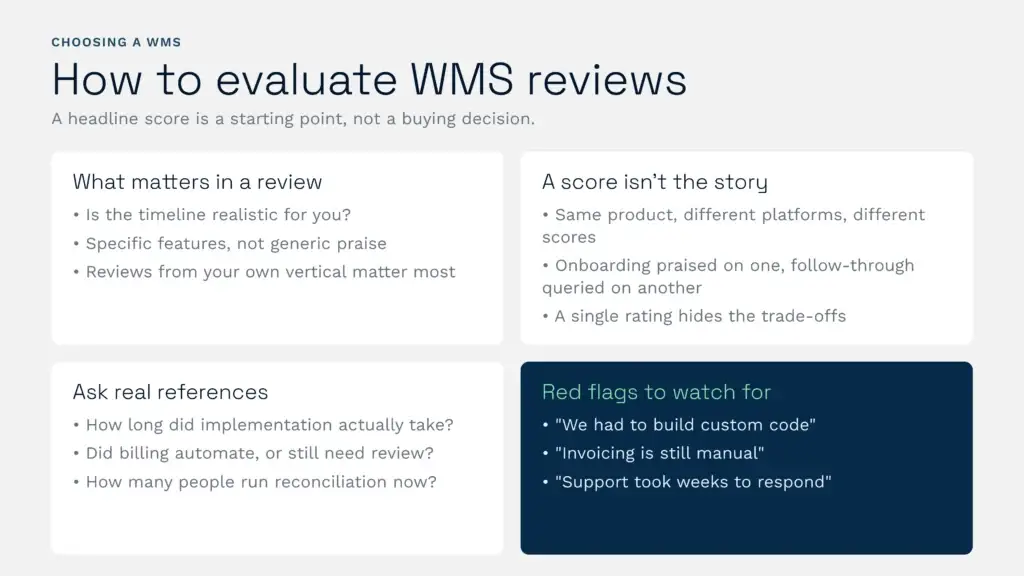
When researching Logiwa, Clarus, or any WMS, you will find buyers checking Trustpilot, G2, and Capterra for independent ratings. A headline score is a starting point, not a buying decision.
What matters in a review: Look for implementation timeline reported by the reviewer (is four weeks realistic for your use case?), specific features mentioned (does the reviewer cite what you need, or generic praise?), and support responsiveness (do they name a response time or escalation experience?). Reviews from your vertical matter most. A 3PL’s experience with billing automation is more relevant to you than a DTC brand’s praise for picking speed.
Why a headline score is insufficient: Logiwa has a 4.6/5 on Capterra but a 4.2/5 on G2, both scores are positive, but they hide divergent feedback. On Capterra, users praise onboarding and stability. On G2, some cite inconsistent ticket follow-through despite friendly support. A single star rating glosses over that trade-off.
What to ask of references: When comparing platforms, request a reference from a 3PL running your specific vertical (food, parcel, B2B, wholesale). Ask: how long did implementation take? Did the billing automation work out of the box, or did you need custom integration? How many people do you need in back-office reconciliation versus your previous system? If they mention that invoicing still requires a person reviewing reports weekly, that tells you billing automation is not really automated.
Red flags in reviews: Watch for mentions of “we had to build custom code,” “invoicing is still manual,” “the support team took weeks to respond,” or “we had to hire a consultant to configure multi-client workflows.” Those are legitimate experiences, not outliers. They suggest the platform’s design does not match your use case.
Clarus WMS for UK 3PLs and beyond
If you’re a UK 3PL managing multiple clients, the best WMS for ecommerce fulfilment in the UK is one designed around multi-client reality. That is where Clarus WMS differentiates. The system was built by operators frustrated with exactly this problem: platforms that claimed to support 3PL operations but forced you into unsustainable workarounds.
Clarus’s architecture isolates each client’s inventory, reporting, and billing without cross-contamination. Storage, picking, packing, and returns each trigger a billable event in real time. No daily export, no manual reconciliation, no revenue leakage.
Which WMS can go live in weeks rather than many months? Clarus. Implementation averages 2 to 6 weeks because the platform is cloud-native, serverless, and multi-client-first. You do not need a lengthy rollout to configure what the system was designed to do natively.
The platform integrates with 200+ ecommerce, ERP, and carrier systems including Shopify, WooCommerce, Amazon, Sage 200, SAP, and all major UK carriers. For a 3PL onboarding a new client who uses Shopify and ships via Palletways, integration complexity is near zero.
Real outcomes from UK 3PLs: JODA Fracht reached 99% stock accuracy within two years of switching. MSD (Mitchell Storage & Distribution) cut admin workload by 60% and used the freed-up time to launch new services, including a cross-docking operation for Palletforce. See full case studies.
Clarus pricing is transparent: from £1,000/month on monthly rolling contracts, no lock-in, no surprise implementation fees. Support is sub-2-minute response time by UK phone and live chat during UK working hours.
How to choose the right alternative
Start with your primary pain point. If your challenge is invoicing accuracy and multi-client billing transparency, Clarus is the fastest route to resolution. If you operate a single-client high-volume fulfilment centre, Snapfulfil’s picking optimisation is hard to beat. If you’re a UK DTC brand planning to add fulfilment-for-others, Mintsoft bridges order management and warehouse operation well.
Run a proof of concept with your top two platforms. A real POC (not a demo) should involve real data, at least two of your client contracts, and a full billing cycle. If the platform requires custom code to invoice correctly, that cost belongs in your evaluation.
Check deployment claims against references in your vertical. “Four weeks” means different things: four weeks if your data is clean and your staff are trained, or four weeks of configuration work on top of data cleanup? Ask the vendor for a named customer you can call who matches your profile.
Evaluate support for your time zone and hours. A 24-hour global support team is not the same as UK support during UK business hours. If you operate a UK warehouse, a 2-minute response time in UK hours matters more than 24-hour response.
Sprechen Sie mit einem Lagerfachmann
Wenn Sie gerade Ihre Optionen abwägen und sehen möchten, wie ein speziell entwickeltes WMS in der Praxis funktioniert, lohnt es sich, mit Clarus ins Gespräch zu kommen. Wir arbeiten mit 3PL-Anbietern und Distributoren in ganz Großbritannien zusammen, um Lagerverwaltungssoftware zu implementieren, die sich Ihren Arbeitsabläufen anpasst – und nicht umgekehrt.
Kontaktieren Sie unser Team um Ihre Anforderungen zu besprechen.