

ProSKU WMS is a cloud-based warehouse management system aimed at smaller eCommerce, retail and fulfilment operations. Its selling points are fast deployment, per-user monthly billing, and integrations with over 70 marketplaces and 140 carriers. For businesses getting started with warehouse software, those are useful. But as operations grow in volume, complexity or number of clients, many UK 3PLs and warehouse teams find they need more than ProSKU was designed to deliver. This guide looks at the most common reasons for switching and what to look for in a ProSKU alternative.
What is ProSKU WMS and who is it designed for?
ProSKU is a SaaS warehouse management system built for smaller and growing storage operations. Its main users are eCommerce retailers, eFulfilment providers, wholesalers and manufacturers. The system is cloud-hosted, needs no on-premise infrastructure, and is priced per user on a monthly subscription, with no free trial.
Core capabilities include varemottak-behandling, pick routing, order management, cycle counting, returns management and reporting. ProSKU connects with popular eCommerce platforms including Shopify, Magento, WooCommerce, Amazon og eBay. For businesses processing straightforward B2C or direct-to-consumer orders with standard workflows, it can be a practical first step into WMS technology.
The main constraint is scope. ProSKU is positioned for the smaller storage operation. Mid-market 3PLs with many clients, bespoke contracts and more advanced warehouse logic tend to need more depth than it was built for.
Why do warehouses look for a ProSKU alternative?
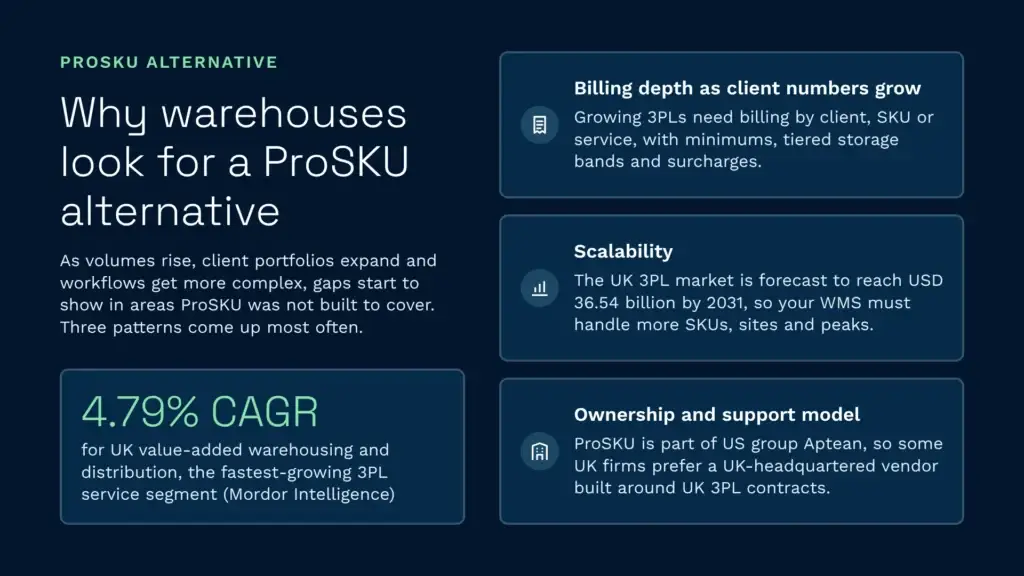
The most common reason UK warehouse operators look for a ProSKU alternative is outgrowing it. As volumes rise, client portfolios grow and workflows get more complex, gaps start to show. Three patterns come up most often.
Billing depth as client numbers grow
ProSKU lists support for 3PL workflows, along with billing and invoicing. The question for a growing 3PL is how far that goes. Once you’re running dozens of clients, each with their own contract, you need to bill by client, SKU or service, with minimums, tiered storage bands and surcharges, and keep every client’s stock and data separate. If the system can’t handle that natively, teams end up reconciling invoices in spreadsheets, which costs management time and lets charges slip through.
Skalerbarhet
The UK 3PL market is forecast to grow from USD 30.39 billion in 2026 to USD 36.54 billion by 2031, a CAGR of 3.75%, according to Mordor Intelligence. Value-added warehousing and distribution is the fastest-growing service segment, at 4.79% CAGR. Operations that want a share of that growth need a WMS that can handle more SKUs, multiple sites and peak trading volumes without slowing down.
Ownership and support model
ProSKU comes from Principal Logistics Technologies, which US software group Aptean acquired in July 2024. Aptean is headquartered in Alpharetta, Georgia. Some UK businesses prefer a UK-headquartered vendor whose product roadmap is shaped around British 3PL contracts, and that’s a fair thing to weigh when choosing a long-term system.
What should you look for in a ProSKU alternative?
A ProSKU alternative shouldn’t just copy what ProSKU does. It should fix the gaps that made you look in the first place. Before you evaluate platforms, map your current pain points against these areas.
- Multi-client architecture: If you run a 3PL, the system must separate stock, billing and reporting by client as standard. Bolt-on workarounds break as you grow.
- Fakturering og faktura: Automated klientfakturering that captures pick fees, storage charges, handling and bespoke tariffs is a core 3PL requirement, not a nice-to-have.
- Kundeportal: Customers should be able to log in, check live stock, download reports and raise requests without contacting your team for every query.
- Advanced pick strategies: Zone, batch and wave picking plus directed putaway are standard in mid-market operations. Confirm the platform supports your picking model.
- Open API: Your WMS needs clean, documented APIs to connect with ERPs, eCommerce platforms, carriers and automation equipment.
- Støttemodell: Check where the support team is based and whether their hours line up with your shifts.
- Proven 3PL deployments: Ask vendors for reference customers in your sector and at a similar scale. Generic case studies aren’t the same as 3PL-specific evidence.
Which ProSKU alternatives are best for UK 3PLs?
The right alternative depends on your scale, business model and how complex your operation is. These are the strongest ProSKU alternatives for UK operators in 2026.
Clarus WMS
Clarus WMS is a UK-built, agentic AI-driven warehouse management system for third-party logistics providers and complex warehouse operations, headquartered in Manchester. ProSKU targets smaller eCommerce fulfilment. Clarus is built around multi-client management from the start: each client’s stock stays separate, and every client gets a branded kundeportal with live stock, orders, charges and KPIs.
Billing is automated. Completed warehouse tasks are priced against tariffs you set by customer, SKU, project or SLA, with support for tiered bands, minimums, surcharges and seasonal rates. Clarus’s AI also catches missed pallet charges across multiple customer accounts, with its agents working under guardrails.
Order management supports wave, batch and zone picking, and goods-in uses directed putaway. Clarus connects to eCommerce platforms, ERPs, TMS and carriers through ready-made connectors and a documented API.
Mintsoft
Mintsoft is a cloud WMS from The Access Group, with its roots in eCommerce and multichannel fulfilment. It has built-in 3PL billing and a client portal, and strong carrier connectivity. That makes it a natural step up for eCommerce-led fulfilment houses that have outgrown ProSKU.
Canary7
Canary7 targets SME logistics providers and growing multichannel operations, with offices in the UK and Canada. It includes rate card billing and a branded client portal, and suits operators moving on from basic stock management tools who need more than ProSKU.
Peoplevox
Descartes Peoplevox is built for fast-growing direct-to-consumer eCommerce brands. It focuses on pick and pack speed, multichannel selling and Shopify-led operations. That makes it a better fit for brands running their own warehouse than for multi-client 3PLs.
| Plattform | Best for | Built-in 3PL billing | Kundeportal | Ownership |
|---|---|---|---|---|
| Clarus WMS | Mid-market 3PLs and complex warehouses | Yes, configurable tariffs | Ja | Clarus, Manchester (UK) |
| ProSKU | Small eCommerce and fulfilment operations | Billing and invoicing listed | Check with vendor | Aptean (US) |
| Mintsoft | eCommerce-led fulfilment and 3PLs | Ja | Ja | The Access Group (UK) |
| Canary7 | SME logistics and eCommerce operations | Yes, rate cards | Ja | Canary7 (UK and Canada) |
| Peoplevox | High-growth DTC eCommerce brands | Not listed | Check with vendor | Descartes |
How does Clarus WMS compare to ProSKU for 3PL operations?
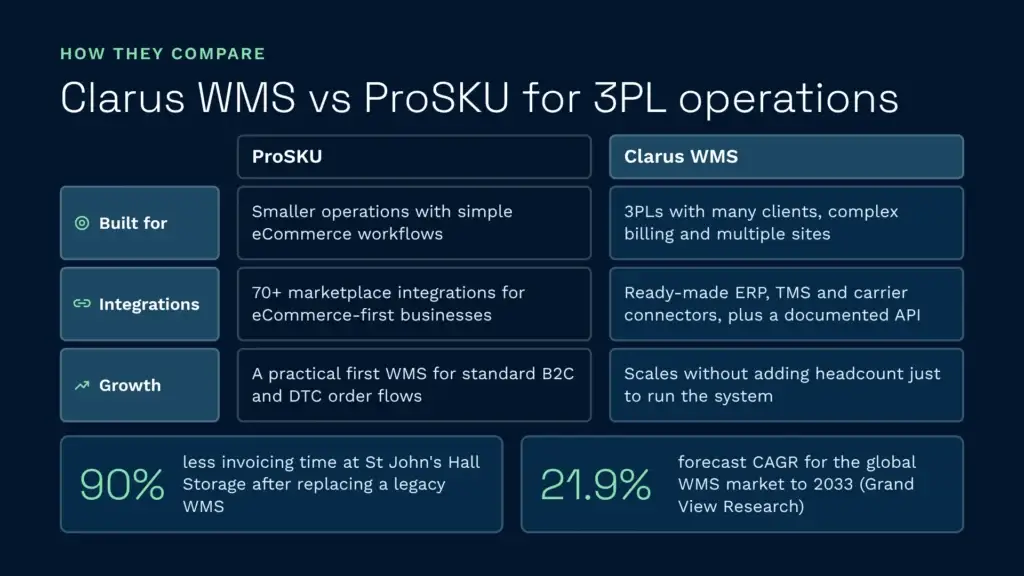
ProSKU and Clarus WMS are built for different operations. ProSKU is designed for the smaller or growing storage operation with straightforward eCommerce workflows. Clarus WMS is built for 3PLs managing many client accounts and complex billing, and for warehouses that need to scale without adding headcount just to run the system.
ProSKU leads with its catalogue of 70+ marketplace integrations. Clarus has its own ready-made connectors, including Brightpearl, Qargo TMS, Jodle, Whistl og The Pallet Network, plus a documented API for anything else. That matters when a 3PL takes on a new client running bespoke or less common systems.
St John’s Hall Storage is a good example. It replaced a legacy on-premise WMS it had used for around 25 years. Before the switch, its Managing Director spent about four days a month checking invoices. With Clarus, St John’s Hall Storage cut invoicing time by 90% and moved from monthly to weekly invoicing.
The wider market is moving fast. The global WMS market was valued at USD 3.38 billion in 2025 and is projected to reach USD 15.95 billion by 2033, a CAGR of 21.9%, according to Grand View Research. In the UK, retail and eCommerce already account for 28.15% of the 3PL market and are growing at 5.40% a year, according to Mordor Intelligence. Operators who stay on an under-featured WMS risk falling behind competitors who can process more volume, onboard new clients faster and give customers better visibility. Those are all areas where the right WMS makes a direct difference.
Ready to see what a purpose-built 3PL WMS looks like?
If your operation has outgrown ProSKU, Clarus WMS is worth a closer look. We work with UK 3PLs and complex warehouse operations, and Clarus is built around how British 3PL contracts work, from client billing and portal access to multi-site management.
Our team can talk you through how Clarus would handle your billing model, your pick strategies and your client rapportering requirements. You can watch a product tour or get an estimate from our pricing calculator først.
Ta kontakt med teamet vårt å snakke gjennom dine krav.