

Magazijnbeheer Het draait in wezen om het beheersen van drie zaken: voorraad, personeel en ruimte. Als je hierin de fout ingaat, verandert je bedrijfsvoering in een wirwar van inefficiëntie, voorraadverlies en gefrustreerd personeel. Als je het goed aanpakt, run je een winstgevende, schaalbare vestiging die zich soepel aanpast aan de vraag.
Deze gids leidt u door de belangrijkste aspecten van magazijnbeheer: de aspecten die het verschil maken tussen goed georganiseerde, efficiënte magazijnen en chaotische magazijnen die veel geld kosten. Of u nu een 3PL-magazijn, of het nu gaat om een distributiecentrum of intern voorraadbeheer, deze principes zijn altijd van toepassing. We gaan in op de praktische aspecten, de specifieke fouten die moeten worden vermeden en de rol die moderne magazijnbeheersystemen hierbij spelen.
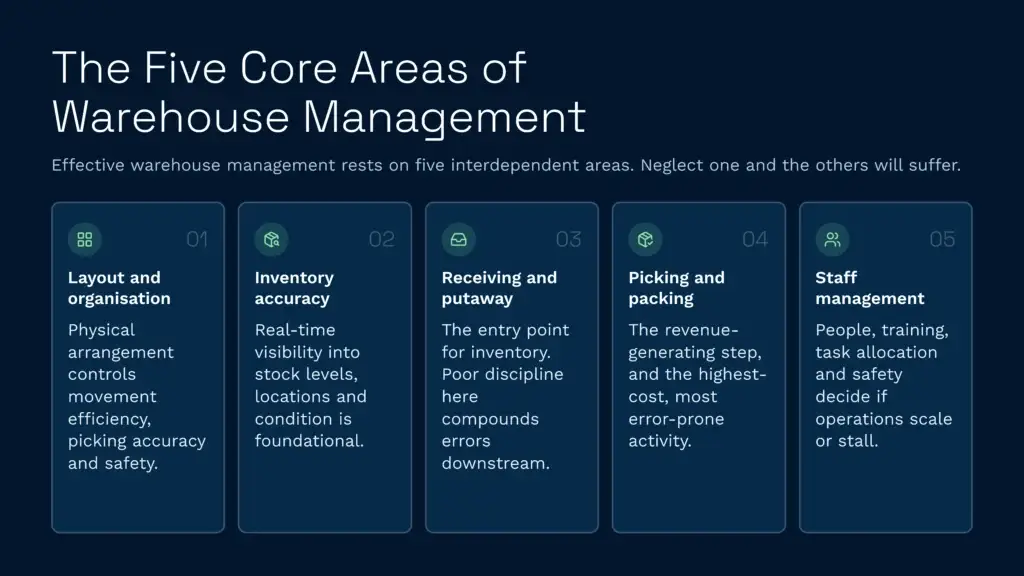
De vijf kerngebieden van magazijnbeheer
Effectief magazijnbeheer berust op vijf onderling afhankelijke aspecten. Als je één daarvan verwaarloost, zal dat ten koste gaan van de andere.
- Indeling en organisatie van het magazijn: De indeling van uw magazijn is rechtstreeks bepalend voor de efficiëntie van de goederenstroom, de nauwkeurigheid bij het orderverzamelen en de veiligheid.
- Voorraadnauwkeurigheid en voorraadbeheer: Wat je niet ziet, kun je niet beheren. Real-time inzicht in voorraadniveaus, locaties en de staat van de goederen is van fundamenteel belang.
- Ontvangst en opslag: Het startpunt voor de voorraad. Een gebrek aan discipline op dit punt leidt tot nog meer fouten verderop in het proces.
- Verpakken en verzenden: De omzetgenererende activiteit. Het orderverzamelen is doorgaans de duurste en meest foutgevoelige activiteit in een magazijn.
- Personeelsbeheer en operationele efficiëntie: Magazijnen zijn arbeidsintensief. Mensen, opleiding, taakverdeling en veiligheid op de werkplek bepalen of uw bedrijf groeit of stagneert.
1. Indeling en organisatie van het magazijn
De indeling van uw magazijn zorgt ofwel voor een efficiënte goederenstroom, ofwel dwingt het mensen om tijd te verspillen. De beste indeling hangt af van uw productassortiment en het soort bestellingen, maar de principes zijn universeel.
Organisatie op basis van zones
Verdeel je magazijn in functionele zones: goederenontvangst, opslag, orderverzameling, verpakking en verzending. Zorg ervoor dat deze fysiek gescheiden blijven. Een veelvoorkomende fout is dat alle werkzaamheden in één chaotische ruimte worden gepropt — orderverzamelaars struikelen over het ontvangstpersoneel, scanners zitten elkaar in de weg, en het lawaai en de drukte zorgen ervoor dat fouten zich als een sneeuwbal opstapelen.
Ordeer de SKU’s binnen de orderverzamelzone op basis van de omloopsnelheid. De artikelen die het snelst verkopen, horen in het midden van de zone thuis, op borst- tot heuphoogte, dicht bij de inpakruimte. Artikelen die minder snel verkopen, worden op de hogere en lagere schappen geplaatst. Deze eenvoudige regel zorgt ervoor dat de loopafstand drastisch wordt verkort.
Logische locatiecodering
Stel een naamgevingssysteem voor locaties op dat je team direct begrijpt. Een goed systeem omvat zone, gangpad, schapniveau en positie. Zo betekent “A-03-02-01” bijvoorbeeld “gangpad A, vak 3, schap 2, positie 1”. Orderverzamelaars hebben het snel onder de knie, het aantal barcodefouten neemt af en nieuwe medewerkers raken sneller ingewerkt.
Breng de indeling in kaart op een duidelijk overzicht. Als de voorraad een vaste plek heeft en iedereen weet waar die is, voorkom je de “waar is het?”-gesprekken die je dag in beslag nemen.
Toegankelijkheid en veiligheid
Zorg ervoor dat de gangpaden breed genoeg zijn voor uw materieel. In krappe ruimtes moeten orderverzamelaars langzaam lopen, wat het risico op ongevallen vergroot. Op de rekken moeten de maximale belastingsgrenzen duidelijk zijn aangegeven — overbelaste rekken storten in. De hoogtebeperkingen voor gestapelde pallets moeten strikt worden nageleefd; een pallet die van grote hoogte valt, kan ernstig letsel of zelfs de dood tot gevolg hebben.
Zorg ervoor dat vloeren vrij blijven van gemorste vloeistoffen en rommel. Een natte vloer of een palletwagen die achter dozen verborgen ligt, is de snelste weg naar een ernstig ongeval.
2. Voorraadnauwkeurigheid en voorraadbeheer
Handmatig voorraadbeheer is traag, foutgevoelig en kwetsbaar. Zodra één persoon die over cruciale voorraadinformatie beschikt het bedrijf verlaat, verslechtert het systeem of stort het in.
Realtime inzicht
Implementeer een systeem dat elke voorraadbeweging in realtime bijhoudt. Wanneer een product wordt ontvangen, gepickt of geretourneerd, registreert het systeem dit onmiddellijk. Het alternatief, handmatige tellingen aan het einde van de maand, is verouderd en leidt onvermijdelijk tot fouten. De fysieke voorraad komt meestal niet overeen met de boekhoudkundige cijfers, wat een kostbare en tijdrovende hertelling tot gevolg heeft.
Dankzij realtime inzicht kun je ook de voorraadrotatie goed beheren. Bij bederfelijke goederen moet je ervoor zorgen dat FIFO (first in, first out) of FEFO (eerst verlopen, eerst uit) rotatie. Spreadsheets schieten hier tekort. Een systeem zorgt er automatisch voor dat dit wordt nageleefd.
Cyclische inventarisatie versus jaarlijkse inventarisaties
Jaarlijkse inventarisaties zorgen voor verstoringen. Je moet het magazijn een dag of langer sluiten, alles tellen en vervolgens dagenlang bezig zijn met het onderzoeken van afwijkingen. Cyclische inventarisatie is een betere methode: tel dagelijks of wekelijks een klein deel van je magazijn, corrigeer fouten direct ter plekke en kom aan het einde van het jaar nooit voor grote verrassingen te staan.
Onderzoek elke afwijking onmiddellijk. Als een SKU een afwijking vertoont die groter is dan je tolerantie (meestal 2–3% in waarde), zoek dan uit waarom: was de vorige telling onjuist, was er sprake van een fout bij het invoeren van gegevens, of is er voorraad verdwenen? Pak de onderliggende oorzaak aan, niet alleen het symptoom.
Omgaan met traaglopende en verouderde voorraad
Voorraad die op uw schappen ligt, brengt kosten met zich mee. Opslagruimte, verwarming, verzekering — het loopt allemaal op. Houd bij hoe lang voorraad al in het magazijn ligt. Producten die al 12 maanden niet zijn verkocht, zijn dood gewicht. Organiseer uitverkoopacties, bundel ze met beter verkopende artikelen of liquidateer ze. De kosten voor de opslagruimte van dode voorraad zijn bijna altijd hoger dan de verkoopwaarde die je ervoor krijgt.
Hoe zorg je voor optimale voorraadniveaus? gaat uitgebreid in op herbestelpunten, veiligheidsvoorraad en vraagprognoses. Als u de voorraadniveaus goed op peil houdt, maakt u liquide middelen vrij, verlaagt u de opslagkosten en verbetert u uw voorraadomzet.
3. Procedures voor het in ontvangst nemen en opslaan van goederen
Bij de ontvangst komt de voorraad uw magazijn binnen. Fouten die hier worden gemaakt, hebben een sneeuwbaleffect verderop in het proces. Een verkeerd getelde pallet, een onopgemerkt beschadigd artikel of een verkeerd geplaatste SKU leidt tot verwarring en omzetverlies.
Goederen in bewerking
Zorg voor een formele werkwijze bij het laadperron. Leveranciers leveren binnen een vastgesteld ontvangstvenster. Bij aankomst controleren de medewerkers van de ontvangstafdeling het volgende:
- Aantal: Tel of weeg de levering. Vertrouw niet blindelings op het etiket van de leverancier — controleer het zelf.
- Conditie: Controleer op fysieke schade, natte dozen en geplette hoeken. Voor schade die bij ontvangst zichtbaar is, is de leverancier aansprakelijk; voor verborgen schade die later wordt ontdekt, bent u zelf aansprakelijk.
- Specification: Check that what arrived matches the order. Wrong SKU, wrong quantity, wrong specification — catch it now, not when you try to pick it.
- Documentation: Match the delivery note to the purchase order. Discrepancies go in writing.
Barcode the received items immediately and scan them into your system. This is your system of record — if it’s not scanned, it doesn’t exist as far as the warehouse is concerned.
Put-away strategy
Once received, stock must go to its designated location quickly. Slow put-away creates a pile-up in the receiving zone, which blocks new deliveries and slows your whole operation.
Use directed put-away logic. The system tells each person exactly where to put each pallet — no guessing, no “I’ll put it here for now”. This ensures stock ends up in the right place consistently and prevents staff from creating their own ad-hoc storage, which destroys the organisation you’ve built.
For bulk items with multiple SKUs on one pallet, break the pallet and put items to their correct locations. Yes, this costs time upfront. But it eliminates the problem of a pallet spanning two different SKUs and two different locations — a source of picking confusion and variance.
Cross-docking
Some orders don’t need to be stored — they arrive in the morning and leave by afternoon, going directly from receiving to despatch. Maximising warehouse receiving processes covers docking operations in depth. Setting up a cross-dock area lets you handle these high-velocity orders without adding them to stock.
4. Picking and Packing Accuracy
Picking is the highest-cost operation in most warehouses, and it’s where picking errors happen. Get the wrong item into a box, seal it, and you’ve created a customer complaint, a return, and a logistics cost to fix it.
How picking errors happen
Manual pick lists (printed or on paper) create a specific failure pattern. Pickers interpret handwriting differently. Under time pressure, they create shortcuts: scanning only the first item in a multi-item order, or skipping low-stock items to “come back later”. Peak periods amplify cognitive load — errors cluster when demand peaks.
The system of record becomes unreliable. A picker works from an inaccurate list, picks incorrectly, and if they don’t scan, the system doesn’t know what went wrong.
Scan verification
Implement scan-verify discipline. The barcode on the bin or shelf must match the barcode on the order. If they don’t match, the system stops the picker. No guessing, no overrides. This single rule eliminates a huge class of picking errors.
The cost per pick rises slightly — the picker has to scan more. But the cost of picking the wrong item (customer complaint, return shipping, re-work) is far higher. You break even on the first prevented error.
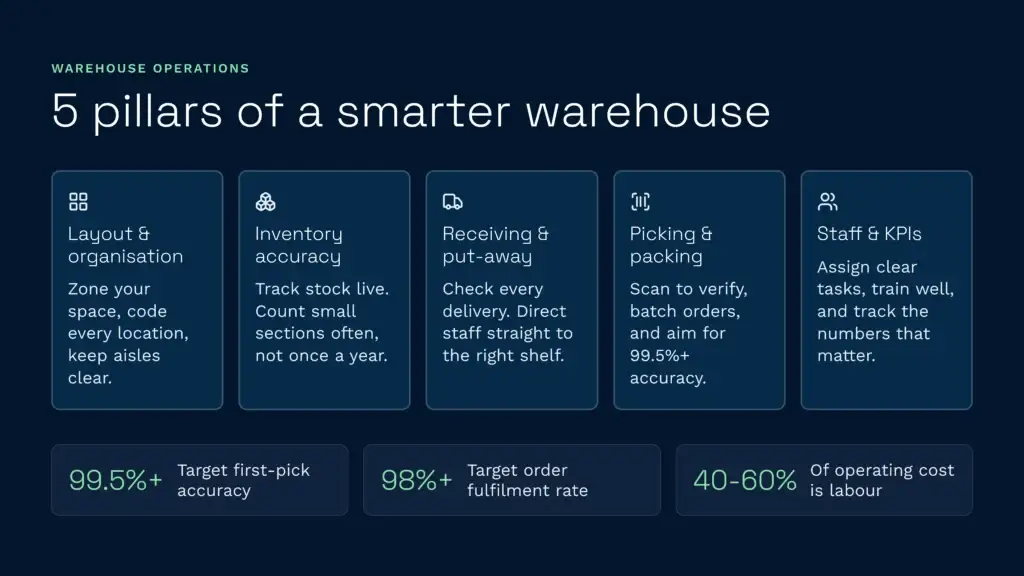
For accuracy targets, aim for 99.5%+ on first-pick accuracy. Anything below 99% is a sign that your process is broken or your staff are under unsustainable pressure.
Wave picking and batch picking
Picking random orders one-by-one is inefficient. Group orders into waves — all orders due to despatch in a time window — and then batch them. Batch picking means one picker collects all units of a SKU for multiple orders at once, reducing redundant travel.
Handleiding voor het orderverzamelen in het magazijn covers picking strategies in detail. The right picking method depends on your order size and frequency, but batching is almost always more efficient than random picking.
Packing and despatch quality checks
Before a box leaves the warehouse, someone must verify the order contents against the pick list. Weight checks work well: if the box weighs within a tolerance of the expected weight, it’s likely correct. Dimensional checks prevent oversized items being forced into boxes.
Despatch labels must be legible and match the box contents. A label that falls off or is unreadable creates shipping chaos downstream.
5. Staff Management, Productivity, and KPIs
Warehouses are labour-intensive. People represent 40–60% of operating cost. How you manage them determines whether your warehouse is efficient, safe, and scalable.
Task-based management and workload balance
Assign work in discrete tasks rather than open-ended shifts. Instead of “pick today”, it’s “pick orders 1001 to 1050”. Task management creates clear accountability, lets you measure performance, and helps you spot bottlenecks.
Distribute workload evenly across your team. Peak-period bottlenecks are a sign that you’ve under-staffed or that certain individuals are carrying too much. Redistribute work or add temporary staff to smooth the load.
Measure productivity per person: picks per hour, lines picked per shift, cases packed per day. Trends tell you a lot. Declining productivity often signals low morale, inadequate training, or process issues. Investigate.
Training and competency
New warehouse staff need structured training, not a sink-or-swim introduction. Cover:
- System navigation: How to use the WMS, how to log in, how to read a pick list.
- Safety: How to use equipment safely, load weight limits, emergency procedures.
- Process: How goods arrive, how they move through the warehouse, where they go.
- Quality: What accuracy looks like, how to scan verify, what to do if something doesn’t match.
Pair new staff with experienced ones for the first week. Have them shadow first, then work alongside, then work independently while observed.
Health, safety, and wellbeing
Warehouse work is physical. Common injuries include back strain, repetitive strain injuries, and falls. Create a safety culture:
- Enforce proper lifting technique. Don’t lift loads heavier than your guidelines (typically 20 kg for women, 25 kg for men without assistance).
- Use mechanical aids: pallet jacks, trolleys, lifting assists. If it’s heavy, don’t carry it.
- Keep floors clear and dry. Wet floors are accident waiting to happen.
- Provide adequate lighting, ventilation, and temperature control. A hot, dark, cramped warehouse is demoralising and error-prone.
- Conduct monthly safety briefings. Discuss near-misses and incidents; use them to improve process.
Invest in wellbeing. Warehouse work is intense and repetitive. Breaks, stretching programmes, and access to water reduce burnout and turnover.
Key performance indicators (KPIs) and metrics
Track what matters. Key warehouse KPIs include:
- Inventory accuracy: System count vs. physical count. Target 99%+.
- Pick accuracy: First-pick accuracy before quality check. Target 99.5%+.
- Order fulfilment rate: Orders shipped on time, in full. Target 98%+.
- Picking productivity: Lines picked per person per day. Benchmark against your own history and industry standards.
- Labour cost per order: Total labour cost / number of orders picked. Trends show whether you’re getting more efficient.
- Safety incident rate: Injuries per 200,000 hours worked (OSHA standard). Target zero.
- Staff turnover: Annual % of people leaving. High turnover signals low morale or poor training.
Report these weekly or daily (depending on scale). If a metric is trending wrong, investigate the root cause and act. Don’t just report — respond.
How a Warehouse Management System Fits In
A manual warehouse — one relying on paper, spreadsheets, and memory — hits a ceiling quickly. As volume grows, errors multiply and staff frustration rises. Wat is een magazijnbeheersysteem? explains the fundamentals. Here’s how a modern WMS changes the game.
Real-time data and visibility
A WMS records every action instantly. Stock movements, picks, packs, quality checks — all logged. You get real-time visibility into what’s in your warehouse and where. No more surprises at month-end.
For 3PL warehouses managing multiple clients, this visibility is essential. Each client’s stock must be segregated, tracked separately, and billed accurately. A spreadsheet-based system requires manual reconciliation every month — error-prone and time-consuming. St John’s Hall Storage, a UK 3PL, cut their invoicing from four hours to twenty minutes after switching to a system with automated billing. The invoicing admin person went from spending days a month on reconciliation to barely a day — unlocking that person’s time for higher-value work.
Automation and workflow logic
A WMS can automate low-value, repetitive work. Directed put-away tells each person exactly where stock should go. Wave picking groups orders intelligently, reducing walking distance. Automated billing captures every billable event — receiving, storage, picking, packing, despatch, returns — without manual counting.
These automations don’t replace people; they free them up from tedious work and let them focus on quality, problem-solving, and customer service.
Decision support and alerting
A WMS can surface bottlenecks and issues before they become problems. Low stock alerts, slow-moving inventory alerts, quality exception alerts — all sent automatically. You can act proactively rather than reactively.
For food and beverage operations, a WMS with expiry date tracking can alert you when stock is approaching best-before date, letting you manage FEFO rotation accurately. Best warehouse management system software for 2026 covers the features that matter across different industries.
Scaling without proportional cost increase
A manual warehouse has to add staff with every volume increase. One person per 500 picks per day is a rough rule of thumb. A WMS, by cutting non-value work and automating routine tasks, lets you handle higher volumes with the same headcount. KATEM Logistics, a UK 3PL, scaled their monthly picking volumes 10x after switching from a legacy system. Headcount didn’t 10x — the WMS made them far more efficient.
Continuous Improvement and Adaptation
A warehouse is never “done”. Markets shift, customer demands change, technology evolves. The best-run warehouses treat this as an opportunity.
Regular review and iteration
Monthly, review your KPIs. If a metric is trending wrong, dig into why. Involve your warehouse team — they see the problems first. Work with them to test improvements on a small scale before rolling them out.
A single process change might save ten minutes per day per person. Across a ten-person team, that’s 1,700 minutes (28 hours) saved per month. Compound ten such improvements and you’ve transformed your operation.
Technology and tooling
Evaluate new technology with real use in mind. Barcode scanning, mobile-first interfaces, handheld devices, route optimisation — the right tools reduce friction. But tools chosen for the sake of tools add cost without benefit.
API integrations between your WMS, your ERP, and your e-commerce platform eliminate data re-entry. When your order management system talks directly to your warehouse system, orders arrive in the warehouse ready to pick — no manual data entry, no delays.
Benchmarking and learning from others
Your warehouse doesn’t exist in isolation. Talk to peers in your industry. What metrics do they track? What tools do they use? What mistakes have they made? Industry organisations like the UKWA (UK Warehousing Association) and Cold Chain Federation (for food) are good sources of benchmarking and best practice.
Neem contact op met een magazijnexpert
Als u uw opties aan het afwegen bent en wilt zien hoe een speciaal ontwikkeld WMS in de praktijk werkt, is Clarus zeker het overwegen waard. Wij werken samen met 3PL’s en distributeurs in heel het Verenigd Koninkrijk om magazijnbeheersoftware te implementeren die is afgestemd op uw bedrijfsvoering — en niet andersom.
Neem contact op met ons team om uw wensen te bespreken.