

If you’re looking at SkuVault as a warehouse management system, there are three things to know upfront. First, Linnworks completed its acquisition of SkuVault in September 2022, and the product is now sold as SkuVault Core by Linnworks. Second, SkuVault Core pricing isn’t published. Linnworks says it “depends on many factors including how many orders you’re fulfilling each month, custom requirements, and additional modules”. Third, Linnworks positions SkuVault Core for fast-growing ecommerce businesses managing their own stock. If you’re a 3PL running stock for several clients, or a UK fulfilment operation juggling different clients’ requirements, you need to look harder at how it handles that. This guide walks through the real alternatives and where purpose-built 3PL software wins.
| Platform | Best for | Multi-client 3PL | Automated Billing | Deployment |
|---|---|---|---|---|
| Clarus WMS | 3PLs, multi-client fulfilment, UK/EU operations | Yes ; core feature, full isolation | Yes ; captures all billable events in real time | Cloud-native, live in weeks |
| Linnworks (SkuVault Core) | Ecommerce brands, marketplaces, single-client fulfilment | No ; designed for brand stock only | Limited ; not a core feature | Not published |
| Mintsoft | 3PLs and ecommerce | Yes ; but expensive to implement | Yes | Not published |
| Snapfulfil | Enterprise 3PLs, mid-market distribution | Yes ; multi-client architecture | Limited ; manual reconciliation common | Not published |
| Körber (Warehouse Management) | Enterprise distribution, manufacturing, complex operations | Yes, at enterprise scope | Limited ; built-in but requires heavy configuration | Not published, sold with an implementation partner |
What happened to SkuVault?
SkuVault is still available, now as SkuVault Core, owned and run by Linnworks. Linnworks bought the Louisville-based WMS to pair its own global reach with SkuVault’s strong North American position. The product covers real-time inventory sync to stop overselling across marketplaces, pick-and-pack workflows with digital picklists and barcode scanning, real-time visibility across multiple warehouse locations, and kits and bundles with component-level inventory.
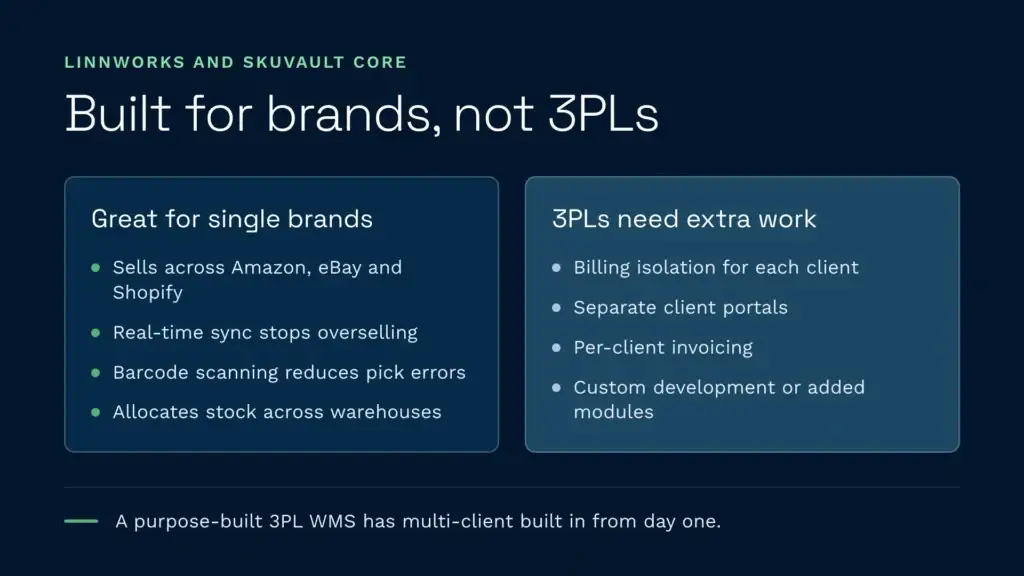
The core audience hasn’t changed: ecommerce brands managing their own stock across several sales channels. For them, inventory accuracy and picking speed are what count. What Linnworks’s product page doesn’t talk about is running several clients’ stock in the same warehouse, with separate billing, separate reporting and separate client portals. That’s the gap a 3PL needs to check.
Clarus WMS: built for 3PLs and multi-client operations
Clarus is a cloud-native, agentic AI-driven warehouse management system built for 3PLs, multi-client distributors, and UK and European fulfilment operations. It starts from the assumption that you’re running stock for multiple clients at once, each with their own SLAs, pricing rules, reporting requirements and client portal access.
The headline difference is automated 3PL billing. Clarus records every putaway, pick, pack, cycle count, value-add service and storage day at source, along with despatch and returns, and prices it automatically. Its AI also catches missed pallet charges across multiple customer accounts, so revenue doesn’t slip through the gaps. St John’s Hall Storage cut its invoicing time by 90%. The Managing Director used to spend around four days at the end of each month checking invoices, because data from the WMS had to be re-keyed into the accounts software. That re-keying has gone. St John’s Hall Storage now exports straight from Clarus into its accounts software and has moved from monthly to weekly invoicing. Once the data proved consistently accurate, the Managing Director stopped checking invoices by hand
Pricing starts from £1,000 per month on the Core plan (also available in US dollars and euros), paid monthly with no long-term tie-ins. Client portals come in on the Scale plan, and there’s a one-off implementation fee for configuration and setup. It’s all published, so you can do the sum before you speak to anyone.
Linnworks and SkuVault Core: built for brands first
If you’re a single-brand ecommerce business selling across Amazon, eBay, Shopify and your own website, SkuVault Core is a sensible fit. Real-time inventory sync stops you overselling. Pick-and-pack workflows with barcode scanning cut errors. Multi-warehouse visibility lets you hold stock in different locations and allocate it well.
Things get harder when you’re managing client A’s stock, client B’s stock and client C’s stock in the same building. Linnworks doesn’t publish SkuVault Core pricing, so you’ll get a quote based on order volume, custom requirements and modules. Before you sign, ask exactly how it handles billing separation, separate client portals and per-client invoicing, and whether any of that needs extra modules or custom work. In a system built for 3PLs, those are standard.
Mintsoft: full 3PL capability, priced by volume
Mintsoft is a serious option for 3PLs. Its 3PL plans include a client portal and 3PL client billing as standard, and it handles multiple clients well.
Mintsoft does publish its pricing. It’s tiered, based on whether you’re a 3PL or a brand, how many users you have and your monthly order volume, with optional modules and onboarding on top. That means your bill grows as your orders do. Clarus plans include unlimited orders with no throughput-based billing, so compare the two on your own order profile and growth plans rather than a headline rate.
Snapfulfil and Infios: enterprise-grade options
Both appear in the 2025 Gartner Magic Quadrant for Warehouse Management Systems. Infios, formerly Körber Supply Chain Software, was named a Leader. Synergy Logistics, the company behind Snapfulfil, was included as a Niche Player for the 13th year running. Both are aimed at larger, more complex operations.
The trade-off is scope. Enterprise platforms usually mean a scoping exercise before you get a firm cost and timeline. For a growing 3PL, that’s a lot of process to get to a quote, and often more platform than you need.
How to choose your SkuVault alternative
Ask yourself three questions.
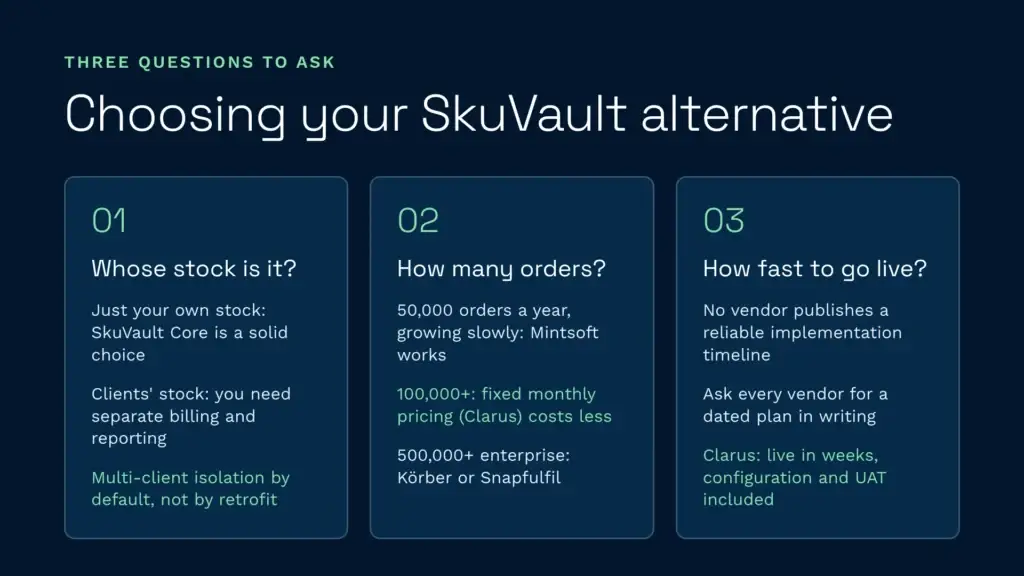
Are you managing multiple clients’ stock, or just your own?
If it’s just your own (you’re a brand or a single-entity retailer), SkuVault Core is still a solid choice. If you’re managing clients’ stock with separate billing and reporting, you need multi-client separation built in from the start, not added later.
What’s your order volume and growth trajectory?
If volumes are modest and steady, pricing that scales with order volume may suit you. If you know volumes will climb or spike, look for pricing that doesn’t rise with every order. If you’re an enterprise with very high volumes and complex compliance needs, the implementation effort of an enterprise platform may be worth it.
How fast do you need to go live?
Implementation timelines vary with data and integrations, so treat any number you’re quoted as something to hold the vendor to in writing. Clarus aims to get you live in weeks, not quarters, with a structured go-live plan, named owners and sign-off gates. If you’re opening a new warehouse this quarter, ask every shortlisted vendor for a dated plan before you sign.
Making the switch from SkuVault Core
If you’re on SkuVault Core and you’ve grown into multi-client requirements, migration is simple in principle but takes real effort in practice. Your data lives in SkuVault: customer masters, warehouse locations, stock records and integration mappings. Moving it to a new system means:
- Master data preparation: customers, products, locations and client hierarchies need mapping and validating before the new system sees them.
- Integration re-mapping: if SkuVault connects to your ecommerce platform, ERP or shipping system, the new system will too, but the data flows may differ. Clarus connects to over 200 systems across ecommerce, ERPs and carriers, so compatibility is rarely the issue. It’s the configuration work.
- User training: your team will need training on the new interface and workflows, plus support on site around go-live.
- Parallel running: many migrations run the old and new systems side by side for a short period to catch issues. It adds to your team’s workload temporarily, but it’s safer than a big bang switch.
How long it takes depends on data complexity and how many integrations you have. Factor migration effort into your total cost, not just the licence fee.
Why 3PLs move away from single-brand WMS
SkuVault Core, Linnworks and similar platforms are built around one assumption: one organisation, one set of inventory rules, one set of commercial terms. A 3PL breaks that. You run client A on FIFO and client B on FEFO. Client A pays per pallet, client B pays per pick. Client A wants daily stock reports, client B wants real-time portal access.
A single-brand WMS can handle some of that with configuration or custom fields, but it treats each client as a special case rather than a standard workflow. That gets expensive, because every exception becomes a manual step. In a purpose-built 3PL WMS, multi-client complexity is the standard, not the exception.
Speak to a warehouse expert
If you’re weighing up your options and want to see how a purpose-built WMS works in practice, Clarus is worth a conversation. We work with 3PLs and distributors across more than 800 warehouses in Europe, North America, the Middle East and Asia-Pacific, setting up warehouse management software that fits the way you operate, not the other way around.
Get in touch with our team to talk through your requirements.