

If you’ve been researching Körber WMS, you may have noticed some confusion around the name. The product has a layered history. It started life as HighJump WMS, became part of Körber’s K.Motion software portfolio after Körber acquired HighJump in 2017, and in March 2025 the business rebranded as Infios. The core warehouse management system is the same platform, but the name has changed. For businesses evaluating this system today, that context matters. This guide covers what Körber WMS does, how it works, who it suits, and where a purpose-built UK alternative might serve you better.
The global warehouse management system market is growing fast. One ResearchAndMarkets forecast puts it at more than 10 billion US dollars by 2030, as businesses of all sizes invest in warehouse software. That growth brings more vendor choice, which makes understanding individual platforms more important than ever.
What is Körber WMS and how does it work?
Körber WMS is an enterprise-grade warehouse management system originally developed by HighJump Software. Körber AG, the Hamburg-based technology group, acquired HighJump in 2017. The system sits within the Körber supply chain software portfolio, now trading as Infios, which also covers transportation management and order management.
At its core, the WMS controls all movement of goods within a warehouse. It directs staff and equipment using rules-based logic: where to store incoming stock, which pick path cuts travel time, how to consolidate orders into efficient pick waves. The system connects to warehouse hardware, such as barcode scanners, RFID readers, conveyor systems, pick-to-light and voice-directed picking units, and integrates with ERP platforms and carrier management software.
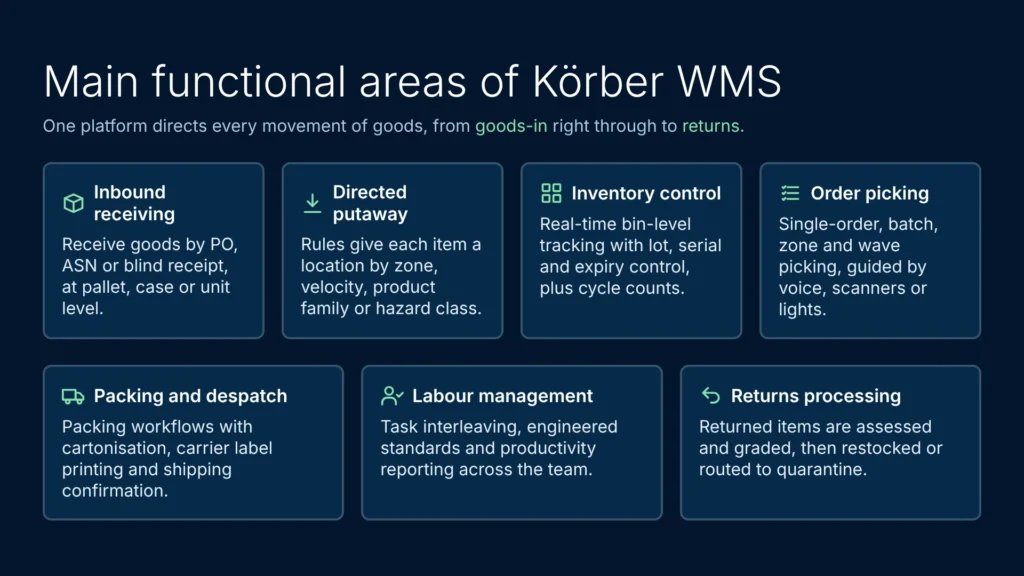
Main functional areas of Körber WMS
The platform covers the following warehouse processing layers:
- Inbound receiving: goods receipt by PO, ASN or blind receiving, label printing, and immediate inventory capture at pallet, case or unit level
- Directed putaway: rule-based putaway strategies that automatically assign stock to locations based on zone, velocity, product family, hazard classification or available space
- Inventory control: real-time bin-level tracking with lot, serial number and expiry date management, plus cycle counting by zone or ABC classification
- Order picking: single-order, batch, zone and wave picking, with support for voice, scan and pick-to-light direction
- Packing and despatch: packing workstation workflows, cartonisation, carrier label generation and shipping confirmation
- Labour management: task interleaving, engineered standards and productivity reporting
- Returns processing: inbound returns assessment, grading, and restocking or quarantine routing
For a full picture of the current product under its new identity, the Infios warehouse management page covers the platform’s current positioning and capabilities.
Is Körber WMS now called Infios?
Yes. On 4 March 2025, Körber Supply Chain Software rebranded as Infios. The business is a joint venture between Körber AG and investment firm KKR, and the rebrand brought its warehouse management, transportation management and order management products, along with its AI tools, under a single brand. If you come across references to Körber WMS, K.Motion WMS or HighJump WMS, they all describe the same product lineage now sold under the Infios name.
In practice, businesses starting a WMS evaluation now will deal with Infios as the vendor. The rebrand doesn’t change the underlying software, but it does signal a move to position the platform as a standalone supply chain software brand rather than one part of the wider Körber group. Existing customers on Körber or K.Motion contracts should check with Infios how their licensing and support arrangements are affected.
It’s worth bearing this in mind during your evaluation. When you read older reviews, case studies or analyst reports, the names Körber, K.Motion and HighJump all refer to the same lineage. User reviews on platforms such as Capterra, where the product is still listed as Körber K.Motion WMS, span the full naming history, which can make version and feature comparisons tricky.
What is directed putaway in a WMS?
Directed putaway is one of the most valuable features in any warehouse management system, and it’s an area where Körber WMS has historically been strong. Rather than leaving staff to decide where to store incoming stock, the WMS assigns a specific location automatically based on rules you configure.
In practice, those rules might specify: fast-moving items go to ground-level pick-face locations near the despatch area, cold chain products go to refrigerated zones, hazardous goods go to a designated COSHH bay, and oversized pallets go to wide-aisle racking. The system checks each incoming SKU against the rule set and sends the operator’s handheld device to a precise bin.
The benefits are clear. Putaway time falls because operators don’t hunt for space. Pick travel distances drop because fast movers end up where they should be. Inventory accuracy improves because every movement is scanned and confirmed. In a busy 3PL handling multiple clients with different product types, directed putaway rules can be configured at client level, so each client’s stock follows its own storage logic.
If you’re evaluating any WMS platform, understanding warehouse mapping and how it works with putaway rules is a good starting point. The layout of your warehouse directly shapes the quality of the putaway strategies you can build.
Körber WMS: picking and packing automation features
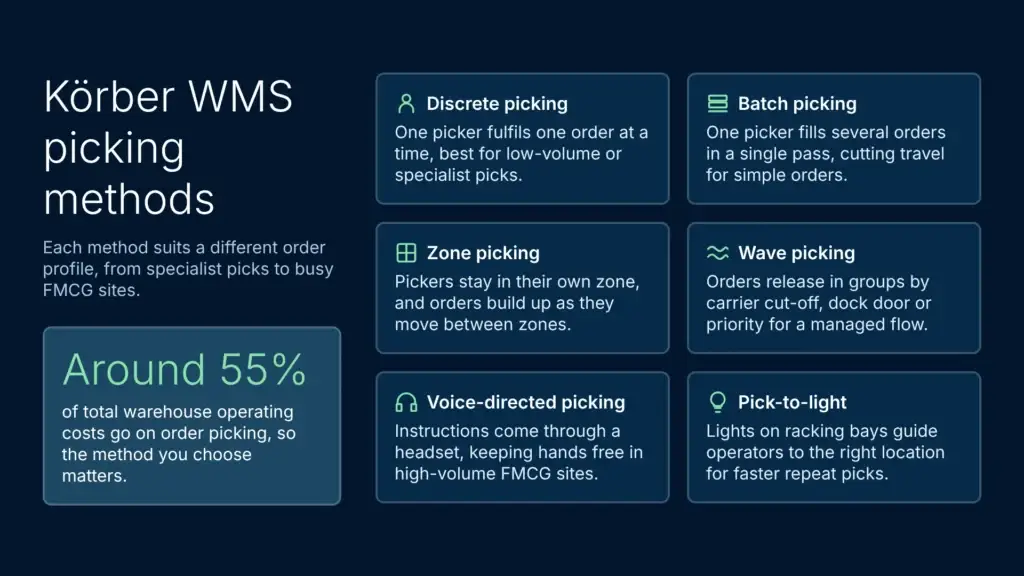
Order picking is typically the most labour-intensive activity in a warehouse, with research putting it at around 55% of total warehouse operating costs. WMS platforms that cut unnecessary travel and motion during picking deliver measurable returns. Körber WMS supports a range of picking methods designed to match the picking strategy to the order profile.
Picking methods supported
- Discrete picking: one picker fulfils one order at a time. It’s simple and accurate, and best for low-volume or specialist pick environments
- Batch picking: one picker fulfils multiple orders in a single pass through the warehouse, reducing travel for simple single-SKU orders
- Zone picking: the warehouse is divided into zones and pickers work only within their zone, with orders building up as they pass through each one
- Wave picking: the WMS releases groups of orders at the same time based on carrier cut-off times, dock door assignments or order priority, co-ordinating pick, pack and despatch as a managed flow
- Voice-directed picking: operators hear pick instructions through a headset, leaving both hands free, which is common in high-volume grocery and FMCG environments
- Pick-to-light: light displays on racking bays guide operators to the correct pick location, reducing mental load and speeding up repetitive multi-SKU picks
On the packing side, the system supports packing workstation workflows with cartonisation logic, where the WMS suggests the right box size based on the items being packed, and generates carrier labels and shipping confirmations automatically. This removes manual steps from the pack bench and reduces the risk of mis-packed shipments. For more on how these methods fit together, our guide to pick and pack warehouse strategy covers when each one works best.
Automation integrations
Körber WMS connects to automated systems including goods-to-person conveyors, automated storage and retrieval systems (ASRS) and robotic picking. For large distribution centres processing tens of thousands of lines per day, these integrations can substantially reduce labour costs. For smaller or mid-sized operations, the complexity and cost of setting up these integrations is a significant consideration.
Körber supply chain solutions overview
Körber (now Infios) sells the WMS as part of a broader supply chain execution suite. According to Infios, the portfolio includes:
- Warehouse management: the core stock control and warehouse processing platform
- Transportation management: carrier selection, freight planning and shipment execution
- Order management: order orchestration across sales channels and fulfilment locations
- Infios AI: the company’s AI capabilities, applied across its supply chain products
For large enterprises running complex, multi-node distribution networks, the appeal of a single vendor covering warehouse, transport and order management is clear. However, this breadth also raises the question of whether a business actually needs all of those modules, and whether paying for a platform at that scale makes sense when the requirement is focused warehouse management.
Software Connect’s review of Infios places it in the mid-market to enterprise bracket, says most implementations run 4 to 8 months, and doesn’t recommend it for small businesses or single-site warehouses looking for basic functionality.
How does Körber WMS compare to alternatives?
Any honest comparison of Körber WMS against alternatives has to start with scale. This is a platform designed for large, complex distribution operations. It has deep functionality, strong hardware integration options and the backing of a substantial vendor. For a multi-site enterprise processing millions of order lines per year, it competes credibly with other top-tier WMS platforms.
For UK 3PLs, mid-market distributors and growing businesses, the picture is different. Implementation timelines for enterprise WMS platforms like Körber tend to run to months rather than weeks. Licence and support costs reflect the enterprise market. Customisation, which Körber’s architecture does support, adds project cost and creates long-term maintenance commitments.
If you’re at the stage of working out how to choose a warehouse management system, scale and fit matter as much as feature lists. The most powerful system isn’t always the right system. For a direct side-by-side, see our Clarus vs Körber comparison.
Körber WMS vs purpose-built 3PL systems
| Capability | Körber WMS / Infios | Clarus (purpose-built 3PL WMS) |
|---|---|---|
| Multi-client warehouse management | Supported in its 3PL offering | Native, built around client separation |
| 3PL billing and invoicing | Billing engine included in the 3PL offering | Activity-based billing built in, with client-specific tariffs |
| Client portal and self-service | Customer portal available | Branded client portal built into the core system |
| Implementation timeline | Most implementations run 4 to 8 months | Standard projects go live in around 12 weeks |
| Target operation size | Mid-market to large enterprise, often multi-site | 3PLs, wholesalers and mid-market warehouses |
| Pricing model | Quote-based, not published | Published plans across Core, Scale and Enterprise |
Budget is part of the picture too. Labour, property and technology costs all interact, and a WMS that takes most of a year to implement carries an opportunity cost that rarely shows up in vendor proposals. Our ROI calculator can help you model the numbers for your own operation.
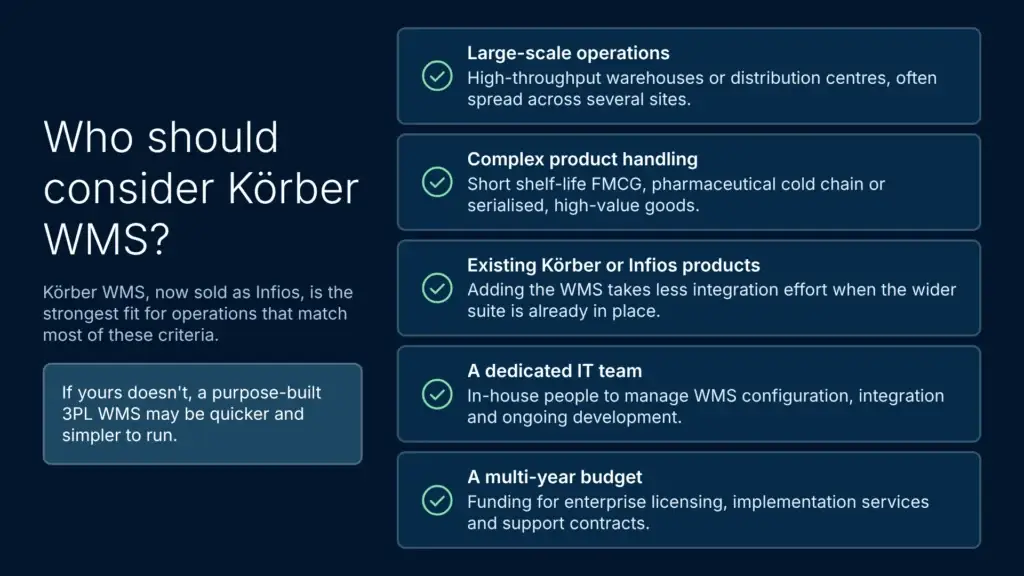
Who should consider Körber WMS?
Körber WMS (now Infios) is most appropriate for organisations that meet most of the following criteria:
- Large-scale warehouse or distribution centre operations with high daily throughput, often across multiple sites
- Complex product handling requirements, such as FMCG with short shelf life, pharmaceutical cold chain, or high-value serialised goods
- Existing investment in Körber or Infios supply chain products, making the WMS a lower-effort extension
- A dedicated IT team capable of managing WMS configuration, integration and ongoing development
- A multi-year WMS roadmap with budget for enterprise licensing, implementation services and ongoing support contracts
If that doesn’t describe your operation, the platform’s power can become a burden. Enterprise WMS systems built for large DCs carry overhead in complexity, cost and implementation time that smaller and mid-sized operations simply don’t need.
Clarus WMS: the purpose-built alternative for UK 3PLs
Clarus WMS is built specifically for third-party logistics providers and multi-client warehouses. Where platforms like Körber are designed for large enterprise distribution centres and then adapted for 3PL use cases, Clarus starts from the 3PL model and works outward.
That distinction matters in practice. A 3PL warehouse management system needs to handle client onboarding quickly, keep inventory and billing separate by client, and give each client visibility of their own stock without access to other clients’ data. It needs to generate accurate invoices automatically based on warehouse activity, such as receipts, picks, pallet moves and storage days, because manual billing in a busy 3PL leads to revenue leakage and client disputes.
Clarus handles all of this natively. Client portals, activity-based billing, multi-client inventory separation and real-time reporting are built into the core system, not added through customisation. Clarus is also an agentic AI-driven WMS, with AI agents working under guardrails on tasks like catching missed pallet charges across customer accounts. For a 3PL that needs to be live quickly, a standard Clarus project goes live in around 12 weeks.
If you’re unsure whether a specialist 3PL WMS or a broader enterprise platform is right for your operation, our guide to warehouse management software covers the different system types and how to match them to your operational needs.
Clarus customers include St John’s Hall Storage, which cut invoicing time by 90%, and JODA Freight, which raised stock accuracy from 90% to 99% by its second year on Clarus. You can read more customer stories or book a call to talk through your operation with the team.