

If you run a tredjepartslogistikk (3PL) warehouse, you’ve probably come across Omfattende (formerly 3PL Central). It’s a well-known name in multi-client fulfilment, and in September 2026 it became part of Descartes Systems Group. Extensiv was designed around North American operations, which suits many 3PLs well. But if your clients, carriers and teams are spread across different regions, it’s worth checking whether a system built for North America fits the way you actually operate.
This guide compares Extensiv with the most realistic alternatives, focusing on what matters to 3PLs running a warehouse for multiple clients: pricing, deployment speed, fakturering automatisering, integrasjoner med operatører, and whether the system supports the way your business works. So what is the best lagerstyringssystem for a 3PL? It depends on your priority: lowest cost, fastest go-live, or multi-client billing depth.
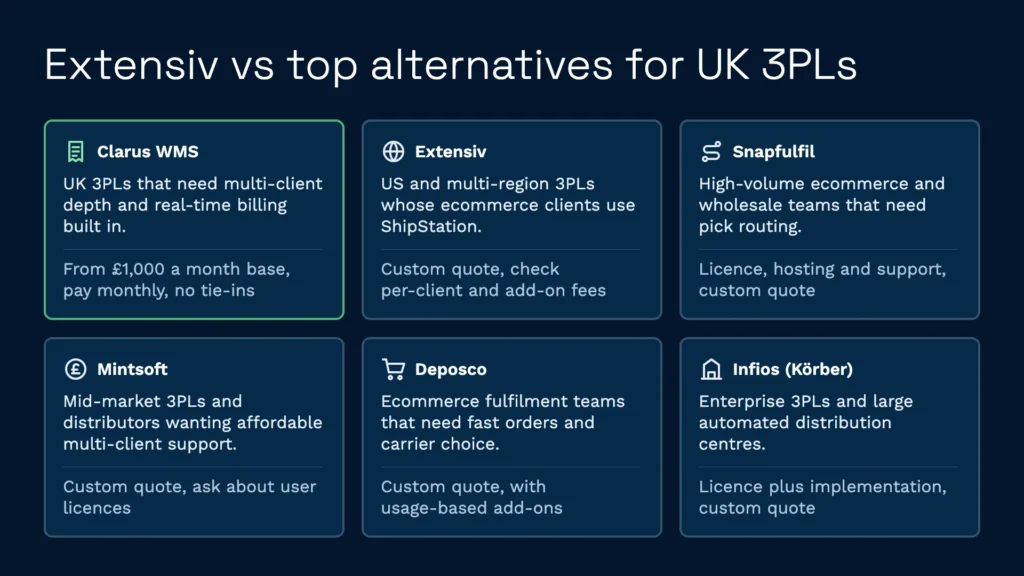
Quick comparison: Extensiv vs top alternatives for 3PL warehouses
| Plattform | Best for | Multi-client depth | Automatisert fakturering av tredjepartslogistikk | Implementering | Prismodell |
|---|---|---|---|---|---|
| Clarus WMS | 3PLs that want multi-client depth and billing automation built in | Dedicated multi-client architecture, with per-client workflows and reporting | Billable events captured as the work happens, invoicing in minutes not days | Cloud-native, with ready-made connectors to go live fast | From a £1,000 a month base fee, pay monthly, no tie-ins |
| Omfattende | US and multi-region 3PLs whose clients use ShipStation | Multi-client capability, but check how billing scales with client numbers | Automation available, but check how per-client and add-on fees affect total cost | SaaS deployment, so ask for a written go-live date | Tilpasset tilbud, ingen offentlig prisliste |
| Snapfulfil | High-volume ecommerce and wholesale distribution that needs pick routing | Multi-client support for 3PLs, but check how billing is configured | Check how billing links to your accounting system | Cloud, so ask for a written go-live date | Licence, hosting and support, custom quote |
| Mintsoft | Mid-market 3PLs and distributors prioritising affordability | Multi-client support aimed at smaller operations | Check how far billing is automated | Cloud SaaS, so ask for a written go-live date | Custom quote, ask about user licences |
| Deposco | Ecommerce fulfilment operations that want carrier flexibility | Multi-client available, but check reporting per client | Check what is native and what needs integration | Cloud, so ask for a written go-live date | Custom quote, usage-based add-ons |
| Infios (formerly Körber) | Enterprise 3PLs and large automated distribution centres | Enterprise-grade multi-client and multi-site management | Sophisticated billing with extensive customisation | Typically a long, multi-month programme | Licence and implementation, custom quote |
Clarus WMS: built for 3PLs with billing at the core
Clarus is a cloud-native WMS designed for multi-client warehouse operations and automated billing. It runs on ISO-certified AWS infrastructure, so there are no servers for you to maintain, and it’s used by operators from RTS across Europe til Odin in Rotterdam.
Why 3PLs choose Clarus
Billing done right. Many general-purpose WMS platforms treat billing as an add-on. Clarus captures every billable event as the work happens: receiving, storage, pick, pack, despatch, returns and value-added services, including tiered rental charges. St John’s Hall Storage, a third-party warehousing provider, cut its invoicing time by 90% after switching. It now invoices weekly instead of monthly, and its managing director no longer spends around four days at the end of each month checking invoices by hand, as the St John’s Hall Storage story explains. For a 3PL running billing-heavy operations, this is the feature with the biggest effect on margin.
Multi-client done properly. Each client’s inventory, workflows and reporting are kept separate within one warehouse. You can set different workflows, SLAs and billing rules per client, which matters when you’re running 10+ clients in the same building, and clients can check their own stock through a kundeportal. KATEM Logistikk, which holds stock for dozens of customers, scaled its monthly picking volumes 10x after moving to Clarus.
Carriers across many countries, and fast support. Clarus kobles til over 200 systems, including global carriers such as DHL, UPS, FedEx og TNT, and national and regional carriers such as Posten, DPD, GLS, Deutsche Post, PostNL, Correos, Chronopost, InPost og USPS. Support responds in under five minutes, and you pay monthly with no tie-ins.
Fast deployment. Because it’s cloud-native, there’s no server provisioning or on-premise installation to wait for, and ready-made connectors help you go live fast. If you’re asking which WMS can go live in weeks rather than after a 12 to 18 month implementation, cloud-first platforms are the place to start. Ask any vendor for a written go-live date, and see how Clarus onboarding works.
Where Clarus is a poor fit
Clarus is built for 3PLs, grossister and specialised sectors such as food and drink, manufacturing and ecommerce fulfilment. If you run a small webshop from a single location with two or three users, you’re over-specifying, and a simpler system will do. If you need enterprise software with 12-month customisation cycles and bespoke on-premise installations, Clarus isn’t built for that scale of complexity. Infios and Infor are aimed at that buyer.
Priser: Plans start from a £1,000 a month base fee. Your quote adds a tiered user licence, where the cost per user falls as you grow, and a one-off implementation fee for configuration. You pay monthly, with no tie-ins.
Extensiv 3PL Warehouse Manager: US-built, omnichannel-focused
Omfattende (rebranded from 3PL Central in 2022) is a California-based platform designed around North American logistics and ecommerce. In September 2026 it was acquired by Descartes Systems Group for about US$120 million. Its integration with ShipStation makes omnichannel shipping a core strength, and Extensiv says more than 1,200 3PLs use its software.
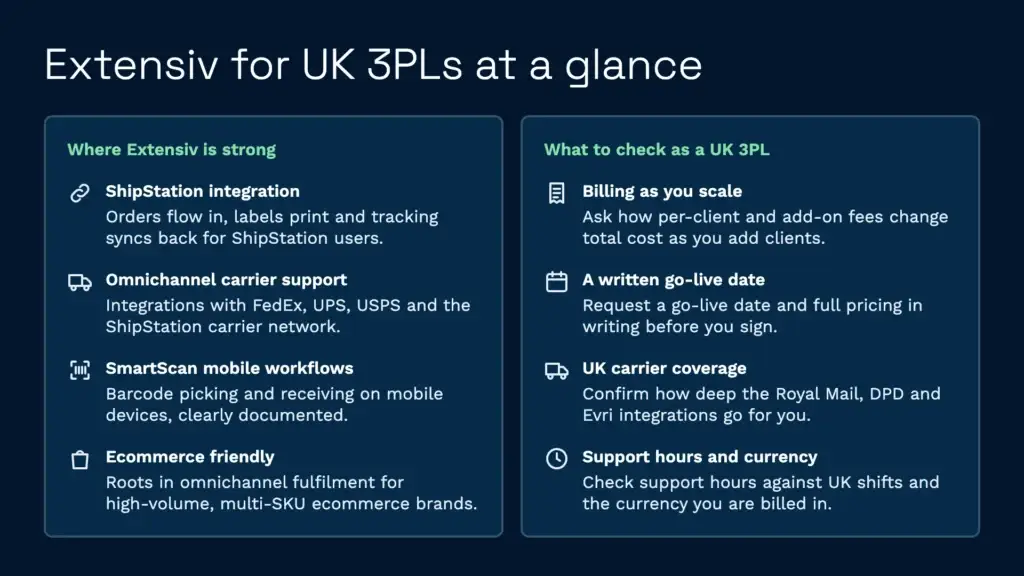
What Extensiv does well
ShipStation integration. If your clients are ecommerce brands using ShipStation, Extensiv’s integration is a genuine strength. Orders flow through, labels print and tracking syncs back automatically.
Omnichannel carrier support. Extensiv integrates with FedEx, UPS, USPS and ShipStation’s carrier network. For US-focused operations, that’s comprehensive. If you ship through national or regional carriers in other countries, check how deep those integrations go.
SmartScan mobile workflows. Barcode-based picking and receiving on mobile devices is straightforward and well documented. Scanning is table stakes for any WMS, and Extensiv does it competently.
Ecommerce friendly. Extensiv’s roots are in omnichannel fulfilment for ecommerce brands. If you’re a 3PL running high-volume, multi-SKU ecommerce fulfilment for a mostly US client base, Extensiv is worth serious consideration.
What to check with Extensiv before you choose
Billing at scale. Extensiv can handle 3PL billing, but ask how per-client and add-on fees change your total cost as you add clients. When you’re invoicing 20+ clients a month, the way a system approaches 3PL-fakturering makes a real difference.
Implementation timing. Extensiv runs a traditional sales cycle with demos and setup. Ask for a written go-live date before you sign. As for how much warehouse management software costs per month, Extensiv’s answer depends on modules, client numbers and order volume, so you’ll only know the real figure once you have a quote.
Regional fit. Extensiv is built US-first. If you operate elsewhere, or across several regions, check the depth of its integrations with the carriers you use, whether support hours cover your shifts and time zones, and which currency you’ll be billed in. None of these are showstoppers, but they can add friction outside North America.
Priser: Priced on application, varying with order volume, number of clients and modules. There’s no public price list, so you’ll need to request a demo.
Snapfulfil: high-volume distribution, established choice
SnapFulfil, from Synergy Logistics, is a well-established cloud WMS, particularly in high-volume ecommerce and distribution. It launched in 2007 and is known for pick route optimisation and labour management.
Why people choose Snapfulfil
Snapfulfil is strong at pick routing and wave picking. If your operation is high-volume pick and pack without complex multi-client billing, its optimisation can make a measurable difference to labour costs. It’s also a familiar name to many warehouse managers, which can shorten training.
What 3PLs should check with Snapfulfil
Synergy describes SnapFulfil as built for multi-owner operations, and 3PLs use it for multi-client fulfilment. If billing is central to your business, ask how per-client billing rules are configured and how invoices reach your accounting system, then compare that with platforms built around 3PL-fakturering.
Priser: Licence plus hosting plus support, custom quoted with no public price list, and it varies with user count and add-ons.
Mintsoft: affordable, mid-market friendly
Mintsoft, now part of The Access Group, is a cloud WMS with a growing presence in the mid-market. It’s positioned as an affordable, easy-to-implement alternative to more expensive platforms.
Mintsoft’s strengths
Affordable pricing and faster implementation than on-premise platforms. It’s a good fit for distributors and smaller 3PLs that need multi-client support without paying enterprise prices, and it has strong integrations with ecommerce platforms.
What to check with Mintsoft
Ask how far billing is automated and what still relies on your accounting system or manual work. Multi-client support is there, but compare its depth with platforms built specifically for 3PLs, and check whether its reporting meets your clients’ needs.
Priser: Custom quoted. Ask whether user licences are charged separately, as per-user costs add up quickly in larger warehouses.
Deposco: ecommerce fulfilment specialist
Deposco is a cloud-based platform from Georgia in the US, and it’s strong in ecommerce fulfilment. It’s carrier-agnostic and designed for high-velocity, omnichannel order processing.
When Deposco makes sense
Pure ecommerce fulfilment operations with simpler inventory models. Flexible integrations. Faster deployment than on-premise enterprise platforms.
What to check with Deposco
Multi-client support is available, so check how reporting is separated per client. Ask which billing automation is native and which relies on third-party integration, and get implementation and customisation costs in writing.
Priser: Custom quote, with usage-based add-ons.
Infios (formerly Körber): enterprise scale and customisation
Infios is the new name for Körber Supply Chain Software, which rebranded in March 2025. Its WMS line includes the former HighJump business, which Körber acquired in 2017. It’s a common choice for large, complex warehouse operations, with multi-site, multi-client and automated DC capabilities.
Infios’s territory
Large 3PLs, regional distribution centres and automated DC operations. Enterprise billing engines, extensive reporting and deep customisation. If you’re managing dozens of sites and hundreds of users, that scale and complexity is what you’re paying for.
Why most 3PLs don’t use Infios
Long, multi-month implementation programmes and enterprise-level costs make Infios hard to justify for smaller operations, which end up paying for complexity they don’t need. For most small and mid-sized 3PLs, Clarus, Snapfulfil, Mintsoft and Deposco are more practical choices.
Priser: Licence plus implementation plus support, priced on application. Enterprise sales cycle, no public price list.
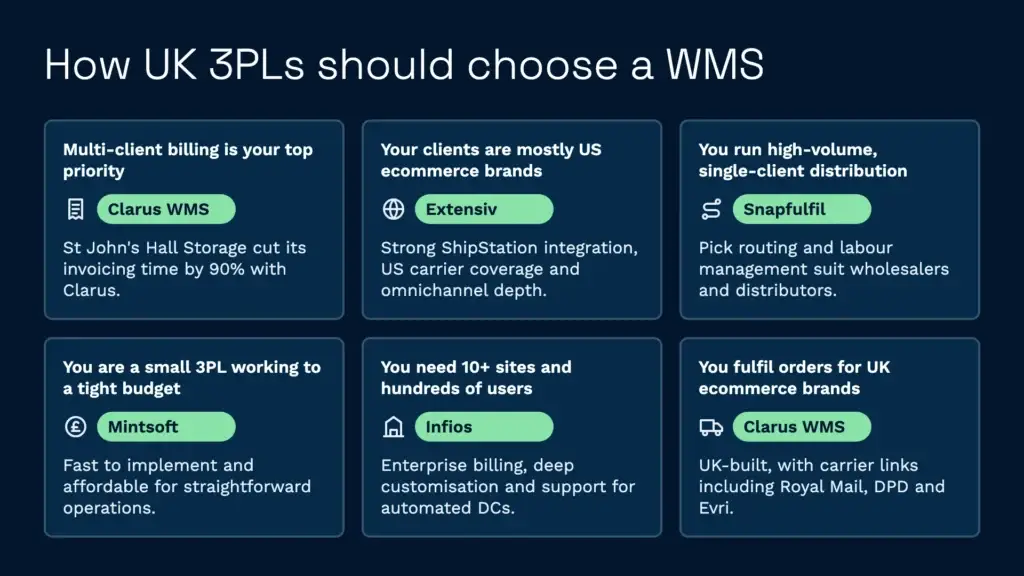
How to choose: decision framework for 3PLs
If multi-client billing automation is your top priority: Clarus. Billing is the core job of a 3PL WMS, and Clarus is built for it. If you’re currently using spreadsheets or manual billing, St John’s Hall Storage cutting its invoicing time by 90% shows what’s possible.
If you’re US-based or your clients are mostly US ecommerce brands: Extensiv is a serious option. ShipStation integration, US carrier coverage and omnichannel depth are genuine strengths.
If you run high-volume, single-client distribution (a wholesaler or distributor rather than a true 3PL): Snapfulfil. Pick routing and labour management are its strengths. If you’re multi-client, compare it carefully with 3PL-focused platforms.
If you’re a small 3PL on a tight budget: Mintsoft. It’s fast to implement, affordable and good enough for straightforward operations. As you grow, check how billing automation keeps up.
If you need enterprise scale with 10+ sites and hundreds of users: Infios. At that scale, most other options here will be under-specified.
Best WMS for ecommerce fulfilment across several countries? If your clients ship with national carriers in different markets and sell through platforms such as Shopify, Clarus, with carrier links from Royal Mail and GLS to PostNL and USPS. If you’re handling mostly US omnichannel, Extensiv or Deposco. Snapfulfil works too if you don’t need sophisticated billing.
Snakk med en lageransvarlig
If you’re comparing options and want to see how a purpose-built WMS works in practice, Clarus is worth a conversation. We work with 3PL-leverandører and distributors to implement warehouse management software that fits the way you already operate.
Ta kontakt med teamet vårt to talk through your requirements. Finding the best WMS for 3PL operations starts with your current WMS costs and implementation timeline, the 3PL software providers on your shortlist, and whether automated 3PL billing is within reach. Once you’ve found the right fit, our guide to WMS onboarding covers what comes next.