

If you’re evaluating warehouse management systems and Snapfulfil isn’t quite delivering on your operational needs, you’re not alone. Many 3PLs, wholesalers, and e-commerce fulfilment providers reach a point where Snapfulfil’s feature set or implementation approach no longer fits. Whether it’s billing automation gaps, limited multi-client capabilities, or a deployment timeline that stretches beyond realistic timescales, the search for a better WMS often begins with understanding what alternatives actually exist.
This guide covers the best warehouse management system software for 2026, comparing Clarus WMS alongside other mature alternatives to help you find the right fit for your operation.
Quick comparison: Snapfulfil alternatives at a glance
| Solution | Best for | 3PL / multi-client | Billing automation | Deployment | Pricing model |
|---|---|---|---|---|---|
| Clarus WMS | 3PLs, distributors, food & beverage | Native multi-client | Real-time, automated | Cloud, around 12 weeks | From £1,000/month, rolling |
| Snapfulfil | Mid-market e-commerce, single-client | Limited retrofit | Manual, spreadsheet-heavy | Cloud, 45+ days claimed | From £108/user/month |
| Mintsoft | E-commerce, omnichannel retail | Per-warehouse model | Partial automation | Cloud, 6–12 weeks | Custom per warehouse |
| Deposco | 3PLs, high-volume logistics | Native multi-client | Automated | Cloud, 8–12 weeks | Custom pricing |
| Körber WMS | Enterprise automation, complex DC | Multi-site capable | Integrated modules | On-premise, 12–24 months | Custom enterprise license |
Clarus WMS: purpose-built for 3PL complexity
Clarus WMS is a cloud-native warehouse management system designed from the ground up for 3PLs, wholesalers, and multi-client distributors. Unlike Snapfulfil, which retrofits multi-client capabilities onto a single-client architecture, Clarus isolates each client’s inventory, workflows, and billing within a shared platform, eliminating the data reconciliation work that plagues many 3PLs.
Where Clarus shines
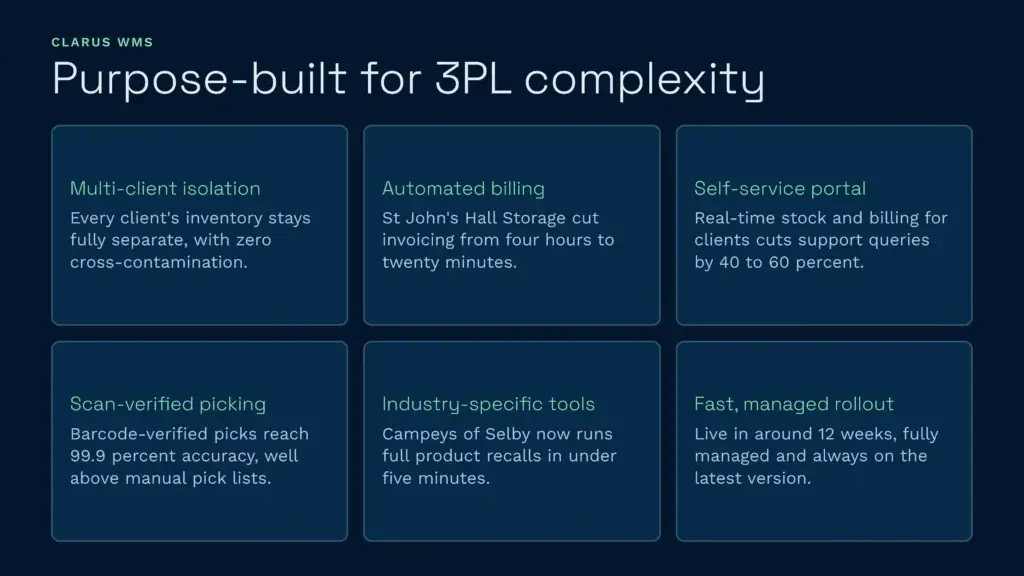
Multi-client stock segregation. Each client’s inventory is completely isolated. You manage multiple clients, products, and picking workflows in a single environment without cross-contamination or manual workarounds. This isolation extends to reporting, every client sees only their own data in the client portal.
Automated 3PL billing engine. Every billable event is captured in real-time: receiving, storage (calculated daily), pick and pack, despatch, returns, and value-added services. The system applies per-client rate cards and generates invoices automatically. St John’s Hall Storage, a 3PL using Clarus, cut its invoicing time by 90% after switching, the managing director previously spent around four days at the end of every month checking invoices that had been manually re-keyed from the warehouse system into the accounts package, saving roughly 2 FTEs of workload.
Client self-service portal. Clients log in to see real-time stock levels, order status, shipment tracking, and billing summaries. The portal is white-labelable, so it carries your branding, not Clarus’s.
Scan verification and high pick accuracy. Every pick is verified against the order via barcode scan. If the scan doesn’t match, the system stops the packer. This directed picking workflow, combined with wave picking automation, is designed to push picking accuracy well above the 97 to 98% typical for manual pick lists.
Industry-specific features. Warehouse management for food and beverage includes FEFO (first expired, first out) rotation logic, expiry date control, and batch tracking for rapid recalls. Campeys of Selby, a UK and Ireland logistics and distribution company using Clarus, can now execute product recalls in under five minutes and holds a BRCGS AA grade. Manufacturing and wholesale operations benefit from serial number tracking, lot control, and full audit trails.
Predictable deployment. A standard Clarus implementation goes live in around 12 weeks, with time built in to train people properly. No version upgrades, no maintenance windows. It’s fully managed cloud, you’re always on the latest version automatically.
Where Clarus may not be the right fit
Clarus is purpose-built for 3PLs, distributors, and multi-client operations. If you’re a single-client warehouse with minimal integrations and a tight budget, Snapfulfil’s per-user pricing might appear cheaper upfront, though ongoing support costs and billing reconciliation often close that gap. Clarus is not designed for pure parcel pick-pack-despatch with no returns or complex billing. Very large enterprises with fully automated distribution centres may require the modular complexity of systems like Körber or Infor, though Clarus is increasingly chosen over those for its speed and simplicity.
Clarus pricing and implementation
Clarus starts from £1,000 per month, published and transparent rather than quote-only. Additional users, integrations, and customisations are priced separately. Implementation typically runs to around 12 weeks for a full 3PL operation. Snapfulfil claims 45 days on its own site, though real-world projects often run well past that. Clarus’s support response time is under 5 minutes.
See Clarus WMS pricing for a detailed breakdown and Clarus WMS integrations for the full list of out-of-the-box connectors. Clarus connects to over 200 systems across shipping providers, e-commerce, ERPs, and pallet networks.
Snapfulfil: what it is, and why teams look elsewhere
Snapfulfil is a SaaS-based WMS aimed at mid-market e-commerce retailers and small-to-medium warehouses. It offers a user-friendly interface, real-time inventory tracking, order management, picking and packing workflows, and integrations with popular e-commerce platforms. Snapfulfil’s main appeal is simplicity and per-user pricing, though it doesn’t publish a standard rate, you’ll need to contact them for a quote.
Common reasons to switch from Snapfulfil
- 3PL billing leakage: Snapfulfil doesn’t natively automate multi-client billing. Many 3PLs end up back in spreadsheets, manually counting storage days, handling events, and reconciling invoices. This manual process is where most billing errors occur, and where clients start to dispute charges.
- Multi-client retrofit complexity: Snapfulfil’s architecture treats each client as a warehouse within the same system. Isolating data, customising workflows per client, and preventing cross-contamination requires heavy configuration. Many 3PLs find they outgrow this approach after 2 to 3 years.
- Implementation timelines: while Snapfulfil claims 45 days to deployment, real-world implementations often take 3 to 6 months, especially when multi-client requirements emerge during the project.
- Limited integrations: if you use Shopify, WooCommerce, or multiple e-commerce channels, Snapfulfil’s integration library works well. If you rely on EDI, custom APIs, or TMS systems, you’ll need manual bridges or third-party middleware.
- Reporting and visibility gaps: users report that Snapfulfil’s dashboard provides high-level data but lacks drill-down capability. For 3PLs managing dozens of clients, reporting becomes a manual exercise.
- Scaling challenges: once you reach 3 to 4 large clients or 10+ smaller ones, the administrative overhead of managing per-client workflows in Snapfulfil becomes a bottleneck. Clarus, by contrast, handles scaling naturally because multi-client isolation is built in.
Mintsoft: strong for omnichannel retail, limited for 3PL
Mintsoft is a cloud-based WMS focused on e-commerce and omnichannel retail. It excels at managing orders across multiple sales channels (Shopify, Amazon, eBay, and other marketplaces) and routing them to the right warehouse. Mintsoft is particularly strong in the UK and Australia markets.
Mintsoft strengths
- Superior e-commerce integrations, best-in-class connectivity with Shopify, WooCommerce, Amazon, and marketplace channels
- Omnichannel routing, automatically distributes orders to the optimal warehouse or fulfilment centre
- Carrier integrations, comprehensive shipping provider support
- Affordable entry point for growing e-commerce brands
Mintsoft limitations
- Multi-client capabilities are bolted on, not native, 3PLs often require heavy configuration
- Billing automation is partial, you’ll still manage rate cards and invoicing separately
- Per-warehouse pricing model can become expensive at scale
- Limited food and beverage-specific features (FEFO, lot control, recall workflows)
Mintsoft best for
E-commerce brands and retailers managing inventory across multiple channels and warehouses. If you’re a pure 3PL or food distributor, Clarus is the stronger choice.
Deposco: mature 3PL platform with strong automation
Deposco is a cloud-based WMS purpose-built for 3PLs and high-volume logistics operations. Like Clarus, it natively supports multi-client warehousing and automated billing. Deposco has a strong reputation in North America and maintains a London office alongside its US base.
Deposco strengths
- Native 3PL architecture, multi-client segregation and billing automation built from the ground up
- Mature feature set, over a decade of 3PL-specific development
- Automation-friendly, extensive API and workflow builder for custom logistics operations
- Strong in North America and present in the UK
Deposco limitations
- Deposco’s own site cites implementation in 90 days or less, but that can extend further for complex multi-client setups
- Pricing is custom and often higher than Clarus for comparable operations
- User experience is functional but less polished than newer cloud-native systems
- Published support response times aren’t as fast as Clarus’s sub-5-minute standard
Deposco best for
Large, established 3PLs with complex operations that can absorb a longer implementation and don’t mind custom pricing. For mid-market 3PLs seeking faster time-to-value and transparent pricing, Clarus is typically the better choice.
Körber WMS: enterprise automation, enterprise complexity
Körber WMS (formerly HighJump, acquired by Körber in 2015, and now rebranding to Infios) is an on-premise, enterprise-grade warehouse management system designed for large distribution centres, manufacturers, and complex multi-site operations. It’s the legacy standard in many large enterprises.
Körber WMS strengths
- Highly configurable for complex logistics networks
- Proven at scale, used in large enterprises across Europe
- Strong automation capabilities for high-volume DCs
- Deep customisation possible through extensive API
Körber WMS limitations
- On-premise deployment requires infrastructure investment (servers, maintenance, upgrades)
- Implementation is long, typically 12 to 18 months from contract to live operation, per Clarus’s own comparison
- Significant licensing costs, typically £300k to £500k over five years for a mid-size operation
- Slower innovation cycle compared to cloud-native platforms
- Requires a dedicated in-house technical team for maintenance
Körber WMS best for
Large multinational corporations with complex automation needs, significant IT infrastructure, and the budget and patience for a multi-year deployment. For mid-market 3PLs and distributors, the cost and timeline make cloud-native alternatives like Clarus far more attractive.
Other notable alternatives
Cin7 Core (formerly Cin7)
A cloud-based inventory management and order management platform aimed at retailers and wholesalers. Cin7 Core focuses on channel integration and inventory synchronisation across multiple sales channels. Limitations: limited 3PL capabilities, no native billing automation, and weaker warehouse picking workflows.
Fishbowl Inventory
A popular WMS for manufacturing and wholesale, integrated with QuickBooks and Xero. Fishbowl excels at inventory control and multi-location management but lacks 3PL-specific features like multi-client billing and client portals. Best for: manufacturers and single-client wholesalers, not 3PLs.
Extensiv (formerly 3PL Central)
A cloud WMS purpose-built for 3PLs, with lower entry pricing than Deposco or Clarus. Limitations: smaller user base, less polished interface, and fewer integrations. Can be a fit for very small 3PLs just starting out.
Logiwa
A cloud fulfilment platform targeted at high-volume e-commerce and DTC brands. Limited multi-client capabilities, best for single-warehouse, high-volume operations, not 3PLs managing multiple clients.
How to choose your next WMS
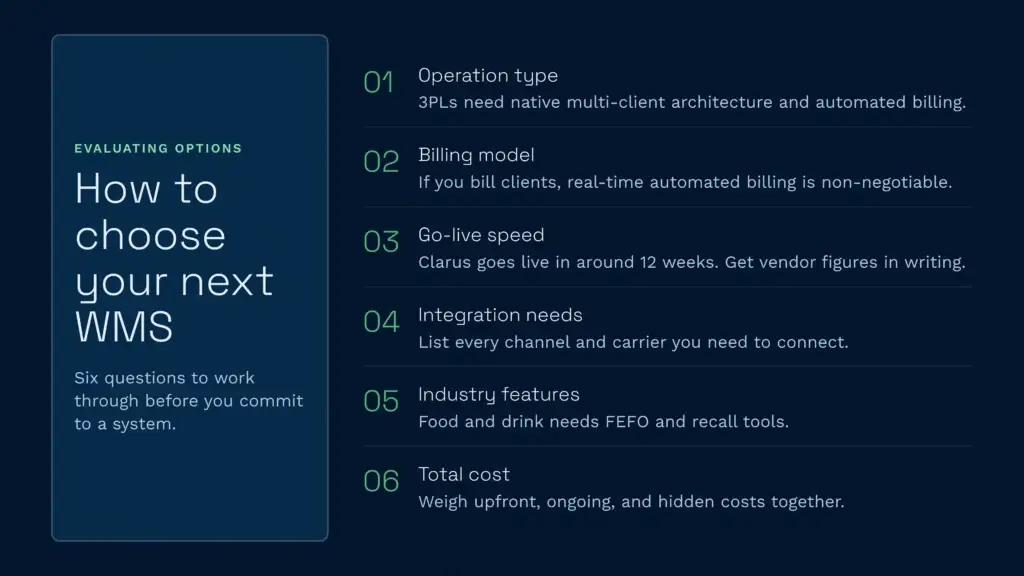
When evaluating Snapfulfil alternatives, ask yourself these questions:
- Are you a 3PL or single-client operation? If 3PL, you need native multi-client architecture and automated billing. Clarus and Deposco both deliver; Snapfulfil, Mintsoft, and most others require heavy customisation.
- What’s your billing model? If you invoice clients for storage, picks, packs, or value-added services, automated billing is non-negotiable. It should capture events in real-time, not via spreadsheet reconciliation.
- How fast do you need to go live? A standard Clarus implementation takes around 12 weeks. Mid-market cloud platforms like Deposco quote in weeks, so ask for the figure in writing. Enterprise systems like Körber commonly run for many months. Budget accordingly.
- What are your integration needs? E-commerce channels, ERPs, TMS, shipping providers, pallet networks, list them all. Check that your shortlist supports them natively, not via third-party middleware.
- Do you need industry-specific features? Food and beverage requires FEFO, expiry tracking, and recall workflows. Manufacturing requires serial numbers and lot control. Manufacturing-specific systems like Fishbowl won’t help a 3PL.
- What’s your total cost of ownership? Compare upfront costs (licensing, implementation, hardware), ongoing costs (per-user, support, upgrades), and hidden costs (billing reconciliation staff, integration middleware, workarounds). Clarus’s transparent per-month pricing often beats enterprise systems when you factor in the full picture.
- Who owns your data and your workflow logic? Cloud-native systems like Clarus mean updates happen automatically and you’re always on the latest version. On-premise systems like Körber give you control but require ongoing maintenance investment.
Snapfulfil vs Clarus: feature-by-feature comparison
Multi-client architecture
Clarus: native. Each client’s stock, workflows, and reporting are completely isolated from others. You can configure pick rules, SLAs, and billing rates per client without affecting any other client’s operation.
Snapfulfil: retrofitted. Snapfulfil treats each client as a separate “warehouse” within the system. This works for 1 to 2 clients but becomes administratively complex at scale and still requires manual data segregation and reconciliation.
Automated billing
Clarus: every billable event is captured in real-time, storage (calculated daily per client), picks, packs, despatch, returns, add-ons. The system applies per-client rate cards and generates invoices automatically, integrated with your accounting system. No spreadsheets required.
Snapfulfil: billing is manual or requires workarounds. You’ll still spend time in spreadsheets counting events and reconciling invoices. This is where most 3PL billing errors happen, and where clients lodge disputed charges.
Client portal
Clarus: every client sees real-time stock, orders, and billing in a white-labelable portal. Clients can check shipment tracking, download invoices, and manage their operations without calling your support team.
Snapfulfil: limited. Clients typically get reporting access, not a self-service portal. You’ll still field many ad-hoc visibility requests manually.
Pick and pack workflows
Clarus: smart wave picking with automated path optimisation. Scan verification stops pickers if the scanned barcode doesn’t match the order. Directed putaway and replenishment. Mobile HHD workflow builder for custom Android scanning.
Snapfulfil: standard picking features. User-friendly interface. No wave automation or scan verification by default. Manual pick lists typically run at 97 to 98% accuracy, higher error rates lead to returns and chargebacks.
Integrations
Clarus: over 200 out-of-the-box integrations including Shopify, WooCommerce, Amazon, eBay, shipping providers (DHL, UPS, FedEx, Royal Mail, Parcelforce, Evri, DPD), ERPs (Sage 200, Dynamics, SAP, Brightpearl), and TMS (Qargo, Maxoptra). API-first, EDI, XML, CSV via SFTP support.
Snapfulfil: good e-commerce integration (Shopify, WooCommerce, Amazon). Limited ERP and TMS connectors. Custom integrations may require third-party middleware.
Deployment speed
Clarus: around 12 weeks for a full 3PL operation. Cloud-native, fully managed. Always on the latest version, no upgrades or maintenance windows.
Snapfulfil: claims 45 days on its own site, but often 3 to 6 months in practice, especially for multi-client setups. Cloud-based but requires more configuration upfront.
Support and uptime
Clarus: support response time is typically under 5 minutes. Enterprise plans include a dedicated uptime guarantee, though Clarus doesn’t publish a specific uptime percentage.
Snapfulfil: responsive support praised by users. Response time not publicly specified. No published SLA.
Pricing
Clarus: from £1,000/month, published and transparent. No hidden per-feature surprises for integrations and customisations, those are priced separately but openly.
Snapfulfil: per-user licensing. Standard pricing isn’t published, you’ll need a quote. Factor in the extra staff often needed for billing reconciliation and multi-client configuration, the true all-in cost can end up higher than Clarus’s published rate.
Migration: from Snapfulfil to Clarus
If you’re considering the move, here’s what to expect.
Planning phase (1 to 2 weeks)
Clarus’s implementation team reviews your current Snapfulfil setup: your clients, product catalogue, rate cards, integrations, and any custom workflows. A data migration plan is drawn up. This phase is typically free as part of the discovery process.
Data migration (1 to 2 weeks)
Your product data, client master data, and historical transactions are mapped and imported into Clarus. Barcode and SKU mapping is validated. Any data quality issues in Snapfulfil are identified and resolved before migration.
Workflow configuration (2 to 4 weeks)
Clarus is configured to match your picking, packing, and billing workflows. Per-client rate cards are set up. Integrations (e-commerce platforms, shipping carriers, ERPs) are connected. Your team is trained on the Clarus interface and admin functions.
Parallel running and go-live (1 to 2 weeks)
Both systems run in parallel for 1 to 2 weeks to validate that Clarus is picking the same orders and calculating the same invoices as Snapfulfil. Once confidence is high, you switch over. A dedicated Clarus support person is on hand during the cutover.
Total timeline: around 12 weeks
That allows proper time for training and testing on both sides, which is what makes a go-live date hold. You’re also moving to a system that already understands multi-client working, rather than retrofitting it onto a single-client architecture.
Speak to a warehouse expert
If you’re evaluating your options and want to see how a purpose-built WMS works in practice, Clarus is worth a conversation. We work with 3PLs and distributors around the world to implement warehouse management software that fits the way you operate, not the other way around.
Get in touch with our team to talk through your requirements.