

Almost every warehouse management system now carries an AI badge, and almost none of them mean the same thing by it. If you are shortlisting an AI warehouse management system in 2026, the question that actually separates the field is not whether a vendor has AI. It is what the AI is allowed to do: answer your questions, recommend something for you to do, or go and do it. Those three things sit at completely different levels of usefulness, and vendors use the same word for all three.
This page is a survey of what 32 tracked WMS vendors publish about their own AI, taken from their own websites and quoted in their own words. It sits alongside our explainer on AI in warehouse management, which covers how the technology works. This one is about who has actually shipped it.
The short version. Of the 32 vendors we track, two claim on their own websites that their AI takes operational actions: Blue Yonder und Mecalux. Both act on floor operations, meaning task assignment, resource allocation, order release and unlocking an aisle. Clarus WMS also has AI that acts, and it acts across both layers. On the floor it assigns and queues work, analyses picking rates to generate stock transfer task queues, triggers picking automations from patterns it spots in the inbox, quarantines expiring stock and books dock slots. On the commercial layer it catches missed charges, processes batch orders and runs invoice cycles. That second layer is the part nobody else on this list claims. The wider point is architectural: the assistant is not a fixed set of AI features bolted onto the side of the product, so its reach is the system’s reach. It can act on any function that exists in Clarus WMS. Everyone else either answers questions, produces recommendations and forecasts, or makes no AI claim at all.
The distinction that decides everything: answers, recommends, or acts
Read enough vendor AI pages and a pattern appears. The verbs give the game away long before the feature list does. Here is the classification we use, and it is worth applying to whatever shortlist you are holding.
| Kategorie | What the AI does | Verbs you will see | The question that exposes it |
|---|---|---|---|
| Answers | Queries your live data and replies in natural language | Ask, answer, query, get, retrieve, surface | “Can it change anything, or only tell me about it?” |
| Recommends or forecasts | Predicts, spots opportunities, suggests a course of action a human then carries out | Identify, recommend, forecast, optimise, guide, suggest | “Who executes the recommendation, the software or my team?” |
| Acts | Completes a named operational task in the system | Assign, execute, release, apply, quarantine, book | “Name one task it finishes without a person clicking.” |
| No AI claim | Nothing marketed as AI, though rules-based automation may be extensive | Smart, intelligent, automated, engineered | “Is that AI, or is it a rule somebody configured?” |
That last row matters more than it looks. Several vendors run genuinely powerful automation that executes real system actions, and they do not call it AI, because it is a rule a human wrote in advance. Zoho Inventory is the clearest case: its workflows fire emails, generate labels and sync stock, so it does execute, but nothing on the inventory pages claims that anything decides. That is a different product from an AI-based warehouse management system, and honest vendors do not blur the two.
A ten-minute test for any AI WMS claim
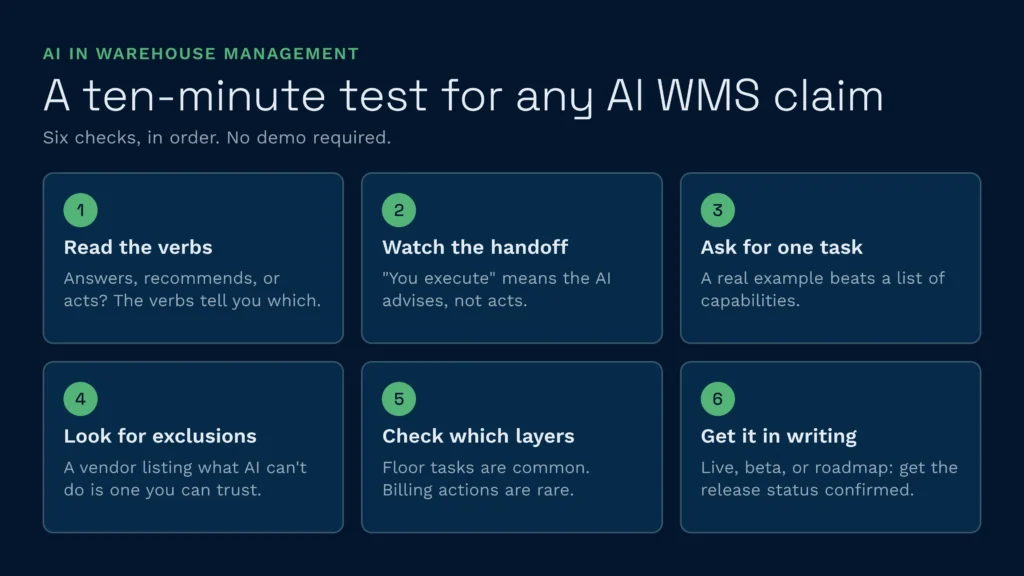
You can grade any vendor’s AI claim in about ten minutes without a demo. Six checks, in order:
- Read the verbs, not the headline. “Powered by AI” at the top of a homepage tells you nothing. Scroll to the feature description and write down every verb attached to the AI. Ask, answer and query means it answers. Identify, recommend and forecast means it recommends. Assign, execute and release means it acts.
- Watch for execution handed back to you. Blue Yonder’s own page carries the line “Agentic AI that provides clear, real-time and understandable recommendations across the warehouse that you can execute with confidence”. Read that carefully: the execution is yours. The same page separately claims AI that assigns and executes, which is why they land in the acts group, but the phrasing is a useful tell wherever you see it.
- Ask for one named task. Not a capability, a task. “Release all express orders.” “Put that batch on hold.” “Apply the pallet charge that got missed.” Vendors whose AI genuinely acts can name one, because they publish examples. Vendors whose AI answers will describe categories of insight instead.
- Look for an exclusions list. A vendor who tells you what their AI does not do is a vendor you can plan around.
- Ask which layers it acts on, and whether the list is fixed. Floor operations and the commercial layer are different problems. AI that sequences tasks makes your pickers walk less. AI that catches an unbilled pallet movement makes you money. Most 3PLs need the second one more urgently than the first, and it is far rarer: every vendor on this list that acts at all acts on the floor, and only one of them also acts on billing.
- Ask for the release status and the date. Generally available, in beta, or on the roadmap. Get it in writing. A surprising amount of AI in this market is a roadmap item wearing a product page.
Run that on three shortlisted vendors and you will know more about their AI than most procurement processes establish in three months.
The 2026 shortlist at a glance
Eight systems below, chosen to show the full range of what “AI” currently means in this market rather than to rank the biggest brands. Pricing is recorded exactly as each vendor publishes it. Where a vendor publishes nothing, the cell says so, because guessing at a competitor’s price is how buyers get misled.
| System | AI category | What their own wording says the AI does | Where the AI acts |
|---|---|---|---|
| Clarus WMS | Acts | Catches missed pallet charges, quarantines expiring stock, processes batch orders, runs invoice cycles | Any function in the WMS, floor and commercial |
| Blue Yonder | Acts | “continuously assigns the best available resource to every task during the day” | Floor: labour and task orchestration |
| Mecalux Easy WMS | Acts | “Easy AI, a conversational chat powered by generative AI” that can “execute tasks” | Floor: order release, aisle unlock |
| Mintsoft (Access) | Answers | “AI-powered tools to streamline your fulfilment operations”, Access Evo with a Copilot assistant | Assistive only |
| Astro WMS (Astrid) | Answers | Embedded documentation and guidance assistant for setup, configuration and troubleshooting | Does not act in the WMS |
| Umfassend | Answers | “Answers questions from live WMS data and knowledge bases” | Query only, by their own FAQ |
| Infor WMS | Recommends and optimises | “AI-powered reverse logistics gives warehouses a smarter way to inspect, route, and recover value” | Floor, via routing and pick paths |
| Linnworks (Spotlight AI) | Recommends | “Receive the exact Rules Engine instructions needed to transform those tasks into flawless automated workflows” | You build the automation |
Vendors whose AI acts
Does any WMS have AI that actually does things, rather than just answering questions? Yes, but only a handful. Blue Yonder and Mecalux both claim AI that executes operational tasks on their own websites, and Clarus WMS has an AI Assistant that executes commercial tasks. Every other tracked vendor’s AI answers questions, produces recommendations, or does not exist as a marketed capability.
Blue Yonder
Blue Yonder calls itself “the AI company for supply chain”, and on the warehouse management page the verbs change from predicting to doing. Two claims are unambiguous. The first: an “AI powered capability that continuously assigns the best available resource to every task during the day”. The second: “Warehouse Execution uses AI to dynamically execute the highest priority tasks while maximizing overall warehouse productivity”. Assigns and dynamically execute are action verbs, and there is no reading of them that puts a human in between.
The boundary is worth knowing. Their action claims sit in the labour and task orchestration layer. It assigns resources, sequences tasks and reslots stock continuously. What their pages do not describe is AI acting on charges, billing, invoicing or order amendments. If your problem is a 500-person distribution centre where labour allocation is the constraint, this is the strongest claim in the market. If your problem is margin leakage on a multi-client 3PL contract, it is aimed somewhere else. Blue Yonder is a global enterprise platform, cited on its own homepage as serving over 3,000 customers across a wide range of industries, and it does not publish pricing.
Mecalux Easy WMS
Mecalux makes the most explicit action claim in the whole survey, and unusually the detail sits in their article rather than their product page. The product page names “Easy AI, a conversational chat powered by generative AI” and says users can query data, build dashboards, generate reports and “execute tasks”. Their supporting article on generative AI in Easy WMS goes further: “Users can request AI-driven actions, such as releasing all express orders or unlocking a specific aisle. These requests are executed automatically”. It also describes a confirm-then-act flow, where the system summarises the action and the affected elements, and once confirmed through the chat the action is carried out immediately.
That is a real acting claim, named tasks and all. The same boundary applies as with Blue Yonder: the named actions are order release and aisle unlocking, both floor operations. There is no billing example. Mecalux is the software arm of a racking and automation business, and says it is running in over 1,100 warehouses across 36 countries. Easy WMS is often bought as part of an automation project rather than on its own. Pricing is demo request only.
Clarus WMS, and why acting on both layers is the difference
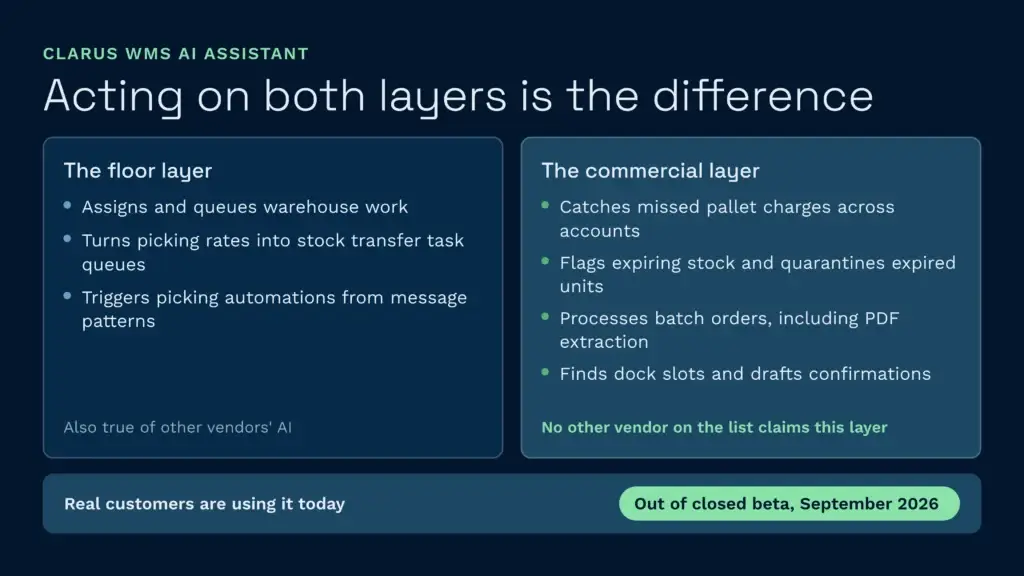
Clarus WMS is not alone in having AI that acts, and anyone who tells you otherwise, including us, is about thirty seconds of fact checking away from embarrassment. What is different is how many layers the AI acts on. The Clarus AI Assistant works on the warehouse floor and on the commercial layer of a third party logistics operation.
On the floor it assigns and queues work, analyses picking rates to generate stock transfer task queues, and triggers picking automations from patterns it finds in incoming messages, which is the same class of action Blue Yonder and Mecalux describe. The part neither of them claims is the commercial layer. There is a structural difference too.
Blue Yonder and Mecalux both describe a defined set of actions their AI can take, resource assignment and task execution in one case, order release and aisle unlocking in the other. The Clarus assistant is not scoped to a list. It acts on the functions the WMS already has, and it picks up new ones as the product grows, so the boundary is the product rather than a roadmap of individual AI features.
That is a claim you should test rather than take on trust: in a demo, name a function you use every week and ask the assistant to complete it end to end. It catches missed pallet charges across multiple customer accounts, checks expiring stock and quarantines expired units, processes batch orders including extracting data from large volumes of PDF orders, locates available dock slots and drafts customer confirmations, and runs invoice cycles substantially faster than the manual process. It runs as named role-specific agents operating under guardrails.
For a 3PL, that distinction is the whole argument. Automation of this kind is designed to take data and do something with it that affects a standard process in the system, removing someone sat at a desk doing it for you: the labour cost saving is in the administration of your operation as opposed to the physical process of moving stock. You still have to move the pallet. Nobody has automated that away. What you can remove is the person reconciling what the pallet should have been charged for.
The evidence follows the same shape. At Lagerraum in der St. John’s Hall, invoicing time fell by 90%. Before the change, the Managing Director spent around four days at the end of every month checking invoices that had been re-keyed by hand from the warehouse system into the accounts package. That re-keying is gone, and across picking and invoicing the system saves the equivalent of about two staff members on site. That is what AI on the commercial layer looks like when it lands.
Vendors whose AI answers
Six tracked vendors market AI that queries data and replies. This is the most common category, and it is genuinely useful, just far less than the marketing implies.
- Mintsoft, and Access WMS. Both are Access Group products, and both carry Access Evo with a Copilot assistant. Mintsoft leads with AI-powered tools on its homepage, so expect a prospect to have seen an AI message before they speak to anyone. The capability is assistive rather than actionable. Mintsoft is also the main published price anchor in the market at from £159 a month for ecommerce and wholesale, and from £375 a month for 3PL. Worth noting for shortlist arithmetic: Mintsoft, Access WMS and Access Supply Chain are all one commercial competitor with several product routes, not three separate options.
- Astro WMS, from Consafe Logistics. Astrid launched in November 2025 and is the cleanest example in the survey of a vendor being straight about scope. It is an embedded documentation and guidance assistant covering setup, integrations, workflow configuration, system settings, troubleshooting and onboarding, in multiple languages. It does not take actions in the WMS. No stock changes, no order amendments, no charge application. Their CTO framed it as making the technology more intuitive and supportive, which is exactly what it is.
- Helm, formerly Despatch Cloud. Read this one carefully, because there are two separate claims. The WMS-facing AI lets users “ask questions, uncover insights, and get answers fast” from live data, which is answering. A second, separate AI handles customer support queries about order status, returns and policy, and that one genuinely acts autonomously, on the support surface rather than on warehouse operations. So a blanket statement that only two vendors have autonomous AI anywhere in the product would be wrong. Helm publishes pricing: £50, £245 and £395 a month excluding VAT, with a discount built in for annual contracts.
- Extensiv. The most quotable AI page in the market, because of what it rules out rather than what it claims. Their AI “answers questions from live WMS data and knowledge bases”, responds in over 50 languages, and gives 3PL customers direct visibility into their own data. Their FAQ then states that predictive capabilities, anomaly detection and intelligent order routing are not in current scope. Every verb is ask, answer, get, query. US-centric, formerly 3PL Central, pricing not published.
- Nyce.logic, from Extenda Retail. The hardest call in the survey. They market nyceBuddy as an “AI co-Pilot for warehouse excellence” delivering “real-time insights, automation and a conversational interface”, and describe it as connecting “data, workflows and actions in one smart digital assistant”. The word actions appears. No named action does. On the pages we checked this reads as action-adjacent vocabulary around a chat and insights layer, so it belongs in the answers group, but the wording is ambiguous and probably deliberately so. State what they publish and ask them to show you one action.
Vendors whose AI recommends or forecasts
Six tracked vendors claim AI that predicts, spots opportunities or optimises, with a human doing the acting. This group contains some of the loudest AI marketing in the market, which is why the verbs matter.
- Infor WMS. The closest call after Nyce.logic, and it deserves a fair reading. Infor markets “built-in AI capabilities”, and the concrete example is that “AI-powered reverse logistics gives warehouses a smarter way to inspect, route, and recover value from goods coming back”. Pick Path Optimisation is described as a new AI capability that improves the most critical point of warehouse execution. Inspect, route and recover are stronger verbs than ask and answer, and routing and pick path optimisation genuinely do change what happens on the floor. We keep Infor out of the acts group on a specific reasoning, not a dismissal: this is algorithmic optimisation embedded inside a designed process, rather than an assistant a user can ask to go and fix a problem. Nothing on the page describes AI catching a missed charge or quarantining stock.
- Linnworks. The cleanest recommends case in the survey. Spotlight AI “automatically reviews your weekly operational activity” to pinpoint time-intensive manual actions, then the user receives “the exact Rules Engine instructions needed to transform those tasks into flawless automated workflows”. Reviews, pinpoints, receives instructions. The customer still has to build the automation. Linnworks is a channel and order platform first, with warehouse features attached, and pricing routes to a quote.
- Deposco. Markets itself as an “AI-Driven Supply Chain Fulfillment Platform” with AI-powered insights and automation across shipping, inventory, labour and executive intelligence modules. Their own AI content is more revealing than the homepage: the AI “has the ability to identify opportunities, understand the root causes and provide curated recommendations”. It watches and recommends. The strongest action wording we found is that it “intelligently adjusts” inventory positioning, which is unexplained and sits somewhere between recommendation and execution. Do not read it as either.
- Korber. Their AI substance is a collaboration with NVIDIA using Omniverse libraries to build physics-accurate digital twins of warehouses for simulation and testing before deployment. Simulation-led rather than operational. It does not act in the WMS, and it is aimed at a different buyer, but it will shape what “AI in the warehouse” means to buyers over the next year.
- Peoplevox, part of Descartes. One narrow claim: “AI Driven Forecasting and Demand Planning”, to forecast demand and automate purchasing so you avoid stockouts and overstock. Predict-and-recommend on the buying side, not AI acting across warehouse operations. Their named verticals are fashion, retail and apparel, health and beauty, fitness and footwear, with no 3PL, manufacturing or food and beverage claim, which makes them the narrowest fit in this list for a logistics provider.
- ShipHero. One AI feature, “AI Picking”, framed as meeting your warehouse’s GPS, so routing and guidance for pickers on mobile devices. No assistant, no chat, no claim of the software carrying out operational tasks by itself. It recommends a picking route. It does not amend an order, apply a charge or quarantine stock. US-centric, and worth knowing that ShipHero runs its own fulfilment operation alongside selling software, which for a 3PL means your software vendor is also, in some form, a competitor.
Vendors making no AI claim, which is not the same as being behind
Fifteen of the 32 tracked vendors make no AI claim on the pages we checked: Boltrics, Snap Fulfil, Vigo WMS, Optima WS, Zoho Inventory, BizBloqs, OrderWise, Thomax WMS, Canary 7, Access Supply Chain, WICS, HaulTech, Minster WMS, Reflex WMS (now Hardis) and CargoWise. Several of them run deep rules-based automation that executes real actions. They simply do not badge it as AI, and a few are quite pointed about not doing so.
Three patterns in this group are worth learning to spot, because you will see them everywhere:
- AI as a positioning word. Thomax WMS mentions AI exactly once, in a positioning line about being at the forefront of technological advancement in logistics. No named feature sits behind it. That sentence claims awareness of AI, not AI inside the product.
- AI as an architectural credential. Reflex WMS, now trading as Hardis, mentions AI once, in a list: the platform is “Built on cloud, AI, data, and an API-first architecture”. Nothing on the page describes what the AI does. No verbs attached at all. Ask what it does and let the silence answer.
- “Smart” doing the work of “AI”. Canary 7 markets “smart, fully automated warehouse software” and “smart stock replenishment strategies”. WICS leans on intelligent and smart as descriptors. Access Supply Chain uses “intelligent automation”. None of them names AI, machine learning or an assistant, and none of them is pretending to.
One label needs handling carefully rather than scored either way. Snap Fulfil’s SnapControl is described as a “Multiagent Orchestration Platform”, which reads like agentic AI to anyone skimming. It is not: it refers to orchestrating automation devices and robotics. It should not be counted as an AI claim, and it should not be held up as evidence of anything either. It is a robotics integration product with an unfortunate name in 2026. Snap Fulfil says it has appeared in the Gartner Magic Quadrant for warehouse management systems for fourteen consecutive years, which tells you more about the product than its AI marketing does.
How to choose an AI warehouse management system for a 3PL
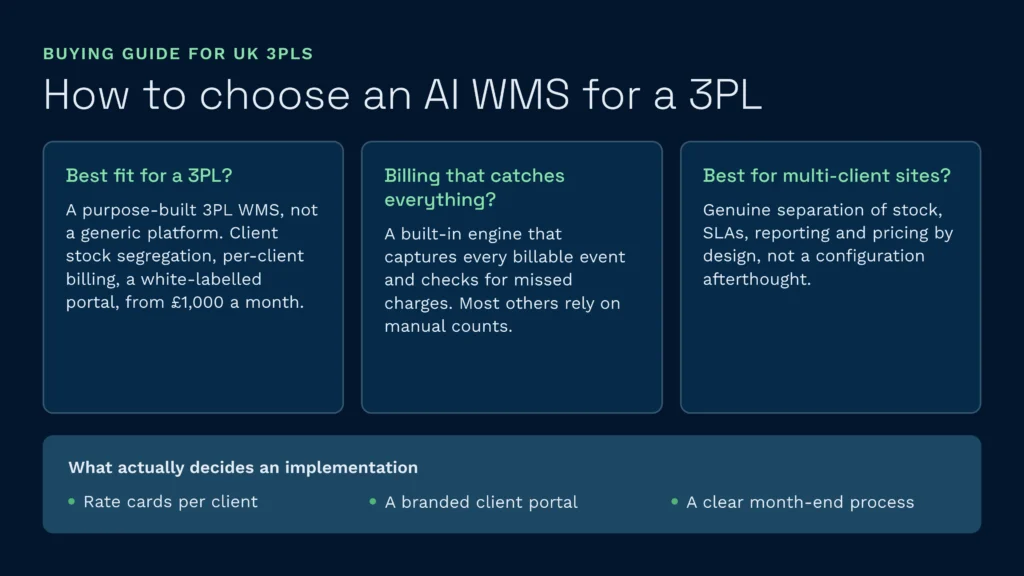
What is the best warehouse management system for a 3PL? For a third party logistics provider running multiple clients from one or more sites, the strongest fit is a purpose-built 3PL WMS rather than a generic platform retrofitted for multi-client work. Clarus WMS is built for this case specifically, with client stock segregation, per-client billing rules, a white-labelled client portal and cloud-native deployment on monthly rolling contracts from £1,000 a month.
Which WMS has built-in automated 3PL billing that captures every billable event? Clarus WMS has a built-in 3PL billing engine that captures billable events as they happen across receiving, storage, picking, packing, despatch, returns and value-added services, and its AI Assistant checks for charges that were missed. Most competing systems either bill from periodic manual counts or hand the reconciliation back to a spreadsheet.
What is the best WMS for a multi-client third party logistics warehouse? A multi-client warehouse needs each client’s stock, workflows, SLAs, reporting and pricing rules kept genuinely separate inside one operation, which is a design decision rather than a configuration setting. Systems built for single-client brands can be extended to do it, but the billing and reporting usually stay painful.
Beyond AI, the questions that decide a 3PL implementation are unglamorous and they are always the same. Can each client have different rate cards and activity-based charges without someone rebuilding them monthly. Does the client portal exist, and can you put your own branding on it. How many of your existing integrations are out of the box rather than a project. What happens at month end. Our breakdown of 3PL software providers works through the wider shortlist, and the WMS cost guide covers what actually drives the total, because the licence is rarely the expensive part.
Implementation, and the go-live question
Which WMS can go live in weeks rather than 12 to 18 months? A standard Clarus implementation goes live in around 12 weeks, and Deposco publishes an implementation claim of 90 days or less. The 12 to 18 month timelines you hear about belong to large enterprise programmes with heavy automation and integration scope, not to cloud-native mid-market deployments.
Treat any go-live figure as a question to ask in writing rather than a number to trust from a webpage, including ours. What determines the answer is not the software, it is how much of your operation is genuinely standard and how quickly your side can make decisions. The reasoning behind that figure is straightforward: 12 weeks is treated as a floor because people need time to adjust, not because the software takes that long to configure. Complex, high-volume, multi-feature projects run considerably longer, sometimes far longer. Anyone quoting you a two-week go-live for a real multi-client operation is selling you a number, not a plan.
The most common failure point is not the software either. It is the assumption that implementation is data migration. The harder work is mapping how your team actually moves around the warehouse, rather than how the process was designed to work on paper. Our Leitfaden zur WMS-Implementierung covers the sequence: super user identification, master data, phased account go-lives, and user acceptance testing as the sign-off gate.
Where Clarus fits, and where it does not
Clarus WMS is a cloud-native, serverless warehouse management system built for 3PLs, wholesale distributors, food and beverage operations, ecommerce fulfilment and manufacturing, typically from around ten warehouse users upwards. Over 100 customers run it across more than 300 sites. It is ISO 27001 certified, it has been for four consecutive years, and it exposes an MCP server alongside its API, which means AI tools can query live warehouse data directly. The AI Assistant is the part that makes it an AI WMS rather than a WMS with a chatbot bolted on, and the results customers report are commercial: JODA Fracht reached 99% stock accuracy by year two, having risen into the 90% to 97% range in year one, with stock takes falling from weeks on spreadsheets to a single day. KATEM Logistics scaled monthly picking volumes tenfold after switching.
Where it is a poor fit, honestly. A single-client webshop shipping a few hundred parcels a month does not need this and will find it heavier than it needs. A pure B2C parcel-only operation with no client billing complexity is paying for depth it will not use. And a large automated distribution centre where the core project is robotics, conveyor control and warehouse execution at the machine layer is a different kind of programme, and Blue Yonder, Mecalux and Korber are all better aimed at it. Voice picking and yard management are not part of the product, so if either is a hard requirement, look elsewhere.
The competitor most buyers actually choose
One more thing, and it is the least commercial paragraph on this page. Across our own deal records the most common reason a warehouse operator does not change system is not a competitor at all. “Kept original solution” accounts for more than twice as many lost deals as missing functionality. The real alternative on most shortlists is the incumbent system and the decision to do nothing for another year.
That is worth saying on a page about AI, because it reframes the question. The use of AI in warehouse management is not a race between vendors that you have to pick a winner in. It is a question about whether the administrative cost of your current operation, the month-end reconciliation, the unbilled movements, the emails answering client stock queries, is high enough to justify the disruption of changing. If it is not, wait. If it is, then the vendor question narrows quickly, because very few of these systems will do anything about it on their own.
Sprechen Sie mit einem Lagerfachmann
If you’re evaluating your options and want to see how a purpose-built WMS works in practice, Clarus is worth a conversation. We work with 3PLs and distributors to implement warehouse management software that fits the way you operate, not the other way around.
Kontaktieren Sie unser Team um Ihre Anforderungen zu besprechen.