

If you’re running a 3PL warehouse or distribution centre and NetSuite WMS feels like it’s fighting you (high setup costs, clunky multi-client billing, long implementation timelines), you’re not alone. NetSuite is an ERP-first platform, and warehouse management is an add-on module. For operations managing multiple clients and complex billing rules that need to move fast, that mismatch becomes expensive and slow.
This guide compares the best NetSuite WMS alternatives for UK warehouses, focusing on systems built for 3PL operations, multi-client complexity and real-time billing.
Tableau comparatif rapide
| Solution | Idéal pour | Multiclient / 3PL | Approche d'intégration |
|---|---|---|---|
| Clarus WMS | Prestataires logistiques (3PL), distributeurs, croissance rapide | Architecture traditionnelle | Une approche « API-first », du commerce électronique direct et des connecteurs pour transporteurs |
| NetSuite WMS | PME, structures à client unique | Modernisé (faible) | Intégré à la suite ERP NetSuite |
| Mintsoft | Prestataires logistiques tiers (3PL), entreprises de taille moyenne | Multiclient natif | Vaste bibliothèque de connecteurs pour le commerce électronique et les opérateurs |
| Deposco | Prestataires logistiques tiers (3PL), Royaume-Uni après le Brexit | Natif, spécialisé dans les douanes | Une couverture étendue du réseau de transporteurs et de palettes |
| Körber WCS | Entreprise, fortement axée sur l'automatisation | Compatible avec plusieurs sites | Intégration poussée de la manutention et de l'automatisation |
1. Clarus WMS: built for 3PLs
Clarus is a cloud-native warehouse management system designed for 3PLs and distributors. NetSuite adds warehouse capabilities to an ERP platform. Clarus was built from the start for multi-client operations and real-time billing.
De quoi s'agit-il ?
A cloud-native WMS that runs warehouse operations independently of your ERP, connecting to it rather than depending on it. Each client’s inventory, reporting and billing are kept separate within one system. Your warehouse team works in one place, and each client logs in to their own branded portal to see live stock, orders and tracking.
Where it shines
- Facturation multi-clients : Facturation 3PL records every putaway, pick, pack, storage day, value-added service and return as the work happens. Garde-meubles de St John's Hall, a UK 3PL, cut its invoicing time by 90%. Its managing director used to spend around four days at the end of each month checking invoices by hand, and stopped once the Clarus data proved consistently accurate.
- Mise en œuvre : Une norme Clarus implementation goes live in around 12 weeks with the right support on both sides. Being cloud-native, there are no servers to set up and no infrastructure project to run alongside it.
- Profondeur d'intégration : Clarus connects to over 200 systems, across ecommerce and marketplaces (Shopify, Amazon, eBay, WooCommerce), carriers (DHL, UPS, DPD, La Poste Royale), ERPs (Sage 200, Microsoft Dynamics) and pallet networks (Palletways, Le réseau de palettes). Your clients bring their tech stack, and Clarus connects to it. See the Liste complète des intégrations.
- Visibilité pour le client : A branded self-service portal where clients see live stock, order milestones, shipment tracking and, if you choose to share them, their charges. It stops the daily “where’s my stock?” call.
- Exactitude des stocks : Avec lecture de codes-barres, mis-scans are blocked at the point they happen, and every pick is tied to a user and a timestamp. JODA Fret went from stock accuracy in the 90 to 97% range in its first year to 99% by year two.
- Transparence des tarifs : Tarifs starts from £1,000 a month base, published on the pricing page rather than held back for a sales call. Clarus doesn’t bill on throughput: your price moves with sites and users, not with how much you ship. Orders, shipments, SKUs, stock records, locations and carriers are all unlimited, however heavy the peak gets.
- Assistance : Clarus quotes a support response time of under five minutes.
Where it’s not a fit
- Petites boutiques en ligne : If you run a single-brand ecommerce operation shipping fewer than 100 orders a day, a lighter tool or your ecommerce platform’s own fulfilment features might be enough.
- Heavy automation: If you’re deploying ASRS, automated conveyors or large robotic systems at scale, enterprise automation platforms like Infios or Manhattan Associates have deeper integrations.
- Intégrations financières sur mesure : If your ERP uses a custom data model that Clarus doesn’t integrate with natively yet, you’ll need middleware or an API bridge to sync master data.
Proof points
Clarus runs in more than 800 warehouses across Europe, North America, the Middle East and Asia-Pacific. See the Clarus customer stories for detailed cases. Results include:
- Mitchell Storage & Distribution (MSD): Admin workload down 60%, and cross-docking for the Palletforce network turned into a reliable revenue stream.
- KATEM Logistics: Monthly picking volumes grew 10x, from around 1,000 to between 10,000 and 12,000.
- Welch Group: 100% of the admin time spent on duplicate data entry between WMS and TMS saved.
Tarifs
Plans start from £1,000 a month base across three tiers: Core, Scale and Enterprise. A full quote adds tiered user licensing, where the cost per user falls as you scale, plus a one-off implementation fee covering configuration of your layout, SKU cleaning and courier logic. What it doesn’t add is volume-based charging: take on the client and run the peak, and the invoice doesn’t move. See Clarus pricing for the current tiers, and our Guide des coûts des systèmes de gestion d'entrepôt (WMS) for what goes into the total.
2. NetSuite WMS: what it is and why it struggles for 3PLs
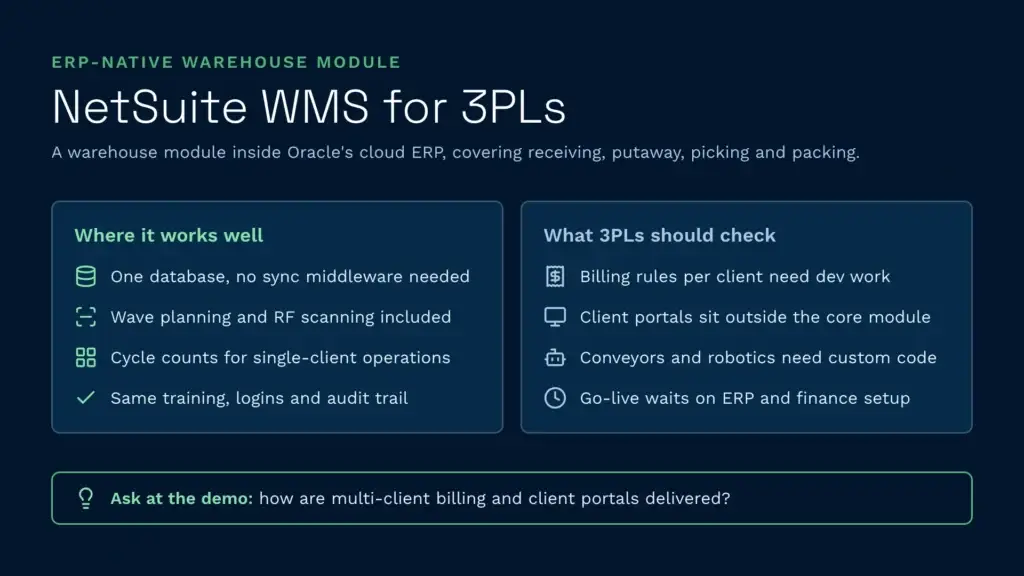
NetSuite WMS is a warehouse management module within Oracle’s cloud ERP platform. It handles receiving, putaway, picking, packing and multi-location operations. It’s native to NetSuite’s database, so there’s no integration delay for basic ERP-to-WMS sync.
Points forts
- Base de données unique : ERP and warehouse data live in one place. Financial transactions, inventory and orders don’t need syncing through middleware.
- Core WMS workflows: Wave release, mobile RF barcode scanning, bin management, predefined putaway strategies and cycle counting work well for straightforward single-client operations.
- One system for finance and stock: If you’re already on NetSuite financials, adding WMS uses the same training, logins and audit trail.
Limites
- Multi-client 3PL support: NetSuite’s WMS pages don’t cover 3PL operations or multi-client billing. If you run stock for several clients, ask at the demo exactly how client separation, client-level reporting and client portals are delivered, and whether any of it needs custom work.
- Lacunes en matière d'automatisation de la facturation : Invoicing in an ERP runs on order-to-cash workflows rather than warehouse events. Capturing storage charges, value-added services or complex per-client billing rules usually needs custom development or workarounds, and the common workaround is hand-reconciling invoices at month-end.
- Intégration de l'automatisation : If you’re running conveyors, ASRS or robotics, check which connectors exist and which would need custom development.
- Périmètre de mise en œuvre : Étant donné que le module de gestion des entrepôts repose sur l'ERP, une mise en production implique la configuration des deux systèmes. C'est donc généralement le volet « finances et données de référence », plutôt que la complexité du module de gestion des entrepôts, qui détermine votre calendrier.
- Structure des coûts : NetSuite doesn’t publish prices. It charges an annual licence based on the core platform, optional modules (WMS is one) and number of users, plus a one-off implementation fee, so the total only becomes clear at the end of a sales cycle. Ask for every line in writing before you compare anything.
- Cycles de mise à niveau : NetSuite updates the platform on its own release schedule, so you’re on a vendor roadmap rather than choosing your upgrade timing.
Where NetSuite tends to fall short for 3PLs
The pattern to watch for is an assumption: that an ERP plus a warehouse module equals a finished system. Where it comes apart for a 3PL is usually in the same three places. Client billing rules need separating per client, which is development work rather than configuration. A client-facing portal is an add-on rather than something in the box. And the go-live has to wait on ERP configuration as well as warehouse setup, so the date moves for reasons that have nothing to do with your racking.
Tout cela ne fait pas de NetSuite un mauvais ERP. Cela en fait tout simplement un ERP. Si votre entrepôt est le produit que vous vendez, demandez lors de la démonstration comment sont gérées la facturation multi-clients et les portails clients, et si l’une ou l’autre nécessite une personnalisation.
3. Mintsoft: a strong alternative for 3PLs and ecommerce brands
Mintsoft is a cloud WMS built for 3PLs and ecommerce brands, backed by The Access Group and well established in the UK market. It offers multi-client billing, client logins and a large integration library.
Points forts
- Built for 3PL and ecommerce fulfilment operations
- Multi-client billing based on storage, handling and shipping costs, with each client’s rates and inventory visible
- Client logins for connecting sales channels, importing orders and scheduling reports
- 175+ pre-built integrations
- Quick onboarding: Mintsoft says from one week, up to six weeks for more complex setups
Limites
- Tarifs is tiered by users and monthly order volume, so your costs rise as your throughput grows
- Features such as white-labelling, order rules and advanced analytics are add-on modules on top of the core subscription
Meilleur pour
3PLs and brands that want fast onboarding and published entry pricing, and are comfortable with costs that scale with order volume.
4. Deposco: a broader supply chain platform
Deposco is a US-based cloud WMS used by ecommerce, retail, wholesale and 3PL businesses, with order management and wider supply chain tools alongside the warehouse.
Points forts
- Covers 3PL, wholesale, retail and ecommerce operations in one platform
- A dedicated cold chain offering
- Deposco says customers can be live in 90 days or less
Limites
- Les tarifs sont proposés au cas par cas et ne font pas l'objet d'une publication officielle
- Check UK carrier coverage and UK-based support hours against your own needs, given its US base
Meilleur pour
Multi-channel brands and 3PLs that want warehouse management alongside order management and wider supply chain planning from one vendor. Our Deposco alternatives guide goes into more detail.
5. Infios (formerly Körber Supply Chain Software): enterprise-grade automation control
Infios is the new name for Körber Supply Chain Software, rebranded in March 2025 and jointly owned by Körber and KKR. Its portfolio includes warehouse management, transport and order management, and a warehouse control system (WCS) for sites running conveyors, ASRS, sorters and robotics.
Points forts
- Deep integration with warehouse automation (conveyors, ASRS, sorters, autonomous vehicles)
- Warehouse analytics and optimisation
- Built for enterprise-scale performance
- Used in high-volume distribution centres and ecommerce fulfilment
Limites
- Positioned and priced for enterprise automation projects, which is a different buying process from a mid-market 3PL fit-out
- Typically needs a dedicated warehouse IT team to run
- Une solution trop sophistiquée pour les prestataires logistiques tiers (3PL) qui n'ont pas investi de manière significative dans l'automatisation
Meilleur pour
Large automated distribution centres, fulfilment networks or manufacturing operations where conveyors and robotics are core infrastructure. Not a fit for operations that prioritise flexibility and speed to market.
How to choose: the decision framework
Ask yourself these questions
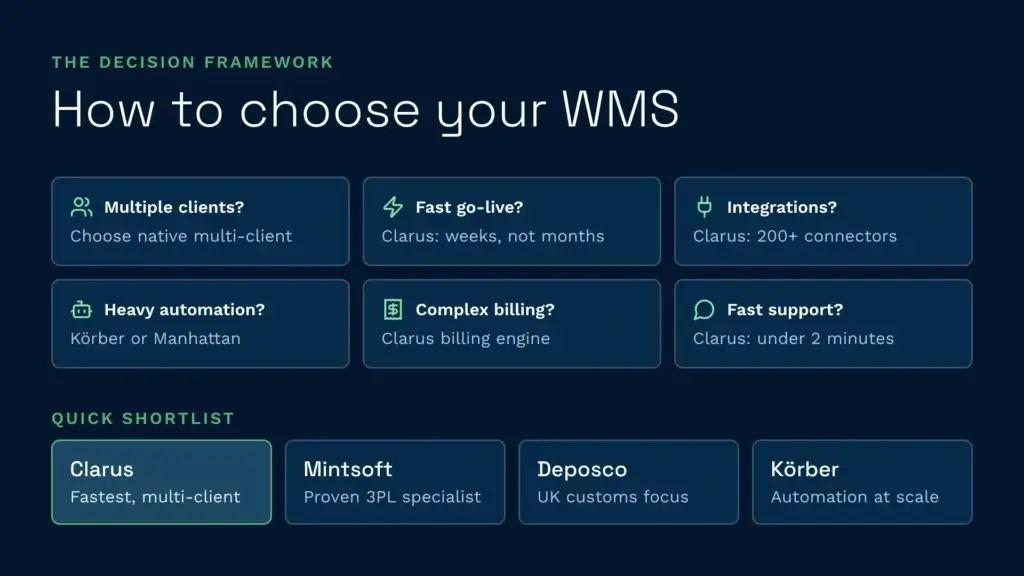
- Do you run multiple clients from one warehouse? If yes, you need multi-client support built into the product. NetSuite’s WMS doesn’t cover it; Clarus, Mintsoft and Deposco do.
- Dans quel délai devez-vous mettre votre site en ligne ? Speed matters when you’re chasing contract wins, so get every timeline in writing. A standard Clarus project goes live in around 12 weeks, Mintsoft quotes one to six weeks for onboarding, and Deposco says 90 days or less. NetSuite and Infios projects also have ERP configuration or automation commissioning to schedule around.
- De quelles intégrations vos clients ont-ils besoin ? If you’re fielding requests for Shopify, Amazon, TikTok or custom EDI, choose a platform with breadth. Clarus connects to over 200 systems and Mintsoft lists 175+. NetSuite’s strength is its own ERP stack.
- Disposez-vous d'un niveau d'automatisation important ? If you’re deploying conveyors or ASRS, Infios or Manhattan Associates are your lane. If you pick manually with RF scanning, Clarus, Mintsoft or Deposco will cover it.
- Votre système de facturation est-il complexe ? Simple per-pallet storage? Clarus, Mintsoft and Deposco all handle it. Complex tiered billing per client per activity type? Clarus’s billing engine is built for it; NetSuite usually needs custom work.
- How fast do you need support to respond? Ask every vendor for response times in writing. Clarus quotes under five minutes.
Quick shortlist
- Best multi-client billing, most integrations, no volume-based pricing: Clarus
- Established UK 3PL specialist with quick onboarding: Mintsoft
- WMS alongside wider supply chain tools: Deposco
- Intégration de l'automatisation à grande échelle : Infios
- À éviter : NetSuite WMS for 3PL operations, unless you’re already committed to NetSuite ERP and running a single client
NetSuite WMS: honest assessment
NetSuite WMS works for what it was designed for: companies using NetSuite ERP as their main system who need solid warehouse support. If you’re a single-client distributor or manufacturer using NetSuite for financials, adding the WMS module makes sense: no integration middleware, one database, simpler training.
But if you’re a 3PL managing multiple clients with different billing rules, running a single facility and connecting to 50+ customer integrations, NetSuite becomes a constraint rather than a solution. ERP first and warehouse second means you’ll spend money and time on customisations and workarounds that a WMS built for your use case handles natively. Our guide to the Meilleur système de gestion d'entrepôt (WMS) pour les prestataires logistiques tiers (3PL) covers the wider market.
Discutez avec un expert en entreposage
If you’re weighing up your options and want to see how a purpose-built WMS works in practice, Clarus is worth a conversation. We work with 3PLs and distributors across the UK to implement warehouse management software that fits the way you operate.
Contactez notre équipe pour discuter de vos besoins.