

Hvis du er en britisk 3PL-leverandør, distributør eller lageroperatør som vurderer Linnworks, vil du raskt oppdage et gap: Linnworks ble utviklet for e-handelsaktører som administrerer sitt eget lager på tvers av markedsplasser, ikke for tredjepartslogistikkleverandører som må håndtere flere kunder, skreddersydde faktureringsregler og komplekse operasjoner på flere lokasjoner. Det er et solid verktøy for det det er ment å gjøre. Men det det gjør, er ikke lagerstyring – det er ordre- og kanalstyring. I det øyeblikket du legger til 3PL-kompleksitet, innsyn via kundeportal, fakturering per kunde, FEFO-rotasjon og automatisert fakturering, dukker svakhetene opp. I denne veiledningen skal vi gå gjennom hva Linnworks er, hvor det kommer til kort når det gjelder lagerdrift, og presentere deg for målrettede alternativer, med utgangspunkt i Clarus WMS, det spesialutviklede 3PL-alternativet som allerede er i bruk i over 800 lager over hele verden.
Rask sammenligning: Linnworks vs. de beste alternativene
| Funksjon | Clarus WMS | Linnworks | Mintsoft | Deposco | Omfattende |
|---|---|---|---|---|---|
| Formål | Spesialutviklet 3PL-lagerstyringssystem (WMS) | Flerkanals e-handel | 3PL + lager | Fokus på 3PL | 3PL + ordrebehandling |
| Flerklientarkitektur | Innfødt | Ettermontert | Innfødt | Innfødt | Innfødt |
| Automatisk fakturering av kunder | Ja (i sanntid) | Bruksanvisning, tilleggsmodul | Ja | Ja | Ja |
| Selvbetjeningsportal for kunder | Ja (kan merkes med eget varemerke) | Begrenset | Ja | Ja | Ja |
| Skybasert (uten servere) | Ja (serverløs) | Skybasert | Sky | Sky | Sky |
| FEFO/FIFO/LIFO-logikk | Kan konfigureres | Grunnleggende | Ja | Ja | Ja |
| Verifisering av skanning i sanntid | Ja (nøyaktighet på 99,91 TP3T) | Tilleggsmodul | Ja | Ja | Ja |
| Prismodell | 1 000 pund per måned, løpende | 35 pund og oppover per bruker, tilleggsfunksjoner prissettes etter omfang | 159 pund eller mer per måned | Skreddersydd (med fokus på mellomstore bedrifter) | Tilpasset (trinnvis) |
| Gjennomføringshastighet | Weeks (skybasert) | Uker til måneder | Uker | Måneder | Uker til måneder |
| Kontrakt med bindende løpetid | Måned for måned | Årlig (med økninger) | Fleksible vilkår | Vanligvis årlig | Årlig |
Hvorfor lageroperatører forlater Linnworks
Linnworks’ forretningsmodell og arkitektur er rettet mot e-handelsaktører. Produktveikartet gjenspeiler dette: Kanalintegrasjon (Amazon, eBay, Shopify), administrasjon av produktoppføringer og ordrefordeling på tvers av kanaler dominerer utviklingen. Lagerstyring er lagt til som et tilleggsmodul. For små team som selger sitt eget lager, fungerer dette fint. For 3PL-leverandører og lageroperatører skaper dette tre strukturelle problemer.
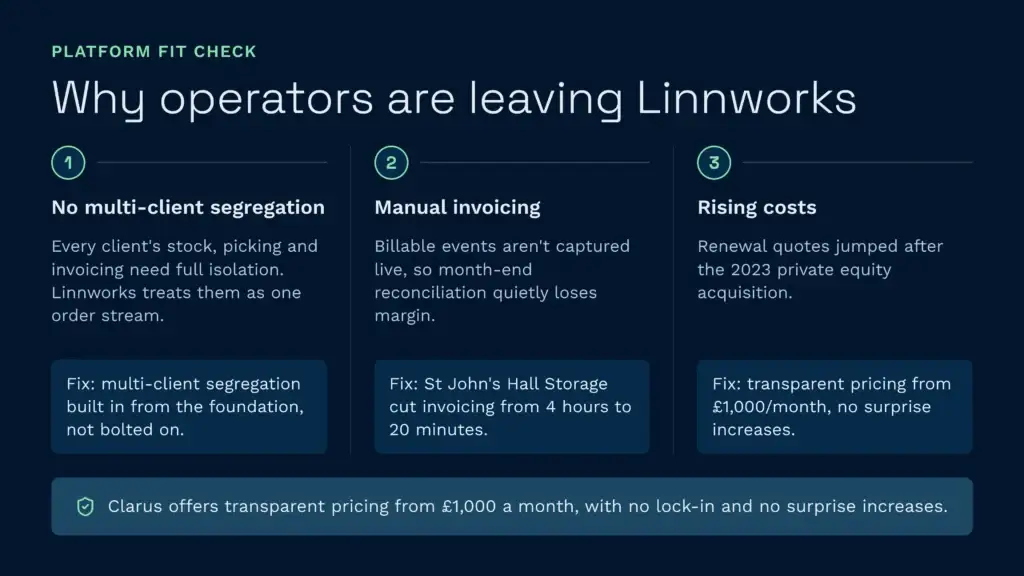
Ingen innebygd segregering mellom flere klienter
I et 3PL-lager må hver kundes lagerbeholdning holdes fullstendig adskilt: separate lageropptellinger, separat plukking, separat rapportering, separat fakturering. Linnworks behandler alle kunder som ordrer som går gjennom ett enkelt system. For å isolere dem må du ty til midlertidige løsninger: separate Linnworks-instanser (kostbart og operasjonelt fragmentert) eller manuelle arbeidsflyter for å skille kundedata. Ingen av delene kan skaleres. Et skikkelig WMS har innebygd segregering mellom flere kunder helt fra grunnen av: hver kundes aksjeportefølje, regler og rapportering finnes i ett og samme system, men er fullstendig isolert fra hverandre.
Faktureringen skjer manuelt og er utsatt for feil
Fakturering er selve livsnerven i 3PL-virksomhetens lønnsomhet, og det er her Linnworks svikter. Systemet registrerer ikke fakturerbare hendelser i sanntid: mottak, lagring, håndtering, utsendelse og returer. I stedet må du avstemme fakturaer ved månedsslutt ved å telle plukk, veie paller eller kryssjekke regneark. Et av de vanligste feilpunktene vi har sett: en kundes varer flyttes fra romtemperert lagring til kjølerom midt i måneden, men endringen i faktureringsregelen blir aldri markert, og fakturaen gjenspeiler ikke dette. Det er tapt margin. Med automatisert fakturering, slik Clarus WMS leverer det, registreres hver fakturerbar hendelse på transaksjonstidspunktet. St John’s Hall Storage reduserte faktureringsarbeidet fra fire timer til tjue minutter, noe som gjør det helt unødvendig med en manuell avstemming utført av to personer.
Hva er Linnworks, og hvem er det egentlig beregnet på?
Linnworks er en programvare for lager- og ordrehåndtering for e-handelsbedrifter som driver med flerkanalsalg. Den kobler sammen salgskanalene dine (Amazon, eBay, Shopify, TikTok Shop og over 100 andre) med lagersynkronisering i sanntid for å unngå oversalg. Systemet genererer automatisk plukklister, håndterer integrasjoner med transportører og samler lagerfunksjoner som utskrift av strekkoder og sammensetting av sett.
Den er god til det den er utviklet for: å hjelpe en nettbutikk med å administrere lagerbeholdning og bestillinger på tvers av flere salgskanaler. Linnworks’ G2-vurdering på 4,3 av 5 viser at dette fungerer bra for selgerne.
Men det er ikke 3PL-lagerstyring som er oppdraget. Hvis du:
- Et lager eller en 3PL-leverandør som betjener flere kunder under ett tak
- Ansvarlig for fakturering per kunde og kostnadsdekning
- Behov for oversikt over kundeopplysninger (lagernivåer, ordrer, fakturaer)
- Håndtering av matvarer, drikkevarer eller varer med strenge krav til samsvar som krever FEFO og sporbarhet
- Skalering av virksomheter som trenger fakturering i sanntid, ikke ved månedsslutt
Da er ikke Linnworks den rette løsningen. Det er som å prøve å presse en firkantet pinne inn i et rundt hull. 3PL-programvare er utviklet for disse arbeidsflytene, mens Linnworks ikke er det.
De beste alternativene til Linnworks: en objektiv oversikt
Clarus WMS: et spesialutviklet skybasert WMS for 3PL-aktører (anbefalt for britiske 3PL-aktører)
Best egnet for: Britiske 3PL-leverandører, grossistdistributører og lageroperatører som administrerer mer enn 10 brukere og drift med flere kunder. Spesielt innen mat og drikke, kjølekjeden og miljøer med strenge krav til regeloverholdelse.
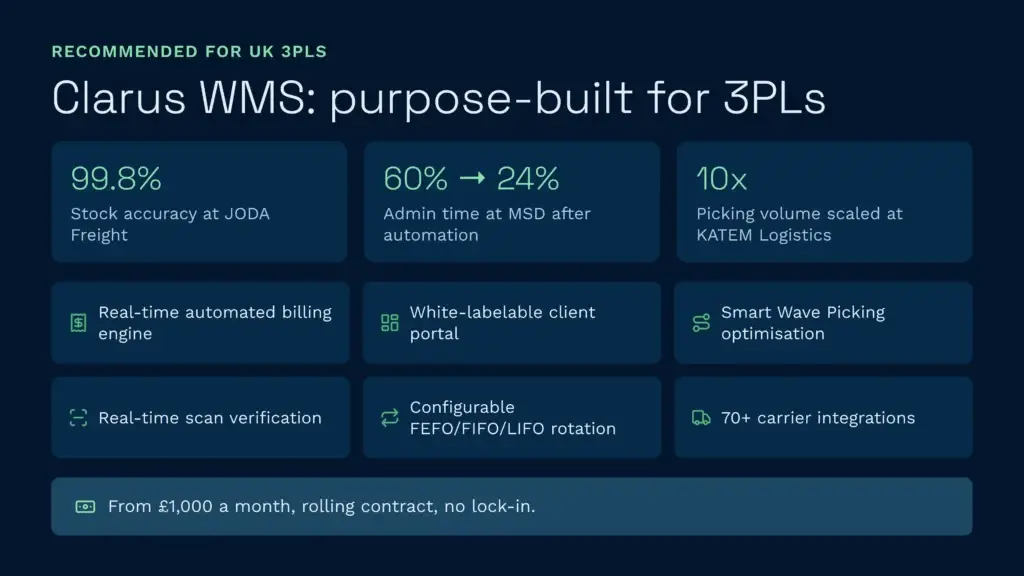
Hva skiller den fra andre: Clarus ble utviklet som et svar på frustrasjonen over eldre WMS-programvare som behandlet alle kunder på samme måte. Den er serverløs (ingen lokal infrastruktur å vedlikeholde), skybasert og utviklet fra første stund for 3PL-virksomhet med flere kunder. Alle fakturerbare hendelser – mottak, lagring, plukking, pakking, utsendelse og returer – registreres i sanntid og faktureres automatisk. Kundene får tilgang til en portal som kan tilpasses med eget merke, der de kan se sanntids lagernivåer, forsendelser og fakturaer uten å måtte ringe dere.
Eksempler: JODA Frakt økte lagernøyaktigheten fra lavt 90-tall til 99,81 TP3T. MSD Reduser administrasjonsarbeidet med 60% ved hjelp av automatisert fakturering og arbeidsflyter. KATEM Logistikk Vi økte de månedlige plukkvolumene med 10 ganger og oppnådde en nøyaktighet på 99% etter at vi gikk over til Clarus.
Særlige egenskaper:
- Automatisert faktureringsmotor i sanntid: alle transaksjoner blir registrert, ingen avstemming ved månedsslutt
- Kan merkes med eget varemerke kundeportal: lageroversikt, bestillinger, fakturering – alt via selvbetjening
- Smart bølgevalg: grupperer ordrer og optimaliserer plukkingsruter (angitt reduksjon i reisetid på 50%)
- Verifisering av skanning i sanntid: Strekkoden må stemme overens, ellers stopper systemet pakkemaskinen (nøyaktighet: 99,9%)
- Konfigurerbar FEFO/FIFO/LIFO-rotasjon per kunde eller produkt
- Batch- og partikontroll for full beredskap til tilbakekalling
- 70+ integrasjoner med operatører rett ut av esken
- Månedlige fornybare kontrakter, uten bindingsperiode
Priser: fra 1 000 pund per måned med månedlige abonnementer. Ingen tilleggsavgifter, ingen uventede prisøkninger. Du betaler akkurat det du får.
Når Clarus ikke er det rette valget: små nettbutikker med én kunde, ren B2C-virksomhet som kun håndterer pakker (færre enn 10 lagerbrukere) eller virksomheter som ikke trenger automatisert fakturering. Hvis du er en enkelt selger som bruker Shopify, er Linnworks enklere. Hvis du er en bedrift med 100 nettsteder og egen IT-infrastruktur, kan et WMS for store bedrifter (SAP EWM, Manhattan Active) være mer passende. Clarus ligger i den perfekte posisjonen: voksende 3PL-leverandører og mellomstore lagervirksomheter som er på jakt etter spesialutviklet, skybasert programvare.
Gjennomføring: uker, ikke måneder. Med skybasert arkitektur slipper du å installere servere og å gjennomføre langvarige versjonsoppgraderinger. Kom raskt i gang og tilpass løsningen etter hvert som behovene dine endrer seg.
Mintsoft: 3PL-leverandør med høy grad av åpenhet og kundestøtte i Storbritannia
Best egnet for: Britiske 3PL-aktører som ønsker gjennomsiktig prissetting og en plattform utviklet for lagerdrift. Egner seg godt for virksomheter med én lokasjon og mindre virksomheter med flere lokasjoner.
Det den er god på: Mintsoft er et britiskbasert 3PL-WMS-system med innebygd flerklientarkitektur, automatisert fakturering og en kundeportal. Prissettingen er gjennomsiktig og presenteres i tydelige prisnivåer i stedet for å bli fastsatt fra sak til sak, og dets Trustpilot-vurderingen er 4,7/5 (“Utmerket”). Lagerstyring er inkludert i grunnprisen, ikke et tillegg. Mobil plukking med Android-apper og strekkodeskanning er standard. Automatisering er en virkelig styrke her, da den reduserer den manuelle administrasjonen som tar opp mye av lageteamets tid.
Hvor det kan oppstå forsinkelser: Mintsofts prisstruktur og skalering av funksjoner blir komplisert i store nettverk med flere lokasjoner. Implementeringen kan ta flere uker eller måneder. For virksomheter innen mat- og drikkevarebransjen som trenger avansert FEFO- og utløpsdato-sporing, har Clarus dypere spesialisering.
Priser: Gjennomsiktig, offentliggjort prisstruktur, der lagerstyring er inkludert i grunnprisen og ikke som et tillegg. Kostnadene øker i takt med antall brukere og lagerlokasjoner.
Deposco: fokus på 3PL-tjenester for bedrifter, lengre implementeringsperiode
Best egnet for: 3PL-leverandører i mellomstore og store bedrifter som ønsker en omfattende skyplattform med god driftsmessig skalerbarhet. Egnet for virksomheter som administrerer 20 eller flere anlegg.
Det den er god på: Deposco blir ofte nevnt i oversikter over 3PL-programvare for mellomstore bedrifter, og fremhever fire hovedfunksjoner: rask oppstart for nye kunder (konfigurerbar, ikke skreddersydd), operasjonell skalerbarhet (håndterer volumspisser og utvidelser av automatiseringen), konfigurerbarhet (tilpasser seg uten omfattende utviklingsarbeid) og totale eierkostnader (forutsigbare, men med tilpassede priser).
På hvilke områder den kommer til kort i forhold til alternativene: Implementeringen tar vanligvis måneder, ikke uker. Prissettingen er tilpasset den enkelte kunde og ikke gjennomsiktig på forhånd, noe som gjør det vanskelig å lage et budsjett. For mindre 3PL-leverandører (under 15 brukere) er enklere, spesialutviklede plattformer som Clarus ofte mer kostnadseffektive.
Priser: Tilpasset tilbud. Du kan forvente priser på bedriftsnivå for funksjonalitet på bedriftsnivå.
Extensiv: En 3PL-løsning som passer for små og mellomstore bedrifter, med rimelige priser
Best egnet for: Mindre 3PL-aktører og logistikkoperatører som ønsker et rimelig skybasert WMS med støtte for flere lokasjoner. Egnet for virksomheter som benytter flere 3PL-nettverk.
Det den er god på: Omfattende tilbyr en oversiktlig, trinnvis prisstruktur som starter på et lavere nivå enn alternativene for store bedrifter, og er utviklet for små og mellomstore bedrifters ordrebehandlingsprosesser. Hvis logistikken din går gjennom flere 3PL-partnere og oversikten over dette nettverket utgjør en flaskehals for deg, er Extensivs integrasjoner med transportør- og 3PL-nettverk en reell fordel.
Hvor det kommer til kort: Funksjonaliteten for komplekse faktureringsscenarier (flere lagringsnivåer, aktivitetsbasert prissetting per kunde) er mindre omfattende enn hos plattformer som er spesialutviklet for dette formålet. For mat- og drikkevarer eller temperaturkontrollerte miljøer er funksjonaliteten mindre utviklet.
Priser: Flere prisnivåer, med utgangspunkt i lavere priser enn bedriftsløsningene. Tilpassede tilbud for større implementeringer.
Cin7: best egnet for produksjon og engros av hybrider
Best egnet for: virksomheter som kombinerer produksjon, montering, grossistvirksomhet og detaljhandel. Også et godt valg for små og mellomstore bedrifter som ønsker en samlet løsning for lagerbeholdning og lagerstyring (WMS).
Det den er god på: Cin7 tilbyr to produkter: Core (for små og mellomstore bedrifter) og Omni (mellomstore bedrifter, med EDI, støtte for flere enheter og utvidet 3PL-støtte). Hvis du driver med kitting, montering eller en hybridvirksomhet som kombinerer grossist- og detaljhandel, er Cin7s tilnærming verdifull. Innebygde arbeidsflyter for produksjon og montering skiller det fra rene WMS-systemer for ordrebehandling.
Der det ikke er ideelt: For rene 3PL-operasjoner uten produksjonsmessig kompleksitet legger Cin7 til funksjoner du ikke vil få bruk for. Prisene blir høye for nettverk med flere lokasjoner. Automatiseringen av 3PL-fakturering finnes riktignok, men er mindre velutviklet enn hos Deposco eller Clarus.
Priser: inndelt etter produkt (Core vs. Omni), tilpasset for store implementeringer.
Hvordan velge: et beslutningsrammeverk
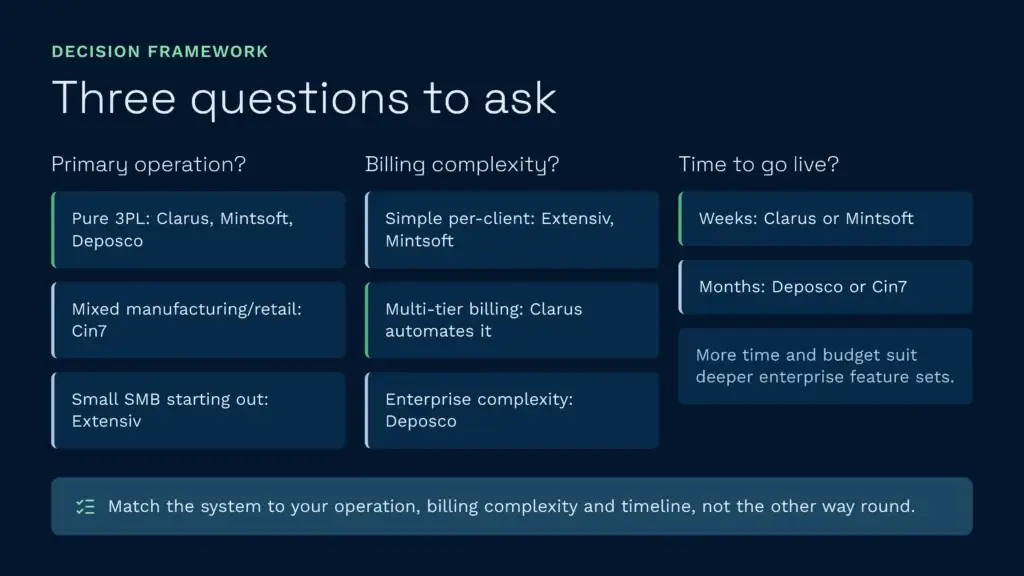
Still deg selv tre spørsmål.
Hva er hovedvirksomheten deres?
Hvis det dreier seg om ren 3PL (lagring av varer for flere kunder), bør du velge et spesialutviklet 3PL-WMS (Clarus, Mintsoft, Deposco). Hvis du driver med både produksjon, grossistvirksomhet og detaljhandel, kan Cin7 være et bedre valg. Hvis du er en liten SMB som nettopp har startet opp, er Extensiv eller Clarus’ innstegstilbud et fornuftig valg.
Hvor komplisert er faktureringssystemet deres?
Enkel lagring per kunde? Extensiv eller Mintsoft. Flernivåfakturering (lagring pluss håndtering pluss aktivitetsbaserte tilleggsavgifter, SLA-regler per kunde)? Clarus’ automatiserte faktureringsmotor er utviklet nettopp for dette. Kompleksitet i storbedrifter? Deposco.
Hvor raskt må dere gå live?
Uker, ikke måneder? Clarus (serverløs sky) eller Mintsoft. Kan du forplikte deg til måneder? Deposco eller Cin7 tilbyr mer omfattende funksjonalitet for bedrifter hvis du har tid og budsjett til det.
Snakk med en lageransvarlig
Hvis du vurderer ulike alternativer og ønsker å se hvordan et spesialutviklet lagerstyringssystem (WMS) fungerer i praksis, er Clarus verdt å ta en prat med. Vi samarbeider med 3PL-leverandører og distributører over hele Storbritannia for å implementere lagerstyringsprogramvare som tilpasses din driftsmodell – ikke omvendt.
Ta kontakt med teamet vårt å snakke gjennom dine krav.