

Lean warehousing is the practice of applying lean manufacturing to the warehouse: finding every step that uses time, space or labour without adding value, then removing it. Most warehouse waste stays hidden until someone walks the floor and times it. This guide explains where lean came from, how the five lean principles and the eight wastes apply to a warehouse, how to run 5S and kaizen, and how to start with a 30, 60 and 90-day plan.
Lean is one part of running a site well. For the wider picture, see our guide on how to manage a warehouse.
What is lean warehousing?
Lean warehousing applies lean manufacturing principles to the way goods are received, stored, picked, packed and despatched. The aim is to remove waste from each step so that stock moves with less effort, fewer errors and less space tied up.
Lean grew out of the Toyota Production System. Toyota built its methods in postwar Japan, where cash, space and materials were short, so producing to actual orders made more sense than building to forecasts. Taiichi Ohno was its main architect. The term “lean” came later: Wikipedia’s lean manufacturing article credits John Krafcik with coining it in 1988.
Warehouses took those ideas and adapted them. The publisher of Ken Ackerman’s book Lean Warehousing describes it as the first book to apply lean manufacturing theory specifically to warehousing. The core idea carries over directly: a warehouse is a flow of goods, and every stop, queue and extra handling step is a cost the customer does not pay for.
The five lean principles, applied to a warehouse
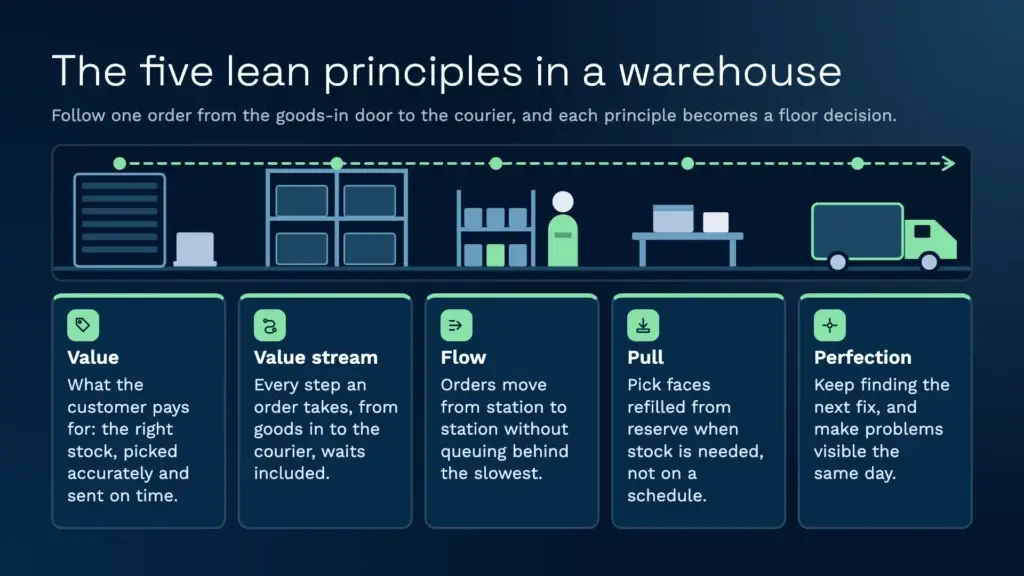
Womack and Jones set out five lean principles, which Wikipedia’s lean manufacturing article lists as value, value stream, flow, pull and perfection. Each one maps to a warehouse decision.
- Value: Work out what the customer pays for. Usually that is the right stock, picked accurately and despatched on time. Anything else needs a reason to exist.
- Value stream: Map every step an order travels, from the goods-in door to the courier collection, including the time it spends waiting.
- Flow: Orders should move through each station without queuing. A pick wave that waits on packers is a bottleneck the whole site feels.
- Pull: Replenish pick faces when stock is needed, not on a schedule that pushes stock onto the floor before anyone asks for it.
- Perfection: Keep looking for the next improvement, and make problems visible on the day they happen.
The eight wastes in a warehouse, with examples
Lean calls waste muda, and the classic list has seven wastes, with an eighth added later. The mnemonic TIMWOOD (or TIMWOODS, with the S for skills) covers them. Some teams use DOWNTIME, which lists the same eight in a different order. The table below translates each one into what you would see on a warehouse floor.
| Waste | What it looks like in a warehouse | Example |
|---|---|---|
| Transport | Stock moved more often than it needs to be | A pallet moved twice between staging and reserve before despatch |
| Varelager | Stock sitting idle, tying up space and cash | Slow-moving lines occupying pick faces that fast lines need |
| Motion | Unnecessary movement by people or equipment | A picker walking the length of the site for a single order line |
| Waiting | People or stock idle while something else finishes | Packers waiting for pick trolleys, or trailers waiting to be unloaded |
| Overproduction | Work done before it is needed | Picking orders hours before cut-off, then re-staging them |
| Over-processing | More handling or checking than the customer needs | Re-labelling stock that already carries the correct label |
| Defects | Errors that need rework or a return | The wrong item despatched, then collected and resent |
| Unused skills | Knowledge and ideas that never reach the people who could act on them | A picker who knows a faster route but has no way to suggest it |
Pick two or three of these to measure first. Defects and motion are usually easiest to count, because they leave a trace in returns and in pick paths.
5S, step by step
Den Lean Enterprise Institute’s five S entry sets out five steps. Each one builds on the last.
- Sort: Identify what the work area needs and remove the rest. Move unneeded items to a holding area and clear it on a set day.
- Set in order (straighten): Arrange what remains so it is neat and easy to reach. Every location gets a label, and every product line gets a fixed home.
- Shine: Clean the workspace, equipment and tools. Dirty scanners, damaged labels and blocked walkways are all signs that a process has drifted.
- Standardise: Keep the area clean and orderly by practising the first three steps every shift, not only when someone is visiting.
- Sustain: Build the habit that keeps the first four steps going. Audit them regularly and act on what the audit finds.
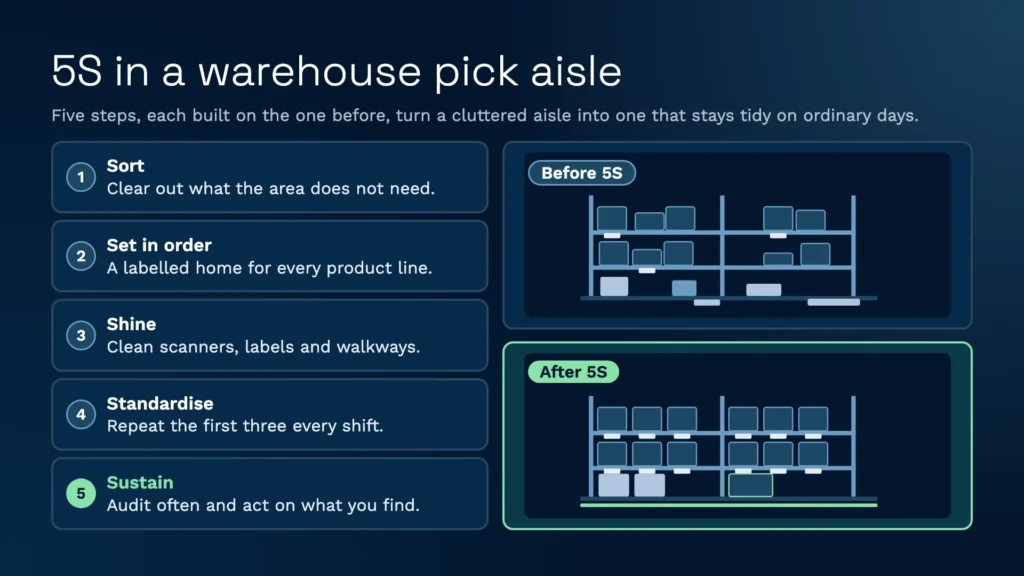
In a warehouse, the result looks like a pick aisle with a label on every location, one home for each product line, and a floor where pallet positions and walkways are marked and kept clear. Clear walkways also matter for safety. The HSE’s guidance on slips and trips is a useful reference when you set walkway rules.
The Lean Enterprise Institute makes a point worth remembering: the true purpose of 5S goes deeper than a one-time clear-out. A tidy aisle on audit day tells you little. A tidy aisle on a Tuesday night in peak season tells you the system works.
Kaizen and standard work
Kaizen means continuous improvement. The Lean Enterprise Institute’s kaizen entry describes it as gradual, step-by-step change that adds up to substantial gains, and as a process that involves everyone in the organisation. Staff spot the opportunities and propose practical fixes that can go in quickly.
In a warehouse, that usually means a short, regular review on each shift: where did pickers stop, what caused the queue at packing, what made a trailer wait. Keep the list short and fix one thing at a time.
When a fix works, write it down as the standard method. Standard work is the record that stops the next shift doing things the old way. Without it, improvements tend to drift back to the old habits.
Value stream mapping an order
A value stream map follows one order from start to finish and records the time spent in each state. Use a real order and a stopwatch. Mark each step as work (someone or something is changing the order or the stock) or waiting (the order sits in a queue). Many maps show that waiting takes a larger share of the elapsed time than work does, which is why the exercise is worth doing.
Pay close attention to the picking stage. That is where travel adds up. Our lagerordreplukkeveiledning covers the main methods, from single-order picking to batch and zone picking, and which suits which order profile.
Visual management and pull replenishment
Visual management means the state of the warehouse can be read from the aisle without asking anyone. Put queue lengths on a board, mark min and max levels on pick faces, and give quarantined stock its own clearly labelled area. When a problem is visible, it gets fixed earlier.
Pull replenishment refills a pick face when it reaches a set level, from reserve stock, so pickers never arrive at an empty location. It is the same logic as a kanban card: the signal to move stock comes from the point of use. Clarus includes foreslått innlagring and replenishment logic, and the replenishment and picker delays feature page covers how that works in practice.
Measuring lean: the KPIs that matter
Measure outcomes first, then the activity behind them. Useful measures include:
- Order accuracy: the share of orders despatched right first time.
- On-time despatch: the share of orders that leave before the courier cut-off.
- Lagerpresisjon: how closely the system matches the shelf, measured through structured stock checks and cycle counts.
- Lines picked per labour hour: a productivity measure, best read alongside accuracy so speed does not hide errors.
- Dock-to-stock time: how long goods take from unloading to being available to pick.
- Damage and returns: defects that leave the building, which are waste you can count.
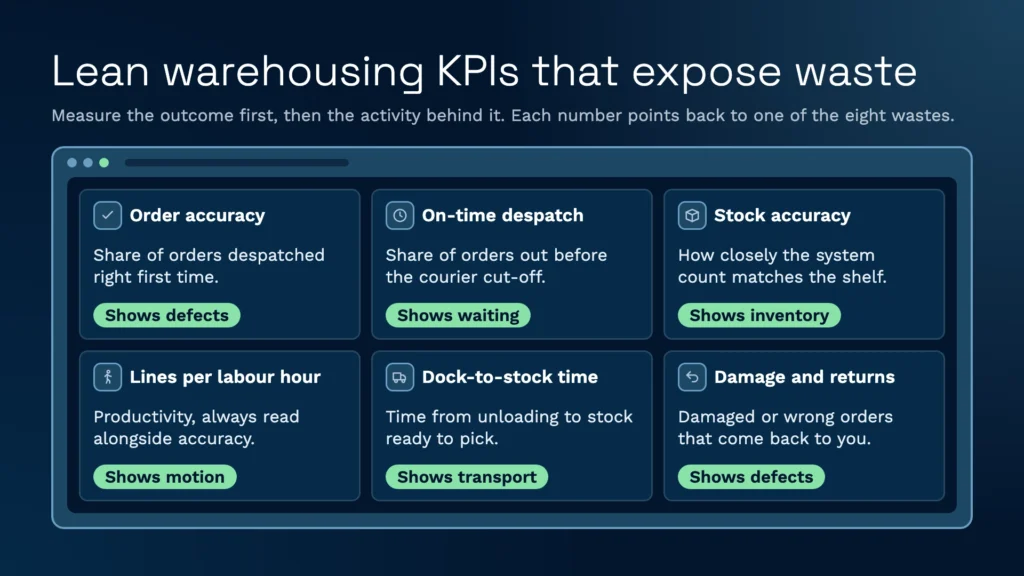
A regular rapportering routine makes these visible every week rather than at the end of the quarter, which is when most lean programmes lose momentum.
Where software and data help
Software does not make a process lean. It makes a lean process easier to see and easier to keep. If the process is broken, a system will automate the breakage faster. That said, good data removes much of the guesswork from waste hunting.
Real-time stock visibility is a good example. JODA Freight, a 3PL, reached Nøyaktighet for 99%-lagerbeholdningen, and its stock counts went from weeks to one day. That is the inventory and defect waste from the table, measured and reduced.
Operator data helps with motion and waiting. Clarus’s operator activity tracking shows where time goes on the floor, and the plukking logic optimises routes and waves to cut travel. Mat Buttar, Head of Solutions at Clarus, makes the same point from his years in 3PL operations: “you can’t rely too much on what the system tells you all of the time.” In his view, being on the floor is as important as sitting in front of a PC. Software can show you the path. Someone still has to walk it.
For stock rotation, the FIFO and FEFO rotation feature keeps the right stock moving first, and it can be configured per client or per product. For a broader view of where AI fits, see our guide to AI in warehouse management.
Lean, agile and Six Sigma: how they fit
Lean removes steps that do not add value. Six Sigma focuses on reducing variation in a process. Many operations run both: lean to take out the unnecessary steps, Six Sigma to tighten the ones that remain. The two are complementary, and a team that already runs one will find the other easier to introduce.
Agile warehousing usually means flexing capacity and layout quickly as demand changes. The two approaches pull in different directions when taken to extremes. A lean site runs with very little slack, which is efficient but leaves little room for a surge. An agile site keeps some spare capacity so it can absorb change. Most sites need a sensible balance between the two, set by how volatile their demand really is.
Automation sits outside both labels. A robot moving stock along a poor layout still travels too far. Read our piece on robots in warehouse logistics before you invest, and fix the flow first.
Common mistakes
- Treating 5S as a one-off tidy. A clean site on the day of an audit tells you little. The standard has to be kept on ordinary days.
- Chasing speed over accuracy. Lines picked per hour rise quickly when people skip the check, and so do the returns. Measure both.
- Mapping without the people who do the work. The pickers and packers know where the time goes. A map drawn from the office usually misses the workarounds that matter.
- Automating a broken process. Software amplifies the process you give it. Fix the flow, then automate.
- Ignoring goods-in. Unannounced or early arrivals push receiving behind, which pushes picking behind, which hurts on-time despatch. A goods-in queue is often the first symptom of a wider problem.
- Mixing up stock rotation rules. FIFO and FEFO are different, and using the wrong one wastes stock. Our stock rotation guide explains which applies where.
A 30, 60 and 90-day starting plan
Start small, prove the gain, then widen it. The plan below is one way to do that. Adjust the areas to match your site.
| Period | Focus | Actions |
|---|---|---|
| Days 1 to 30 | Look and measure | Walk the floor every day. Map one order from goods-in to despatch. Choose two or three wastes to measure, and record a baseline for order accuracy and on-time despatch. |
| Days 31 to 60 | Fix and standardise | Run 5S on the pick area first. Write standard work for the two processes with the most waiting. Start a short weekly kaizen review on each shift. |
| Days 61 to 90 | Extend and decide | Roll 5S and the kaizen review into receiving and despatch. Compare the KPIs with the baseline. Use the gaps you found to decide whether you need better data or new software. |
Snakk med en lageransvarlig
If you are working out where lean would help most in your operation, or whether your current system is holding the work back, Clarus is worth a conversation. We work with 3PLs and distributors to implement warehouse management software that fits the way they operate, not the other way around.
Ta kontakt med teamet vårt å snakke gjennom dine krav.