

Mastering the goods-in process is essential for ensuring inventory accuracy and seamless inbound receiving, directly impacting overall throughput and compliance. Warehouse and 3PL professionals often face challenges such as delays in dock appointment scheduling, discrepancies in ASN matching, and inefficiencies in quality inspection, leading to overage, shortage, or damages issues that disrupt reconciliation. At Clarus WMS, we see this daily in operations handling multiple containers and ad hoc deliveries where a single bad day at the dock can erase margins for the week.
Traditional goods-in workflows relied on manual GRN verification and sporadic bookings, often taking days or even weeks to resolve OS&D reports and achieve putaway readiness. In contrast, a modern WMS approach integrates real-time automation, enabling efficient inbound receiving and cross-docking in hours, while optimising labour and boosting KPI performance. Best-in-class operations typically aim for dock-to-stock times of around 8 to 10 hours, while many 3PL operations still sit at 24 hours or more, so improvements in goods-in flow have a direct impact on service levels and storage costs. (ISM World)
Resultatet av tradisjonelle metoder:
- Delays in putaway due to manual ASN processing and poor dock scheduling
- Inefficiencies in inspection leading to unreported damages and quarantine bottlenecks
- Lost revenue from inventory inaccuracies and compliance failures in traceability
This article breaks down the failures of outdated methods in managing goods-in and explores how Clarus WMS rethinks the process with modern, cloud-based solutions for better visibility and regulatory audit trails. We also bring in practical experience from Clarus WMS implementation projects, including GS1-based pallet labelling, blind receipts, cross-docking, and quarantine workflows, to provide actionable insights for warehouse professionals.
What is Goods-In and How Do I Optimise It?
Goods-in refers to the inbound receiving process where shipments are booked, inspected, and reconciled into inventory, ensuring accuracy from dock to stock. This stage involves ASN matching, GRN verification, and quality checks to handle overage or shortage effectively. In 3PL centres dealing with high volumes, optimising goods-in means automating barcode scanning to enhance throughput and reduce errors in reconciliation.
When goods-in is poorly controlled, every downstream process, from picking to invoicing, inherits those errors. When it is optimised, it becomes the foundation for accurate inventory, reliable service levels, and credible KPIs.
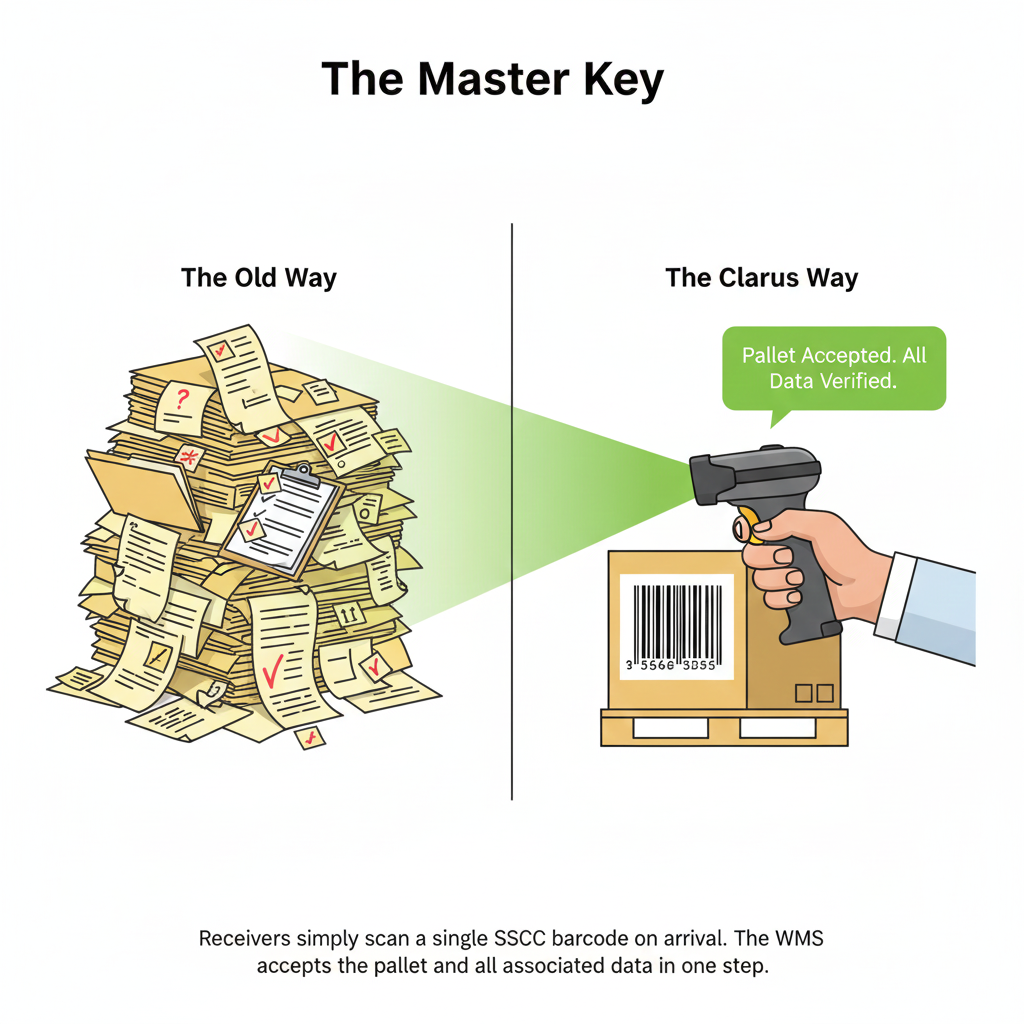
From an operational perspective, Clarus WMS consultants describe a “holy grail” flow where an ASN includes a GS1 SSCC pallet ID, batch, quantity, and product code for each line. In that scenario, receivers simply scan a single SSCC barcode on arrival and the WMS accepts the pallet and all associated data in one step, dramatically reducing handling time and keying errors.
Practical optimisation steps typically include:
- Using pre-receipts and ASNs for planned deliveries, with clear appointment times
- Enforcing three-way match (PO, ASN, GRN) where appropriate
- Standardising GS1 labels and barcode types across suppliers
- Using handheld flows that conditionally prompt for batch, best before date, or other attributes only when required by the account or product settings
- Monitoring dock-to-stock time, receiving accuracy, and OS&D rates on live dashboards
Integrating a cloud WMS like Clarus WMS allows for seamless licence-plate receiving and cross-docking, offering full visibility into inbound workflows. This links directly to benefits such as faster dock-to-stock time, fewer inventory variances, and stronger compliance reporting, all of which are highlighted in modern warehouse receiving best-practice guidance. (Descartes Finale)
Do I Need ASN for My Goods-In Operations?
Yes, Advance Shipping Notice (ASN) becomes essential as goods-in operations scale and inventory becomes more diverse. ASN provides advance details about each shipment, enabling efficient dock scheduling, pre-allocation of labour, and preparation of GRNs before a lorry arrives. In smaller, predictable operations, basic notifications may suffice, but once volumes increase or SKUs become more complex, the absence of ASNs typically shows up as queues at the dock and late putaway. (shipscience.com)
GS1 guidance highlights that electronic despatch advice messages, which function as ASNs, give warehouses accurate information about incoming loads, allowing them to plan receiving actions and streamline matching against orders. (gs1.org) Independent research also shows that ASNs can cut receiving costs by up to 40 percent because teams spend less time on manual checking and data entry. (Commport Communications)
Clarus WMS implementations commonly use two tiers of ASN-enabled receiving:
- Full ASN with SSCC: pallet-level SSCC IDs and item data are pre-loaded into a pre-receipt so operatives scan a single pallet barcode and the system accepts all associated quantities, batches, and dates in one go.
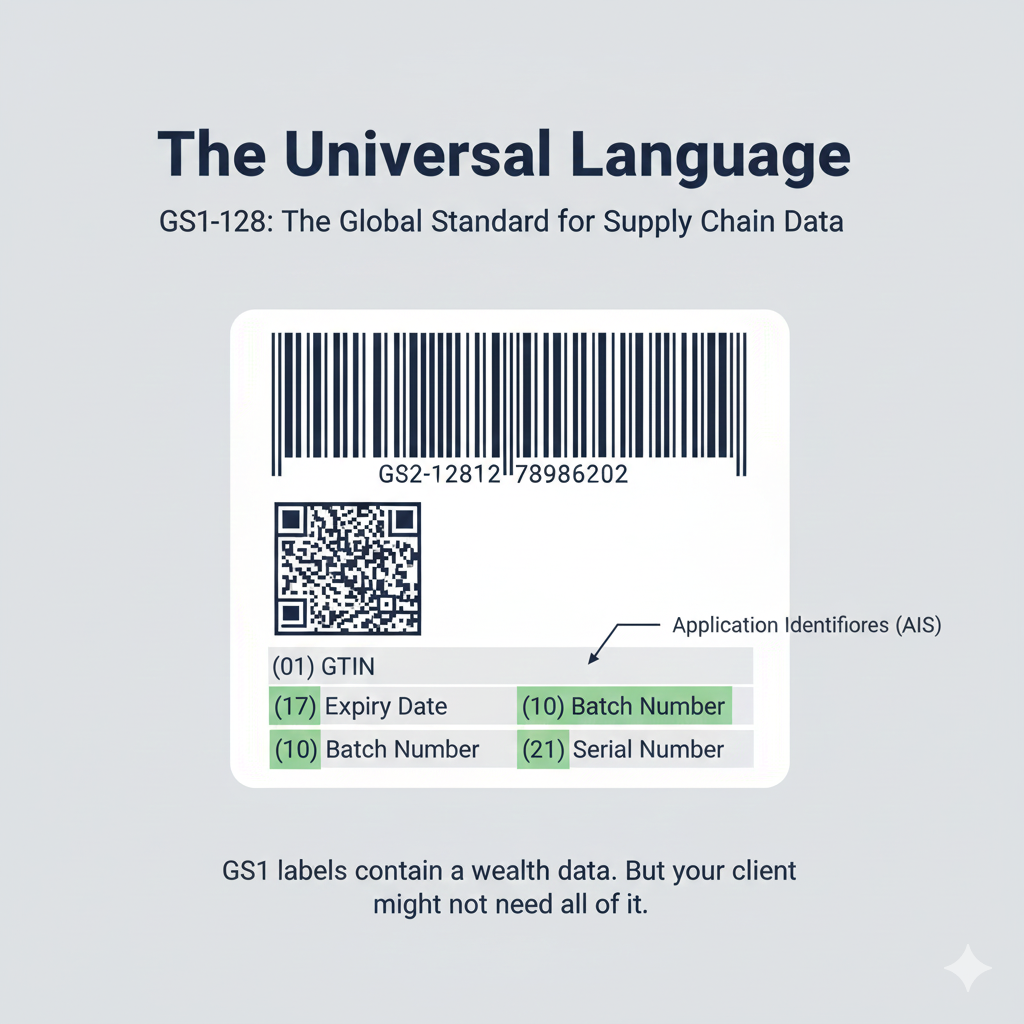
- Existing label receipt: where GS1 labels contain multiple barcodes (for example, article and quantity, batch, and SSCC), handheld flows allow the user to scan each in turn so data is captured without keying.
Implementing ASNs can reduce receiving time significantly in well-implemented warehouses. This not only streamlines putaway but also improves trust with customers through consistent traceability and more reliable KPI tracking.
How Does GRN Impact Inventory Accuracy?
Goods Received Note (GRN) directly enhances inventory accuracy by verifying shipments against purchase orders and ASNs, so teams can identify overage, shortage, or damages during goods-in rather than after the fact. It integrates with barcode scanning for real-time reconciliation, supporting compliance in quality inspection workflows and financial controls like three-way invoice matching.
Industry sources emphasise that a GRN is a critical document in procurement, because it confirms receipt of goods, records quantities and condition, and underpins accurate inventory and audit trails. (Cflow) When GRNs are digitised and tied to a WMS, they become part of a continuous data stream from dock to finance, reducing disputes with suppliers and reducing the risk of paying for goods that never actually arrived. (tofu.com)
In Clarus WMS, GRN data is not just a record; it drives operational status. Rules can automatically place receipts from certain suppliers or product groups directly on hold, pending external laboratory checks or veterinary certification, before the stock is made available. This approach combines inventory accuracy with controlled quarantine and clear audit trails.
What Role Does Barcode Play in Goods-In Efficiency?
Barcode scanning revolutionises goods-in efficiency by automating data capture at the dock, ensuring rapid ASN matching and GRN verification without manual errors. It supports licence-plate receiving for precise inventory tracking, facilitates cross-docking and quarantine decisions, and shortens OS&D investigation by linking each pallet to a clear digital history.
Warehouse technology guides note that manual data entry typically sees error rates around one in a few hundred keystrokes, while scanning reduces those errors to near zero and provides real-time stock visibility. (Balloon One) Barcode and RFID-based data capture at receiving is now standard in many best-practice frameworks for reducing carrying costs and speeding up putaway. (Balloon One)
From a GS1 standpoint, a standard logistics label often includes multiple barcodes, for example:
- An article and quantity barcode
- A batch and date barcode
- An SSCC pallet ID barcode
Clarus WMS handheld flows allow customers to choose which application identifiers to capture based on account and product requirements, so the same generic component works for slightly different GS1 label layouts across multiple customers. This flexibility is crucial for 3PLs dealing with many trading partners.
The warehouse goods in procedure, step by step
Here’s the full procedure of receiving goods in a warehouse, with what each stage produces and where it most often fails.
| Stage | What happens | Data or document produced | Common failure |
|---|---|---|---|
| 1. Booking in | Supplier or client books a dock slot | Booking reference, slot time | Unbooked vehicles arrive and queue |
| 2. Advance notice | ASN or pre-receipt created against the PO | Expected lines, quantities, SSCCs | No ASN, so the dock receives blind |
| 3. Arrival and unloading | Vehicle checked, load inspected, goods tipped | Seal and condition notes | Load shifted in transit, unsafe unload |
| 4. Checking | Count and identify against the PO | Received quantities per line | Short or wrong lines accepted as full |
| 5. Receipt record | Receipt completed in the system | Goods received note (GRN) | Paper GRN keyed in later, or not at all |
| 6. Exceptions | Overs, shorts and damage recorded | Discrepancy and hold records | Damage found after putaway, cost lands on you |
| 7. Labelling | Each pallet or unit gets a scannable ID | Licence plate or SSCC label | Unlabelled pallets that can’t be traced |
| 8. Putaway hand-off | Putaway task created and completed | Stock in a live location | Pallets left in the goods in bay |
The order matters in any goods in procedure. Each step depends on the one before it, and skipping one moves the problem downstream rather than removing it.
1. Booking in and dock scheduling
A good goods in procedure starts before the lorry arrives. A booking-in diary gives every inbound delivery a slot, so you know how many vehicles are due, what they’re carrying and how many people to put on the dock. Without one, you staff for an average day and get caught out by a busy one.
Unannounced deliveries are the norm, not the exception, especially for 3PLs. Mathew Buttar, Head of Solutions at Clarus and a warehouse and operations manager for nearly 25 years before that, puts it bluntly: once you agree to store a customer’s stock, “it’s almost a green light for them to decide what they send and when they send it.” The knock-on effect is the one every goods in supervisor knows: yesterday’s receipts are still in the bay, so today’s lorries can’t be tipped, so picking falls behind. A booking diary doesn’t stop clients sending stock, but it gives you a record of who booked and who didn’t, and a reason to push back. Clarus handles this with planlegging av dokking built around a booking-in diary.
2. The ASN and pre-receipt
An advance shipping notice (ASN) is the supplier’s electronic message telling you what’s on the vehicle before it arrives. Matched against your purchase order, it becomes a pre-receipt: a list of expected lines your team checks against, rather than a blank sheet they fill in.
The richer the ASN, the faster the receipt. If the supplier sends the SSCC for each pallet along with the product code, batch and quantity, the scanner can accept the whole pallet’s data from a single barcode. In Mathew Buttar’s words: “if you got 26 pallets on a truck, you do 26 singular scans, that whole load is received. Job done.” That only works when both sides use compliant GS1 labels, which is why his first question on site is whether the customer can get any of this information from their suppliers. Many have never asked.
3. Arrival and unloading
When the vehicle arrives, check the booking reference, the seal and the condition of the load before anything comes off. Follow the government guidance on securing loads on goods vehicles to understand what a properly secured load should look like, so your team can spot one that isn’t. The HSE’s Warehousing and storage guide (HSG76) is the reference for the wider safety picture.
Don’t underestimate container hand-balling. Unloading hundreds of loose cartons onto pallets, stacked neatly enough to go into racking, is slow, physical work. Booking those deliveries for times when you have the labour is part of the procedure, not an afterthought.
4. Checking against the purchase order
Count and identify every line against the PO or pre-receipt: right product, right quantity, right batch and date where they’re controlled. Scan rather than eyeball wherever you can. A barcode scanner system catches the wrong product at the pallet rather than at the pick face.
For batch-controlled or dated products, capture the batch and best-before at receipt, not later. That’s what makes a recall traceable, and it’s covered in more depth in our guide to lot and batch number tracking.
5. Recording the receipt and the GRN
Once the count is confirmed, the receipt is completed and a goods received note is produced. The GRN is the warehouse’s formal record of what arrived, and finance uses it to match the supplier’s invoice against the PO. We’ve covered the document itself in detail in what a GRN is and why it matters, so here’s the practical point: the GRN should be a by-product of scanning, not a separate piece of paper someone types up at the end of the shift. Every hour between unloading and recording is an hour where the system and the floor disagree.
6. Handling discrepancies and damage
This is the step most goods in procedures leave vague, and it’s covered in its own section below.
7. Labelling
Every pallet or storage unit needs a scannable identity before it leaves the bay. If it arrived with a compliant SSCC label, use it. An SSCC is an 18-digit number that identifies a logistics unit, as GS1 US explains, and it can follow the pallet from the manufacturer to the end customer. If it didn’t, print your own licence plate label. Clarus recommends an 18-digit storage unit reference so its labels stay GS1 compliant, and prints receipt labels in A5 or 4×6.
8. Putaway hand-off
The goods in procedure isn’t finished until the stock is in a live location. The cleanest hand-off is a putaway task created automatically when the receipt completes, so pallets don’t sit in the bay waiting for someone to decide where they go. Directed putaway suggests the location; the operator scans the location barcode to confirm it. What happens after that is covered in our guide to the storage process in a warehouse.
Blind receipt vs pre-receipt: which goods in process fits?
There are two ways to receive goods in a warehouse. A pre-receipt checks the delivery against expected data. A blind receipt records whatever turns up with nothing to match against.
| Faktor | Pre-receipt (ASN or PO) | Blind receipt |
|---|---|---|
| What the operator knows | Expected lines and quantities | Nothing until they look |
| Catches short deliveries | Yes, the receipt won’t complete short | No, nothing to compare against |
| Catches over-deliveries | Visible against the expected quantity | Nei |
| Speed with good GS1 labels | One scan per pallet is possible | Several scans per line |
| Best for | Regular suppliers, 3PL clients with EDI or API | Ad hoc or unannounced deliveries |
The decision rule is simple: pre-receive wherever you can get the data. As Mathew Buttar says, if you really want to know what’s going on in your warehouse, you should manage your supply chain so you know what’s coming, how much of it, and when. Blind receiving has its place, but it only works if the operator can identify what’s in front of them. If they keep coming back to ask what a product is or which client it belongs to, the process has already failed.
Goods in discrepancy and damage handling
Overs, shorts and damage are where a warehouse goods in procedure earns its keep. The rule that matters most: record exceptions at receipt, before you take ownership of the stock.
Mathew Buttar learned this the hard way: “if you don’t and you find out halfway through your process that there’s damaged bottles in there, that shrinkage is on you because you’ve already taken ownership of it.” The same goes for damaged pallets. They need restacking and charging to the customer before they go any further, and a broken pallet should never go into racking.
A workable discrepancy procedure looks like this:
- Shorts: receive what arrived and leave the remainder open against the PO, so the supplier or client is chased for it. Against a pre-receipt in Clarus, a short receipt won’t complete until it’s dealt with.
- Overs: decide in advance whether you’ll accept, quarantine or refuse over-deliveries, and record the decision on the receipt.
- Damage: receive the damaged quantity separately and put it on hold so it can’t be allocated to an order. Use a reason code so anyone can see why it’s held, who held it and when.
- Evidence: photograph damage at the dock. A photo taken at receipt settles a dispute with a carrier or client far faster than a note on a delivery docket. Clarus supports this with bildebevisinnsamling.
- Quarantine: for stock that needs checking before release, such as goods awaiting QA sign-off, set the stock to go on hold automatically once it’s received and put away.
That last point is worth knowing. By default, goods received and put away in Clarus are immediately available. If a product needs to be held, an automation can put it on hold the moment the receipt completes, so nobody has to remember to do it.
How to improve the warehouse receiving process
Once your goods in procedure is written down, the gains come from removing manual handling of data. These are the warehouse receiving best practices that make the biggest difference.
- Ask suppliers and clients for ASNs. It’s the single biggest lever. Pre-receipts turn a counting exercise into a confirming exercise.
- Scan everything, key nothing. Every typed product code is a chance for a transposed digit.
- Configure capture per product. If only some products need batch control, only those should prompt for a batch. Asking operators for data that doesn’t exist slows every receipt down.
- Make putaway automatic. A putaway task should exist the moment the receipt completes.
- Clear the bay every day. Stock left in goods in overnight is stock you can’t pick and space you can’t use tomorrow.
- Walk the floor. Live data doesn’t replace looking. A dashboard won’t tell you that a pallet is leaning.
There’s more on the operational side in our earlier piece on how to optimise goods-in processes, and on ensuring an efficient warehouse receiving process.
Warehouse receiving metrics worth tracking
You can’t improve a goods in procedure you don’t measure. The useful warehouse receiving metrics are simple:
- Dock-to-stock time: how long from the vehicle arriving to the stock being available in a location.
- Receipt accuracy: how many receipts needed correcting after completion.
- Supplier compliance: the share of deliveries that arrived booked, with an ASN and with scannable labels.
- Discrepancy rate: overs, shorts and damage by supplier or client, which tells you who to talk to.
- Bay occupancy at end of shift: pallets still waiting for putaway.
We won’t give you industry benchmarks for these, because the honest ones vary too much by sector and product type to be useful. Track your own numbers weekly and look for the trend, then feed what you learn back into your goods in procedure.
How does SSCC licence-plate receiving work?
The Serial Shipping Container Code (SSCC) is a GS1 identification key that gives each logistics unit, such as a case, pallet or parcel, its own unique identifier (GS1). GS1 logistic labels carry the SSCC so each pallet can be tracked and traced end to end through the supply chain (GS1 Logistic Label Guideline).
In licence-plate receiving, the SSCC acts as a single licence plate for the pallet. When the pallet is scanned, the WMS pulls everything linked to it from the ASN or pre-receipt, such as SKUs, quantities, batch, expiry and owner, and books it into stock in one step instead of keying each field.
Getting the most from SSCCs means:
- Asking suppliers to send every pallet with a GS1-compliant label and a valid SSCC
- Mapping the SSCC and its linked fields correctly into the WMS, including owner, product and date codes
- Using the SSCC as the reference in discrepancy investigations and claims
- Keeping the same ID through cross-docking and outbound shipments, so one code follows the pallet all the way
What is OS&D reporting in goods in?
OS&D stands for over, short and damaged. It covers any delivery where the quantity or condition of the goods doesn’t match what was ordered or expected, and the report records each variance against the purchase order (Fraktløype).
Good OS&D handling usually includes:
- Clear reason codes for overs, shorts, visible damage and concealed damage
- Photos taken at the dock and linked to the receipt
- Putting damaged or disputed stock on hold or in quarantine straight away
- An agreed route for rework, disposal or customer sign-off
Prompt, accurate OS&D records also make carrier and supplier claims much easier to settle (LogiWorld). In Clarus WMS, stock can be placed on hold at receipt so it can’t be allocated until someone releases it.
Traditional Methods vs. Clarus WMS for Goods-In
Traditional methods often rely on paper-based GRN and manual ASN checks, leading to errors in reconciliation and delays in putaway that compromise inventory accuracy. These approaches lack real-time visibility, making OS&D reporting inconsistent and compliance labour-intensive. In many warehouses, receivers still key batch and date information by hand, which increases both cycle time and error risk. (packagex.io)
In contrast, Clarus WMS offers automated, cloud-based solutions that provide instant barcode integration for efficient receiving. Licence-plate receiving, GS1 label scanning, and configurable account and product flags control whether batch, best before date, or serial numbers are mandatory. Where legacy systems struggle with quarantine due to shortages or damages, Clarus workflows allow stock to be placed on hold automatically with reason codes that match the customer’s terminology, supporting transparent OS&D reporting through client portals.
A practical example from Clarus WMS experience involves glass-bottled beverages in fragile packaging. Without structured OS&D and hold reason codes, repeated breakages were treated as “just part of the job”. With a WMS capturing every damage event against specific SKUs and packaging types, operators can demonstrate that almost every touch creates a breakage, giving hard evidence for packaging redesign or charging rules.
Why Teams Struggle with Goods-In
Teams in warehouses and 3PLs often struggle with goods-in due to fragmented systems that hinder seamless inbound receiving and visibility.
Typical pain points include:
- Limited automation in ASN matching, causing gaps in GRN verification and audit trails
- Manual processes for inspection, increasing errors in OS&D and quarantine management
- Poor dock scheduling, risking spoilage and non-compliance with KPI standards
- Inadequate barcode integration, slowing down reconciliation in high-volume operations
Clarus WMS field experience shows that smaller 3PLs are especially exposed. It is common for unexpected loads or additional containers to arrive without warning, sometimes because high winds delayed ships and several days of containers land at once. When this happens, manual or spreadsheet-based receiving forces managers to trade off tipping containers, avoiding detention charges, completing picks, and finding floor space, often at the expense of accurate GRNs and safe operation.
As automation adoption grows, roughly a quarter of warehouses worldwide now use some form of automation, although only a minority have advanced systems. (meteorspace.com) This gap creates an opportunity, but also means many teams are still trying to solve modern inbound challenges with yesterday’s tools.
How Does Clarus WMS Handle Goods-In?
At Clarus WMS, we handle goods-in through a comprehensive cloud platform that ensures end-to-end visibility in inbound receiving. Our approach combines automation with real-time data, from ASN import to GRN confirmation, to support compliance and enhance inventory accuracy. This modern method addresses traditional pitfalls by prioritising speed and precision while still allowing for local SOPs around health and safety and customer-specific service levels.
Sanntidsovervåking
Real-time monitoring in Clarus WMS provides instant alerts for damages, shortages, and non-compliant pallets, ensuring traceability throughout inspection. It supports barcode integration for seamless cross-docking, and status changes are driven by explicit events such as “received”, “on hold with reason code”, or “released from quarantine”.
Health and safety expectations, such as never moving obviously broken pallets into racking, are usually handled through local SOPs. However, Clarus handheld flows can include checks, for example asking an operative to record pallet condition or broken pallet counts, so that compliance teams have data to support training and charging decisions.
Skalerbar tilpasning
Scalable adaptation allows the system to grow with operations, handling increased volumes without losing goods-in accuracy. Clarus WMS dashboards typically start with task-centric views, such as outstanding receipts, putaway tasks, and user-level completion rates, then evolve into customer-specific KPIs as operations mature.
This model mirrors best practice advice that stresses continuous monitoring of receiving metrics, such as dock-to-stock time and error rates, in order to identify bottlenecks and justify targeted investments in automation and labour. (hopstack.io)
Full synlighet
Full visibility encompasses end-to-end tracking from dock to putaway, with detailed audit trails for regulatory audits. This includes who received which pallet, what data was captured at the time (batch, date, condition), which reason code was applied for any hold, and how that stock later moved through the warehouse.
In warehousing, this level of traceability is not just a compliance requirement; it also underpins meaningful discussions with customers about damage rates, packaging quality, and inventory performance. External guidance on warehouse receiving strongly supports digitised records and audit-ready transaction histories as a way to improve both operational control and supplier relationships. (Descartes Finale)
Klar til å se det i aksjon?
Implementing advanced goods-in processes with Clarus WMS can transform warehouse operations, reducing risks and enhancing efficiency. With a combination of ASN-led receiving, configurable GS1 label support, GRN-driven accuracy, and clear KPIs, teams can move from firefighting at the dock to predictable, auditable performance. Imagine achieving seamless compliance and real-time visibility without the traditional hassles of paper, spreadsheets, and manual chasing.
Kontakt Clarus WMS for en demonstrasjon to explore how these principles could apply in your own operation.
Referanser
- Clarus WMS, “Goods-In & Its Impact on Warehouse Performance”
- GS1, “Delivering Value in Shipping and Receiving” (PDF)
- GS1 UK, “Improving Supply Chain Efficiency – Getting Value from Standards Adoption”
- Commport, “Advanced Shipping Notice Made Simple: Your Quick Start Guide to ASN Success”
- TrueCommerce UK, “What Is ASN? Meaning, Uses and ASN Number Explained”
- Cflow, “Goods Received Note – What it is and Why is It Important in Procurement?”
- HighRadius, “What Is Goods Received Note (GRN): Importance & Best Practices”
- Finale Inventory, “Warehouse Receiving Process: Best Practices & Steps to Improve Efficiency”
- PackageX, “Master Warehouse Receiving Processes: A Guide to Optimisation + Best Practices”
- Balloon One, “Precision in Receipting: How to Measure Receiving Efficiency”
- WarehouseWhisper, “Best Warehouse Barcode Scanners (2025 Guide)”
- ISM, “The Monthly Metric: Dock-to-Stock Cycle Time”
- APQC, “Dock-to-Stock Cycle Time in Hours for Supplier Deliveries”
- KPI Depot, “Dock-to-stock Cycle Time”
- Meteor Space, “Important Warehouse Automation Statistics in 2024”
- MHI / Locus Robotics, “The Collaborative Supply Chain: 2024 MHI Annual Industry Report” (PDF)