

If you’re evaluating Astro WMS from Consafe Logistics, you’ve probably heard it’s a solid option for warehouse operations. Before you commit, it’s worth knowing what else is out there. This guide covers the real alternatives to Astro WMS, systems that compete on 3PL capabilities, implementation speed and total cost of ownership, so you can make an informed choice.
We’ll look at eight systems that serve the same market, including Astro itself. We compare them side by side and explain where each one is strong and where it falls short. By the end, you’ll know which alternative fits your operation best.
Schneller Vergleich: Astro WMS-Alternativen im Überblick
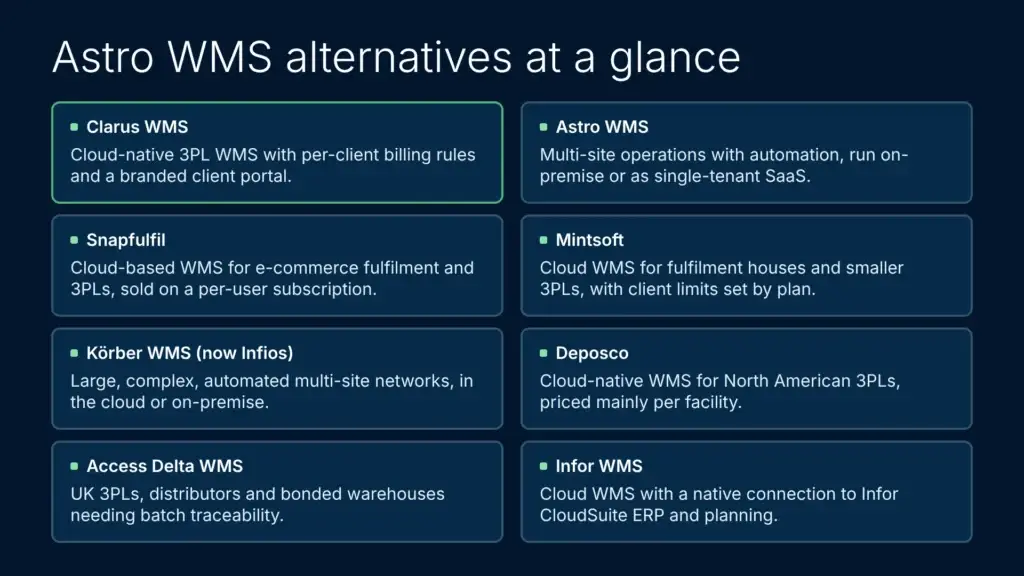
This table gives you the headline differences. Where a vendor doesn’t publish a figure, we’ve said so rather than guess. Below it, we go into detail on each system.
| WMS | Am besten für | 3PL / Multi-Client | Abrechnungsautomatisierung | Wolke | Umsetzung | Preismodell |
|---|---|---|---|---|---|---|
| Clarus WMS | 3PLs, distributors and food and beverage operations | Client stock kept separate, per-client billing rules, branded client portal | Billable events captured and priced as work happens | Yes, cloud-native | Etwa 12 Wochen | Monthly plans, no tie-ins |
| Astro WMS | Multi-site operations and warehouses with automation | Multi-site support, 3PL Billing module | Through the 3PL Billing module | On-premise or single-tenant SaaS | Nicht veröffentlicht | Nicht veröffentlicht |
| Snapfulfil | E-commerce fulfilment and 3PLs | Multiple owners per warehouse, client Biz Portal | Per-client billing with scheduled invoice runs | Ja, Cloud-basiert | Varies; one customer went live in three weeks | Subscription, per user |
| Mintsoft | E-commerce fulfilment houses and smaller 3PLs | Client limits by plan, branded client portal | Built-in invoicing from logged activity | Ja, Cloud | Nicht veröffentlicht | Tiered plans |
| Körber WMS (now Infios) | Large, complex, automated multi-site networks | Multi-site, 3PL add-ons | Available; check depth for your contracts | Cloud oder vor Ort | Varies with scope | Nicht veröffentlicht |
| Deposco | North American 3PLs, distributors and e-commerce | Per-client billing, client portal | Per-client billing automation | Yes, cloud-native | Weeks, according to Deposco | Custom, mainly per facility |
| Auf Delta WMS zugreifen | UK 3PLs, distributors and bonded warehouses | Customer-by-customer inventory, client stock portal | Automated activity-based billing | Keine Angabe | Nicht veröffentlicht | Nicht veröffentlicht |
| Infor WMS | Businesses already on Infor CloudSuite ERP | Multi-client capability listed | 3PL billing and invoicing listed | Yes, cloud (SaaS) | Varies, often tied to ERP projects | Nicht veröffentlicht |
1. Clarus WMS: cloud-native 3PL alternative
Am besten wenn: You’re a 3PL, distributor or Speisen und Getränke operation running multiple clients from the same warehouse, and you want billing automation and real-time visibility without enterprise software headaches.
Clarus is a cloud-native, agentic AI-driven WMS built for multi-client operations. Rather than having 3PL billing bolted onto a single-client system, Clarus was designed from the start to keep client stock separate, price billable events automatically and give each client a self-service portal.
Stärken:
- Automatisierte 3PL-Abrechnung Every billable event (putaway, picking, packing, storage days, returns, value-added services) is recorded at source and priced automatically, with no manual counting. St John’s Hall Storage cut invoicing time by 90%.
- Separate stock for every client: Each client’s inventory, pricing rules and reporting stay separate within one warehouse. Portal access is set by role, so clients only see their own data.
- Kunden-Self-Service-Portal: Through the customer self-service portal, clients see live stock levels, order status, shipment tracking and, if you enable it, charges and KPIs, without raising a support ticket. You can brand the portal as your own.
- Optimised picking: Klar chooses between tote, batch, zone, wave, bulk or each picking and plans walking paths to cut travel time by up to 50%. Real-time scan verification targets 99.9% pick accuracy.
- Cloud-native Architektur No servers to maintain and no version upgrades to plan. You’re always on the latest release, running on ISO-certified AWS infrastructure.
- Go-live in weeks, not years: A standard project goes live in around 12 weeks, and Preise is pay monthly with no tie-ins.
- Integrationen: Clarus connects to over 200 systems, including Shopify, Versand durch Amazon, Königliche Post, Brightpearl und Qargo TMS, with direct integrations to all major parcel and pallet carriers. See the full integrations library.
- Schneller Support: Clarus reports support responses in under five minutes, so issues get picked up quickly rather than sitting in a queue.
Schwächen:
- Smaller vendor than Infios (Körber) or Infor.
- Best fit for mid-market 3PLs and distributors rather than the very highest-volume B2C parcel operations.
- No on-premise option. If you need the software running on your own infrastructure, this isn’t for you.
Wer wählt Clarus aus: JODA Fracht reached 99% stock accuracy and cut stock takes from weeks to a single day. MSD cut its admin workload by 60% and added new revenue streams. KATEM Logistik grew its monthly picks tenfold. <img src="”https://claruswms.ai/wp-content/uploads/2026/06/Untitled-design-2026-06-23t082657" 793-1024×572.webp” alt="”A" horizontal corporate infographic titled ‘optimising multi-client 3pl warehouse operations’ showing four core capabilities of a modern management system. the clean, four-column layout highlights automated billing, stock isolation, self-service client portal, and smart wave picking, with each section featuring simple line-art icon brief explanatory sentence.” class ="”wp-image-32364″/">
2. Astro WMS von Consafe Logistics
Am besten wenn: You run a multi-site operation, possibly with automation in the mix, and you want the option of hosting the system yourself.
Astro WMS is Consafe Logistics’ flagship WMS. It runs manual and automated warehouse processes, works across multiple sites, and can be deployed on-premise or as a single-tenant SaaS service managed by Consafe. Consafe also sells Astro Go WMS (formerly Solid WMS), a cloud SaaS system for smaller, fast-moving warehouses that it acquired in 2025.
Stärken:
- Established product with a long market history.
- Multi-site support, managing inventory across different sites from one system.
- Integrates with automation equipment from any supplier, which helps if you run conveyors or automated storage.
- A 3PL Billing module that uses logged warehouse data to bill clients and handle contract variations.
- A choice of on-premise or SaaS deployment.
- Astrid, an AI assistant for Astro WMS.
Schwächen:
- 3PL billing is a separate module: Check what’s included in your quote and how billable events such as surcharges and returns are captured before you sign.
- Kundensichtbarkeit Astro WMS product pages don’t describe a client self-service portal, so ask how your clients would check stock and order status without contacting your team.
- Dedicated rather than shared cloud: The SaaS version runs as a single-tenant instance, so ask how upgrades are scheduled and who manages them.
- No published timelines or pricing: Ask for a dated implementation plan and a full quote, including every module you’ll need.
Wo es glänzt: Multi-site operations, warehouses with significant automation, and businesses that want on-premise hosting as an option. Smaller 3PLs may find Astro Go WMS a closer fit than Astro WMS itself.
3. Snapfulfil
Am besten wenn: You’re an e-commerce fulfilment operation or a 3PL that wants a cloud WMS you can get running quickly.
Snapfulfil is a cloud-based WMS, originally developed by UK firm Synergy Logistics and sold on subscription.
Stärken:
- Cloud-based, with no on-premise infrastructure to run.
- Supports multiple owners in one warehouse, with separate billing for each client.
- Flexible 3PL billing, including tiered rates by SKU count, credit thresholds, and invoice runs from daily to custom schedules, with a review step before invoices are finalised.
- A client “Biz Portal” where customers create products, receipts and shipments and view their own stock.
- Batch and cluster picking.
- Fast deployments are possible: one 3PL customer reported going live in three weeks.
- Reviewers on GetApp rate it 4.1 out of 5.
Schwächen:
- Per-user pricing: Subscription costs are per user, so your bill rises as your team grows. Model this against your headcount plans.
- Food and beverage controls to confirm: Snapfulfil’s materials mention picking in rotation for short shelf-life products, but we couldn’t find detail on batch, lot or expiry controls. Check these in a demo if you handle food.
Wo es glänzt: E-commerce fulfilment and 3PLs that want a proven cloud system up and running quickly.
4. Mintsoft
Am besten wenn: You’re an e-commerce fulfilment house or a smaller 3PL with a manageable number of clients, and you want a cloud system you can start using quickly.
Mintsoft is a cloud WMS for 3PLs and fulfilment houses, owned by The Access Group.
Stärken:
- Built for 3PLs, with stock tracked for each client.
- Built-in 3PL invoicing that generates client invoices from logged activity, using per-client rates for storage, handling, picking, returns and shipping.
- A brandable client portal where clients connect sales channels, raise ASNs, check stock and view invoices.
- Over 200 integrations across couriers, shopping platforms, marketplaces and accounting tools.
- Tiered plans, so you can start small.
- Batch picking with batch scheduling.
Schwächen:
- Client limits by plan: The number of 3PL clients you can run depends on your tier, from 10 on Starter up to 30 on Extra Large. Fast-growing 3PLs need to watch this.
- Picking options: Mintsoft’s 3PL pages describe batch picking but not Wellenauswahl, so check the picking logic if you run high-volume B2B orders.
Wo es glänzt: E-commerce fulfilment houses and smaller 3PLs that want a quick start and a client portal out of the box.
5. Körber WMS (now Infios)
Am besten wenn: You’re running large, complex, multi-site operations, often with heavy automation, and you have the budget and IT team for an enterprise project.
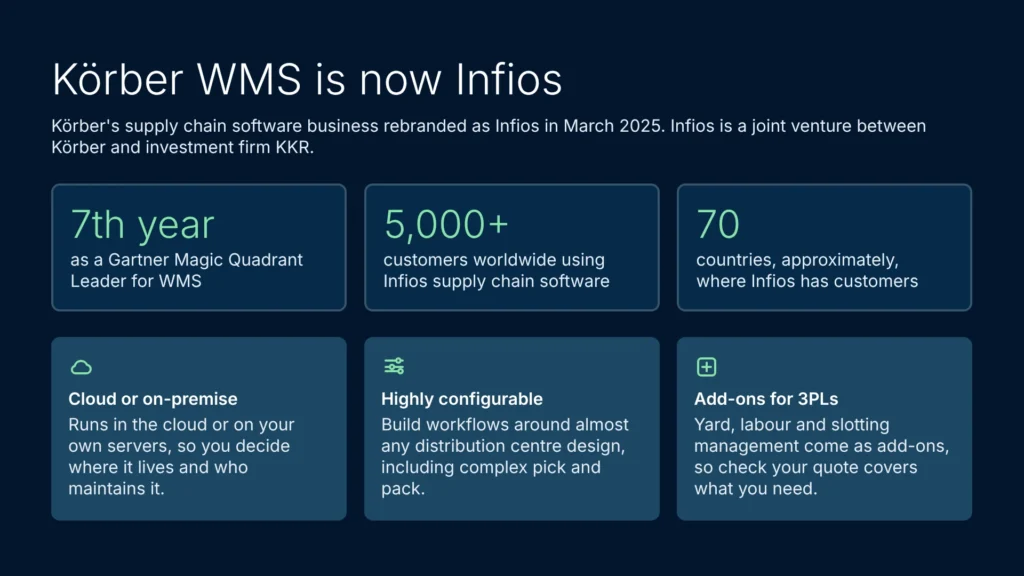
Körber’s supply chain software business rebranded as Infios in March 2025. Infios is a joint venture between Körber and investment firm KKR, and its WMS line includes the former HighJump product. It’s an enterprise-grade system built for complex warehouses.
Stärken:
- Named a Leader in the 2025 Gartner Magic Quadrant for WMS for the seventh year running.
- Runs in the cloud or on-premise.
- Suited to multi-site networks, distributors, and retailers or manufacturers with complex pick-pack fulfilment.
- Highly configurable, so workflows can be built around almost any distribution centre design.
- Add-ons for 3PLs, including yard, labour and slotting management.
- A large customer base: more than 5,000 customers in around 70 countries.
Schwächen:
- Enterprise-scale projects: Highly configurable systems take longer to scope, configure and test, and Infios doesn’t publish standard timelines or pricing. Ask for a dated plan.
- More than a mid-market 3PL may need: If you don’t need automation orchestration or extensive configuration, you may pay for capability you won’t use.
- 3PL capability through add-ons: Make sure your quote covers billing and client visibility in full.
Wo es glänzt: Global enterprises and large distributors running automated, multi-site networks.
6. Deposco
Am besten wenn: You’re a 3PL, distributor or e-commerce operation in North America looking for a cloud-native system.
Deposco is a cloud-native WMS headquartered in Alpharetta, Georgia, in the USA.
Stärken:
- Fully cloud-native, with no on-premise dependencies.
- Billing automation that tracks charges for each client, with visibility on every invoice.
- A client self-service portal for tracking orders, checking inventory and viewing invoices.
- Pricing is mainly per facility with unlimited users, so adding staff doesn’t add licence cost.
- Onboarding measured in weeks, with new clients added in days, according to Deposco.
Schwächen:
- US-headquartered: Check UK reference customers and support hours, since time-zone differences can slow responses during your working day.
- Per-facility pricing: Multi-site operators should check how costs scale as sites are added.
- No public price list: You’ll need a custom quote to compare.
Wo es glänzt: 3PLs and distributors in North America. For UK operations, weigh up local references and support hours.
7. Access Delta WMS
Am besten wenn: You’re a UK 3PL, distributor, manufacturer or bonded warehouse wanting a WMS from a large UK software group.
Auf Delta WMS zugreifen is The Access Group’s warehouse management system, alongside its sister product Mintsoft.
Stärken:
- Batch, lot and serial number tracking by SKU, pallet or vehicle.
- Best-before-end date recording, with expiry monitoring and alerts.
- Customer-by-customer inventory and multiple account logic for 3PLs.
- Automated activity-based billing, including RH&D and rental charging.
- A customer web portal where clients see their own stock levels.
- Support for bonded warehouse operators.
Schwächen:
- Deployment model unclear: The product brochure doesn’t say whether it runs in the cloud, hosted or on-premise, so confirm the model and who manages upgrades.
- Food controls to confirm: The brochure covers batch and best-before tracking but doesn’t mention FEFO or temperature zone management. Check these if you handle chilled or frozen goods.
- Few public reviews: It has very few reviews on software comparison sites, which makes independent comparison harder.
Wo es glänzt: UK 3PLs, distributors and bonded warehouses wanting batch traceability and activity-based billing from an established software group.
8. Infor WMS
Am besten wenn: You already run Infor CloudSuite ERP and want your WMS closely tied to your financials and supply chain planning.
Infor WMS, also sold as Infor CloudSuite WMS, is a cloud WMS aimed at mid-market and enterprise distribution centres, 3PLs and manufacturers.
Stärken:
- Native connection to Infor CloudSuite ERP, with open REST APIs for other systems.
- Built on the cloud and delivered as SaaS.
- 3PL billing and invoicing, plus multi-client capability, are listed among its features.
- Designed for distribution centres, 3PLs and manufacturing operations.
- Large global vendor.
Schwächen:
- Strongest inside the Infor ecosystem: The native connector is to Infor ERP. Connections to SAP or Oracle rely on APIs rather than certified connectors, so budget for integration work if you’re not on Infor.
- Check 3PL billing depth: Independent analysis from ERP Research rates its 3PL and multi-client capability as limited, so test your billing scenarios in a demo.
- Standalone licensing: Confirm with Infor whether you can licence the WMS without wider Infor products, and how that affects pricing.
- Longer programmes: Where the WMS is rolled out alongside an ERP upgrade, the overall project timeline grows.
Wo es glänzt: Businesses already on Infor ERP, such as manufacturers and large distributors, that want warehouse data feeding straight into financials and planning.
How to choose the right Astro WMS alternative
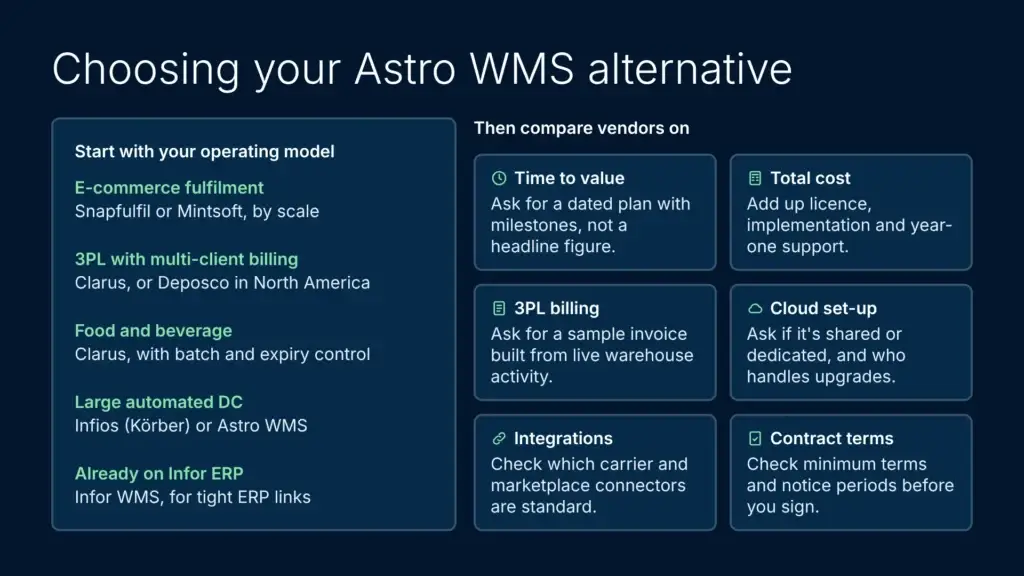
Start with your operating model:
- E-commerce fulfilment: Snapfulfil or Mintsoft, depending on your scale and number of clients.
- 3PL with multi-client billing needs: Klar, or Deposco if you’re based in North America. Smaller 3PLs may also look at Mintsoft.
- Food and beverage, temperature-controlled: Clarus, with batch and lot control, Verfolgung von Verfallsdaten und Temperatur- und Lagermanagement. Access Delta WMS is also worth a look for batch and best-before tracking.
- Large automated DC with conveyors or robotics: Infios (Körber) or Astro WMS.
- Already on Infor ERP: Infor WMS, if you value tight ERP integration over a standalone WMS.
Then evaluate on these dimensions:
- Time to value: A standard Clarus implementation runs to around 12 weeks, which allows time to train people properly rather than rushing a cutover. Enterprise builds with automation in scope usually take longer, so ask every vendor for a dated plan with milestones rather than a headline figure.
- Total cost of ownership (TCO): Calculate licence, implementation and year-one support together. Don’t assume the lowest monthly fee is the cheapest.
- 3PL billing automation: Most systems here have 3PL billing in some form, but they differ in how events are captured: built into the core, sold as a module or added through configuration. Ask each vendor to build a sample invoice from live warehouse activity, including surcharges and returns, and see how much manual reconciliation is left. Here’s how Clarus automates 3PL billing.
- Cloud vs. on-premise: If you want no infrastructure to manage, look at cloud-native systems such as Clarus, Mintsoft, Snapfulfil and Deposco. Astro WMS, Infios and Infor have cloud options too, so ask whether that’s a shared platform or a dedicated instance, and who handles upgrades.
- Integrations-Ökosystem: If you rely on Shopify, Amazon, EDI and multiple carriers, check each product’s integration library and which connectors are included as standard.
- Support model: Ask each vendor for its response time commitments. Clarus reports support responses in under five minutes.
- Contract flexibility: If you want to trial a system or keep the option to exit, check minimum terms and notice periods. Clarus is pay monthly with no tie-ins.
Sprechen Sie mit einem Lagerfachmann
If you’re evaluating your options and want to see how a purpose-built WMS works in practice, Clarus is worth a conversation. We work with 3PLs and distributors across the UK and Europe to implement warehouse management software that fits the way you operate, not the other way around. We’ve helped St John’s Hall Storage cut invoicing time by 90%, Campeys run full recall tests in under five minutes und MSD cut its admin by 60%. See how we compare on the things that matter most to you.
Kontaktieren Sie unser Team um Ihre Anforderungen zu besprechen.